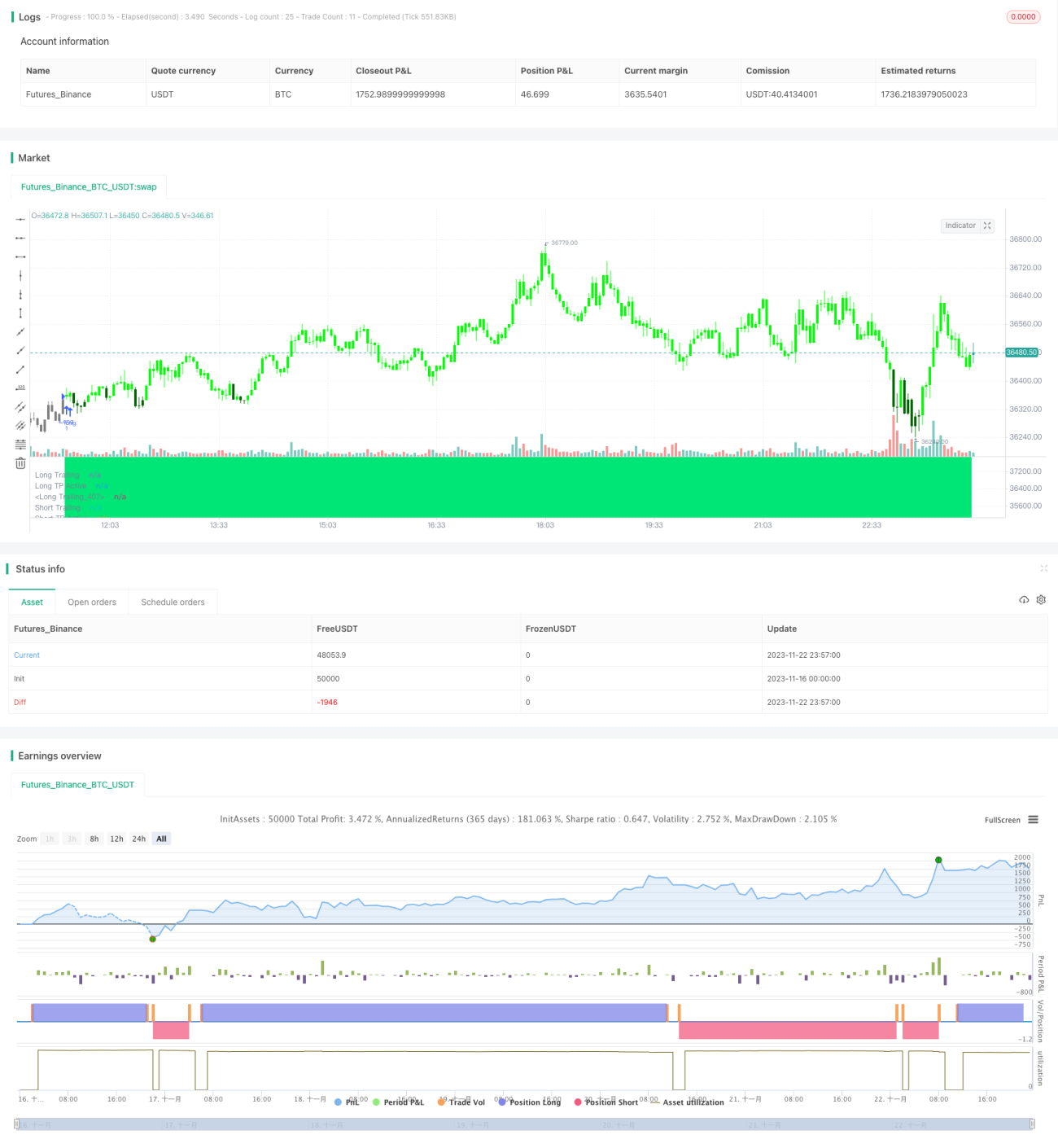
Momentum Reversal Moving Average Combination Strategy
Overview
This strategy identifies trends by combining multiple moving average indicators. Specifically, this strategy uses a fast moving average ribbon and a slow moving average ribbon at the same time. The fast moving average ribbon consists of a 5-day EMA and a 25-day WMA, while the slow moving average ribbon consists of a 28-day EMA and a 72-day WMA. It generates a buy signal when the fast MA crosses above the slow MA, and a sell signal when the fast MA crosses below the slow MA. In addition, this strategy also uses the RSI indicator to assist in judging the timing.
Strategy Logic
- Use double moving averages to determine the trend direction
- Fast MA Ribbon: 5-day EMA, 25-day WMA
- Slow MA Ribbon: 28-day EMA, 72-day WMA
- When fast MA crosses above slow MA, generate a buy signal
- When fast MA crosses below slow MA, generate a sell signal
- Use RSI indicator to assist in determining the timing of buys and sells
- RSI Low to Buy: Generate a buy signal when RSI<35
- RSI High to Sell: Generate a sell signal when RSI>65
- Adopt trend tracking mechanisms including moving stop loss and moving take profit
- Moving stop loss: Track highest/lowest price to prevent excessive losses
- Moving take profit: Track highest/lowest price for timely profit taking
Advantage Analysis
- Using double MAs to determine trends, fast and slow MAs working together can effectively identify turning points
- RSI indicator’s assistance helps avoid erroneous signals from MAs
- Moving stop loss mechanism effectively controls losses of individual losing trades
- Moving take profit mechanism locks in profits and prevents profit retracement
Risk Analysis
- Relatively high probability of failure in trend determination by double MAs, may generate false signals
- Improper RSI parameter settings may miss trading opportunities
- Excessively large stop loss magnitude may cause unnecessary losses
- Excessively small take profit magnitude may result in profit shrinkage
Optimization Directions
- Parameters of fast and slow MAs can be optimized to find optimal parameter combinations
- RSI parameters can also be optimized to find better overbought/oversold lines
- Test with different stop loss magnitudes to find balance between minimizing losses and avoiding false signals
- Try adaptive take profit strategies to allow take profit magnitude to adjust on its own based on market volatility
Conclusion
This strategy captures and tracks trends by determining trend direction with double MAs, judging timing assisted by RSI, and methods like moving take profit and stop loss. Further improvements can be achieved by optimizing parameters of MAs, RSI and profit/loss limits. The overall logic is clear and easy to understand and optimize. It is a practical and effective trend tracking strategy.
- 1

