Multi-indicator Adaptive Trend Trading Strategy

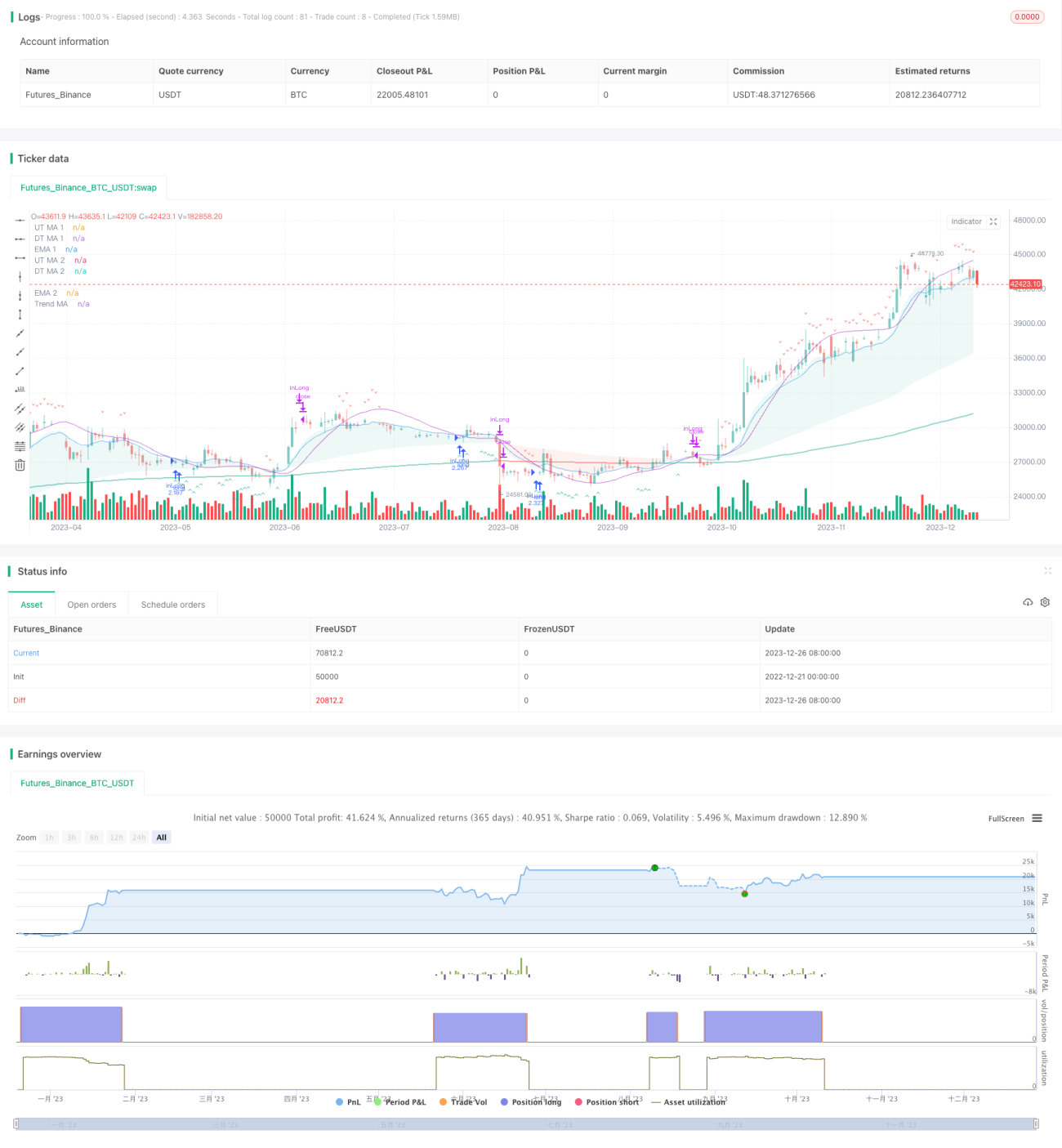
Overview
The multi-indicator adaptive trend trading strategy is a quantitative trading strategy that integrates signals from multiple technical indicators. It can automatically identify the trend direction of the market and generate trading signals with different configurations based on different market conditions.
The strategy combines indicators including moving averages, Stoch RSI, WaveTrend and so on to form trade signals. Also, it switches the parameter configurations of each indicator dynamically based on the judgement of overall market trend. This allows for adaptive trading under different market environments.
In overall, the strategy has strong capabilities of tracking trends and adaptivity. It can reduce trading frequency and capture large unidirectional trend profits.
Strategy Logic
Trend Judgement
The strategy uses a 300-period exponential moving average to determine the overall trend direction. An upward EMA line signifies a bullish outlook, and a downward EMA line signifies a bearish outlook.
When price breaks through the EMA line, it will trigger a reverse sell signal to lock in previous long positions. This can effectively control risks.
Trade Signals
Under different market trends, the strategy adopts different parameter configurations to generate trading signals.
Trading signals under an uptrend include:
- Moving average crossovers and positions
- Stoch RSI signals
- WaveTrend signals
Trading signals under a downtrend include:
- Moving average cross unders and positions
- Stoch RSI signals
- WaveTrend signals
Users can enable or disable different signals from different indicators to implement customized trading logic.
Each signal contributes +1 signal score. When the total score meets the threshold set by users, real trading signals will be triggered.
Profit Taking and Stop Loss
The strategy provides multiple ways of profit taking and stop loss, including percentage profit taking, percentage stop loss, price breakout, etc. These parameters also switch dynamically based on different market trends.
If profit requirements are not met, the strategy also provides a way to directly close positions to control holding period and risks.
Advantage Analysis
The multi-indicator adaptive trend trading strategy has the following advantages:
- Enhanced trend identification capability. The strategy uses EMA and other indicators to determine trends, avoiding being misguided by false breakouts or short-term corrections in the market.
- Great flexibility. Users can enable or disable different signals from different indicators to customize their own trading rules.
- Strong adaptivity. The strategy can automatically identify different market conditions and adopt different parameters to generate trading signals without manual intervention.
- Multiple profit taking and stop loss methods. The strategy provides abundant tools of profit taking and stop loss to lock in gains and control risks.
- Reduced trading frequency. Only trading when trends are clear can decrease unnecessary round-trip trading.
Risk Analysis
The multi-indicator adaptive trend trading strategy also has the following risks:
- Missing market turning points. Trend trading strategies cannot capture price reversals in time and may miss short-term profit opportunities.
- Failed breakout risk. When prices break through the EMA line to generate signals but fail quickly, it will lead to losses.
- Parameter tuning risk. Users need sufficient understanding of the meaning of each parameter to achieve optimal backtesting results.
- Trend identification risk. The strategy may also wrongly identify trends in extreme market conditions.
- Indicator failure risk. Some indicator signals may underperform in different products and timeframes too.
Some of the risks can be solved by properly adjusting the EMA length, expanding stop loss range, etc.
Optimization Directions
The strategy can also be upgraded from the following aspects:
- Add dynamic parameter optimization module based on machine learning. So parameters can be automatically optimized based on real-time market changes, instead of fixed preset values.
- Add model ensemble voting mechanism. Combine judgements from multiple models and select the optimum as final signal.
- Optimize stop loss mechanism. Can try trailing stop loss, moving stop loss to better lock in profits and control risks.
- Customize signal weights. Allow users to set different weights for different signals rather than simple 0/1 logic. Achieve weighted combination of indicator signals.
Summary
The multi-indicator adaptive trend trading strategy integrates methods including trend judgment, fusion of multiple indicator signals, dynamic parameter switching. As a quantitative trading strategy, it has great adaptivity and customizability. It can reduce unnecessary trading while maximizing the capture of unilateral trends. The strategy is an outstanding representative of quantitative trading and deserves in-depth research and application.
/*backtest
start: 2022-12-21 00:00:00
end: 2023-12-27 00:00:00
period: 1d
basePeriod: 1h
exchanges: [{"eid":"Futures_Binance","currency":"BTC_USDT"}]
*/

////////////////////////////////////////////////////////////////////////////////
//START▼▼▼▼▼▼▼▼▼▼▼▼▼▼▼▼▼▼▼▼▼▼▼▼▼▼▼▼▼▼▼▼▼▼▼▼▼▼▼▼▼▼▼▼▼▼▼▼▼▼▼▼▼▼▼▼▼▼▼▼▼▼▼▼▼▼▼▼▼▼▼▼▼

c="███████╗ █████╗ █████╗ ██╗ ██╗ █████╗ ██╗ ██╗ ██████╗ ██╗ ██╗███╗ ██╗"- 1