ATR and Volatility Index Based Trend Tracking Strategy

Overview
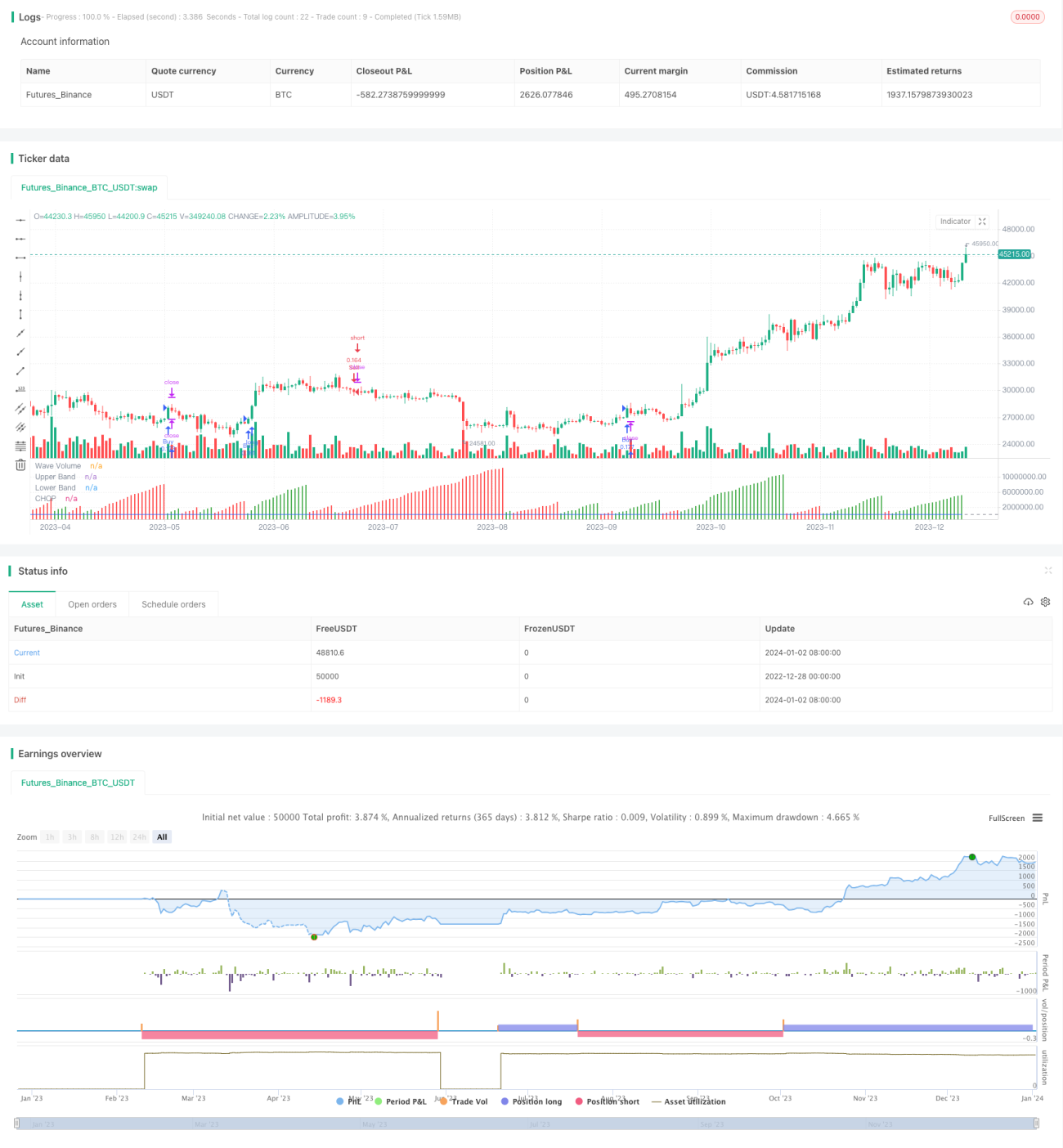
This strategy uses Average True Range (ATR) and CHOP index as the main technical indicators to identify and track trends. It enters when the index breaks through the upper and lower rails, combined with the trend direction as entry signals; and exits with stop loss or take profit when the index re-enters the belt area.
Strategy Principle
-
Use ATR to calculate the box size and construct the Renko channel to determine the price trend direction.
-
Apply the CHOP index to judge if the market is suitable for trading. This index incorporates highest price, lowest price and ATR. When it is between 38.2-61.8, it indicates low market volatility; otherwise, it signals high volatility and unsuitable trading market.
-
When the CHOP index breaks down the 61.8 upper rail, the price enters a downward trend. If the short-term fast EMA also shows the price is leading, go short. Conversely, when CHOP breaks up the 38.2 lower rail and the short-term EMA rises, go long.
-
Use stop loss/take profit strategy. When the price re-enters the 38.2-61.8 belt area of CHOP, close the position with stop loss or take profit.
Advantage Analysis
This strategy combines trend judgment and volatility control, which can both capture price trends and control risks. It is a relatively stable trend tracking strategy.
-
The Renko channel constructed by ATR can effectively track price trends.
-
The CHOP index judges market volatility rate to avoid incorrect trading in violent fluctuations.
-
Combining fast EMA to determine short-term trend direction avoids reverse operation.
-
Stop loss/take profit strategy controls single loss.
Risk Analysis
The main risks this strategy faces:
-
In sideways market, ATR channel and CHOP signals may produce incorrect signals. Fine tune parameters to filter out wrong signals appropriately.
-
Single technical indicator combo cannot fully avoid losses. Manual intervention is needed to determine major trends.
-
Stop loss position set too loose may lead to oversized single loss. Should narrow down stop loss magnitude properly.
Optimization Direction
This strategy can be optimized in the following aspects:
-
Increase other auxiliary indicators to determine signals, like candlestick patterns, volume etc to improve signal accuracy.
-
Optimize parameters of ATR and CHOP to capture price fluctuations better.
-
Set dynamic stop loss/take profit positions for larger profit margins and faster stop loss.
-
Properly loosen stop loss range after determining major trend to gain more profits in the trend.
Conclusion
This strategy integrates commonly-used technical indicators and is simple & practical. With parameter adjustment and optimization, satisfactory tracking effects can be obtained. But it still requires manual judgment of major trends and cannot be fully automated. It can serve as an auxiliary decision-making tool and reference for other strategies.
- 1