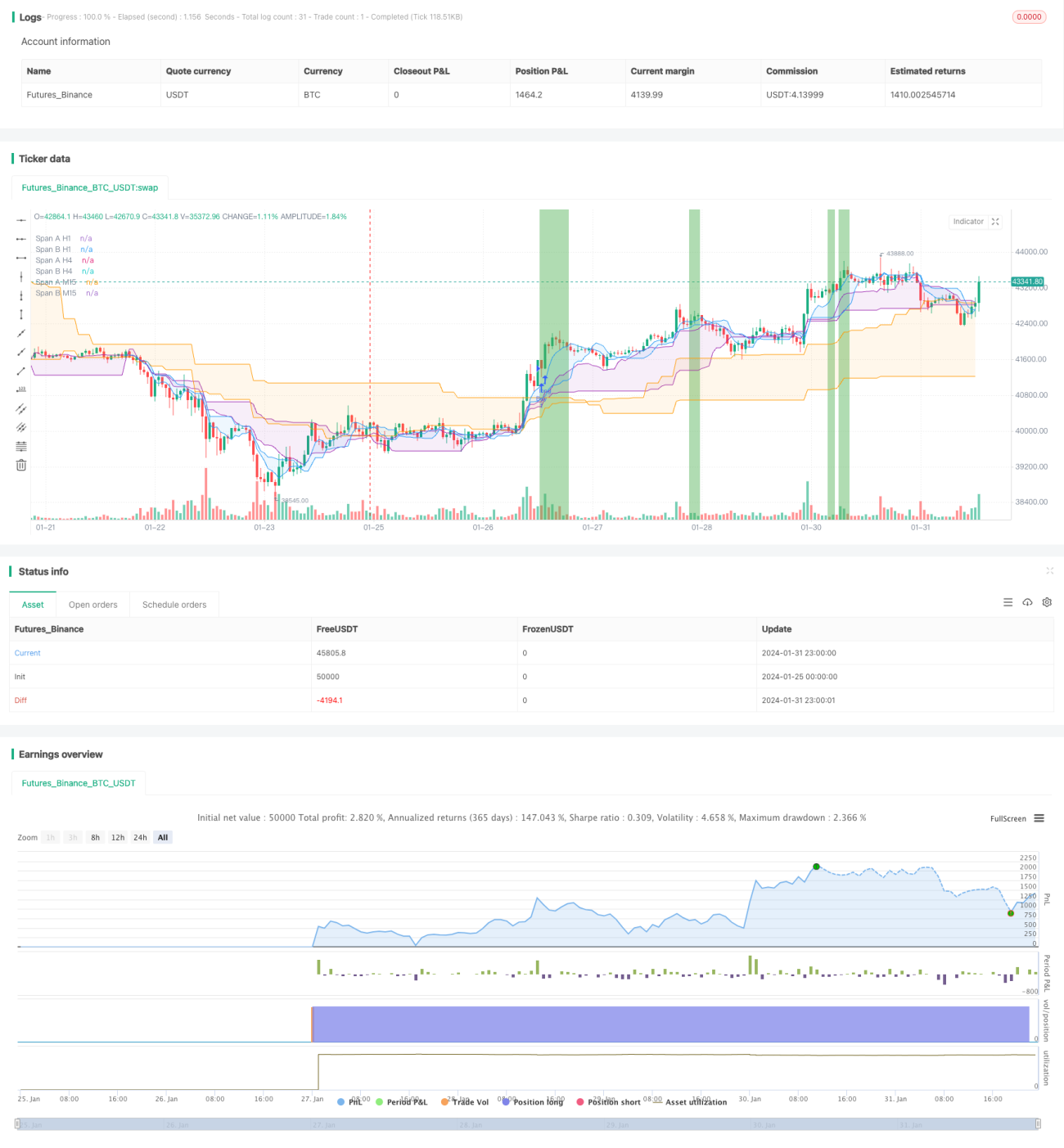
Multi-Timeframe Ichimoku, MACD and DMI Combined Strategy
Overview
This strategy combines Ichimoku Cloud, Moving Average Convergence Divergence (MACD) and Directional Movement Index (DMI) across multiple timeframes to identify potential buy and sell signals. It aims to provide references for traders wishing to take a multi-dimensional view of the market from both short-term and medium-term perspectives.
Strategy Logic
The strategy executes buy and sell conditions based on consistent signals from 15-min (M15) and 1-hour (H1) charts, with additional confirmation from the 4-hour (H4) timeframe.
Buy Conditions
- Price above Ichimoku Cloud on M15, H1 and H4 timeframes
- MACD line above signal line and both above zero on H1
- DI+ above DI- and ADX at least 25 on H1
- MACD line above zero, DI+ above DI- and ADX at least 25 on M15
Sell Conditions
- Price below Ichimoku Cloud on M15, H1 and H4 timeframes
- MACD line below signal line and both below zero on H1
- DI- above DI+ and ADX at least 25 on H1
- MACD line below zero, DI- above DI+ and ADX at least 25 on M15
Entry and Exit
- Long position entered when all buy conditions met, suggesting upward momentum across timeframes
- Short position entered when all sell conditions met, suggesting downward momentum across timeframes
- Position closed when opposite conditions met, indicating potential trend reversal or loss of momentum
Advantages of the Strategy
- Considers multiple timeframes for improved accuracy
- Ichimoku judges trend direction and strength
- MACD gauges short-term and medium-term momentum
- DMI judges buying/selling pressure and trend activity
- Combines signals from multiple indicators
- Customizable parameters for buy/sell conditions
- Widely applicable to markets with clear trends
Risks of the Strategy
- Conflicting signals across timeframes may cause bad signals
- Ichimoku can be misleading if used improperly
- MACD and DMI have lagging nature, may miss turns
- Need to monitor multiple timeframe indicators
- Cautious handling of huge price moves from sudden events
Optimization Direction
- Optimize combination of Ichimoku, MACD and DMI parameters
- Test more timeframes like daily
- Add confirmation from more indicators like volatility, moving averages etc.
- Optimize buy/sell conditions with more historical data
- Dynamic parameter optimization with machine learning etc.
Conclusion
The strategy fully utilizes the advantage of multi-timeframe analysis and multiple indicators to effectively identify trend direction and strength. It can be adapted to different products through parameter tuning and optimized for specific market conditions. But traders should still be mindful of indicators' limitations and take appropriate risk control measures. Overall the strategy provides a relatively comprehensive framework to gauge the market.
- 1

