Momentum Trading with Dual Moving Average Crossover Strategy

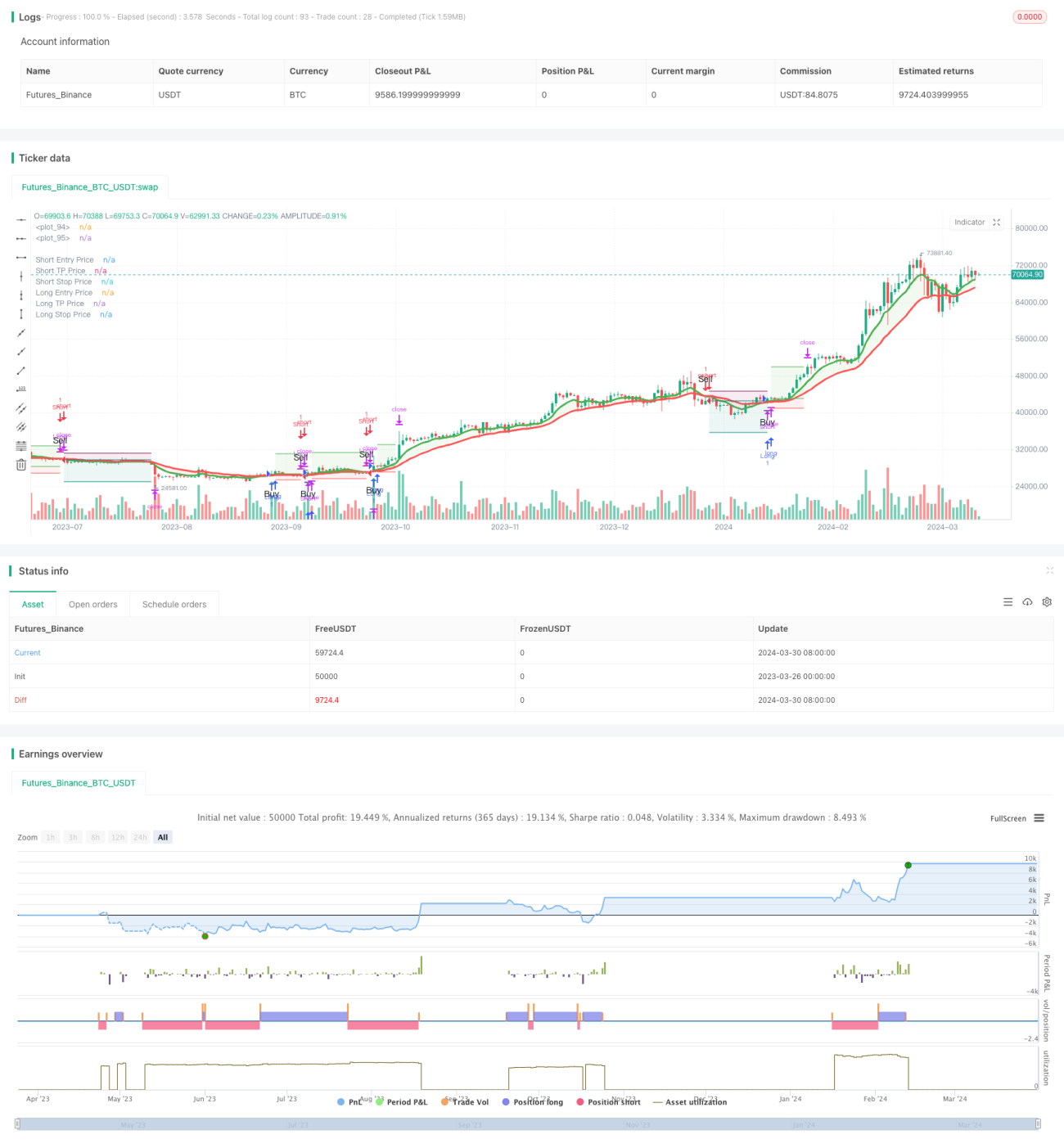
Overview
This strategy employs the 8-period and 21-period Exponential Moving Averages (EMAs) to identify changes in market trends. A buy signal is generated when the shorter-term EMA crosses above the longer-term EMA from below, while a sell signal is generated when the shorter-term EMA crosses below the longer-term EMA from above. The strategy also incorporates three consecutive Higher Lows (HLs) and three consecutive Lower Highs (LHs) as further confirmation of trend reversals. Additionally, stop-loss and take-profit levels are set to manage risk and lock in profits.
Strategy Principles
- Calculate the 8-period and 21-period EMAs to identify the primary trend direction.
- Identify three consecutive Higher Lows (HLs) and three consecutive Lower Highs (LHs) as early signals of potential trend reversals.
- Generate a buy signal when the 8-period EMA crosses above the 21-period EMA and an HL breakout occurs; generate a sell signal when the 8-period EMA crosses below the 21-period EMA and an LH breakout occurs.
- Set the stop-loss level at 5% of the entry price and the take-profit level at 16% of the entry price to manage risk and lock in profits.
- Close the position and open a reverse position when an opposite signal appears.
Strategy Advantages
- Combines EMAs and price action patterns (HLs and LHs) to confirm trends, enhancing signal reliability.
- Sets clear stop-loss and take-profit levels, helping to manage risk and lock in profits.
- Applicable to multiple timeframes and different markets, offering some level of versatility.
- Clear logic, easy to understand and implement.
Strategy Risks
- In choppy markets, frequent crossovers may lead to multiple false signals, resulting in losses.
- Fixed stop-loss and take-profit levels may not adapt well to different market conditions, leading to potential opportunity costs or larger losses.
- The strategy relies on historical data and may not adapt well to sudden events or fundamental changes.
Strategy Optimization Directions
- Introduce adaptive stop-loss and take-profit mechanisms, such as adjusting the levels based on volatility (e.g., ATR), to better adapt to different market conditions.
- Incorporate other indicators or factors, such as volume, Relative Strength Index (RSI), etc., to further filter signals and improve reliability.
- Optimize parameters (e.g., EMA periods, stop-loss and take-profit percentages) to find the best-performing combination for specific markets or instruments.
- Consider introducing risk management measures, such as position sizing, to control the risk exposure of individual trades.
Summary
This strategy utilizes the crossover of 8-period and 21-period EMAs, combined with HL and LH price patterns, to identify trend reversals and generate trading signals. Clear stop-loss and take-profit rules help manage risk and lock in profits. However, the strategy may generate false signals in choppy markets, and fixed stop-loss and take-profit levels may not adapt well to different market conditions. To further improve, consider introducing adaptive stop-loss and take-profit, incorporating other indicators, optimizing parameters, and introducing risk management measures. Overall, the strategy provides a framework for momentum and trend-following trading but requires adjustments and optimizations based on specific markets and individual preferences.
/*backtest
start: 2023-03-26 00:00:00
end: 2024-03-31 00:00:00
period: 1d
basePeriod: 1h
exchanges: [{"eid":"Futures_Binance","currency":"BTC_USDT"}]
*/

//@version=5
strategy('Trend Following 8&21EMA with strategy tester [ukiuro7]', overlay=true, process_orders_on_close=true, calc_on_every_tick=true, initial_capital = 10000)

//INPUTS- 1