EMA23/EMA50 Double Moving Average Crossover Quantitative Trading Strategy

Overview
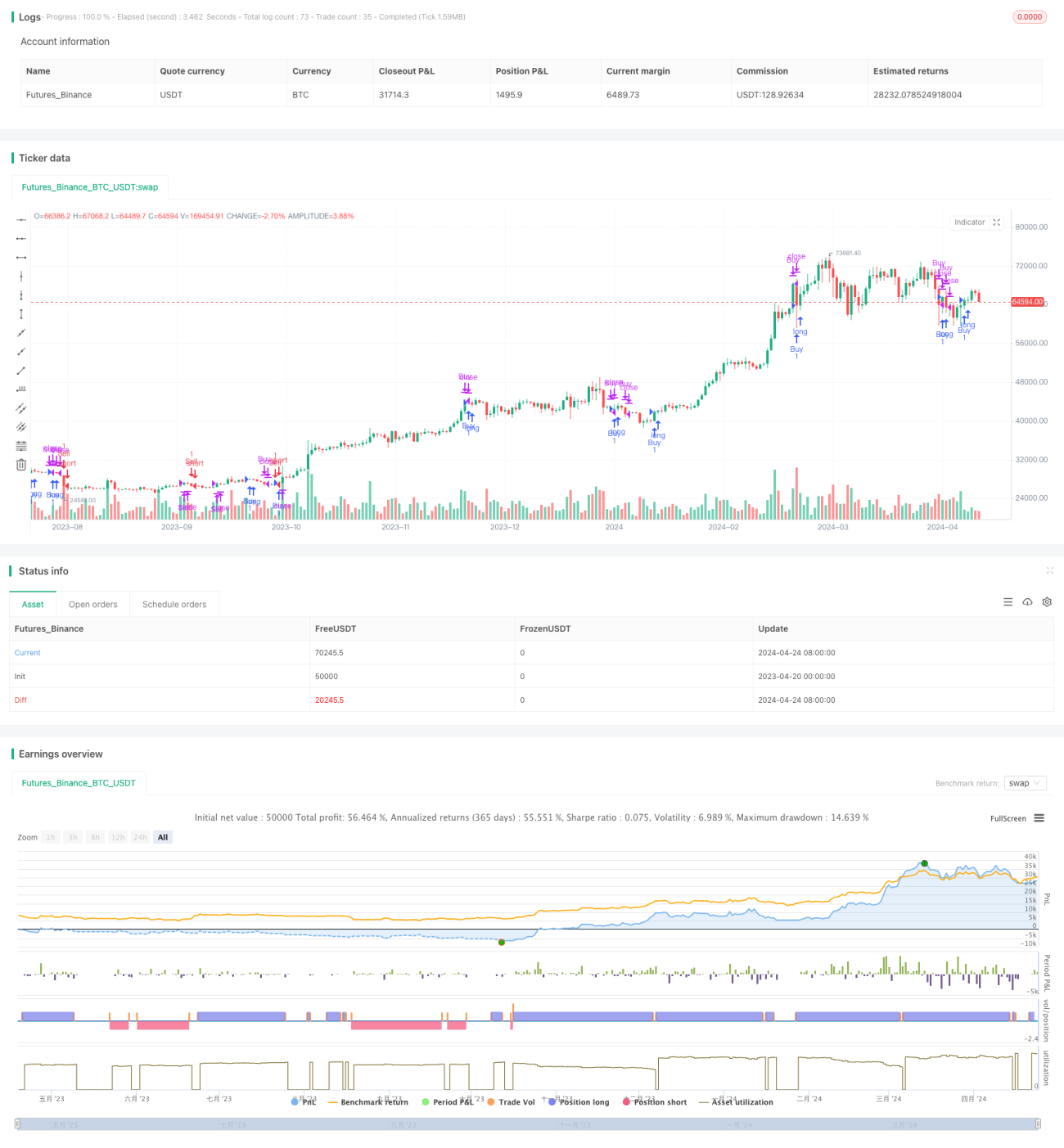
This strategy is based on the crossover signals of EMA23 and EMA50 for trading. When EMA23 crosses above EMA50, it generates a buy signal, and when it crosses below, it generates a sell signal. The strategy also implements a stop-loss for long positions when the price falls below EMA50 and for short positions when the price rises above EMA50. Additionally, the strategy re-enters the market when the price moves back above EMA50. The strategy is suitable for the 30-minute timeframe.
Strategy Principles
- Calculate the two exponential moving averages: EMA23 and EMA50.
- Generate a buy signal when EMA23 crosses above EMA50, and a sell signal when EMA23 crosses below EMA50.
- For long positions, implement a stop-loss if the price falls below EMA50 and the closing price is lower than the EMA50 of the previous candle.
- For short positions, implement a stop-loss if the price rises above EMA50 and the closing price is higher than the EMA50 of the previous candle.
- For long positions, re-enter the market if the price moves back above EMA50, with the closing price and high price both higher than EMA50, and EMA23 higher than EMA50.
- For short positions, re-enter the market if the price moves back below EMA50, with the closing price and low price both lower than EMA50, and EMA23 lower than EMA50.
- Set the take-profit level for long positions at 1.6 times the entry price, and for short positions at 0.75 times the entry price.
Strategy Advantages
- The double moving average crossover is a simple and effective trend-following indicator that helps capture trends.
- The stop-loss mechanism helps control risk and prevent losses from expanding.
- The re-entry mechanism allows the strategy to capture trends again, increasing profit potential.
- The take-profit levels help lock in profits in a timely manner.
- The 30-minute timeframe provides more trading opportunities while also filtering out some noise.
Strategy Risks
- EMA, as a trend-following indicator, has a lag and may miss the optimal entry points.
- The placement of stop-loss levels may not be optimized, leading to premature stop-outs.
- Frequent trading may increase transaction costs and affect profitability.
- The strategy may generate more false signals in a ranging market.
- Fixed take-profit levels may limit the strategy's profit potential.
Strategy Optimization Directions
- Consider introducing other technical indicators to assist in trend determination and improve entry and exit points, such as MACD, RSI, etc.
- Optimize the placement of stop-loss levels, considering the use of volatility indicators like ATR to dynamically adjust stop-loss positions.
- Control the trading frequency by setting appropriate trade filtering conditions to reduce false signals.
- Use different strategy parameter settings for ranging and trending markets.
- Make take-profit levels more flexible, such as adjusting them dynamically based on market volatility, risk-reward ratio, etc.
Summary
This strategy is a quantitative trading strategy based on the crossover of two moving averages, EMA23 and EMA50. It captures trends through the crossover signals and implements stop-loss and re-entry mechanisms to control risk and increase profit potential. The strategy is simple and easy to understand, suitable for medium to short-term trading on the 30-minute timeframe. However, the strategy also has some limitations, such as lagging trend identification, suboptimal stop-loss placement, and poor performance in ranging markets. In the future, the strategy can be optimized by introducing more technical indicators, optimizing stop-loss positions, controlling trading frequency, differentiating between trending and ranging markets, and implementing dynamic take-profit levels to achieve more robust returns.
- 1