Exponential Moving Average Crossover Leverage Strategy

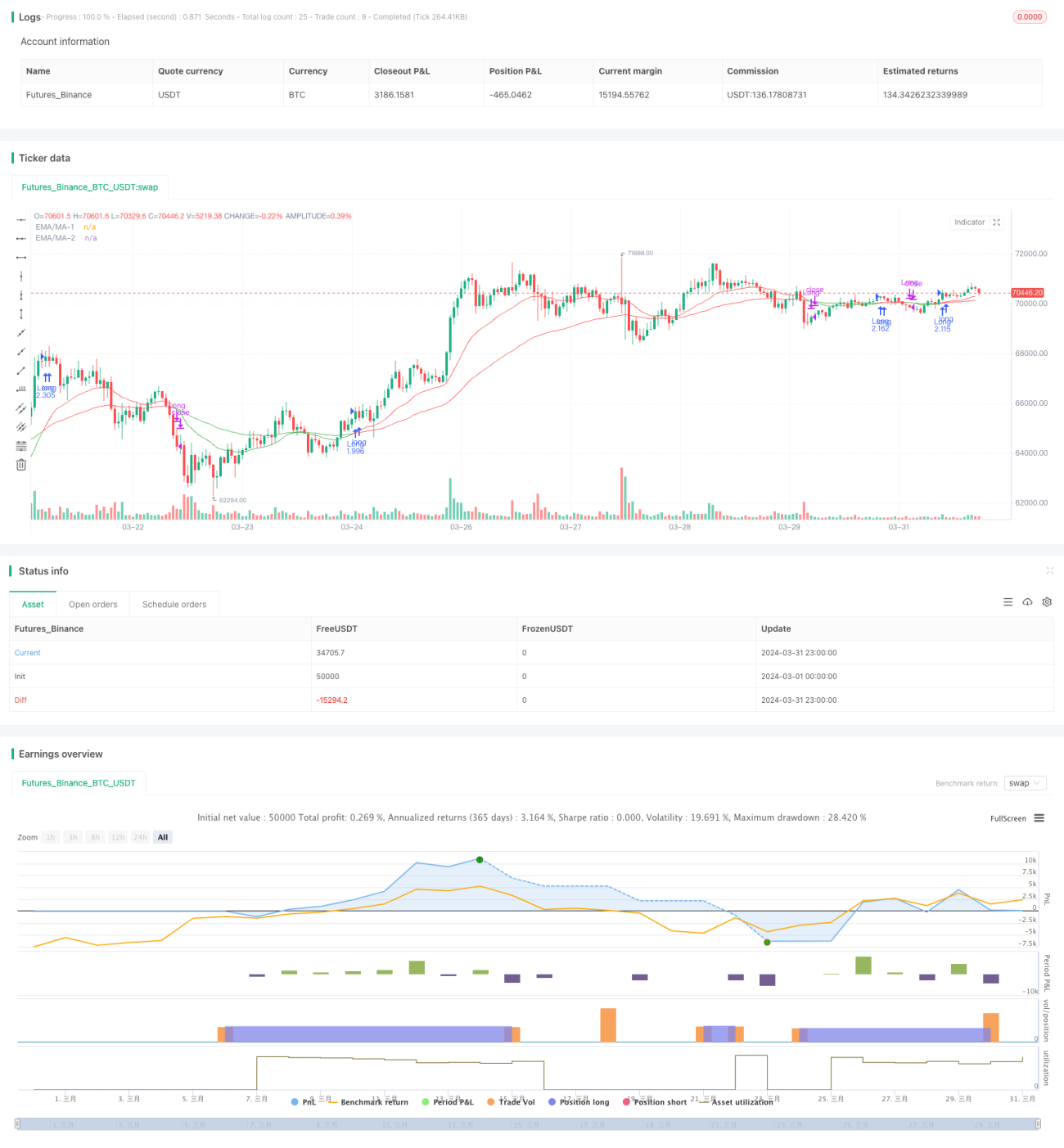
Overview
This strategy uses the crossover of the 20-day and 55-day exponential moving averages (EMAs) to generate trading signals. A buy signal is triggered when the short-term EMA crosses above the long-term EMA, and a sell signal is triggered when the opposite occurs. The strategy also introduces leverage trading, which amplifies both potential returns and risks. Additionally, the strategy includes a conditional restriction that only allows entering a position when the price touches the short-term EMA after the crossover, to reduce the risk of false signals. Finally, users have the option to use simple moving averages (SMAs) instead of EMAs.
Strategy Principle
- Calculate the 20-day and 55-day EMAs (or SMAs).
- Determine if the short-term EMA crosses above the long-term EMA. If true, set the readyToEnter variable to true, indicating readiness to enter a position.
- If readyToEnter is true and the price touches the short-term EMA, execute a buy order and reset readyToEnter to false.
- If the short-term EMA crosses below the long-term EMA, close the position.
- Set the position size based on the leverage parameter.
- Execute the strategy only within the user-defined backtesting period.
Strategy Advantages
- The moving average crossover is a simple and easy-to-use method for determining trends, suitable for most markets.
- Introducing leverage trading can amplify returns.
- Adding conditional restrictions reduces the risk of false signals.
- Providing the choice between EMA and SMA suits different user preferences.
- The code structure is clear and easy to understand and modify.
Strategy Risks
- Leverage trading amplifies risks. If the judgment is wrong, it may lead to significant losses.
- Moving average crossovers have a lag effect and may miss the best entry opportunities.
- Only suitable for markets with clear trends. If the market is volatile, frequent trading may occur, resulting in high transaction fees.
Strategy Optimization Directions
- Try optimizing the moving average periods to find the most suitable parameters for the current market.
- Introduce other indicators, such as RSI and MACD, to comprehensively judge trends and improve the win rate.
- Set stop-loss and take-profit levels to control single-trade risk.
- Dynamically adjust leverage size based on market volatility, increasing leverage when volatility is low and decreasing leverage when volatility is high.
- Introduce machine learning algorithms to adaptively optimize parameters.
Summary
This strategy combines moving average crossovers and leverage trading to capture market trends while amplifying returns. However, leverage also brings high risks and needs to be used with caution. In addition, there is room for optimization in this strategy, which can be achieved by introducing more indicators, dynamically adjusting parameters, etc. Overall, this strategy is suitable for traders who pursue high returns and can bear high risks.
/*backtest
start: 2024-03-01 00:00:00
end: 2024-03-31 23:59:59
period: 1h
basePeriod: 15m
exchanges: [{"eid":"Futures_Binance","currency":"BTC_USDT"}]
*/

//@version=5
strategy("EMA Crossover Strategy with Leverage, Conditional Entry, and MA Option", overlay=true, default_qty_type=strategy.percent_of_equity, default_qty_value=100)

// Inputs for backtesting period- 1