Adaptive Multi-State EMA-RSI Momentum Strategy with Choppiness Index Filter System

Overview
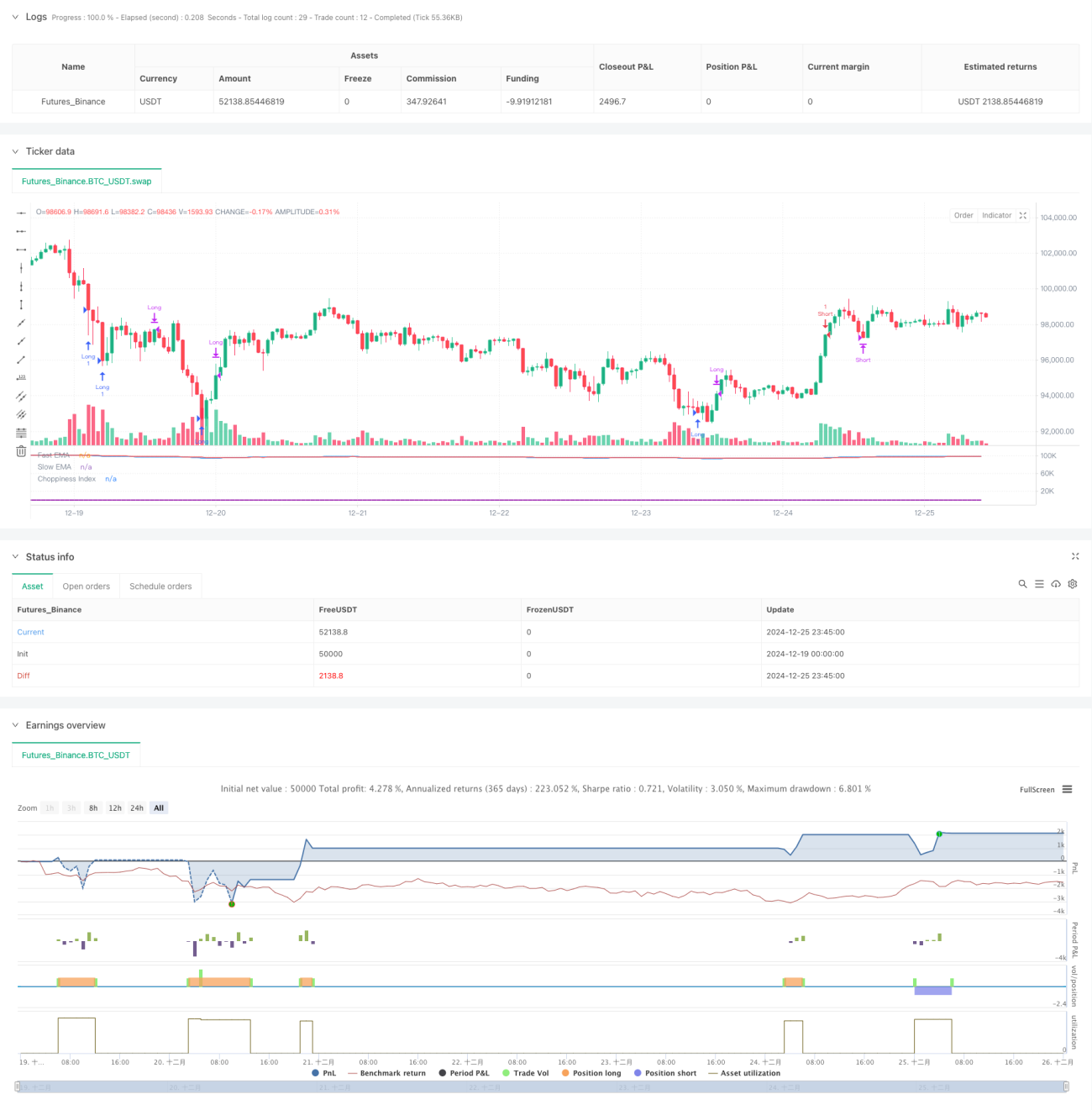
This strategy is an adaptive system combining trend following and range trading, using the Choppiness Index (CI) to determine market conditions and applying corresponding trading logic. In trending markets, the strategy utilizes EMA crossovers and RSI overbought/oversold signals for trading; in ranging markets, it primarily relies on RSI extreme values. The strategy also includes stop-loss and take-profit mechanisms to control risk and lock in profits.
Strategy Principles
The core of the strategy lies in using the Choppiness Index (CI) to classify the market into trending (CI<38.2) and ranging (CI>61.8) states. In trending markets, long positions are opened when the fast EMA (9-period) crosses above the slow EMA (21-period) and RSI is below 70, while short positions are opened when the slow EMA crosses above the fast EMA and RSI is above 30. In ranging markets, long positions are opened when RSI is below 30, and short positions when RSI is above 70. The strategy includes corresponding exit conditions with 2% stop-loss and 4% take-profit levels.
Strategy Advantages
- High market adaptability: Identifies market states through CI indicator, enabling flexible strategy switching in different market environments
- Multiple signal confirmation: Combines moving averages, momentum indicators, and volatility index for improved signal reliability
- Comprehensive risk management: Includes stop-loss and take-profit mechanisms for effective risk control
- Clear trading logic: Distinguishes between trending and ranging market states with explicit trading rules
- High win rate: Demonstrates 70-80% win rate on 15-minute timeframe
Strategy Risks
- Parameter sensitivity: Multiple technical indicators require complex parameter optimization
- False breakout risk: Potential false signals during market state transitions
- Slippage impact: Possible significant slippage in low liquidity market conditions
- Overtrading: Frequent market state transitions may lead to excessive trading
- Market dependency: Strategy performance may be heavily influenced by specific market conditions
Strategy Optimization Directions
- Dynamic parameter optimization: Adjust indicator parameters based on different market environments
- Additional filters: Add volume and volatility filters to improve signal quality
- Stop-loss optimization: Consider dynamic stop-loss mechanisms like ATR stops or trailing stops
- State identification improvement: Refine market state classification, add neutral market handling logic
- Signal confirmation system development: Implement additional signal confirmation mechanisms to reduce false signals
Summary
This strategy builds an adaptive trading system by combining multiple technical indicators, maintaining stable performance across different market environments. Its core advantages lie in market adaptability and comprehensive risk management mechanisms, while attention must be paid to parameter optimization and market condition dependencies. Through continuous optimization and improvement, the strategy shows promise for achieving better trading results across various market conditions.
- 1