
Overview
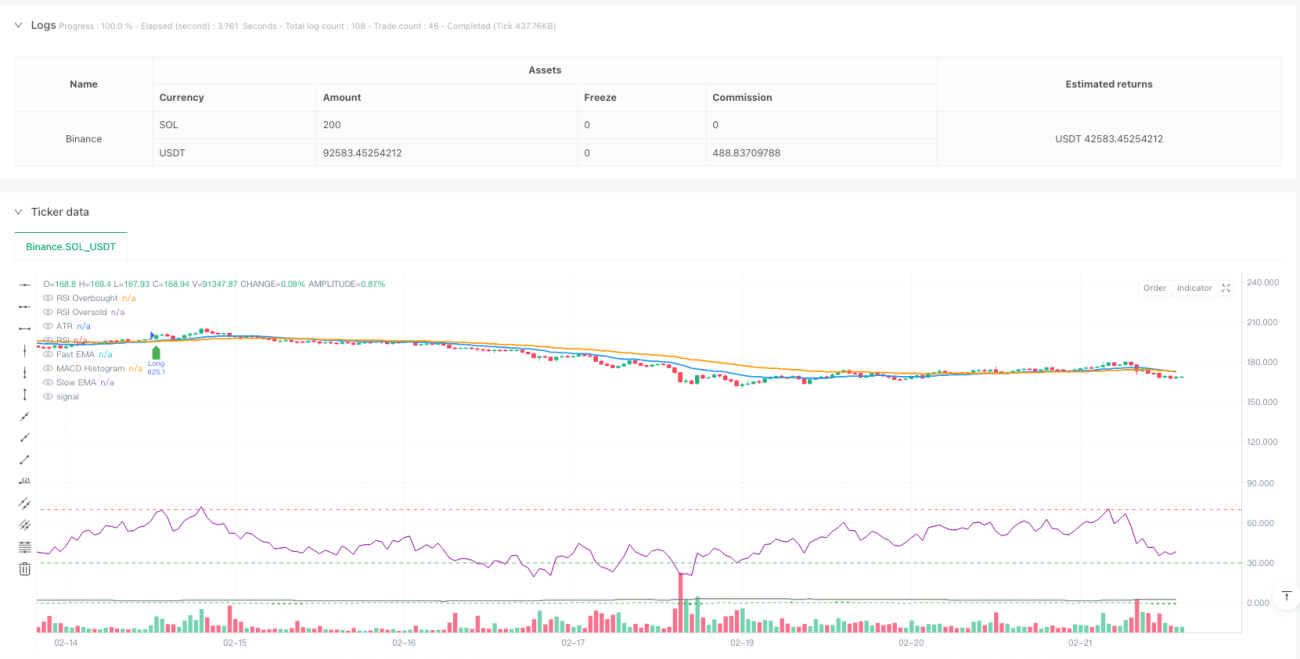
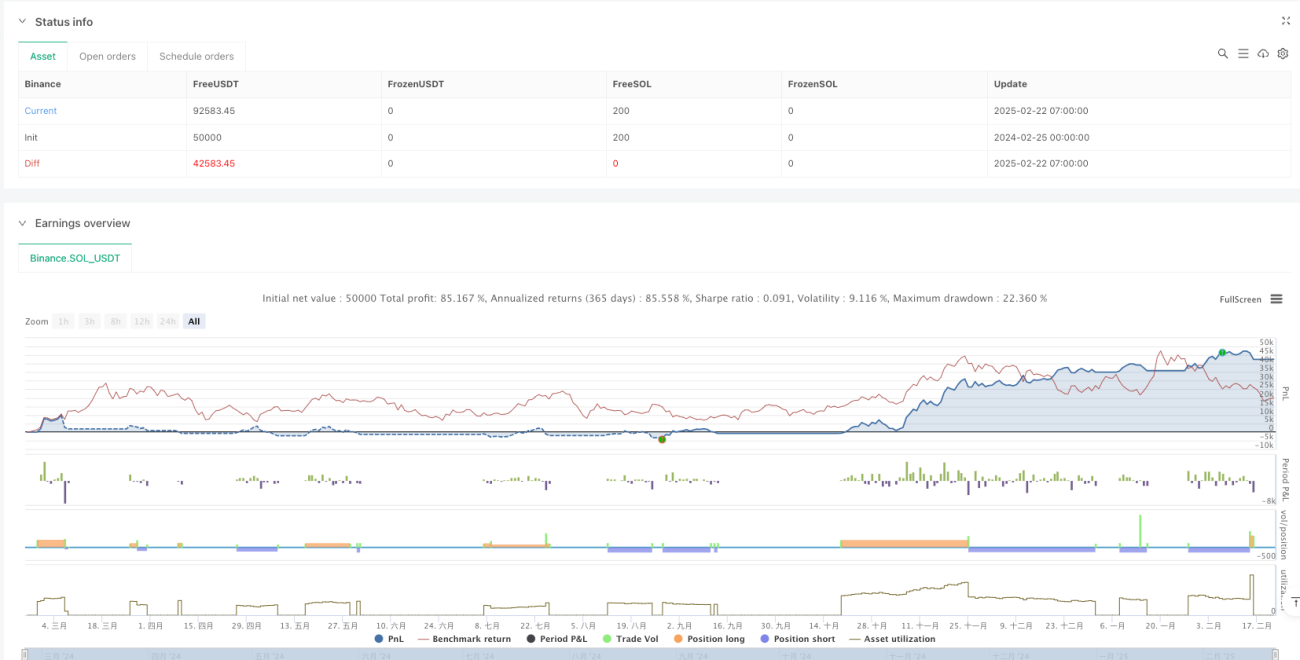
This strategy is a comprehensive trend-following trading system that combines multiple technical indicators to identify market trends and momentum while incorporating a dynamic risk management mechanism. The strategy confirms trading signals through the coordination of moving average crossovers, Relative Strength Index (RSI), and Moving Average Convergence Divergence (MACD), while using the Average True Range (ATR) to dynamically adjust stop-loss positions for adaptive risk management.
Strategy Principles
The core logic is built on cross-validation of multiple technical indicators. First, it identifies potential trend turning points through the crossover of fast exponential moving average (EMA20) and slow exponential moving average (EMA50). Second, it uses the RSI indicator to confirm whether prices are in overbought or oversold zones, avoiding counter-trend trading in extreme areas. Third, it incorporates MACD as a momentum confirmation tool, validating trend momentum through histogram polarity. Finally, it integrates an ATR-based dynamic stop-loss system that automatically adjusts stop distances based on market volatility. The strategy also includes an optional volume filter to confirm adequate market participation.
Strategy Advantages
- Multi-dimensional signal confirmation mechanism significantly reduces false breakout risks and improves signal reliability.
- Dynamic risk management system automatically adjusts stop-loss positions based on market volatility, avoiding issues associated with fixed stops.
- Money management system automatically calculates position sizes based on account equity, ensuring consistent risk exposure.
- Strategy demonstrates good adaptability, applicable to different timeframes and market conditions.
- Volume filter design helps identify strong market movements with institutional participation.
Strategy Risks
- In highly volatile market conditions, the lag of multiple indicators may delay entry signals.
- Excessive indicator filtering might miss potential opportunities, reducing strategy win rate.
- Moving average crossovers may generate frequent false signals in ranging markets, increasing trading costs.
- ATR stops might lead to larger drawdowns during sudden volatility expansions.
- Reliance on volume indicators may generate misleading signals in markets with poor liquidity.
Strategy Optimization Directions
- Introduction of adaptive parameter mechanisms to dynamically adjust indicator parameters based on different market conditions.
- Addition of trend strength filters to reduce trading frequency in weak trend environments.
- Optimization of stop-loss mechanisms by incorporating support and resistance levels for smarter stop placement.
- Integration of volatility prediction models to adjust risk management parameters proactively.
- Development of more sophisticated volume analysis models to improve market participation judgment accuracy.
Summary
This is a well-designed trend-following strategy that enhances trading signal reliability through the synergy of multiple technical indicators and features a professional risk management system. The strategy offers strong scalability, suitable for both intraday trading and longer-term trend capture. Through the suggested optimization directions, there is room for further improvement. Before live implementation, it is recommended to thoroughly validate parameter settings in a backtesting environment and make targeted adjustments based on specific market characteristics.
- 1