Multi-Channel Adaptive Turtle Trading Strategy with Dynamic Stop Loss System

Overview
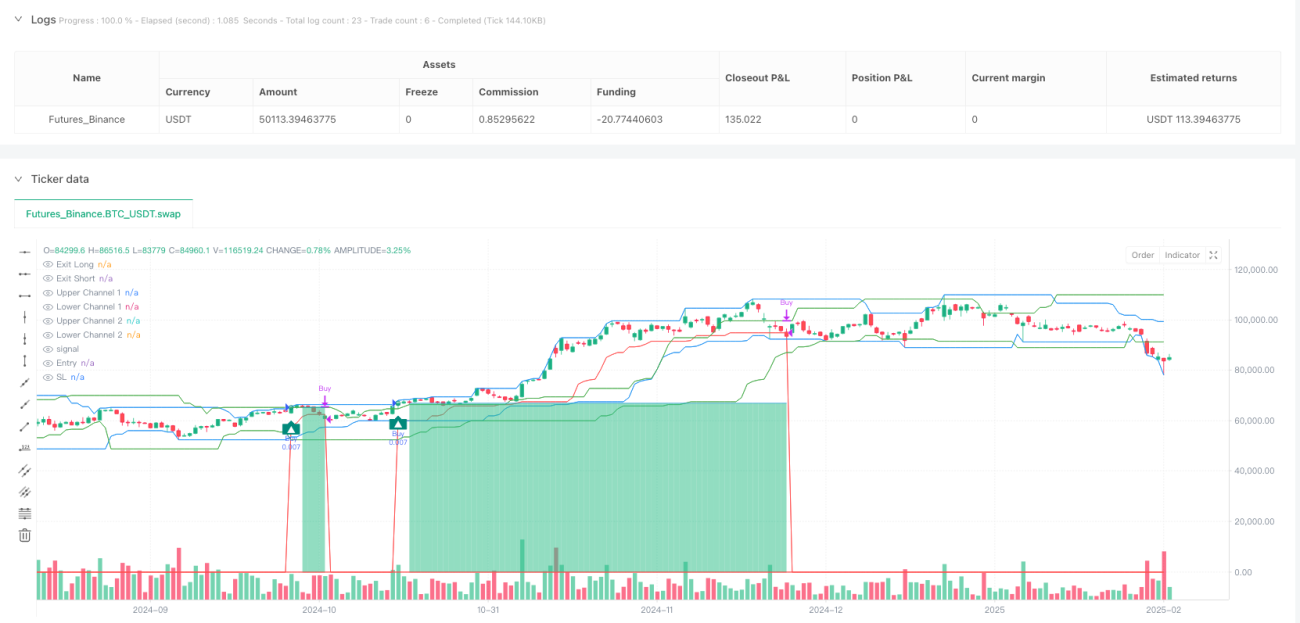
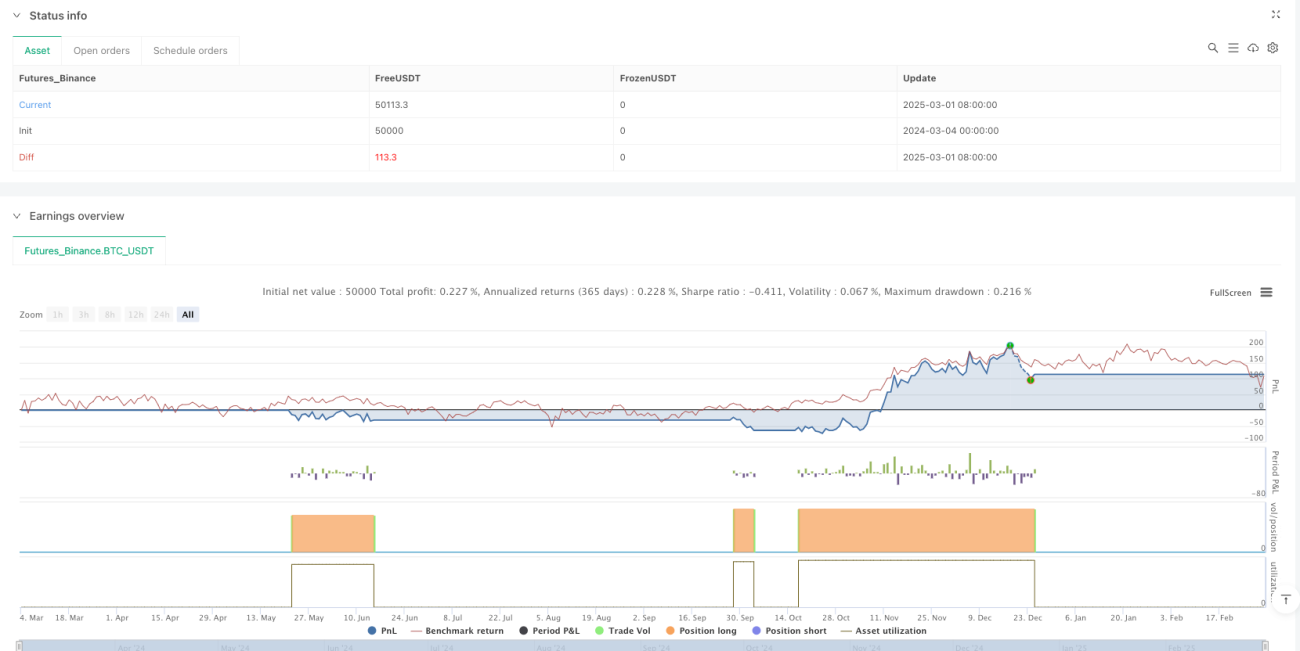
The Multi-Channel Adaptive Turtle Trading Strategy is a modernized trend-following system that has been comprehensively optimized and expanded based on the classic Turtle Trading rules. The core of this strategy utilizes a dual Donchian Channel system to identify market breakouts and provides precise stop-loss positioning through a dynamically adjusting exit channel. The strategy implements a dual confirmation mechanism: Channel 1 captures short-term price breakouts, while Channel 2 acts as a confirmation filter to reduce false signals. Additionally, the strategy integrates with the 3Commas trading bot interface, supporting fully automated trade execution, making it suitable for traders looking to capture long-term trends in volatile markets.
Strategy Principles
This strategy is based on the core principles of the classic Turtle Trading system but adds modernized dual-channel confirmation mechanisms and a dynamic stop-loss system:
-
Dual-Channel Breakout Confirmation System:
- Channel 1 (default 20 periods): Calculates the highest highs and lowest lows within a specific period, forming upper and lower boundaries.
- Channel 2 (default 20 periods with 20 offset): Acts as a second layer of confirmation, reducing false signals through rightward offset.
- Valid signals are only generated when price breaks through Channel 1 boundaries and is confirmed by Channel 2.
-
Dynamic Exit Channel:
- Uses a shorter period Donchian Channel (default 10) as a dynamic stop-loss.
- For long positions, the exit point is the lowest point of the channel; for short positions, the exit point is the highest point.
- Requires full candle close confirmation before executing exits, preventing premature exits due to price noise.
-
Entry and Exit Logic:
- Long Entry: When closing price breaks above the previous high of Channel 1 and is above the previous high of Channel 2.
- Short Entry: When closing price breaks below the previous low of Channel 1 and is below the previous low of Channel 2.
- Long Exit: Price breaks below the lowest point of the exit channel or reaches the optional take profit percentage.
- Short Exit: Price breaks above the highest point of the exit channel or reaches the optional take profit percentage.
-
Money Management:
- Default usage of 1% of account funds per trade, adjustable based on backtesting results.
- Ensures maximum drawdown does not exceed 10% to maintain risk control.
- Considers commission (default 0.1%) and slippage (default 5 ticks) to approximate real trading conditions.
Strategy Advantages
-
Improved Signal Quality: The dual-channel confirmation mechanism significantly reduces false breakouts, improving signal quality and accuracy. This design is reflected in the code with
buy = buy_fast and close > upper_slow[1]andsel = sel_fast and close < lower_slow[1]. -
Dynamic Risk Management: The strategy employs an adaptive exit channel that dynamically adjusts stop-loss positions based on market structure. When the market moves favorably, the stop-loss position automatically follows, locking in partial profits. This is implemented in the code through
exit_buy_level:= math.max(nz(exit_buy_level,10e-10), lower_exit). -
Comprehensive Money Management System: The strategy has built-in professional money management rules, controlling risk exposure for each trade through a percentage allocation system.
-
Visual Trade Management: The strategy clearly marks entry points, stop-loss points, and take-profit points on the chart, helping traders visually understand trading logic and risk ranges.
Strategy Risks
-
Poor Performance in Ranging Markets: As a trend-following strategy, it may generate consecutive false signals during sideways consolidation phases. Code analysis shows that although the dual-channel system reduces false positives, it will still trigger multiple small losing trades in markets without clear trends.
-
Parameter Sensitivity: Strategy performance is highly dependent on channel period and offset settings. Different markets and timeframes require different parameter combinations, necessitating thorough backtesting and optimization. The code controls these key variables through input parameters
_period_dc1,_period_dc2, and_period_off. -
Lag Risk: The dynamic stop-loss channel may not react quickly enough in violently volatile markets, leading to expanded drawdowns. In particular, requiring candle close confirmation (
barstate.isconfirmed) may miss optimal exit opportunities in highly volatile environments. -
Over-reliance on Historical Patterns: The strategy assumes that historical breakout patterns will continue to be effective in the future, but market characteristics may change over time, affecting strategy performance.
Strategy Optimization Directions
-
Add Trend Filters: Code analysis indicates that the current strategy lacks judgment of overall market trends. It is recommended to add trend indicators such as moving averages, ADX, or MACD to activate the strategy in strong trend environments and reduce sensitivity in weak trend or oscillating markets.
-
Adaptive Channel Periods: The strategy currently uses fixed period values. An optimization direction is to introduce adaptive channel periods based on ATR or market volatility, allowing the strategy to better adapt to different market environments. This can be implemented by modifying how
_period_dc1and_period_dc2are calculated. -
Optimize Exit Mechanism: The exit logic in the code relies solely on the Donchian Channel. It is recommended to implement a staged exit strategy, such as closing part of the position after achieving a certain profit, and setting a more relaxed trailing stop for the remaining portion.
-
Time Filtering: Add trading time filters to avoid market periods of low liquidity or high volatility. Especially for 24-hour cryptocurrency markets, certain time periods may be more suitable for executing trades.
-
Sentiment Indicator Integration: Integrate market sentiment indicators such as volume, volatility, or fund flows to enhance entry and exit decisions. For example, increase weight on breakout signals with high volume, or reduce trading frequency in abnormally low volatility environments.
Summary
The Multi-Channel Adaptive Turtle Trading Strategy is a modernized, comprehensive trend-following system that addresses many challenges faced by traditional Turtle Trading rules through dual-channel confirmation mechanisms and dynamic stop-losses. This strategy is particularly suitable for medium to long-term trend traders and performs more stably on higher timeframes such as H4 or daily charts. The strategy's 3Commas integration feature makes it an ideal choice for automated trading, reducing emotional interference.
While it may underperform in oscillating markets, its overall performance can be significantly improved through appropriate parameter optimization and additional trend filters. The strategy's money management module ensures effective risk control, while the dynamic stop-loss system helps protect profits already gained.
For traders looking to capture trends across various market conditions, this is a strategy worth considering, especially when combined with other market analysis tools. Remember that any strategy needs to be adjusted according to individual risk tolerance and trading goals, and should undergo thorough backtesting and simulation before actual capital investment.
- 1