RSI MA Crossover Swing Trading Strategy with Trailing Stop System

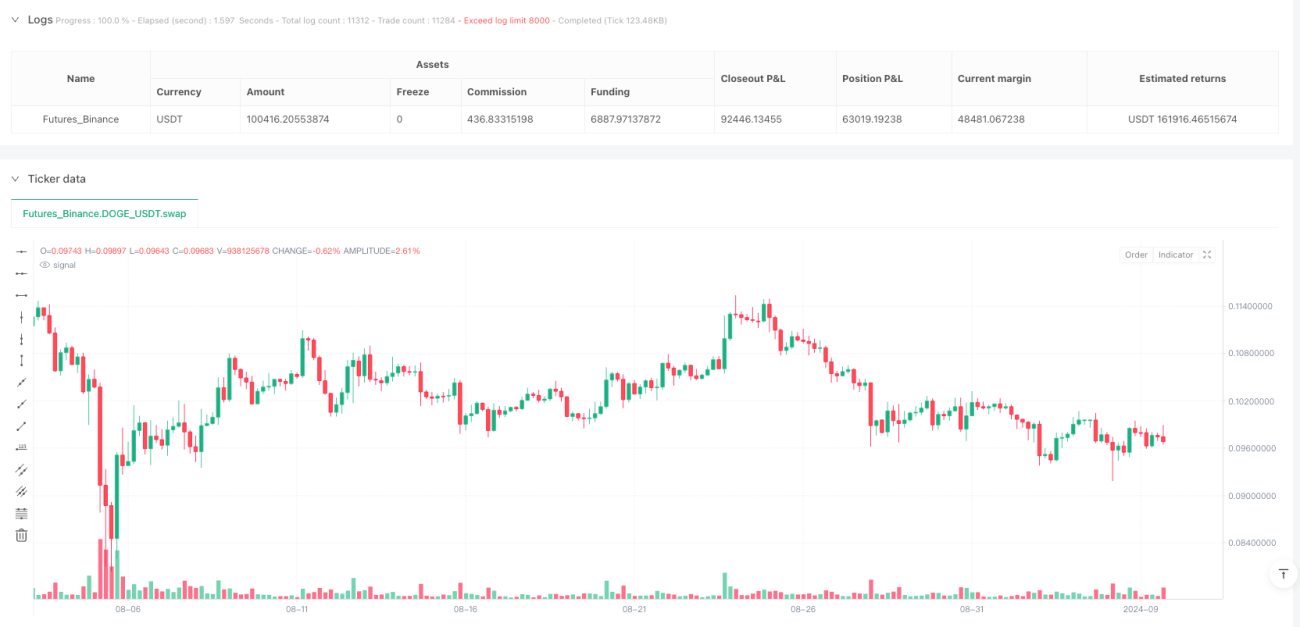
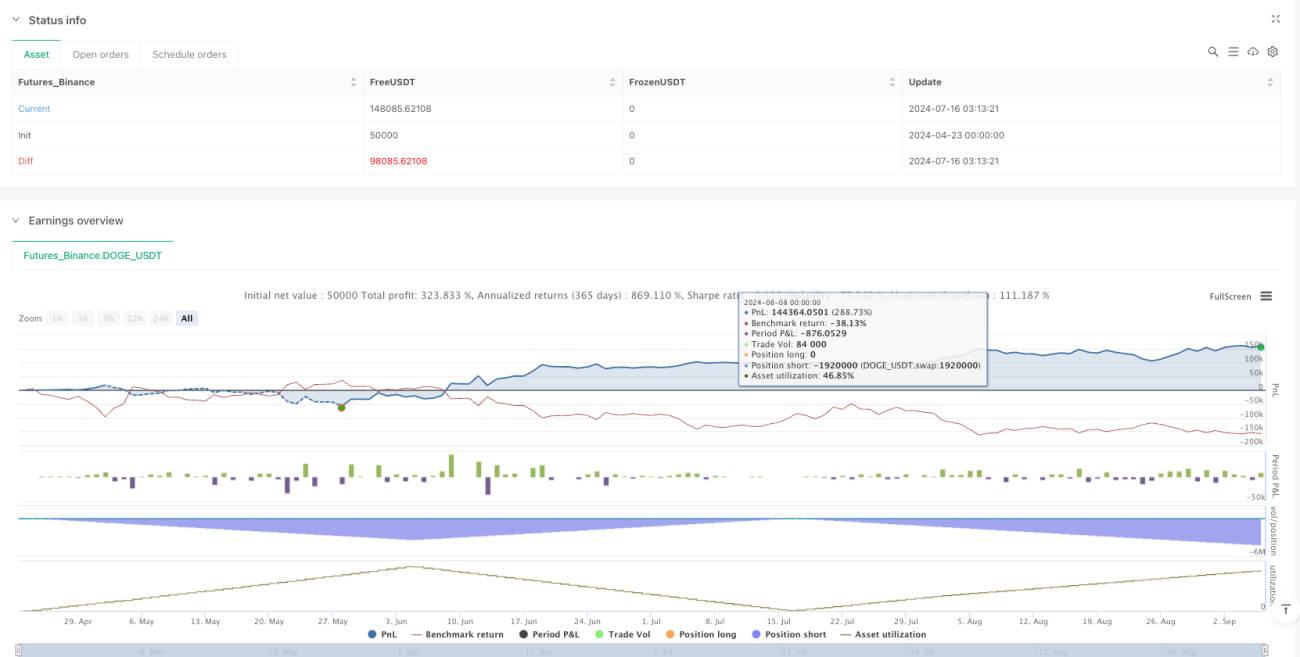
Overview
This strategy is a swing trading approach based on the crossover between RSI (Relative Strength Index) and its moving average (MA), designed for 4-hour charts. It generates trading signals through RSI-MA crossovers and incorporates multiple risk management tools, including fixed stop-loss/take-profit, trailing stop-loss, and reversal exit mechanisms. The strategy also imposes a consecutive loss limit, pausing trading after two consecutive losses until a daily reset.
Strategy Logic
- Timeframe Enforcement: The strategy operates exclusively on 4-hour charts to ensure signal alignment with the designed period.
- Indicator Calculation: Uses RSI (default length 14) and its MA (SMA or EMA, default length 14) for signals.
- Golden cross (RSI above MA) triggers long entries.
- Death cross (RSI below MA) triggers short entries.
- Position Sizing: Calculates position size based on allocated capital per trade and current price.
- Exit Mechanisms:
- Fixed SL/TP: Percentage-based stop-loss (default 1.5%) and take-profit (default 2.5%).
- Trailing Stop-Loss: Exits when price retracts by a specified points (default 10) from the peak.
- Reversal Exit: Closes positions on opposing signals.
- Risk Control:
- Pauses trading after two consecutive losses, with a daily reset at 9:15 AM.
Advantages
- Multi-Layered Signal Validation: Combines RSI and MA for reduced false signals.
- Dynamic Risk Management: Trailing stop-locks profits, fixed SL limits losses.
- Strict Capital Allocation: Position sizing prevents over-leverage.
- Disciplinary Control: Loss count mechanism avoids emotional trading.
- Visual Markers: Clear chart annotations for quick signal identification.
Risks
- Parameter Sensitivity: RSI and MA lengths significantly impact signal quality.
- Trend Market Performance: RSI may lag in strong trends due to prolonged overbought/oversold conditions.
- Timeframe Limitation: Requires revalidation for other periods.
- Consecutive Loss Risk: May miss opportunities during pause periods.
Solutions:
- Optimize parameters via backtesting.
- Add trend filters (e.g., ADX).
- Implement dynamic loss count thresholds.
Optimization Directions
- Multi-Indicator Confirmation: Integrate MACD or Bollinger Bands.
- Dynamic Parameters: Adjust RSI length and SL ratios based on market volatility.
- Timeframe Expansion: Test performance on higher/lower timeframes (e.g., daily/1-hour).
- Machine Learning: Train models to optimize entry/exit conditions.
- Advanced Capital Management: Dynamically adjust capital allocation based on equity.
Conclusion
The strategy leverages RSI-MA crossovers for swing trading, balancing profitability and risk through multi-tiered management tools. Its strengths lie in clear logic and discipline, though further optimizations (e.g., multi-indicator integration) could enhance adaptability. Future improvements should focus on dynamic adjustments and broader market validation.
- 1