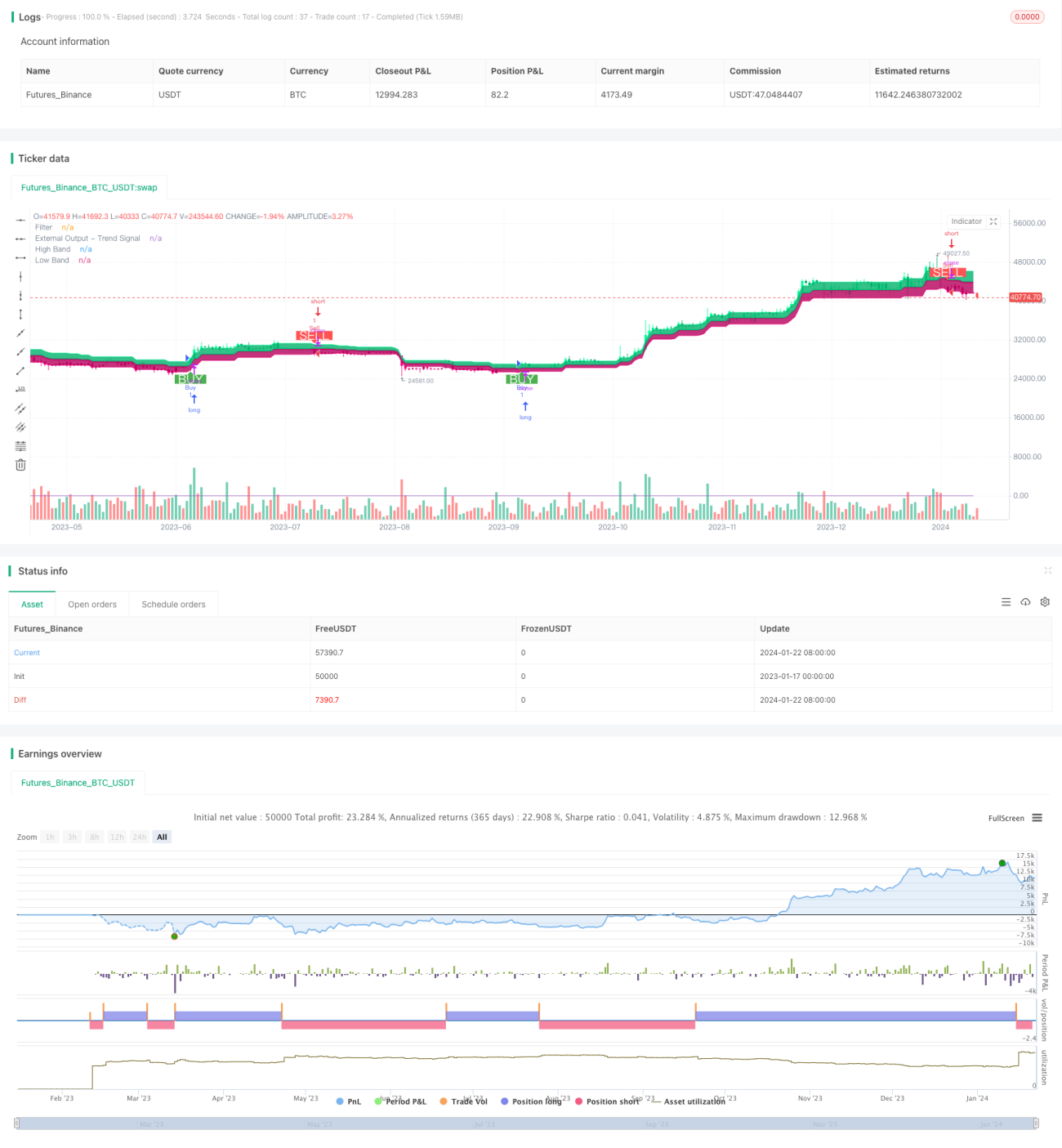
দ্বিমুখী অভিযোজিত পরিসর ফিল্টারিং ভলিউম ট্র্যাকিং কৌশল


সৃষ্টির তারিখ: 2024-01-24 11:31:51 অবশেষে সংশোধন করুন: 2024-01-24 11:32:23
অনুলিপি: 0 ক্লিকের সংখ্যা: 605
1
ফোকাস
1617
অনুসারী

দ্বিমুখী অভিযোজিত পরিসর ফিল্টারিং ভলিউম ট্র্যাকিং কৌশল

ওভারভিউ

এই কৌশলটি একটি দ্বি-মুখী স্ব-অনুকূলিত পরিসীমা ফিল্টার ভোল্টেজ ট্র্যাকিং কৌশল। এটি স্ব-অনুকূলিত পরিসীমা ফিল্টার ব্যবহার করে মূল্যের অস্থিরতা ট্র্যাক করে এবং মূল্যের দিকনির্দেশের জন্য পরিমাণের সাথে মিলিত হয়।

কৌশল নীতি

  1. স্বনির্ধারিত পরিসীমা ফিল্টার ব্যবহার করে দামের ওঠানামা ট্র্যাক করুন। ফিল্টার আকারটি ব্যবহারকারীর সেট করা পরিসীমা, সময়কাল, পরিমাণ এবং স্কেল অনুযায়ী স্বনির্ধারিতভাবে সামঞ্জস্য করুন।
  2. ফিল্টারগুলি টাইপ 1 এবং টাইপ 2 এর দুটি ধরণের মধ্যে বিভক্ত। টাইপ 1 হল স্ট্যান্ডার্ড রেঞ্জ ট্র্যাকিং টাইপ, টাইপ 2 হল সিঁড়ি প্রায় পুরো ধরণের।
  3. ফিল্টার এবং বন্ধের দামের আকারের সম্পর্কের উপর ভিত্তি করে দামের ওঠানামা নির্দেশ করুন। দামগুলি উপরের রেলের উপরে bullish হয় এবং নীচের রেলের নীচে bearish হয়।
  4. মূল্যের দিকনির্দেশনা নির্ধারণের জন্য, আগের দিনের তুলনায় মূল্যের পতন এবং পতনের সাথে সমাপ্তির মূল্যের সম্পর্ক যুক্ত করুন। মূল্যের বৃদ্ধি পল্টু মাথা, পতন খালি মাথা।
  5. যখন দাম উর্ধ্বমুখী হয় এবং মূল্য বৃদ্ধি পায় তখন কেনার সংকেত দেওয়া হয়; যখন দাম নিম্নমুখী হয় এবং মূল্য হ্রাস পায় তখন বিক্রয় সংকেত দেওয়া হয়।

সামর্থ্য বিশ্লেষণ

  1. স্বনির্ধারিত পরিসীমা ফিল্টারগুলি বাজারের অস্থিরতা সঠিকভাবে ধরতে পারে।
  2. দুই ধরনের ফিল্টার বিভিন্ন লেনদেনের পছন্দ পূরণ করতে পারে।
  3. সমন্বয়যোগ্যতা সূচকগুলি কার্যকরভাবে মূল্যের দিকনির্দেশনা সনাক্ত করে।
  4. কৌশলগতভাবে নমনীয়, বাজার অনুযায়ী প্যারামিটারগুলিকে সামঞ্জস্য করতে পারে
  5. Customize উপযুক্ত লেনদেন শর্ত লজিক নির্বাচন করুন

ঝুঁকি বিশ্লেষণ

  1. ভুল প্যারামিটার সেট করলে অতিরিক্ত লেনদেন বা ফাঁকা লেনদেন হতে পারে।
  2. “এটি একটি বিরল ঘটনা, কিন্তু আমি এটি বিশ্বাস করি।
  3. ক্যান্সার সংক্রান্ত ঝুঁকি রয়েছে।
  4. কিন্তু, এটাও সত্য যে, এই ধরনের হামলার ঘটনা ঘটতে পারে।

ঝুঁকি প্রতিরোধঃ

  1. উপযুক্ত প্যারামিটার নির্বাচন করুন এবং যখন প্রয়োজন তখন সামঞ্জস্য করুন।
  2. অন্যান্য সূচকগুলির সাথে মিলিত হয়ে ট্রেন্ডগুলি চিহ্নিত করুন।
  3. ট্রেডিংয়ে সতর্কতা অবলম্বন করুন যখন ট্রেডিংয়ের মূল পয়েন্টের কাছাকাছি থাকবেন এবং ট্রেন্ডটি বিপরীত দিকে যাবে।

অপ্টিমাইজেশান দিক

  1. বিভিন্ন পরিসীমা আকার এবং মসৃণ চক্রের প্যারামিটার সমন্বয় পরীক্ষা করে সর্বোত্তম সমন্বয় খুঁজে বের করুন।
  2. বিভিন্ন ধরনের ফিল্টার ব্যবহার করে দেখুন এবং আপনার পছন্দের ফিল্টারটি বেছে নিন।
  3. অন্যান্য পরিমাণগত বা সহায়ক প্রযুক্তিগত সূচকগুলি পরীক্ষা করুন।
  4. অযৌক্তিক লেনদেন হ্রাস করার জন্য লেনদেনের শর্তের যুক্তিকে অনুকূলিতকরণ এবং সমন্বয় করা।
  5. বাজার শ্রেণীবিভাগ তত্ত্বের সাথে মিলিত, স্বনির্ধারিত পজিশনিং অনুপাত নির্ধারণ করা হয়েছে।
কৌশল সোর্স কোড
/*backtest
start: 2023-01-17 00:00:00
end: 2024-01-23 00:00:00
period: 1d
basePeriod: 1h
exchanges: [{"eid":"Futures_Binance","currency":"BTC_USDT"}]
*/

//@version=4
strategy("Range Filter [DW] & Labels", shorttitle="RF [DW] & Labels", overlay=true)


//Conditional Sampling EMA Function 
Cond_EMA(x, cond, n)=>
    var val     = array.new_float(0)
    var ema_val = array.new_float(1)
    if cond
        array.push(val, x)
        if array.size(val) > 1
            array.remove(val, 0)
        if na(array.get(ema_val, 0))
            array.fill(ema_val, array.get(val, 0))
        array.set(ema_val, 0, (array.get(val, 0) - array.get(ema_val, 0))*(2/(n + 1)) + array.get(ema_val, 0))
    EMA = array.get(ema_val, 0)
    EMA

//Conditional Sampling SMA Function
Cond_SMA(x, cond, n)=>
    var vals = array.new_float(0)
    if cond
        array.push(vals, x)
        if array.size(vals) > n
            array.remove(vals, 0)
    SMA = array.avg(vals)
    SMA

//Standard Deviation Function
Stdev(x, n)=>
    sqrt(Cond_SMA(pow(x, 2), 1, n) - pow(Cond_SMA(x, 1, n), 2))

//Range Size Function
rng_size(x, scale, qty, n)=> 
    ATR      = Cond_EMA(tr(true), 1, n)
    AC       = Cond_EMA(abs(x - x[1]), 1, n)
    SD       = Stdev(x, n)
    rng_size = scale=="Pips" ? qty*0.0001 : scale=="Points" ? qty*syminfo.pointvalue : scale=="% of Price" ? close*qty/100 : scale=="ATR" ? qty*ATR :
               scale=="Average Change" ? qty*AC : scale=="Standard Deviation" ? qty*SD : scale=="Ticks" ? qty*syminfo.mintick : qty   

//Two Type Range Filter Function
rng_filt(h, l, rng_, n, type, smooth, sn, av_rf, av_n)=>
    rng_smooth = Cond_EMA(rng_, 1, sn)
    r          = smooth ? rng_smooth : rng_
    var rfilt  = array.new_float(2, (h + l)/2)
    array.set(rfilt, 1, array.get(rfilt, 0))
    if type=="Type 1"
        if h - r > array.get(rfilt, 1)
            array.set(rfilt, 0, h - r)
        if l + r < array.get(rfilt, 1)
            array.set(rfilt, 0, l + r)
    if type=="Type 2"
        if h >= array.get(rfilt, 1) + r
            array.set(rfilt, 0, array.get(rfilt, 1) + floor(abs(h - array.get(rfilt, 1))/r)*r)
        if l <= array.get(rfilt, 1) - r
            array.set(rfilt, 0, array.get(rfilt, 1) - floor(abs(l - array.get(rfilt, 1))/r)*r)
    rng_filt1 = array.get(rfilt, 0)
    hi_band1  = rng_filt1 + r
    lo_band1  = rng_filt1 - r
    rng_filt2 = Cond_EMA(rng_filt1, rng_filt1 != rng_filt1[1], av_n)
    hi_band2  = Cond_EMA(hi_band1, rng_filt1 != rng_filt1[1], av_n)
    lo_band2  = Cond_EMA(lo_band1, rng_filt1 != rng_filt1[1], av_n)
    rng_filt  = av_rf ? rng_filt2 : rng_filt1
    hi_band   = av_rf ? hi_band2 : hi_band1
    lo_band   = av_rf ? lo_band2 : lo_band1
    [hi_band, lo_band, rng_filt]
 
//-----------------------------------------------------------------------------------------------------------------------------------------------------------------
//Inputs
//-----------------------------------------------------------------------------------------------------------------------------------------------------------------

//Filter Type
f_type = input(defval="Type 1", options=["Type 1", "Type 2"], title="Filter Type")

//Movement Source
mov_src = input(defval="Close", options=["Wicks", "Close"], title="Movement Source")

//Range Size Inputs
rng_qty   = input(defval=2.618, minval=0.0000001, title="Range Size")
rng_scale = input(defval="Average Change", options=["Points", "Pips", "Ticks", "% of Price", "ATR", "Average Change", "Standard Deviation", "Absolute"], title="Range Scale")

//Range Period
rng_per = input(defval=14, minval=1, title="Range Period (for ATR, Average Change, and Standard Deviation)")

//Range Smoothing Inputs
smooth_range = input(defval=true, title="Smooth Range")
smooth_per   = input(defval=27, minval=1, title="Smoothing Period")

//Filter Value Averaging Inputs
av_vals    = input(defval=true, title="Average Filter Changes")
av_samples = input(defval=2, minval=1, title="Number Of Changes To Average")

//-----------------------------------------------------------------------------------------------------------------------------------------------------------------
//Definitions
//-----------------------------------------------------------------------------------------------------------------------------------------------------------------

//High And Low Values
h_val = mov_src=="Wicks" ? high : close
l_val = mov_src=="Wicks" ? low : close

//Range Filter Values
[h_band, l_band, filt] = rng_filt(h_val, l_val, rng_size((h_val + l_val)/2, rng_scale, rng_qty, rng_per), rng_per, f_type, smooth_range, smooth_per, av_vals, av_samples)

//Direction Conditions
var fdir = 0.0
fdir    := filt > filt[1] ? 1 : filt < filt[1] ? -1 : fdir
upward   = fdir==1 ? 1 : 0
downward = fdir==-1 ? 1 : 0

//Colors
filt_color = upward ? #05ff9b : downward ? #ff0583 : #cccccc
bar_color  = upward and (close > filt) ? (close > close[1] ? #05ff9b : #00b36b) :
             downward and (close < filt) ? (close < close[1] ? #ff0583 : #b8005d) : #cccccc

//-----------------------------------------------------------------------------------------------------------------------------------------------------------------
//Outputs
//-----------------------------------------------------------------------------------------------------------------------------------------------------------------

//Filter Plot
filt_plot = plot(filt, color=filt_color, transp=0, linewidth=3,  title="Filter")

//Band Plots
h_band_plot = plot(h_band, color=#05ff9b, transp=100, title="High Band")
l_band_plot = plot(l_band, color=#ff0583, transp=100, title="Low Band")

//Band Fills
fill(h_band_plot, filt_plot, color=#00b36b, transp=85, title="High Band Fill")
fill(l_band_plot, filt_plot, color=#b8005d, transp=85, title="Low Band Fill")

//Bar Color
barcolor(bar_color)

//External Trend Output
plot(fdir, transp=100, editable=false, display=display.none, title="External Output - Trend Signal")

// Trading Conditions Logic
longCond = close > filt and close > close[1] and upward > 0 or close > filt and close < close[1] and upward > 0 
shortCond = close < filt and close < close[1] and downward > 0 or close < filt and close > close[1] and downward > 0

CondIni = 0
CondIni := longCond ? 1 : shortCond ? -1 : CondIni[1]
longCondition = longCond and CondIni[1] == -1
shortCondition = shortCond and CondIni[1] == 1

// Strategy Entry and Exit
strategy.entry("Buy", strategy.long, when = longCondition)
strategy.entry("Sell", strategy.short, when = shortCondition)

strategy.close("Buy", when = shortCondition)
strategy.close("Sell", when = longCondition)

// Plot Buy and Sell Labels
plotshape(longCondition, title = "Buy Signal", text ="BUY", textcolor = color.white, style=shape.labelup, size = size.normal, location=location.belowbar, color = color.green, transp = 0)
plotshape(shortCondition, title = "Sell Signal", text ="SELL", textcolor = color.white, style=shape.labeldown, size = size.normal, location=location.abovebar, color = color.red, transp = 0)

// Alerts
alertcondition(longCondition, title="Buy Alert", message = "BUY")
alertcondition(shortCondition, title="Sell Alert", message = "SELL")