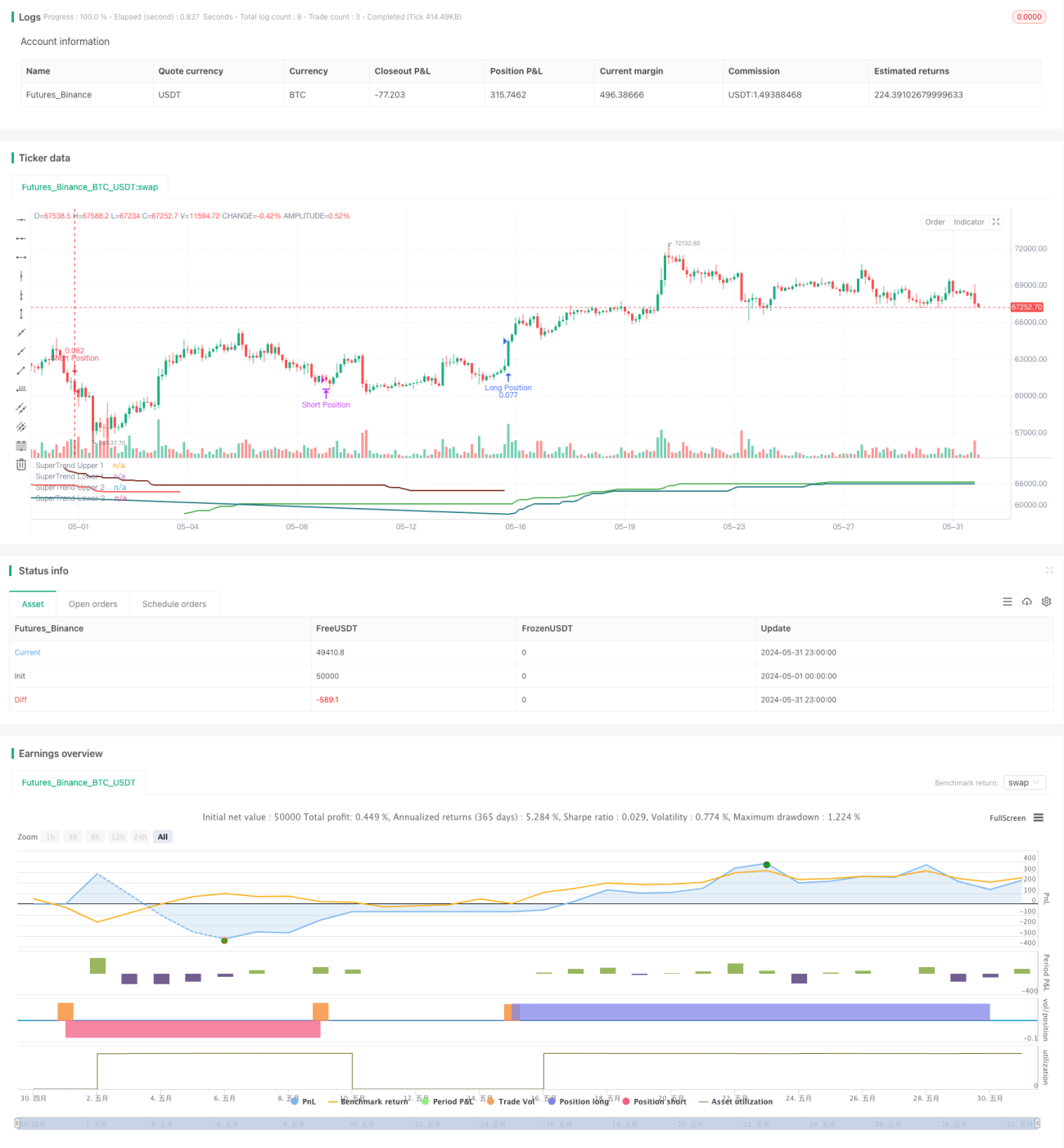
“ডুয়াল ভেগাস চ্যানেলের অস্থিরতা সমন্বিত সুপারট্রেন্ড কোয়ান্টাম ট্রেডিং কৌশল” একটি উচ্চমানের কোয়ান্টাম ট্রেডিং সিস্টেম যা দুটি ভেগাস চ্যানেলের অস্থিরতা সমন্বিত সুপারট্রেন্ড সূচককে বিভিন্ন প্যারামিটার সেট দিয়ে একত্রিত করে যাতে বাজারের প্রবণতা আরও সঠিকভাবে ধরা যায় এবং সামগ্রিক বাজারের দিকের সাথে সামঞ্জস্যপূর্ণ ট্রেডিং সংকেত তৈরি করা যায়। এই কৌশলটি সুপারট্রেন্ড গণনাকে অপ্টিমাইজ করার জন্য একটি গতিশীল প্রতিক্রিয়াশীল ট্রেডিং সিস্টেম তৈরি করে, অস্থিরতা সমন্বয় এবং ভেগাস চ্যানেলের প্রশস্ততা ব্যবহার করে। উপরন্তু, এই কৌশলটি কাস্টমাইজযোগ্য স্টপ এবং স্টপ লস স্তরের সাথে মিলিত হয় যা ঝুঁকি পরিচালনার জন্য একটি শক্ত কাঠামো সরবরাহ করে।
এই কৌশলটি প্রথমে ভেগাস চ্যানেল গণনা করে, যা একটি নির্দিষ্ট উইন্ডোর দৈর্ঘ্যের মধ্যে ক্লোজিং মূল্যের সরল চলমান গড় (এসএমএ) এবং স্ট্যান্ডার্ড ডিভার্জেন্স (এসটিডি) থেকে প্রাপ্ত। এই চ্যানেলটি বাজারের অস্থিরতা পরিমাপ করতে সহায়তা করে এবং সুপারট্রেন্ড সূচকগুলিকে সমন্বয় করার জন্য ভিত্তি স্থাপন করে। এরপরে, গড় সত্যিকারের ব্যাপ্তি (এটিআর) এবং সমন্বয়কৃত গুণক ব্যবহার করে সুপারট্রেন্ডের উত্থান-পতন নির্ধারণ করা হয়। মূল্যবান বাজার প্রবণতা সুপারট্রেন্ডের মূল্যের সাথে তুলনা করে সুপারট্রেন্ডের মূল্য নির্ধারণ করা হয়। কেবলমাত্র যখন দুটি সুপারট্রেন্ড সূচক একই বাজার দিকে নির্দেশ করে তখনই একটি ট্রেডিং সংকেত তৈরি হয়।
“দ্বৈত ভেগাস চ্যানেলের অস্থিরতা-সংশোধন সুপারট্রেন্ডের পরিমাণগত ট্রেডিং কৌশল” এর প্রধান সুবিধা হ’ল এটি পরিবর্তনশীল বাজার অবস্থার সাথে সামঞ্জস্য করার জন্য সুপারট্রেন্ডের সূচকগুলিকে গতিশীলভাবে সামঞ্জস্য করতে পারে। ভেগাস চ্যানেলের প্রস্থকে একীভূত করে, কৌশলটি বাজারের অস্থিরতার সাথে আরও ভালভাবে প্রতিক্রিয়া জানাতে পারে এবং প্রবণতা সনাক্তকরণের নির্ভুলতা বাড়ায়। এছাড়াও, দুটি সুপারট্রেন্ড সূচক ব্যবহার করে বিভিন্ন প্যারামিটার সেট সহ আরও বিস্তৃত বাজার দৃষ্টিভঙ্গি সরবরাহ করতে পারে যা প্রবণতা সনাক্ত করতে এবং ভুল সংকেতগুলি ফিল্টার করতে সহায়তা করে। কাস্টমাইজযোগ্য স্টপ এবং লস স্তরগুলি কৌশলটির ঝুঁকি ব্যবস্থাপনার ক্ষমতা আরও বাড়িয়ে তোলে।
যদিও এই কৌশলটি প্রবণতা সনাক্তকরণের নির্ভুলতা বাড়ানোর উদ্দেশ্যে তৈরি করা হয়েছে, তবুও কিছু ঝুঁকি রয়েছে। প্রথমত, এই কৌশলটি অত্যন্ত উদ্বায়ী বা বাজার চলন সম্পর্কে অস্পষ্ট হলে ভুল ট্রেডিং সিগন্যাল তৈরি করতে পারে। দ্বিতীয়ত, খুব ঘন ঘন ট্রেডিং উচ্চ ট্রেডিং খরচ হতে পারে, যা কৌশলটির সামগ্রিক কর্মক্ষমতাকে প্রভাবিত করে। এই ঝুঁকিগুলি প্রশমিত করার জন্য, ব্যবসায়ীরা কৌশলগত পরামিতিগুলিকে অপ্টিমাইজ করার বিষয়ে বিবেচনা করতে পারেন, যেমন এটিআর চক্র, ভেগাস চ্যানেল উইন্ডোর দৈর্ঘ্য এবং সুপারট্রেন্ডের গুণককে নির্দিষ্ট বাজারের অবস্থার সাথে খাপ খাইয়ে নিতে।
“ডাবল ভেগাস চ্যানেলের অস্থিরতা সমন্বয় SuperTrend পরিমাণগত ট্রেডিং কৌশল” বিভিন্ন উপায়ে অপ্টিমাইজ করা যেতে পারে। একটি সম্ভাব্য অপ্টিমাইজেশান দিক হল অন্যান্য প্রযুক্তিগত সূচক যেমন তুলনামূলকভাবে দুর্বল সূচক ((আরএসআই) বা মুভিং এভারেজ সমান্তরাল ছড়িয়ে ((এমএসিডি) এর সাথে মিলিত হওয়া যাতে ট্রেন্ড নিশ্চিতকরণের নির্ভরযোগ্যতা বাড়ানো যায়। আরেকটি অপ্টিমাইজেশন দিক হল স্ব-অনুকূলিতকরণ ব্যবস্থা প্রবর্তন করা, যা বাজারের অবস্থার উপর নির্ভর করে কৌশলগত প্যারামিটারগুলিকে গতিশীলভাবে সামঞ্জস্য করে। এটি মেশিন লার্নিং অ্যালগরিদম বা নিয়ম-ভিত্তিক পদ্ধতি ব্যবহার করে করা যেতে পারে। এছাড়াও, পজিশনের সময় এবং স্টপ লস স্তরের অপ্টিমাইজেশন কৌশলটির সামগ্রিক কর্মক্ষমতা উন্নত করতে পারে।
সামগ্রিকভাবে, ডাবল ভেগাস চ্যানেলের অস্থিরতা-সংশোধন সুপারট্রেন্ড কোয়ান্টাম ট্রেডিং কৌশলটি একটি শক্তিশালী ট্রেডিং সিস্টেম যা অস্থিরতা-সংশোধন এবং ভেগাস চ্যানেলের প্রস্থের সমন্বয় দ্বারা প্রবণতা সনাক্তকরণের নির্ভুলতা বাড়ায়। এই কৌশলটি আরও বিস্তৃত বাজারের দৃষ্টিভঙ্গি অর্জনের জন্য দুটি সুপারট্রেন্ড সূচক ব্যবহার করে যার বিভিন্ন প্যারামিটার সেট রয়েছে। যদিও এই কৌশলটি দুর্দান্ত সম্ভাবনা দেখায়, তবুও এর অন্তর্নিহিত ঝুঁকির বিষয়ে সতর্কতা অবলম্বন করা দরকার। কৌশলটির প্যারামিটারগুলি অনুকূলিতকরণ, অন্যান্য প্রযুক্তিগত সূচক প্রবর্তন এবং স্ব-অনুকূলিতকরণ প্রক্রিয়া বাস্তবায়নের মাধ্যমে কৌশলটির কার্যকারিতা আরও বাড়ানো যেতে পারে।
/*backtest
start: 2024-05-01 00:00:00
end: 2024-05-31 23:59:59
period: 3h
basePeriod: 15m
exchanges: [{"eid":"Futures_Binance","currency":"BTC_USDT"}]
*/
// This Pine Script™ code is subject to the terms of the Mozilla Public License 2.0 at https://mozilla.org/MPL/2.0/
// © PresentTrading
// The "Double Vegas SuperTrend Enhanced" strategy uses two SuperTrend indicators with different ATR and Vegas Channel settings
// to identify market trends and generate trades. Trades are executed only when both SuperTrends align in the same direction.
// The strategy includes configurable take-profit and stop-loss levels, and plots the SuperTrend levels on the chart.
//@version=5
strategy("Double Vegas SuperTrend Enhanced - Strategy [presentTrading]", shorttitle="Double Vegas SuperTrend Enhanced - Strategy [presentTrading]", overlay=true, overlay = false,
precision=3, commission_value= 0.1, commission_type=strategy.commission.percent, slippage= 1, currency=currency.USD, default_qty_type = strategy.percent_of_equity,
default_qty_value = 10, initial_capital= 10000)
// Input settings allow the user to customize the strategy's parameters.
tradeDirectionChoice = input.string(title="Trade Direction", defval="Both", options=["Long", "Short", "Both"]) // Option to select the trading direction
// Settings for the first Vegas SuperTrend
atrPeriod1 = input(10, "ATR Period for SuperTrend 1") // Length of the ATR for volatility measurement
vegasWindow1 = input(100, "Vegas Window Length 1") // Length of the moving average for the Vegas Channel
superTrendMultiplier1 = input(5, "SuperTrend Multiplier Base 1") // Base multiplier for the SuperTrend calculation
volatilityAdjustment1 = input.float(5, "Volatility Adjustment Factor 1") // Factor to adjust the SuperTrend sensitivity to the Vegas Channel width
// Settings for the second Vegas SuperTrend
atrPeriod2 = input(5, "ATR Period for SuperTrend 2") // Length of the ATR for volatility measurement
vegasWindow2 = input(200, "Vegas Window Length 2") // Length of the moving average for the Vegas Channel
superTrendMultiplier2 = input(7, "SuperTrend Multiplier Base 2") // Base multiplier for the SuperTrend calculation
volatilityAdjustment2 = input.float(7, "Volatility Adjustment Factor 2") // Factor to adjust the SuperTrend sensitivity to the Vegas Channel width
// Settings for Hold Days and TPSL Conditions
useHoldDays = input.bool(true, title="Use Hold Days")
holdDays = input.int(5, title="Hold Days", minval=1, maxval=60, step=1)
TPSLCondition = input.string("None", "TPSL Condition", options=["TP", "SL", "Both", "None"])
takeProfitPerc = input(30.0, title="Take Profit (%)")
stopLossPerc = input(20.0, title="Stop Loss (%)")
// Calculate the first Vegas Channel using a simple moving average and standard deviation.
vegasMovingAverage1 = ta.sma(close, vegasWindow1)
vegasChannelStdDev1 = ta.stdev(close, vegasWindow1)
vegasChannelUpper1 = vegasMovingAverage1 + vegasChannelStdDev1
vegasChannelLower1 = vegasMovingAverage1 - vegasChannelStdDev1
// Adjust the first SuperTrend multiplier based on the width of the Vegas Channel.
channelVolatilityWidth1 = vegasChannelUpper1 - vegasChannelLower1
adjustedMultiplier1 = superTrendMultiplier1 + volatilityAdjustment1 * (channelVolatilityWidth1 / vegasMovingAverage1)
// Calculate the first SuperTrend indicator values.
averageTrueRange1 = ta.atr(atrPeriod1)
superTrendUpper1 = hlc3 - (adjustedMultiplier1 * averageTrueRange1)
superTrendLower1 = hlc3 + (adjustedMultiplier1 * averageTrueRange1)
var float superTrendPrevUpper1 = na
var float superTrendPrevLower1 = na
var int marketTrend1 = 1
// Update SuperTrend values and determine the current trend direction for the first SuperTrend.
superTrendPrevUpper1 := nz(superTrendPrevUpper1[1], superTrendUpper1)
superTrendPrevLower1 := nz(superTrendPrevLower1[1], superTrendLower1)
marketTrend1 := close > superTrendPrevLower1 ? 1 : close < superTrendPrevUpper1 ? -1 : nz(marketTrend1[1], 1)
superTrendUpper1 := marketTrend1 == 1 ? math.max(superTrendUpper1, superTrendPrevUpper1) : superTrendUpper1
superTrendLower1 := marketTrend1 == -1 ? math.min(superTrendLower1, superTrendPrevLower1) : superTrendLower1
superTrendPrevUpper1 := superTrendUpper1
superTrendPrevLower1 := superTrendLower1
// Calculate the second Vegas Channel using a simple moving average and standard deviation.
vegasMovingAverage2 = ta.sma(close, vegasWindow2)
vegasChannelStdDev2 = ta.stdev(close, vegasWindow2)
vegasChannelUpper2 = vegasMovingAverage2 + vegasChannelStdDev2
vegasChannelLower2 = vegasMovingAverage2 - vegasChannelStdDev2
// Adjust the second SuperTrend multiplier based on the width of the Vegas Channel.
channelVolatilityWidth2 = vegasChannelUpper2 - vegasChannelLower2
adjustedMultiplier2 = superTrendMultiplier2 + volatilityAdjustment2 * (channelVolatilityWidth2 / vegasMovingAverage2)
// Calculate the second SuperTrend indicator values.
averageTrueRange2 = ta.atr(atrPeriod2)
superTrendUpper2 = hlc3 - (adjustedMultiplier2 * averageTrueRange2)
superTrendLower2 = hlc3 + (adjustedMultiplier2 * averageTrueRange2)
var float superTrendPrevUpper2 = na
var float superTrendPrevLower2 = na
var int marketTrend2 = 1
// Update SuperTrend values and determine the current trend direction for the second SuperTrend.
superTrendPrevUpper2 := nz(superTrendPrevUpper2[1], superTrendUpper2)
superTrendPrevLower2 := nz(superTrendPrevLower2[1], superTrendLower2)
marketTrend2 := close > superTrendPrevLower2 ? 1 : close < superTrendPrevUpper2 ? -1 : nz(marketTrend2[1], 1)
superTrendUpper2 := marketTrend2 == 1 ? math.max(superTrendUpper2, superTrendPrevUpper2) : superTrendUpper2
superTrendLower2 := marketTrend2 == -1 ? math.min(superTrendLower2, superTrendPrevLower2) : superTrendLower2
superTrendPrevUpper2 := superTrendUpper2
superTrendPrevLower2 := superTrendLower2
// Enhanced Visualization
// Plot the SuperTrend and Vegas Channel for visual analysis for both lengths.
plot(marketTrend1 == 1 ? superTrendUpper1 : na, "SuperTrend Upper 1", color=color.green, linewidth=2)
plot(marketTrend1 == -1 ? superTrendLower1 : na, "SuperTrend Lower 1", color=color.red, linewidth=2)
plot(marketTrend2 == 1 ? superTrendUpper2 : na, "SuperTrend Upper 2", color=color.rgb(31, 119, 130), linewidth=2)
plot(marketTrend2 == -1 ? superTrendLower2 : na, "SuperTrend Lower 2", color=color.rgb(120, 42, 26), linewidth=2)
// Detect trend direction changes and plot entry/exit signals for both lengths.
trendShiftToBullish1 = marketTrend1 == 1 and marketTrend1[1] == -1
trendShiftToBearish1 = marketTrend1 == -1 and marketTrend1[1] == 1
trendShiftToBullish2 = marketTrend2 == 1 and marketTrend2[1] == -1
trendShiftToBearish2 = marketTrend2 == -1 and marketTrend2[1] == 1
// Define conditions for entering long or short positions, and execute trades based on these conditions for both lengths.
enterLongCondition1 = marketTrend1 == 1
enterShortCondition1 = marketTrend1 == -1
enterLongCondition2 = marketTrend2 == 1
enterShortCondition2 = marketTrend2 == -1
// Entry conditions: Both conditions must be met for a trade to be executed.
enterLongCondition = enterLongCondition1 and enterLongCondition2 and not na(superTrendPrevUpper1[1]) and not na(superTrendPrevUpper2[1])
enterShortCondition = enterShortCondition1 and enterShortCondition2 and not na(superTrendPrevLower1[1]) and not na(superTrendPrevLower2[1])
// Variables to track entry times
var float longEntryTime = na
var float shortEntryTime = na
// Variables to track whether we have recently exited a trade to prevent re-entry in the same trend
var bool recentlyExitedLong = false
var bool recentlyExitedShort = false
// Check trade direction choice before executing trade entries.
if (enterLongCondition and (tradeDirectionChoice == "Long" or tradeDirectionChoice == "Both"))
if (strategy.position_size < 0)
strategy.close("Short Position")
strategy.entry("Long Position", strategy.long)
longEntryTime := time
recentlyExitedLong := false
recentlyExitedShort := false
if (enterShortCondition and (tradeDirectionChoice == "Short" or tradeDirectionChoice == "Both"))
if (strategy.position_size > 0)
strategy.close("Long Position")
strategy.entry("Short Position", strategy.short)
shortEntryTime := time
recentlyExitedShort := false
recentlyExitedLong := false
// Exit conditions: Either condition being met will trigger an exit.
exitLongCondition = marketTrend1 == -1 or marketTrend2 == -1
exitShortCondition = marketTrend1 == 1 or marketTrend2 == 1
// Close positions based on exit conditions or hold days.
if (useHoldDays and not na(longEntryTime) and (time >= longEntryTime + holdDays * 86400000) and strategy.position_size > 0)
strategy.close("Long Position")
longEntryTime := na
recentlyExitedLong := true
if (useHoldDays and not na(shortEntryTime) and (time >= shortEntryTime + holdDays * 86400000) and strategy.position_size < 0)
strategy.close("Short Position")
shortEntryTime := na
recentlyExitedShort := true
if (not useHoldDays and exitLongCondition and strategy.position_size > 0)
strategy.close("Long Position")
longEntryTime := na
recentlyExitedLong := true
if (not useHoldDays and exitShortCondition and strategy.position_size < 0)
strategy.close("Short Position")
shortEntryTime := na
recentlyExitedShort := true
// Reset recently exited flags on trend change to allow re-entry on a new trend
if (trendShiftToBullish1 or trendShiftToBullish2)
recentlyExitedLong := false
if (trendShiftToBearish1 or trendShiftToBearish2)
recentlyExitedShort := false
// Conditional Profit and Loss Management
if (TPSLCondition == "TP" or TPSLCondition == "Both")
// Apply take profit conditions
strategy.exit("TakeProfit_Long", "Long Position", limit=close * (1 + takeProfitPerc / 100))
strategy.exit("TakeProfit_Short", "Short Position", limit=close * (1 - takeProfitPerc / 100))
if (TPSLCondition == "SL" or TPSLCondition == "Both")
// Apply stop loss conditions
strategy.exit("StopLoss_Long", "Long Position", stop=close * (1 - stopLossPerc / 100))
strategy.exit("StopLoss_Short", "Short Position", stop=close * (1 + stopLossPerc / 100))
// Ensure that new entry signals can override the hold days condition
if (enterLongCondition and (tradeDirectionChoice == "Long" or tradeDirectionChoice == "Both"))
if (strategy.position_size < 0)
strategy.close("Short Position")
strategy.entry("Long Position", strategy.long)
longEntryTime := time
recentlyExitedLong := false
recentlyExitedShort := false
if (enterShortCondition and (tradeDirectionChoice == "Short" or tradeDirectionChoice == "Both"))
if (strategy.position_size > 0)
strategy.close("Long Position")
strategy.entry("Short Position", strategy.short)
shortEntryTime := time
recentlyExitedShort := false
recentlyExitedLong := false