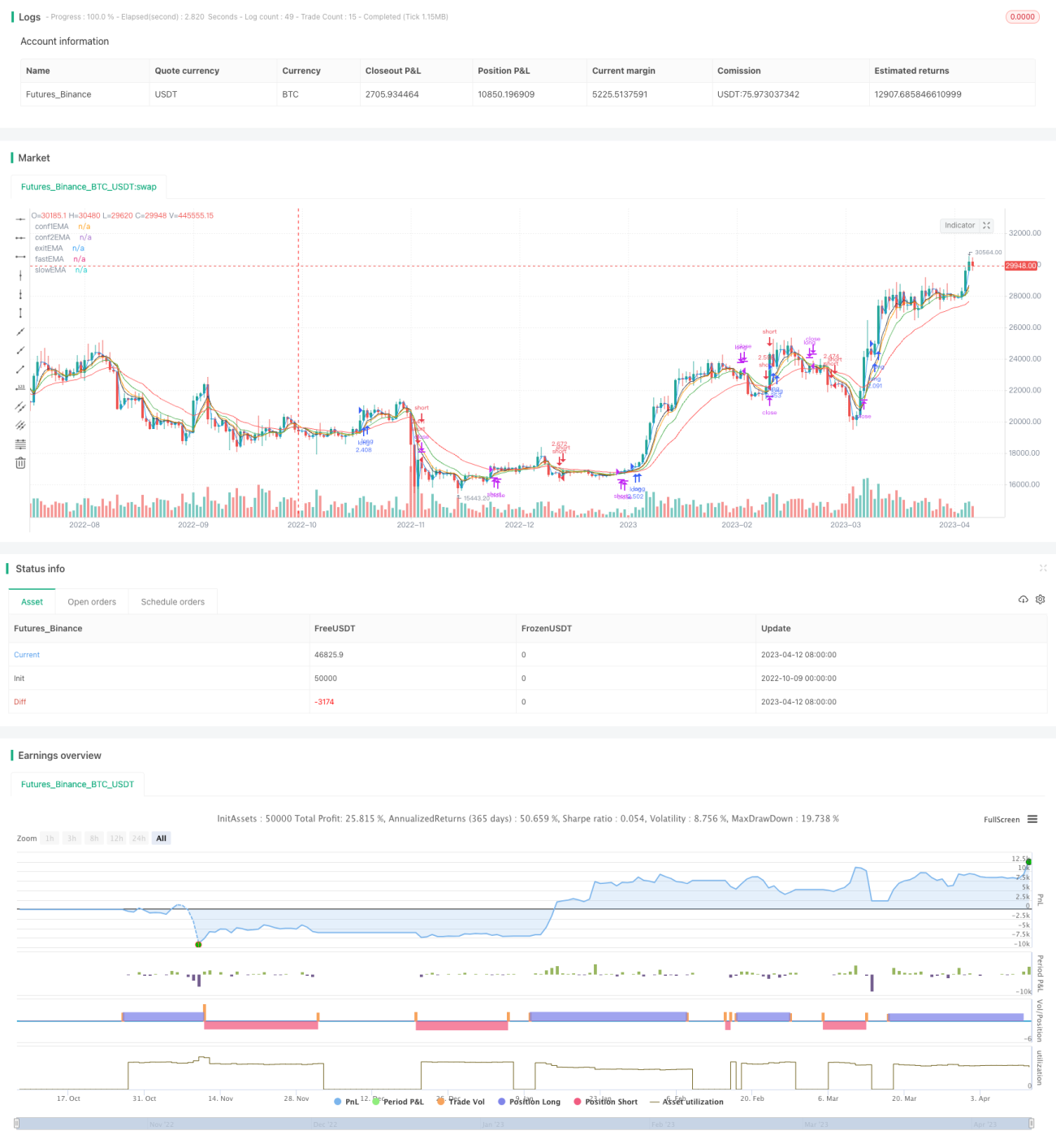
Doppelte EMA-Ausbruchshandelsstrategie


Erstellungsdatum: 2023-10-16 16:24:00 zuletzt geändert: 2023-10-16 16:24:00
Kopie: 1 Klicks: 738
1
konzentrieren Sie sich auf
1617
Anhänger

Doppelte EMA-Ausbruchshandelsstrategie

Überblick

Die Dual EMA Breakout Trading Strategie ist eine Trend-Tracking-Strategie, bei der die EMA-Gewinnlinien zweier unterschiedlicher Perioden verwendet werden, um Kauf- und Verkaufssignale zu beurteilen. Die Strategie kombiniert zusätzliche EMA-Indikatoren zur Filterung von Handelssignalen, um eine bessere Einstiegszeit in Trends zu erhalten.

Grundsätze

Die Strategie nutzt die Goldfork-Deadlines der schnellen EMA ((9 Zyklen) und der langsamen EMA ((21 Zyklen)), um zu entscheiden, wann zu kaufen und zu verkaufen ist. Es wird ein Kaufsignal erzeugt, wenn die schnelle Linie die langsame Linie durchläuft, und ein Verkaufssignal, wenn die schnelle Linie die langsame Linie durchläuft. Um gefälschte Signale zu filtern, wird die Strategie auch ein zusätzliches EMA ((5 Zyklen) und zwei weitere EMA ((1, 4 Zyklen) eingeführt.

Wenn ein Handelssignal ausgelöst wird, setzt die Strategie einen Stop-Loss- und einen Stop-Off-Platz basierend auf dem ATR-Wert. TP1 ist das Sechsfache des ATR, um einen Teil des Gewinns aus der schnelleren Geschwindigkeit zu erhalten. Wenn der Preis TP1 nicht ausgelöst hat, wird die Position direkt abgebremst, wenn die Schnelllinie EMA die Hilfs-EMA erneut überquert, um einen TP2-Stop zu erreichen.

Vorteile

  • Die Verwendung von doppelten EMA-Kombinationen zur Filterung von Falschsignalen verbessert die Qualität der Handelssignale
  • Zusätzliche EMA-Indikatoren zur weiteren Verifizierung der Trendrichtung und zur Verringerung des Risikos von Rückschlägen
  • Dual-Stop-Design für schnelle und nachhaltige Trend-Einnahmen
  • Die ATR-Dynamische Stop-Loss-Sperre kann an die Volatilität des Marktes angepasst werden, um das Risiko zu verringern

Risiko und Optimierung

  • EMAs sind anfällig für Kurvenanpassung, Handelssignale können zurückbleiben
  • Kurzzeit-EMA-Kombinationen könnten mehr Noise-Trading-Signale erzeugen
  • Kurzleitungsbetrieb ist anfällig für Unfälle und hat ein hohes Risiko für Schaden.

Optimierung:

  • Testen mehrerer EMA-Parameterkombinationen, um bessere Parameter zu finden
  • Hinzufügen von zusätzlichen Kennzahlen wie Volumen, Volatilität usw.
  • Entspannung des Stop-Loss-Bereichs, um die Wahrscheinlichkeit zu verringern, dass der Stop-Loss ausgelöst wird
  • Optimierung der Doppelstoppel-Ratio, die Geschwindigkeit der Gewinnung und die Effizienz der Kapitalnutzung ausgleicht

Zusammenfassen

Die Doppel-EMA-Breakout-Handelsstrategie nutzt die Kreuzung der beiden EMAs, um Trends zu beurteilen, unterstützt durch mehrere EMA-Filter und ATR-dynamische Stop-Loss-Stopps, um Trends effektiv zu verfolgen. Es ist jedoch wichtig, auf EMA-Kurvenanpassung und Stop-Loss-Risiken zu achten. Durch Maßnahmen wie Parameteroptimierung und Risikomanagement kann eine stabilere Handelsleistung erzielt werden.

Overview

The dual EMA crossover trading strategy utilizes two EMA lines of different periods to generate buy and sell signals by identifying trend direction. It also incorporates additional EMA indicators for signal filtering, allowing better entry timing in trending markets.

Principles

The strategy uses a fast EMA line (9 periods) and a slow EMA line (21 periods) to determine entries. A golden cross where the fast EMA crosses above the slow EMA generates a buy signal, while a death cross with the fast EMA crossing below the slow EMA produces a sell signal. To filter out false signals, the strategy also employs an auxiliary EMA (5 periods) and two more EMAs (1 period, 4 periods). A real trading signal is only triggered when the fast and slow EMAs cross while the auxiliary EMA is between the two, and the 1-period EMA is above the 4-period EMA.

Once a trading signal is triggered, the strategy utilizes ATR values to set stop loss and take profit levels. TP1 is set at 6 x ATR for faster profit taking. If price doesn’t hit TP1, the strategy will close the position directly when the fast EMA crosses back over the auxiliary EMA, realizing TP2.

Advantages

  • Dual EMA design filters false signals and improves signal quality
  • Auxiliary EMA adds trend direction verification, reducing reverse trade risks
  • Dual take profit allows fast profit and sustained trend following
  • Dynamic ATR stop loss/take profit adjusts to market volatility

Risks and Improvements

  • EMAs can lag prices and generate late signals
  • Shorter EMA combos may produce more noise
  • Tighter stops face larger sudden event risks

Improvement directions:

  • Test multiple EMA combos for better parameters
  • Add other confirmation indicators like volume, volatility etc.
  • Widen stop loss to lower stop out odds
  • Optimize take profit ratios for profit vs capital efficiency

Conclusion

The dual EMA crossover strategy leverages EMA crosses for trend direction, along with multiple EMA filtering and dynamic ATR stop loss/profit taking. This allows effective trend following and profit harvesting. However, EMA fitting limitations and stop loss risks require caution. Proper optimization, risk management etc. can lead to more robust performance. The strategy suits experienced traders to achieve high capital efficiency in trending markets.

[/trans]

Strategiequellcode
/*backtest
start: 2022-10-09 00:00:00
end: 2023-04-13 00:00:00
period: 1d
basePeriod: 1h
exchanges: [{"eid":"Futures_Binance","currency":"BTC_USDT"}]
*/

// This source code is subject to the terms of the Mozilla Public License 2.0 at https://mozilla.org/MPL/2.0/
// @author ADHDCRYPT0

//@version=4
strategy(title = "EMA double crossover", shorttitle = "(TEST) double cross over", overlay = true, default_qty_value = 100, initial_capital = 1000,default_qty_type=strategy.percent_of_equity, pyramiding=0, process_orders_on_close=true)


// Variables
ema_len1 = input(9 , title="Fast EMA")
ema_len2 = input(21, title="Slow EMA")
ema_len3 = input(5, title="Exit EMA")
ema_len4 = input(1, title="FastConf EMA")
ema_len5 = input(4, title="SlowConf EMA")

fastEMA = ema(open, ema_len1)
slowEMA = ema(open, ema_len2)
exitEMA = ema(open, ema_len3)
conf1EMA = ema(open, ema_len4)
conf2EMA = ema(open, ema_len5)
plot(fastEMA, title='fastEMA', transp=0, color=color.green)
plot(slowEMA, title='slowEMA', transp=0, color=color.red  )
plot(exitEMA, title='exitEMA', transp=0, color=color.orange)
plot(conf1EMA, title='conf1EMA', transp=0, color=color.blue)
plot(conf2EMA, title='conf2EMA', transp=0, color=color.black)

vol = volume 
volma = sma(volume,7)
vol_cond = vol>volma

atr = atr(5)


// Entry Conditions and vol_cond
long = crossover(fastEMA, slowEMA) and (conf1EMA > conf2EMA) and (fastEMA < exitEMA)
short= crossunder(fastEMA, slowEMA) and (conf1EMA < conf2EMA) and (fastEMA > exitEMA)

tradeType = input("BOTH", title="What trades should be taken : ", options=["LONG", "SHORT", "BOTH", "NONE"])

pos = 0.0

if tradeType=="BOTH"
    pos:= long? 1 : short? -1 : pos[1]
if tradeType=="LONG"
    pos:= long? 1 : pos[1]
if tradeType=="SHORT"
    pos:=short? -1 : pos[1]

longCond  = long  and (pos[1]!= 1 or na(pos[1]))
shortCond = short and (pos[1]!=-1 or na(pos[1]))

// EXIT FUNCTIONS //
sl  = input(1, title="Stop Loss (ATR)", minval=0)
tp  = input(6, title="Take Profit 1 (ATR)", minval=0)

// Simple Stop Loss + 2 Take Profits
sl_long   =  valuewhen(longCond , low - atr * sl, 0)
sl_short  =  valuewhen(shortCond, high+ atr * sl, 0)

tp_long  = valuewhen(longCond , high + atr * tp, 0)
tp_short = valuewhen(shortCond, low  - atr * tp, 0)


long_exit = crossover(fastEMA, exitEMA) and pos[1]==1
short_exit= crossover(exitEMA, fastEMA) and pos[1]==-1

if long_exit or short_exit
	pos:=0


// Position Adjustment
long_sl  = low <sl_long [1] and pos[1]==1
short_sl = high>sl_short[1] and pos[1]==-1

if long_sl or short_sl
    pos:=0
    
//  Strategy Backtest Limiting Algorithm
i_startTime = input(defval = timestamp("01 Sep 2002 13:30 +0000"), title = "Backtesting Start Time", type = input.time)
i_endTime = input(defval = timestamp("30 Sep 2099 19:30 +0000"), title = "Backtesting End Time", type = input.time)
timeCond = true


// Make sure we are within the bar range, Set up entries and exit conditions
if strategy.equity >0
    strategy.entry("long" , strategy.long , when=longCond  and timeCond and tradeType!="SHORT" , alert_message="INSERT MESSAGE HERE")
    strategy.entry("short", strategy.short, when=shortCond and timeCond and tradeType!="LONG" , alert_message="INSERT MESSAGE HERE")
    
    strategy.exit("SL/TP1", from_entry = "long" , stop=sl_long , limit=tp_long , alert_message="INSERT MESSAGE HERE")
    strategy.exit("SL/TP1", from_entry = "short", stop=sl_short, limit=tp_short, alert_message="INSERT MESSAGE HERE")

    strategy.exit("SL", from_entry = "long" , stop=sl_long, alert_message="INSERT MESSAGE HERE")
    strategy.exit("SL", from_entry = "short", stop=sl_short, alert_message="INSERT MESSAGE HERE")
    
    strategy.close("long", when=long_exit , comment="TP2", alert_message="INSERT MESSAGE HERE")
    strategy.close("short", when=short_exit, comment="TP2", alert_message="INSERT MESSAGE HERE")