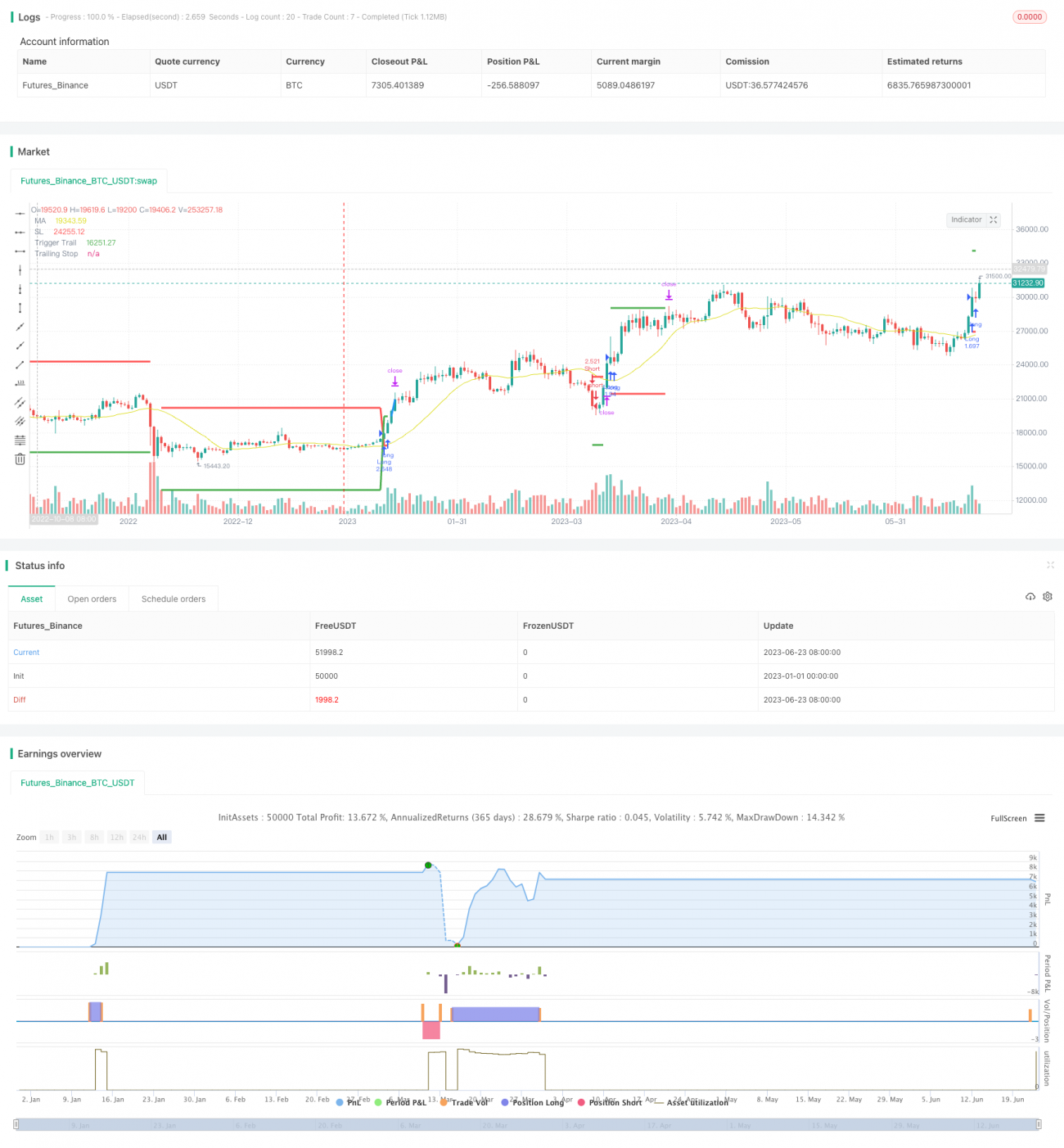
Die Strategie kombiniert den RSI mit einem gewichteten Moving Average, um einen Trend-Tracking-Handel zu ermöglichen. Sie ist bullish, wenn der RSI höher als 60 ist, und bullish, wenn der RSI niedriger als 40 ist, und verlangt, dass der Moving Average die Trend-Bedingungen erfüllt. Der 40-Zyklus-RSI wird als Trend-Tracking-Instrument verwendet.
Die Strategie berechnet zuerst den RSI und den gewichteten Moving Average. Der RSI ist 20 Zyklen lang, der gewichtete Moving Average ist 20 lang, und die Werte sind so eingestellt, dass die Auswirkungen von kurzfristigen Schwankungen reduziert werden. Wenn der RSI größer als 60 ist und die Schwankungsrate des gewichteten Moving Average kleiner als 1% ist, werden mehrere Operationen durchgeführt.
Nach einer übermäßigen Leerstellung wird gleichzeitig ein Stop-Loss- und ein Moving Stop-Order eingerichtet. Der Stop-Loss ist 3 mal ATR vom aktuellen Preis entfernt. Der Moving Stop aktiviert den Preis zunächst 4 mal ATR vom aktuellen Preis entfernt und bewegt sich dann um 3%. Wenn der Preis den Stop-Loss oder den Moving Stop aktiviert, wird der entsprechende Position geschlossen.
Die Strategie fügt auch die Regeln der Geldverwaltung hinzu, die die Position durch die Gesetz des festen Verhältnisses anpassen. Jedes Mal, wenn der Gewinn oder der Verlust einen festen Betrag erreicht, wird eine feste Anzahl von Geschäften erhöht oder reduziert.
Der Gesamtvorteil der Strategie besteht darin, dass sie Trends verfolgen kann und gleichzeitig Stop-Loss- und Move-Stop-Maßnahmen zur Risikokontrolle verwendet, um bessere Erträge bei starken Trends zu erzielen.
Das Hauptrisiko dieser Strategie besteht in der Zuverlässigkeit des RSI-Indikators und der Berechtigung der Stop-Loss-Stillstands. Wenn die Parameter nicht richtig eingestellt sind, kann dies zu unnötigen Schließungen oder Verlusten über die Erträglichkeit führen. Darüber hinaus kann ein Stop-Loss gezwungen werden, wenn ein Stop-Loss oder ein Stop-Preis durchbrochen wird, wodurch die Möglichkeit verloren geht, den Trend weiter zu verfolgen.
Es kann in Betracht gezogen werden, die RSI-Parameter zu optimieren oder andere Indikatoren zu verwenden, um die Beurteilung zu unterstützen. Die Stop-Loss-Parameter können an die verschiedenen Sorten und Schwankungen angepasst werden. Schließlich sollten die Regeln für die Vermögensverwaltung sorgfältig festgelegt werden, die nicht zu radikal sind, um zu vermeiden, dass die Risikobereitschaft überschritten wird.
Diese Strategie kann in mehrfacher Hinsicht optimiert werden. Erstens ist es wichtig, nach anderen technischen Indikatoren zu suchen, die den RSI unterstützen oder bestätigen können, um die Signalsicherheit zu verbessern. Zweitens ist es von entscheidender Bedeutung, die Stop-Loss-Moving-Stop-Parameter entsprechend der jeweiligen Variante zu optimieren.
Die RSI-Trend-Tracking-Strategie hat eine klare Gesamtkonzeption. Der Kern besteht darin, die Richtung des Trends mit dem RSI zu bestimmen und die Genauigkeit der Beurteilung durch die Gewichtung des Moving Averages zu verbessern. Der Vorteil der Strategie besteht darin, dass die Trends verfolgt und die Gewinne maximiert werden können, während die Stop-Loss- und Kapitalverwaltung eingerichtet ist, um die Risiken zu kontrollieren.
||
This strategy combines the RSI indicator and weighted moving average for trend following trading. It goes long when RSI is above 60 and goes short when RSI is below 40, with the moving average verifying the trend condition. The 40-period RSI acts as a trend following indicator. The weighted moving average uses different weights to reduce the impact of short-term fluctuations. The strategy also employs stop loss and trailing take profit to control risks.
The strategy firstly calculates the RSI and weighted moving average. The RSI length is 20 periods and the weighted MA length is 20 with higher weights that reduce the impact of short-term volatility. It goes long when RSI is above 60 and weighted MA rate of change is below -1%. It goes short when RSI is below 40 and weighted MA rate of change is above 1%.
After opening long or short, stop loss and trailing take profit orders are placed simultaneously. The stop loss is set at 3 ATR from the current price. The initial trailing take profit activation is 4 ATR away, and trails in 3% increments. When price hits either stop loss or trailing take profit activation, the position will be closed.
The strategy also incorporates money management rules based on the fixed fractional position sizing approach. Whenever PNL hits a fixed amount, the order size is increased or decreased by a fixed amount.
The overall edge is the ability to follow trends, while taking stop loss and trailing take profit measures to control risks, thus capturing significant gains in strong trends.
The main risks come from the reliability of RSI signals and the stop loss/trailing take profit settings. Incorrect parameters may result in unnecessary closing of trades or losses beyond risk appetite. Breaking stop loss/take profit may also force unwarranted stop outs, losing the chance to continue trend trading.
Solutions include optimizing RSI parameters or adding other indicators for signal confirmation. Adjust stop/trailing take profit levels based on different products and volatility conditions. Also be prudent with money management rules to avoid excessive risks.
There are many aspects to optimize. First is identifying other indicators to supplement RSI signals. Next critical step is optimizing stop loss/trailing take profit parameters based on historical performance. Money management can also switch to other types. Finally, entry, add-on conditions can be enhanced to pyramiding positions in strong trends.
The RSI trend following strategy has clear logic, using RSI for trend direction and weighted MA for confirmation. Its strength lies in trend trading, maximizing profits with stops/money management controlling risks. But RSI reliability and parameter optimization need improvement. We can look into enhancing signal indicators, stop/trailing parameters, money management methods etc to make the strategy more robust across different products.
[/trans]
/*backtest
start: 2023-01-01 00:00:00
end: 2023-06-24 00:00:00
period: 1d
basePeriod: 1h
exchanges: [{"eid":"Futures_Binance","currency":"BTC_USDT"}]
*/
// This source code is subject to the terms of the Mozilla Public License 2.0 at https://mozilla.org/MPL/2.0/
// © gsanson66
//This code is based on RSI and a backed weighted MA
//@version=5
strategy("RSI + MA BACKTESTING", overlay=true, initial_capital=1000, default_qty_type=strategy.fixed, commission_type=strategy.commission.percent, commission_value=0.18)
//------------------------FUNCTIONS---------------------------//
//@function which calculate a retro weighted moving average to minimize the impact of short term reversal
rwma(source, length) =>
sum = 0.0
denominator = 0.0
weight = 0.0
weight_x = 100/(4+(length-4)*1.30)
weight_y = 1.30*weight_x
for i=0 to length - 1
if i <= 3
weight := weight_x
else
weight := weight_y
sum := sum + source[i] * weight
denominator := denominator + weight
rwma = sum/denominator
//@function which permits the user to choose a moving average type
ma(source, length, type) =>
switch type
"SMA" => ta.sma(source, length)
"RWMA" => rwma(source, length)
//@function Displays text passed to `txt` when called.
debugLabel(txt, color) =>
label.new(bar_index, high, text = txt, color=color, style = label.style_label_lower_right, textcolor = color.black, size = size.small)
//@function which looks if the close date of the current bar falls inside the date range
inBacktestPeriod(start, end) => (time >= start) and (time <= end)
//--------------------------------USER INPUTS-------------------------------//
//Technical parameters
rsiLengthInput = input.int(20, minval=1, title="RSI Length", group="RSI Settings")
maTypeInput = input.string("RWMA", title="MA Type", options=["SMA", "RWMA"], group="MA Settings", inline="1")
maLenghtInput = input.int(20, minval=1, title="MA Length", group="MA Settings", inline="1")
rsiLongSignalValue = input.int(60, minval=1, maxval=99, title="RSI Long Signal", group="Strategy parameters", inline="3")
rsiShortSignalValue = input.int(40, minval=1, maxval=99, title="RSI Short Signal", group="Strategy parameters", inline="3")
rocMovAverLongSignalValue = input.float(-1, maxval=0, title="ROC MA Long Signal", group="Strategy parameters", inline="4")
rocMovAverShortSignalValue = input.float(1, minval=0, title="ROC MA Short Signal", group="Strategy parameters", inline="4")
//TP Activation and Trailing TP
takeProfitActivationInput = input.float(4, minval=1.0, title="TP activation in multiple of ATR", group="Strategy parameters")
trailingStopInput = input.float(3, minval=0, title="Trailing TP in percentage", group="Strategy parameters")
//Money Management
fixedRatio = input.int(defval=400, minval=1, title="Fixed Ratio Value ($)", group="Money Management")
increasingOrderAmount = input.int(defval=200, minval=1, title="Increasing Order Amount ($)", group="Money Management")
//Backtesting period
startDate = input(title="Start Date", defval=timestamp("1 Jan 2018 00:00:00"), group="Backtesting Period")
endDate = input(title="End Date", defval=timestamp("1 July 2024 00:00:00"), group="Backtesting Period")
strategy.initial_capital = 50000
//------------------------------VARIABLES INITIALISATION-----------------------------//
float rsi = ta.rsi(close, rsiLengthInput)
float ma = ma(close, maLenghtInput, maTypeInput)
float roc_ma = ((ma/ma[maLenghtInput]) - 1)*100
float atr = ta.atr(20)
var float trailingStopOffset = na
var float trailingStopActivation = na
var float trailingStop = na
var float stopLoss = na
var bool long = na
var bool short = na
var bool bufferTrailingStopDrawing = na
float theoreticalStopPrice = na
bool inRange = na
equity = strategy.equity - strategy.openprofit
var float capital_ref = strategy.initial_capital
var float cashOrder = strategy.initial_capital * 0.95
//------------------------------CHECKING SOME CONDITIONS ON EACH SCRIPT EXECUTION-------------------------------//
//Checking if the date belong to the range
inRange := true
//Checking performances of the strategy
if equity > capital_ref + fixedRatio
spread = (equity - capital_ref)/fixedRatio
nb_level = int(spread)
increasingOrder = nb_level * increasingOrderAmount
cashOrder := cashOrder + increasingOrder
capital_ref := capital_ref + nb_level*fixedRatio
if equity < capital_ref - fixedRatio
spread = (capital_ref - equity)/fixedRatio
nb_level = int(spread)
decreasingOrder = nb_level * increasingOrderAmount
cashOrder := cashOrder - decreasingOrder
capital_ref := capital_ref - nb_level*fixedRatio
//Checking if we close all trades in case where we exit the backtesting period
if strategy.position_size!=0 and not inRange
debugLabel("END OF BACKTESTING PERIOD : we close the trade", color=color.rgb(116, 116, 116))
strategy.close_all()
bufferTrailingStopDrawing := false
stopLoss := na
trailingStopActivation := na
trailingStop := na
short := false
long := false
//------------------------------STOP LOSS AND TRAILING STOP ACTIVATION----------------------------//
// We handle the stop loss and trailing stop activation
if (low <= stopLoss or high >= trailingStopActivation) and long
if high >= trailingStopActivation
bufferTrailingStopDrawing := true
else if low <= stopLoss
long := false
stopLoss := na
trailingStopActivation := na
if (low <= trailingStopActivation or high >= stopLoss) and short
if low <= trailingStopActivation
bufferTrailingStopDrawing := true
else if high >= stopLoss
short := false
stopLoss := na
trailingStopActivation := na
//-------------------------------------TRAILING STOP--------------------------------------//
// If the traling stop is activated, we manage its plotting with the bufferTrailingStopDrawing
if bufferTrailingStopDrawing and long
theoreticalStopPrice := high - trailingStopOffset * syminfo.mintick
if na(trailingStop)
trailingStop := theoreticalStopPrice
else if theoreticalStopPrice > trailingStop
trailingStop := theoreticalStopPrice
else if low <= trailingStop
trailingStop := na
bufferTrailingStopDrawing := false
long := false
if bufferTrailingStopDrawing and short
theoreticalStopPrice := low + trailingStopOffset * syminfo.mintick
if na(trailingStop)
trailingStop := theoreticalStopPrice
else if theoreticalStopPrice < trailingStop
trailingStop := theoreticalStopPrice
else if high >= trailingStop
trailingStop := na
bufferTrailingStopDrawing := false
short := false
//---------------------------------LONG CONDITION--------------------------//
if rsi >= 60 and roc_ma <= rocMovAverLongSignalValue and inRange and not long
if short
bufferTrailingStopDrawing := false
stopLoss := na
trailingStopActivation := na
trailingStop := na
short := false
trailingStopActivation := close + takeProfitActivationInput*atr
trailingStopOffset := (trailingStopActivation * trailingStopInput/100) / syminfo.mintick
stopLoss := close - 3*atr
long := true
qty = cashOrder/close
strategy.entry("Long", strategy.long, qty)
strategy.exit("Exit Long", "Long", stop = stopLoss, trail_price = trailingStopActivation,
trail_offset = trailingStopOffset)
//--------------------------------SHORT CONDITION-------------------------------//
if rsi <= 40 and roc_ma >= rocMovAverShortSignalValue and inRange and not short
if long
bufferTrailingStopDrawing := false
stopLoss := na
trailingStopActivation := na
trailingStop := na
long := false
trailingStopActivation := close - takeProfitActivationInput*atr
trailingStopOffset := (trailingStopActivation * trailingStopInput/100) / syminfo.mintick
stopLoss := close + 3*atr
short := true
qty = cashOrder/close
strategy.entry("Short", strategy.short, qty)
strategy.exit("Exit Short", "Short", stop = stopLoss, trail_price = trailingStopActivation,
trail_offset = trailingStopOffset)
//--------------------------------PLOTTING ELEMENT---------------------------------//
// Plotting of element in the graph
plotchar(rsi, "RSI", "", location.top, color.rgb(0, 214, 243))
plot(ma, "MA", color.rgb(219, 219, 18))
plotchar(roc_ma, "ROC MA", "", location.top, color=color.orange)
// Visualizer trailing stop and stop loss movement
plot(stopLoss, "SL", color.red, 3, plot.style_linebr)
plot(trailingStopActivation, "Trigger Trail", color.green, 3, plot.style_linebr)
plot(trailingStop, "Trailing Stop", color.blue, 3, plot.style_linebr)