Quantitative Strategie des adaptiven gleitenden Durchschnitts

Überblick
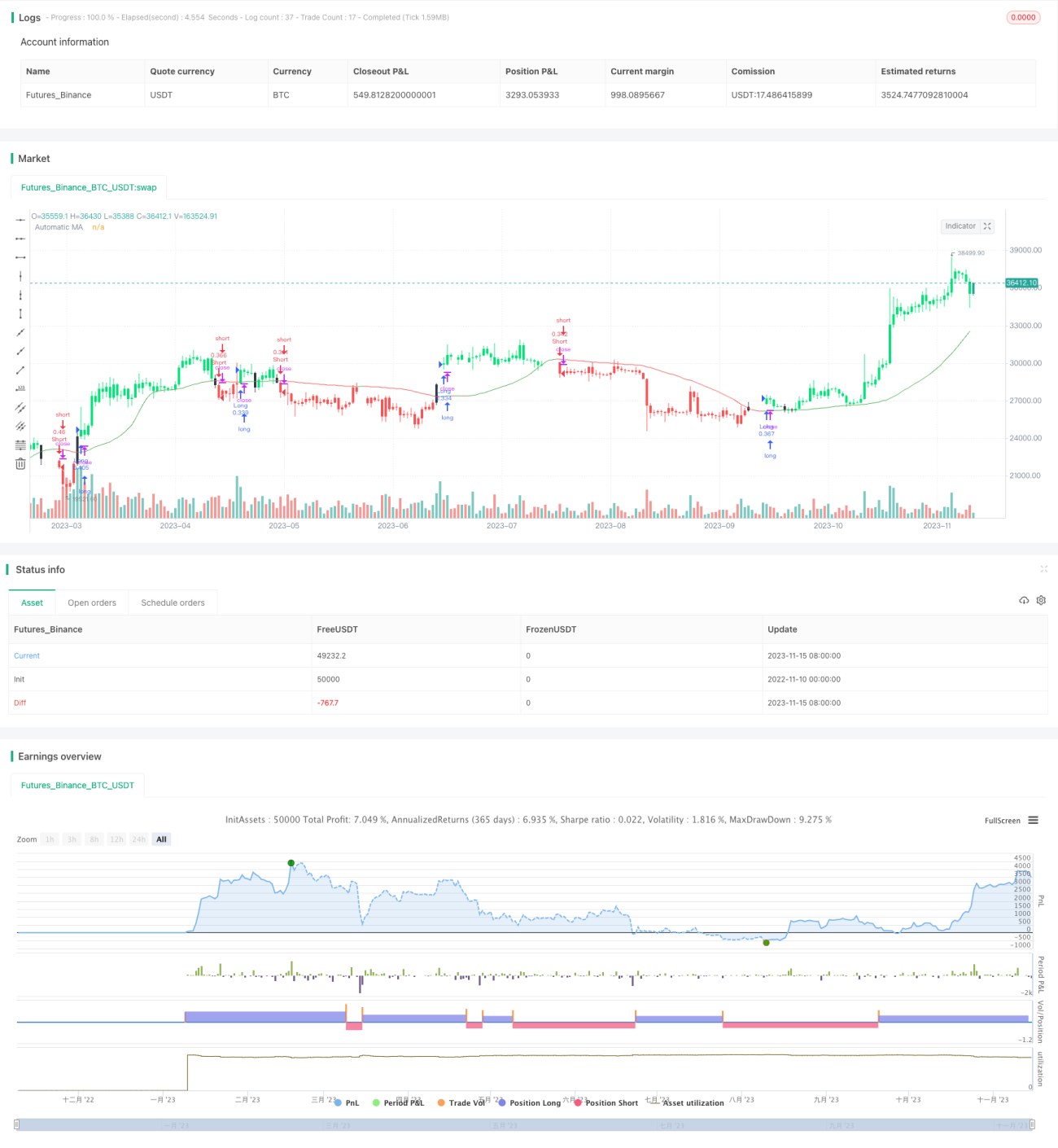
Diese Strategie basiert auf gleitenden Durchschnitten, kann Parameter automatisch anpassen und eignet sich für volatile Märkte in höheren Zeiträumen. Sie findet automatisch die optimale Parameterkombination und generiert Handelssignale, wenn der Preis den gleitenden Durchschnitt durchbricht.
Strategielogik
Die Strategie verwendet einen adaptiven gleitenden Durchschnitt als Handelssignal. Zuerst wird der einfache gleitende Durchschnitt (CMA) des angegebenen Zeitraums (Start) berechnet. Anschließend werden die Parameterkombinationen um den CMA herum getestet, um zu ermitteln, welche Kombination die wenigsten Berührungen durch Kerzenkörper und Dochte aufweist. Schließlich wird der CMA mit den wenigsten Berührungen als Signallinie verwendet.
Konkret testet die Strategie den CMA mit Periode plus 1 (CMA_P1) und minus 1 (CMA_M1) und zählt die Anzahl der Berührungen durch Körper und Dochte. Wenn der CMA weniger Berührungen aufweist als CMA_P1 und CMA_M1, wird die aktuelle Periode beibehalten; wenn CMA_P1 weniger Berührungen hat, wird die Periode um 1 erhöht; wenn CMA_M1 weniger Berührungen hat, wird die Periode um 1 verringert. So wird ein relativ glatter CMA als Signallinie gefunden.
Wenn der Preis den CMA von unten nach oben durchbricht, wird ein Kaufsignal generiert; wenn der Preis den CMA von oben nach unten durchbricht, wird ein Verkaufssignal generiert.
Vorteile
Diese adaptive Gleitende-Durchschnitts-Strategie bietet folgende Vorteile:
-
Automatische Optimierung der Parameter. Keine manuelle Auswahl der Periode des gleitenden Durchschnitts erforderlich; die Strategie testet verschiedene Perioden und findet die optimalen Parameter.
-
Reduzierung von Fehlsignalen. Im Vergleich zu einem festen gleitenden Durchschnitt filtert der adaptive gleitende Durchschnitt mehr Rauschen heraus und reduziert dadurch viele Fehlsignale.
-
Anpassung an Marktveränderungen. Wenn der Markt von einer Seitwärtsbewegung in einen Trend übergeht, verlängert sich die Periode des gleitenden Durchschnitts automatisch, um Signale zu generieren; wenn der Markt von einem Trend in eine Seitwärtsbewegung übergeht, verkürzt sich die Periode automatisch. Die Strategie passt sich dynamisch an Marktveränderungen an.
-
Vereinfachung des Handelssystems. Diese adaptive Methode vereinfacht das gesamte Handelssystem, da keine manuelle Parameteroptimierung erforderlich ist.
-
Hohe Erweiterbarkeit. Das Konzept kann auf andere Indikatoren übertragen werden, z. B. adaptive Bollinger-Bänder, adaptive KD-Strategien usw.
Risikoanalyse
Diese Strategie birgt auch einige Risiken:
-
Call-Options-Risiko. Bei einem Call-Options-Muster kann es vorkommen, dass der Kerzenkörper die gleitende Durchschnittslinie nicht durchbricht, was zu Fehlsignalen führt. Filterbedingungen sollten hinzugefügt werden, um dieses Risiko zu verringern.
-
Risiko fehlgeschlagener Ausbrüche. Ein Ausbruch aus dem gleitenden Durchschnitt setzt sich nicht immer fort; es kann zu fehlgeschlagenen Ausbrüchen kommen. Eine Ausbruchsvalidierung ist erforderlich, um eine hohe Erfolgsrate sicherzustellen.
-
Trendumkehrrisiko. Nach dem Eintritt in einen Trendmarkt muss eine Umkehr rechtzeitig erkannt und die Richtung gewechselt werden, sonst entstehen Verluste. Stop-Loss-Bedingungen können helfen, Verluste zu begrenzen.
-
Risiko der Parameteroptimierung. Die adaptiv angepassten Parameter können in ein lokales Optimum fallen, was zu einem offensichtlich redundanten gleitenden Durchschnitt führt. Modellbewertungsmethoden sollten eingeführt werden, um dies zu vermeiden.
-
Überoptimierungsrisiko. Die adaptive Parameteranpassung kann zu einer Überoptimierung führen, wodurch die Generalisierungsfähigkeit des Modells verloren geht. Eine langfristige Validierung in verschiedenen Marktumgebungen ist erforderlich, und man sollte sich nicht zu sehr auf Backtest-Ergebnisse verlassen.
Optimierungsmöglichkeiten
Diese adaptive Gleitende-Durchschnitts-Strategie kann in folgende Richtungen optimiert werden:
-
Einführung eines Trendausbruchs-Validierungsmechanismus, um Fehlausbrüche durch aufeinanderfolgende Ausbrüche zu filtern.
-
Hinzufügen einer Stop-Loss-Strategie, wenn der Preis wieder auf die andere Seite des gleitenden Durchschnitts zurückkehrt.
-
Einführung eines Call-Options-Filters, um in Call-Options-Märkten Fehlsignale zu vermeiden.
-
Nutzung von Bewertungskennzahlen (z. B. IC, LIC, SIC) zur Einschränkung der Parameteranpassung, um eine Überoptimierung zu verhindern.
-
Erweiterung auf andere Indikatoren, z. B. adaptive Golden-Cross-/Death-Cross-Strategien, adaptive Bollinger-Bänder usw.
-
Optimierung der Berechnungsmethode des gleitenden Durchschnitts durch Verwendung gewichteter gleitender Durchschnitte, exponentieller gleitender Durchschnitte usw.
Zusammenfassung
Diese Strategie passt die Periode des gleitenden Durchschnitts adaptiv an, um optimale Parameter zu finden und Handelssignale zu generieren. Im Vergleich zu festen Parametern kann sie viele Fehlsignale reduzieren und sich an Marktveränderungen anpassen. Dennoch sollten potenzielle Risiken beachtet werden. Die Strategie muss verifiziert und walk-forward-optimiert werden, um im Live-Handel stabile Gewinne zu erzielen.
-
Trendumkehrrisiko. Nach Eintreten in den Trend muss bei einer Trendumkehr rechtzeitig umgeschaltet werden, da es sonst zu Verlusten kommen kann. Es sollte ein Stop-Loss festgelegt werden, um Verluste zu begrenzen.
-
Risiko der Parameteroptimierung. Adaptiv angepasste Parameter können in eine lokale Optimierung fallen, was zu redundanten MA führt. Es müssen Modellbewertungsmethoden eingeführt werden, um dieses Problem zu vermeiden.
-
Überanpassungsrisiko. Übermäßige Parameteroptimierung kann zu Überanpassung führen und die Generalisierungsfähigkeit des Modells beeinträchtigen. Es ist eine verlängerte Validierung in verschiedenen Marktumgebungen erforderlich, nicht nur die Abhängigkeit von Backtest-Ergebnissen.
Verbesserungsrichtungen
Einige Richtungen zur Verbesserung dieser adaptiven MA-Strategie:
-
Hinzufügen einer Validierung von Trendausbrüchen mittels aufeinanderfolgender Ausbrüche, um falsche Ausbrüche herauszufiltern.
-
Erhöhung der Stop-Loss-Strategie, Stop-Loss setzen, wenn der Preis zur anderen Seite der MA zurückkehrt.
-
Hinzufügen eines Optionsfilters, um falsche Signale zu vermeiden, wenn eine Call-Option erscheint.
-
Einführung von Bewertungskennzahlen wie IC, LIC, SIC usw., um die Parameteroptimierung einzuschränken und Überanpassung zu verhindern.
-
Erweiterung auf andere Indikatoren wie eine adaptive Golden-Cross-Strategie, adaptive Bollinger-Bänder usw.
-
Optimierung der MA-Berechnung durch Verwendung von gewichteten MA, exponentiellen MA usw., um glattere MA zu erhalten.
Zusammenfassung
Diese Strategie generiert Handelssignale durch adaptive Anpassung der MA-Periode, um optimale Parameter zu finden. Im Vergleich zu festen Parametern kann sie viele falsche Signale reduzieren und sich an Marktveränderungen anpassen. Wir müssen jedoch auch auf potenzielle Risiken achten und vor dem Einsatz im Live-Handel eine Validierung und Walk-Forward-Optimierung durchführen, um stetige Gewinne zu erzielen.
- 1