Rainbow-Oszillator-Backtesting-Strategie

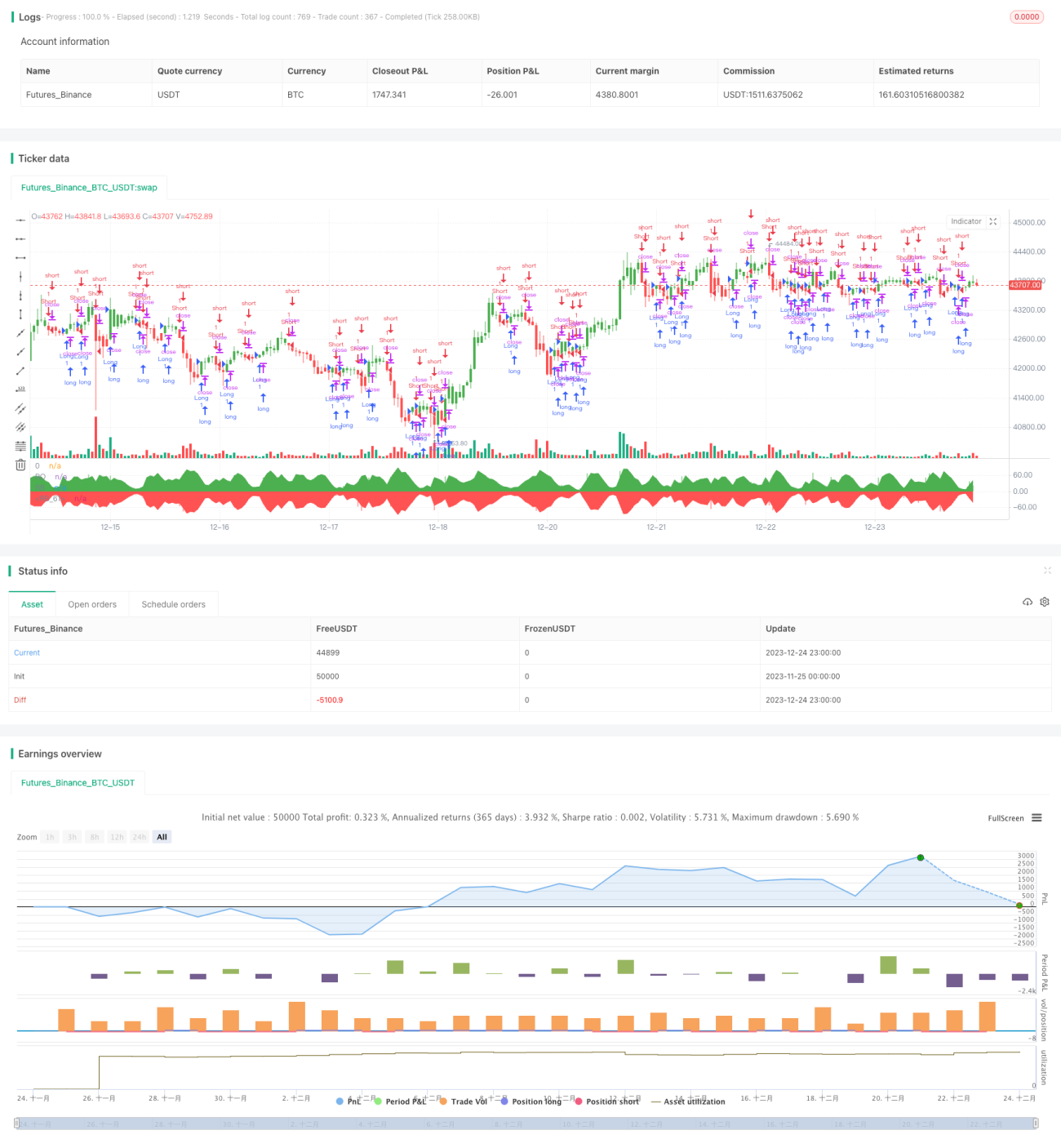
Überblick
Die Rainbow-Oszillator-Rückteststrategie ist eine quantitative Handelsstrategie, die auf dem Rainbow-Oszillator-Indikator basiert. Diese Strategie beurteilt die Richtung und Stärke des Markttrends, indem sie den Grad der Abweichung des Aktienkurses vom gleitenden Mittelwert berechnet, um Long- und Short-Positionen zu bestimmen.
Funktionsweise der Strategie
Der Kernindikator dieser Strategie ist der Rainbow-Oszillator (RO), dessen Berechnungsformel wie folgt lautet:
RO = 100 * ((Schlusskurs - 10-Tage-gleitender Mittelwert) / (Höchster Höchstkurs - Niedrigster Tiefstkurs))
Dabei handelt es sich bei dem 10-Tage-gleitenden Mittelwert um den einfachen gleitenden Mittelwert der Schlusskurse über 10 Perioden. Dieser Indikator spiegelt die Abweichung des Kurses von seinem eigenen gleitenden Mittelwert wider. Wenn RO > 0, bedeutet dies, dass der Kurs über dem gleitenden Mittelwert liegt, ein bullisches Signal; wenn RO < 0, liegt der Kurs unter dem gleitenden Mittelwert, ein bärisches Signal.
Die Strategie berechnet auch einen Hilfsindikator – die Bandbreite (RB), mit folgender Formel:
RB = 100 * ((Höchster Wert des gleitenden Mittelwerts - Niedrigster Wert des gleitenden Mittelwerts) / (Höchster Höchstkurs - Niedrigster Tiefstkurs))
RB spiegelt die Breite zwischen den gleitenden Mittelwerten wider. Je größer RB, desto stärker die Kursvolatilität, und umgekehrt. Der RB-Indikator kann zur Beurteilung der Marktstabilität verwendet werden.
Basierend auf den Werten von RO und RB beurteilt die Strategie den Grad der Kursabweichung und die Marktstabilität, um Long- und Short-Handelssignale zu generieren.
Vorteile der Strategie
Die Strategie bietet folgende Vorteile:
- Beurteilung basierend auf zwei Indikatoren, wodurch die Einschränkungen eines Einzelindikators vermieden werden.
- Gleichzeitige Beurteilung von Kursentwicklung und Marktstabilität.
- Einfache Berechnung, leicht verständlich und umsetzbar.
- Visualisierte Indikatoren erzeugen einen „Regenbogen“-Effekt, intuitiv und leicht lesbar.
Risiken der Strategie
Die Strategie birgt auch einige Risiken:
- Eine falsche Parametereinstellung für RO und RB kann zu fehlerhaften Handelssignalen führen.
- Doppelte gleitende Mittelwerte neigen zu Fehlsignalen und häufigem Handel.
- Eine ungeeignete Wahl des Rücktestzeitraums oder des Instruments beeinträchtigt die Strategieleistung.
- Transaktionskosten werden nicht berücksichtigt, was die Live-Ergebnisse verschlechtern kann.
Gegenmaßnahmen:
- Optimierung der Parameter von RO und RB.
- Hinzufügen von Filterbedingungen, um häufigen Handel zu vermeiden.
- Auswahl geeigneter Rücktestzeiträume und Instrumente.
- Berechnung und Berücksichtigung von Transaktionskosten.
Optimierung der Strategie
Die Strategie kann in folgenden Bereichen optimiert werden:
- Einführung einer Glättungsfunktion für den RO-Indikator, um starke Schwankungen zu vermeiden.
- Einbindung einer Stop-Loss-Strategie zur Begrenzung von Einzelverlusten.
- Kombination mit anderen Indikatoren für eine gemischte Handelssignalerzeugung, um die Gewinnwahrscheinlichkeit zu erhöhen.
- Einsatz von maschinellen Lernmodellen zur Vorhersage und Bewertung der Indikatorwirkung.
- Optimierung der Parameter für verschiedene Instrumente zur Verbesserung der Anpassungsfähigkeit.
Zusammenfassung
Die Rainbow-Oszillator-Rückteststrategie beurteilt den Markttrend und die Stabilität durch die Berechnung der Abweichung des Kurses vom gleitenden Mittelwert und führt auf dieser Grundlage Long- und Short-Trades durch. Die Strategie ist intuitiv und leicht lesbar, einfach umzusetzen und hat einen gewissen praktischen Wert. Es bestehen jedoch auch einige Risiken, die durch Optimierung der Parameter und Handelsregeln gemindert werden müssen, um die Live-Performance zu verbessern.
/*backtest
start: 2023-11-25 00:00:00
end: 2023-12-25 00:00:00
period: 1h
basePeriod: 15m
exchanges: [{"eid":"Futures_Binance","currency":"BTC_USDT"}]
*/

//@version=2
////////////////////////////////////////////////////////////
//  Copyright by HPotter v1.0 18/03/2018
// Ever since the people concluded that stock market price movements are not - 1