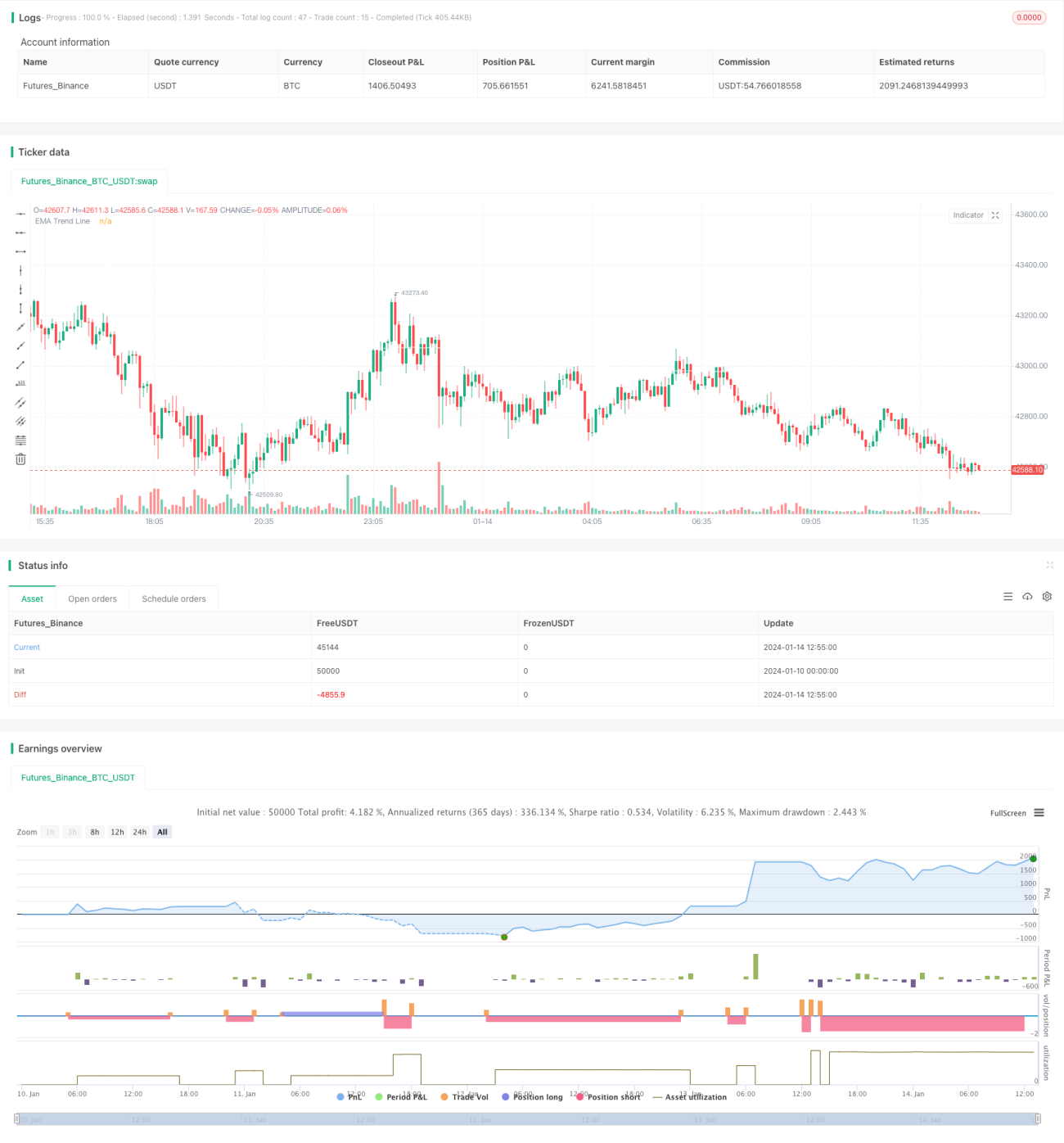
Die Strategie identifiziert die Preisentwicklung durch die Kombination von Doppel-EMA- und RSI-Indikatoren und tritt bei einer Trendwende in die richtige Richtung ein. Insbesondere verwendet die Strategie die EMA mit längeren Perioden, um die Richtung der großen Tendenz zu bestimmen, während die RSI-Indikatoren verwendet werden, um die kurzfristigen Überkauf-Überverkauf zu bestimmen. Wenn der Preis in der Richtung des Haupttrends zurückgeht, wird ein Handelssignal über den RSI-Indikator ausgesendet, um nach der Richtung der Tendenz zu handeln.
Die EMA mit 200-Perioden wird verwendet, um die Richtung des großen Trends zu bestimmen. Ein Überschreiten der EMA-Linie ist ein bullish Signal, ein Unterschreiten der EMA-Linie ist ein bearish Signal.
Der RSI-Indikator ist auf 10 Perioden eingestellt. Ein Überschreiten des RSI-Wertes von 40 ist ein Überverkaufssignal, ein Überschreiten des RSI-Wertes von 60 ein Überkaufssignal.
Wenn der große Trend nach oben ist (der Preis ist höher als die EMA-Linie), sollten Sie einen Überverkauf signalisieren, wenn der RSI unter 40 liegt.
Wenn ein Überkaufsignal von 60 auf dem RSI-Indikator auftritt, wird ein Shorting eingeleitet, wenn der Haupttrend nach unten ist (der Preis ist unterhalb der EMA-Linie).
Die Stop-Loss-Einstellung ist viermal so hoch wie die ATR-Einstellung. Die Stop-Loss-Einstellung ist zweimal so hoch wie die Stop-Loss-Einstellung, um ein Risiko-Rendite-Verhältnis von 2:1 zu erzielen.
Der größte Vorteil dieser Strategie besteht darin, dass die Kombination von Trend- und Umkehrindikatoren zur zeitnahen Eintritt in den Trend zurückzieht und somit eine bessere Leistung erzielt wird. Die konkreten Vorteile sind:
Mit dem Dual EMA-System können Sie die wichtigsten Trends erkennen und die Preisentwicklung effizient verfolgen.
Der RSI kann kurzfristige Überkäufe und Überverkäufe identifizieren und hilft dabei, zu bestimmen, wann man in den Markt eintritt.
Der Stop-Loss wird über den ATR-Indikator festgelegt, der die Stop-Loss-Marge an die Volatilität des Marktes anpasst, was zur Risikokontrolle dient.
Die strikte Einhaltung der Prinzipien des Trendhandels kann unnötige Transaktionen reduzieren und systematische Risiken verringern.
Diese Strategie birgt folgende Risiken:
Wenn die Trendschwankungen nachlassen, kann es zu falschen Handelssignalen kommen.
In extremen Situationen kann der Stop, den der ATR-Indikator festgelegt hat, zu groß oder zu klein sein und erfordert eine dynamische Anpassung. Es kann auch erwogen werden, ihn durch andere Stop-Methoden zu ersetzen.
Die Frequenz des Handelssignals ist möglicherweise höher, und es ist wichtig zu beachten, ob die Frequenz der Handelssignals den eigenen Präferenzen entspricht.
Es ist darauf zu achten, ob die RSI-Parameter richtig eingestellt sind, und die Parameter sollten gegebenenfalls optimiert werden.
Die wichtigsten Optimierungsmöglichkeiten für diese Strategie sind:
Andere Trendindikatoren, wie z. B. MACD, können getestet werden, um die Richtung des Trends zu bestimmen.
Es ist möglich, andere Reversal-Indikatoren, wie KDJ, Bollinger Bands und andere, in Kombination mit dem RSI zu testen, um bessere Handelssignale zu finden.
Es können maschinelle Lernalgorithmen eingeführt werden, um dynamische Stop-Loss- und Stop-Stopp-Parameter durch adaptive Anpassung von Parametern zu ermöglichen.
Es ist möglich, mehrere Faktoren zu beurteilen, wie z.B. Emotionsindikatoren, Nachrichtenseite, um die Gesamtstabilität des Systems zu verbessern.
Die Strategie ist eine typische Kurzstrecken-Strategie, die Trendverfolgung und Umkehrung von Indikatoren kombiniert. Durch die Verwendung von doppelten EMAs, um den großen Trend zu beurteilen, und die Pullback-Gelegenheiten des RSI-Indikators, um den Trend zu erfassen. Die Strategie kombiniert die Vorzüge verschiedener Indikatoren und bietet eine gute Ergänzung.
/*backtest
start: 2024-01-10 00:00:00
end: 2024-01-14 13:00:00
period: 5m
basePeriod: 1m
exchanges: [{"eid":"Futures_Binance","currency":"BTC_USDT"}]
*/
// This source code is subject to the terms of the Mozilla Public License 2.0 at https://mozilla.org/MPL/2.0/
// © kevinmck100
// @description
// This strategy is intended to be used as a base template for building new strategies.
//
// It incorporates the following features:
//
// - Risk management: Configurable X% loss per stop loss
// Configurable R:R ratio
//
// - Trade entry: Calculated position size based on risk tolerance
//
// - Trade exit: Stop Loss currently configurable ATR multiplier but can be replaced based on strategy
// Take Profit calculated from Stop Loss using R:R ratio
//
// - Backtesting: Configurable backtesting range by date
//
// - Trade drawings: TP/SL boxes drawn for all trades. Can be turned on and off
// Trade exit information labels. Can be turned on and off
// NOTE: Trade drawings will only be applicable when using overlay strategies
//
// - Debugging: Includes section with useful debugging techniques
//
// Strategy conditions:
//
// - Trade entry: LONG: C1: Price is above EMA line
// C2: RSI is crossing out of oversold area
// SHORT: C1: Price is below EMA line
// C2: RSI is crossing out of overbought area
//
// - Trade exit: Stop Loss: Stop Loss ATR multiplier is hit
// Take Profit: R:R multiplier * Stop Loss is hit
//
// The idea is to use RSI to catch pullbacks within the main trend. Note that
// this strategy is intended to be a simple base strategy for building upon.
// It was not designed to be traded in its current form.
//@version=5
INITIAL_CAPITAL = 1000
DEFAULT_COMMISSION = 0.02
MAX_DRAWINGS = 500
IS_OVERLAY = true
strategy("Risk Management Strategy Template", "Strategy Template", overlay = IS_OVERLAY, initial_capital = INITIAL_CAPITAL, currency = currency.NONE, max_labels_count = MAX_DRAWINGS, max_boxes_count = MAX_DRAWINGS, max_lines_count = MAX_DRAWINGS, default_qty_type = strategy.cash, commission_type = strategy.commission.percent, commission_value = DEFAULT_COMMISSION)
// =============================================================================
// INPUTS
// =============================================================================
// ------------------------ Replacable section - Start -------------------------
// ------------------
// Indicator Settings
// ------------------
emaLength = input.int (200, "EMA Length ", group = "Indicators: Settings", inline = "IS1", minval = 1, tooltip = "EMA line to identify trend direction. Above EMA trend line is bullish. Below EMA trend line is bearish")
rsiLength = input.int (10, "RSI Length ", group = "Indicators: Settings", inline = "IS2", minval = 1)
// ----------------------
// Trade Entry Conditions
// ----------------------
rsiOverbought = input.int (60, "RSI Overbought ", group = "Strategy: Conditions", inline = "SC1", minval = 50, maxval = 100, tooltip = "RSI overbought level used to identify pullbacks within the main trend. RSI crossing BELOW this level triggers a SHORT when in a DOWN trend")
rsiOversold = input.int (40, "RSI Oversold ", group = "Strategy: Conditions", inline = "SC2", minval = 0, maxval = 50, tooltip = "RSI overbought level used to identify pullbacks within the main trend. RSI crossing ABOVE this level triggers a LONG when in an UP trend")
// ---------------------
// Trade Exit Conditions
// ---------------------
atrLength = input.int (14, "Stop Loss ATR Length ", group = "Strategy: Exit Conditions", inline = "EC1", minval = 0, tooltip = "Length of ATR used to calculate Stop Loss.")
slAtrMultiplier = input.float(4, "Stop Loss ATR Multiplier ", group = "Strategy: Exit Conditions", inline = "EC2", minval = 0, step = 0.1, tooltip = "Size of StopLoss is determined by multiplication of ATR value. Take Profit is derived from this also by multiplying the StopLoss value by the Risk:Reward multiplier.")
// ------------------------- Replacable section - End --------------------------
// ---------------
// Risk Management
// ---------------
riskReward = input.float(2, "Risk : Reward 1 :", group = "Strategy: Risk Management", inline = "RM1", minval = 0, step = 0.1, tooltip = "Previous high or low (long/short dependant) is used to determine TP level. 'Risk : Reward' ratio is then used to calculate SL based of previous high/low level.\n\nIn short, the higher the R:R ratio, the smaller the SL since TP target is fixed by previous high/low price data.")
accountRiskPercent = input.float(1, "Portfolio Risk % ", group = "Strategy: Risk Management", inline = "RM1", minval = 0, step = 0.1, tooltip = "Percentage of portfolio you lose if trade hits SL.\n\nYou then stand to gain\n Portfolio Risk % * Risk : Reward\nif trade hits TP.")
// ----------
// Date Range
// ----------
startYear = input.int (2022, "Start Date ", group = 'Strategy: Date Range', inline = 'DR1', minval = 1900, maxval = 2100)
startMonth = input.int (1, "", group = 'Strategy: Date Range', inline = 'DR1', options = [1, 2, 3, 4, 5, 6, 7, 8, 9, 10, 11, 12])
startDate = input.int (1, "", group = 'Strategy: Date Range', inline = 'DR1', options = [1, 2, 3, 4, 5, 6, 7, 8, 9, 10, 11, 12, 13, 14, 15, 16, 17, 18, 19, 20, 21, 22, 23, 24, 25, 26, 27, 28, 29, 30, 31])
endYear = input.int (2100, "End Date ", group = 'Strategy: Date Range', inline = 'DR2', minval = 1900, maxval = 2100)
endMonth = input.int (1, "", group = 'Strategy: Date Range', inline = 'DR2', options = [1, 2, 3, 4, 5, 6, 7, 8, 9, 10, 11, 12])
endDate = input.int (1, "", group = 'Strategy: Date Range', inline = 'DR2', options = [1, 2, 3, 4, 5, 6, 7, 8, 9, 10, 11, 12, 13, 14, 15, 16, 17, 18, 19, 20, 21, 22, 23, 24, 25, 26, 27, 28, 29, 30, 31])
// ----------------
// Drawing Settings
// ----------------
showTpSlBoxes = input.bool(false, "Show TP / SL Boxes", group = "Strategy: Drawings", inline = "D1", tooltip = "Show or hide TP and SL position boxes.\n\nNote: TradingView limits the maximum number of boxes that can be displayed to 500 so they may not appear for all price data under test.")
showLabels = input.bool(false, "Show Trade Exit Labels", group = "Strategy: Drawings", inline = "D2", tooltip = "Useful labels to identify Profit/Loss and cumulative portfolio capital after each trade closes.\n\nAlso note that TradingView limits the max number of 'boxes' that can be displayed on a chart (max 500). This means when you lookback far enough on the chart you will not see the TP/SL boxes. However you can check this option to identify where trades exited.")
// =============================================================================
// INDICATORS
// =============================================================================
// ------------------------ Replacable section - Start -------------------------
// ---
// EMA
// ---
ema = ta.ema(close, emaLength)
plot(ema, "EMA Trend Line", color.white)
// ---
// RSI
// ---
rsi = ta.rsi(close, rsiLength)
// ------------------------- Replacable section - End --------------------------
// =============================================================================
// STRATEGY LOGIC
// =============================================================================
// ---------
// FUNCTIONS
// ---------
percentAsPoints(pcnt) =>
math.round(pcnt / 100 * close / syminfo.mintick)
calcStopLossPrice(pointsOffset, isLong) =>
priceOffset = pointsOffset * syminfo.mintick
if isLong
close - priceOffset
else
close + priceOffset
calcProfitTrgtPrice(pointsOffset, isLong) =>
calcStopLossPrice(-pointsOffset, isLong)
printLabel(barIndex, msg) => label.new(barIndex, close, msg)
printTpSlHitBox(left, right, slHit, tpHit, entryPrice, slPrice, tpPrice) =>
if showTpSlBoxes
box.new (left = left, top = entryPrice, right = right, bottom = slPrice, bgcolor = slHit ? color.new(color.red, 60) : color.new(color.gray, 90), border_width = 0)
box.new (left = left, top = entryPrice, right = right, bottom = tpPrice, bgcolor = tpHit ? color.new(color.green, 60) : color.new(color.gray, 90), border_width = 0)
line.new(x1 = left, y1 = entryPrice, x2 = right, y2 = entryPrice, color = color.new(color.yellow, 20))
line.new(x1 = left, y1 = slPrice, x2 = right, y2 = slPrice, color = color.new(color.red, 20))
line.new(x1 = left, y1 = tpPrice, x2 = right, y2 = tpPrice, color = color.new(color.green, 20))
printTpSlNotHitBox(left, right, entryPrice, slPrice, tpPrice) =>
if showTpSlBoxes
box.new (left = left, top = entryPrice, right = right, bottom = slPrice, bgcolor = color.new(color.gray, 90), border_width = 0)
box.new (left = left, top = entryPrice, right = right, bottom = tpPrice, bgcolor = color.new(color.gray, 90), border_width = 0)
line.new(x1 = left, y1 = entryPrice, x2 = right, y2 = entryPrice, color = color.new(color.yellow, 20))
line.new(x1 = left, y1 = slPrice, x2 = right, y2 = slPrice, color = color.new(color.red, 20))
line.new(x1 = left, y1 = tpPrice, x2 = right, y2 = tpPrice, color = color.new(color.green, 20))
printTradeExitLabel(x, y, posSize, entryPrice, pnl) =>
if showLabels
labelStr = "Position Size: " + str.tostring(math.abs(posSize), "#.##") + "\nPNL: " + str.tostring(pnl, "#.##") + "\nCapital: " + str.tostring(strategy.equity, "#.##") + "\nEntry Price: " + str.tostring(entryPrice, "#.##")
label.new(x = x, y = y, text = labelStr, color = pnl > 0 ? color.new(color.green, 60) : color.new(color.red, 60), textcolor = color.white, style = label.style_label_down)
// ----------
// CONDITIONS
// ----------
inDateRange = time >= timestamp(syminfo.timezone, startYear, startMonth, startDate, 0, 0) and time < timestamp(syminfo.timezone, endYear, endMonth, endDate, 0, 0)
// ------------------------ Replacable section - Start -------------------------
// Condition 1: Price above EMA indicates bullish trend, price below EMA indicates bearish trend
bullEma = close > ema
bearEma = close < ema
// Condition 2: RSI crossing back from overbought/oversold indicates pullback within trend
bullRsi = ta.crossover (rsi, rsiOversold)
bearRsi = ta.crossunder (rsi, rsiOverbought)
// Combine all entry conditions
goLong = inDateRange and bullEma and bullRsi
goShort = inDateRange and bearEma and bearRsi
// ------------------------- Replacable section - End --------------------------
// Trade entry and exit variables
var tradeEntryBar = bar_index
var profitPoints = 0.
var lossPoints = 0.
var slPrice = 0.
var tpPrice = 0.
var inLong = false
var inShort = false
// Entry decisions
openLong = (goLong and not inLong)
openShort = (goShort and not inShort)
flippingSides = (goLong and inShort) or (goShort and inLong)
enteringTrade = openLong or openShort
inTrade = inLong or inShort
// ------------------------ Replacable section - Start -------------------------
// Exit calculations
atr = ta.atr(atrLength)
slAmount = atr * slAtrMultiplier
slPercent = math.abs((1 - (close - slAmount) / close) * 100)
tpPercent = slPercent * riskReward
// ------------------------- Replacable section - End --------------------------
// Risk calculations
riskAmt = strategy.equity * accountRiskPercent / 100
entryQty = math.abs(riskAmt / slPercent * 100) / close
if openLong
if strategy.position_size < 0
printTpSlNotHitBox(tradeEntryBar + 1, bar_index + 1, strategy.position_avg_price, slPrice, tpPrice)
printTradeExitLabel(bar_index + 1, math.max(tpPrice, slPrice), strategy.position_size, strategy.position_avg_price, strategy.openprofit)
strategy.entry("Long", strategy.long, qty = entryQty, alert_message = "Long Entry")
enteringTrade := true
inLong := true
inShort := false
if openShort
if strategy.position_size > 0
printTpSlNotHitBox(tradeEntryBar + 1, bar_index + 1, strategy.position_avg_price, slPrice, tpPrice)
printTradeExitLabel(bar_index + 1, math.max(tpPrice, slPrice), strategy.position_size, strategy.position_avg_price, strategy.openprofit)
strategy.entry("Short", strategy.short, qty = entryQty, alert_message = "Short Entry")
enteringTrade := true
inShort := true
inLong := false
if enteringTrade
profitPoints := percentAsPoints(tpPercent)
lossPoints := percentAsPoints(slPercent)
slPrice := calcStopLossPrice(lossPoints, openLong)
tpPrice := calcProfitTrgtPrice(profitPoints, openLong)
tradeEntryBar := bar_index
strategy.exit("TP/SL", profit = profitPoints, loss = lossPoints, comment_profit = "TP Hit", comment_loss = "SL Hit", alert_profit = "TP Hit Alert", alert_loss = "SL Hit Alert")
// =============================================================================
// DRAWINGS
// =============================================================================
// -----------
// TP/SL Boxes
// -----------
slHit = (inShort and high >= slPrice) or (inLong and low <= slPrice)
tpHit = (inLong and high >= tpPrice) or (inShort and low <= tpPrice)
exitTriggered = slHit or tpHit
entryPrice = strategy.closedtrades.entry_price (strategy.closedtrades - 1)
pnl = strategy.closedtrades.profit (strategy.closedtrades - 1)
posSize = strategy.closedtrades.size (strategy.closedtrades - 1)
// Print boxes for trades closed at profit or loss
if (inTrade and exitTriggered)
inShort := false
inLong := false
printTpSlHitBox(tradeEntryBar + 1, bar_index, slHit, tpHit, entryPrice, slPrice, tpPrice)
printTradeExitLabel(bar_index, math.max(tpPrice, slPrice), posSize, entryPrice, pnl)
// Print TP/SL box for current open trade
if barstate.islastconfirmedhistory and strategy.position_size != 0
printTpSlNotHitBox(tradeEntryBar + 1, bar_index + 1, strategy.position_avg_price, slPrice, tpPrice)
// =============================================================================
// DEBUGGING
// =============================================================================
// Data window plots
plotchar(slPrice, "Stop Loss Price", "")
plotchar(tpPrice, "Take Profit Price", "")
// Label plots
plotDebugLabels = false
if plotDebugLabels
if bar_index == tradeEntryBar
printLabel(bar_index, "Position size: " + str.tostring(entryQty * close, "#.##"))