Multi-Indikatoren-Entscheidungsbaumstrategie: IMACD, EMA und Ichimoku-Wolke

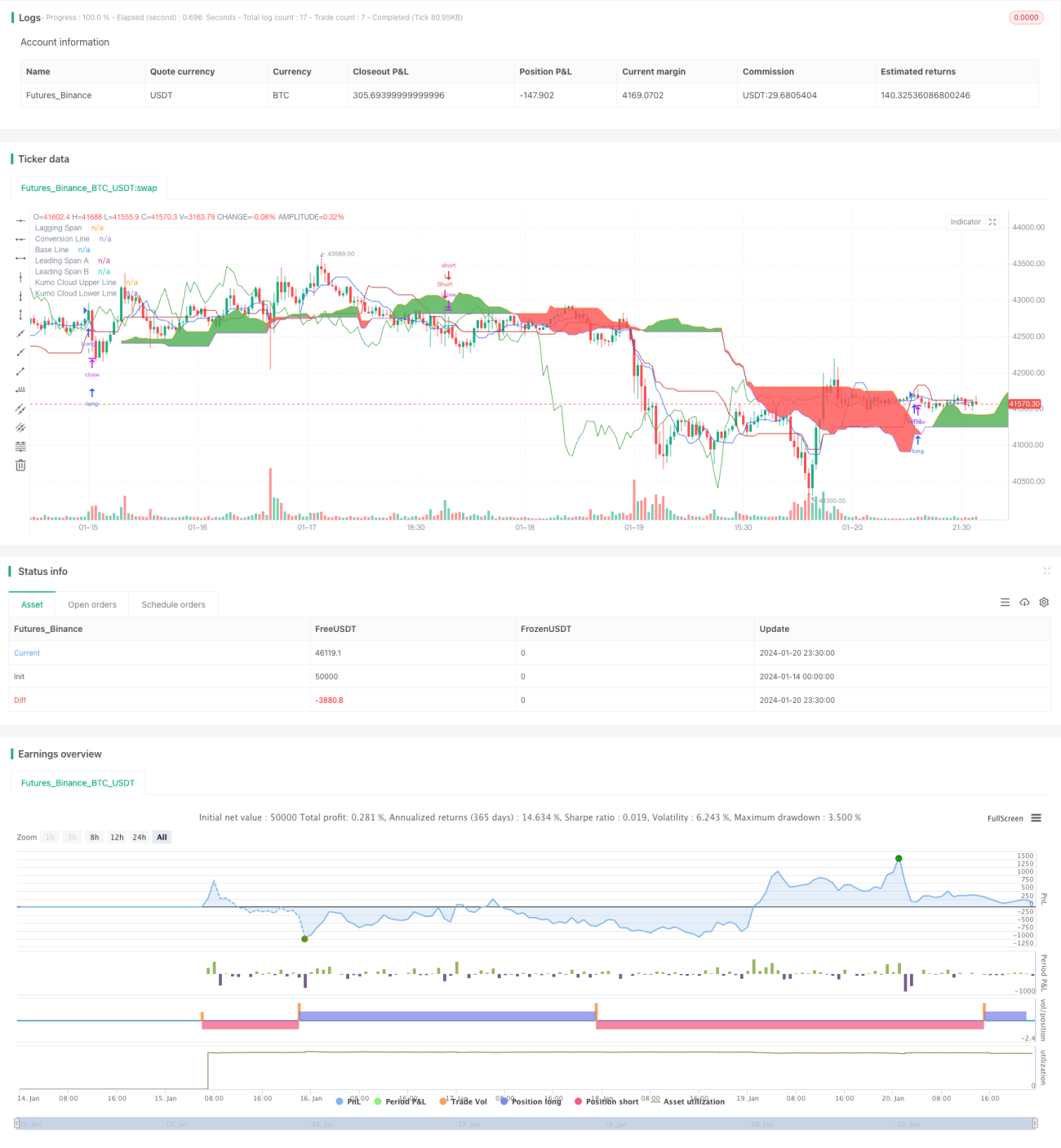
Überblick
Diese Strategie kombiniert mehrere technische Indikatoren wie IMACD, EMA und Ichimoku-Kinko-Hyo, um ein umfassendes Entscheidungsbaummodell für die Generierung von Kauf- und Verkaufssignalen zu erstellen.
Strategieprinzip
- IMACD: Ein verbesserter MACD, der durch ImpulseMACD und ImpulseHisto Markttrends besser erfasst.
- Ichimoku-Kinko-Hyo: Zeichnet Tenkan-sen, Kijun-sen, Senkou Span A, Senkou Span B usw., um Unterstützungs- und Widerstandsniveaus zu erkennen.
- EMA 40: Hilft bei der Bestimmung der Trendrichtung.
- Basierend auf den spezifischen Beziehungen zwischen IMACD, Wolkenkomponenten und EMA 40 werden Long- und Short-Signale ausgegeben.
Long-Signal: Wenn der IMACD eine bestimmte Farbe aufweist und der EMA 40 über der oberen Begrenzung der Wolke liegt, wird eine Long-Position eröffnet.
Short-Signal: Wenn der IMACD rot ist und der EMA 40 unter der unteren Begrenzung der Wolke liegt, wird eine Short-Position eröffnet.
Vorteilsanalyse
- Kombination mehrerer Indikatoren ermöglicht eine umfassende Beurteilung des Markttrends und erhöht die Entscheidungsgenauigkeit.
- Das Entscheidungsbaummodell bietet klare Klassifizierungen und eindeutige Handelssignale.
- Die EMA-Länge ist anpassbar, was eine höhere Flexibilität bei der Trendbeurteilung bietet.
- Durch die Kombination von Wolken- und Trendindikatoren werden Unterstützungs- und Widerstandsniveaus besser identifiziert.
Risikoanalyse
- Die Kombination mehrerer Indikatoren führt zu einer komplexen Parametereinstellung.
- Eine falsche Einstellung der EMA-Länge kann zu falschen Handelssignalen führen.
- Die gleichzeitige Überwachung mehrerer Indikatoren erhöht den operativen Aufwand.
Risikominderung: Optimierung der Parametereinstellungen, Anpassung der EMA-Länge, Vereinfachung des Ablaufs.
Optimierungsansätze
- Optimierung der Parametereinstellungen zur Erhöhung der Strategiestabilität.
- Integration einer Stop-Loss-Strategie zur Begrenzung von Einzelverlusten.
- Backtesting auf Basis großer Datenmengen zur Verbesserung der Signalqualität.
- Kombination mit maschinellen Lernalgorithmen zur Erstellung eines adaptiven Entscheidungsbaums.
Zusammenfassung
Diese Strategie kombiniert mehrere Indikatoren zur Trendidentifikation und erzeugt über ein Entscheidungsbaummodell Handelssignale. Die Vorteile liegen in der hohen Signalqualität und Treffsicherheit, was eine schrittweise Optimierung ermöglicht. Besondere Aufmerksamkeit sollte der Parameteroptimierung und der Stop-Loss-Strategie gelten, um Handelsrisiken zu kontrollieren und langfristig stabile Renditen zu erzielen.
- 1