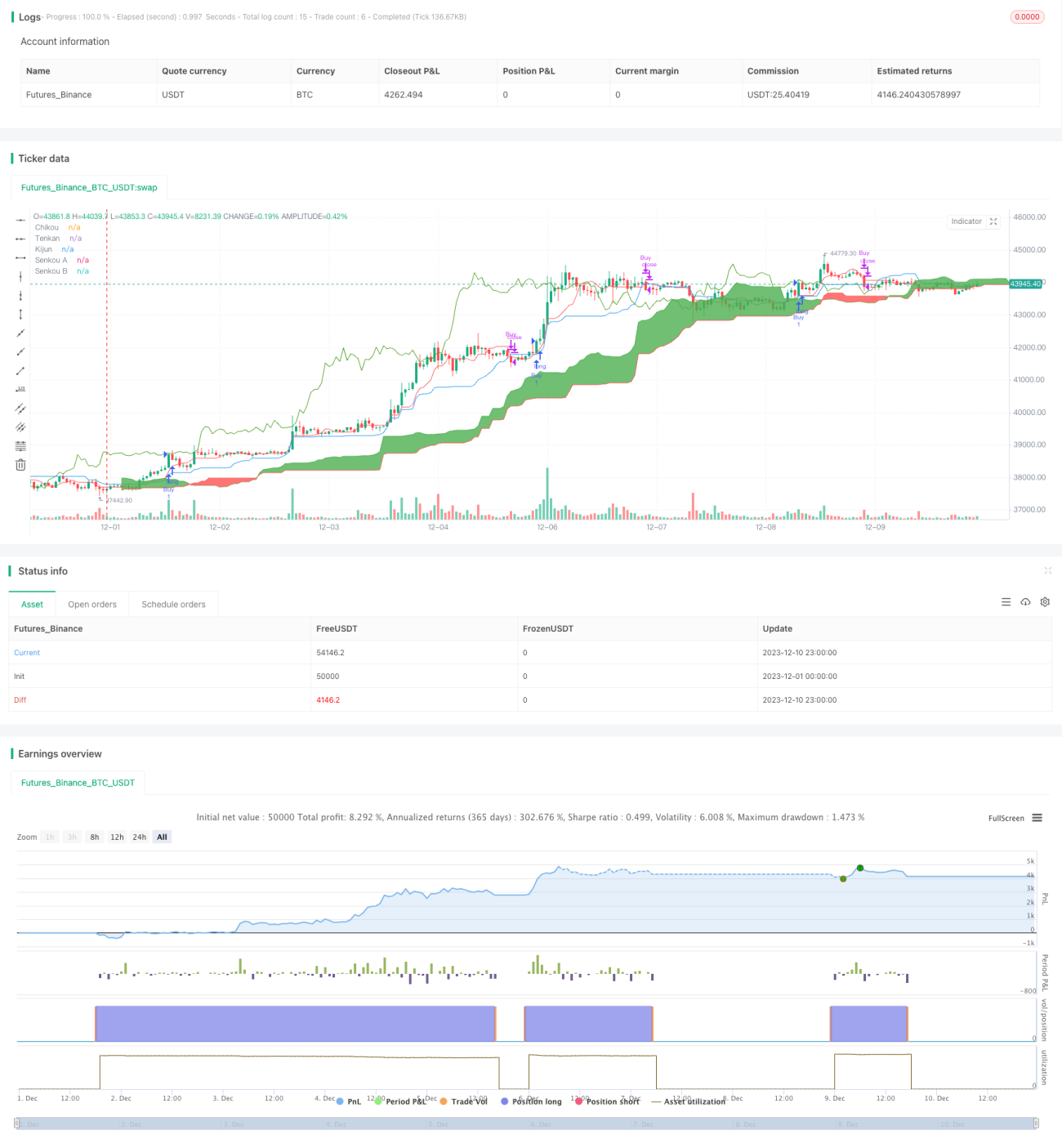
Die Strategie verwendet die Technik der Gleichgewichtstabelle und des Durchschnitts-Directional-Index (ADX) in Kombination, um Trends und wichtige Resistenzpunkte in den Aktienpreisen zu identifizieren und Kauf- und Verkaufssignale zu senden. Die Strategie zielt darauf ab, große Preisschwankungen in trendigen Situationen zu erfassen.
Die erste Gleichgewichtstabelle enthält drei Moving Averages, die vorherige Umrechnungslinie, die Referenzlinie und die Verzögerungslinie. Wenn der Preis die vorherige Umrechnungslinie und die Referenzlinie überschreitet, wird ein Kaufsignal ausgegeben; wenn der Preis die beiden Linien unterhalb durchschreitet, wird ein Verkaufsignal ausgegeben. Darüber hinaus identifiziert die erste Gleichgewichtstabelle die wichtigen Unterstützungs- und Widerstandsbereiche über die Cloud-Diagramme.
Die ADX wird verwendet, um die Stärke der Preisentwicklung zu bestimmen. Wenn + DI und -DI deutlich voneinander getrennt sind, zeigt dies eine Trendentwicklung an. Wenn + DI und -DI nahe sind, zeigt dies eine Ausgleichsentwicklung.
Durch die Kombination von Trendbeurteilungen aus der Gleichgewichtstabelle und der Filterung der Trendstärke durch die ADX können Trendsegmente mit hoher Preisschwankung effektiv identifiziert werden.
Die Strategie ermöglicht eine effektive Erfassung von Trendbewegungen durch eine effektive Kombination von Gleichgewichtstabellen und ADX. Auf der Grundlage weiterer Parameter- und Regeloptimierungen kann die Strategie bessere Rückkopplungen und reale Performance erzielen. Die Strategie ist für Strategieinvestoren geeignet, die Trendaktien handeln.
/*backtest
start: 2023-12-01 00:00:00
end: 2023-12-10 23:59:59
period: 1h
basePeriod: 15m
exchanges: [{"eid":"Futures_Binance","currency":"BTC_USDT"}]
*/
//@version=4
strategy(title="Ichimoku + ADX", shorttitle="Ichimoku & ADX Backtest", overlay=true)
//------------------------------
//------------------------------
// ICHIMOKU
//------------------------------
//------------------------------
conversionPeriods = input(9, minval=1, title="Conversion Line Periods"),
basePeriods = input(26, minval=1, title="Base Line Periods")
laggingSpan2Periods = input(52, minval=1, title="Lagging Span 2 Periods"),
displacement = input(26, minval=1, title="Displacement")
donchian(len) => avg(lowest(len), highest(len))
Tenkan = donchian(conversionPeriods)
Kijun = donchian(basePeriods)
SSA = avg(Tenkan, Kijun)
SSB = donchian(laggingSpan2Periods)
SSAdisp = SSA[displacement]
SSBdisp = SSB[displacement]
// Plot Ichimoku
// --------------------
plot(Tenkan, color=color.red, title="Tenkan")
plot(Kijun, color=color.blue, title="Kijun")
plot(close, offset = -displacement + 1, color=#459915, title="Chikou")
p1 = plot(SSA, offset = displacement - 1, color=color.green,
title="Senkou A")
p2 = plot(SSB, offset = displacement - 1, color=color.red,
title="Senkou B")
fill(p1, p2, color = SSA > SSB ? color.green : color.red)
//------------------------------
//------------------------------
// ADX
//------------------------------
//------------------------------
adxlen = input(14, title="ADX Smoothing")
dilen = input(14, title="DI Length")
keyLevel = input(23, title="key level for ADX")
dirmov(len) =>
up = change(high)
down = -change(low)
truerange = rma(tr, len)
plus = fixnan(100 * rma(up > down and up > 0 ? up : 0, len) / truerange)
minus = fixnan(100 * rma(down > up and down > 0 ? down : 0, len) / truerange)
[plus, minus]
adx(dilen, adxlen) =>
[plus, minus] = dirmov(dilen)
sum = plus + minus
adx = 100 * rma(abs(plus - minus) / (sum == 0 ? 1 : sum), adxlen)
[adx, plus, minus]
[sig, up, down] = adx(dilen, adxlen)
// Plot ADX
// --------------------
//plot(sig, color=color.black, title="ADX")
//plot(up, color=color.green, title="+DI",linewidth=2, style=plot.style_columns, transp=40)
//plot(down, color=color.red, title="-DI",linewidth=2, style=plot.style_columns, transp=40)
//plot(keyLevel, color=color.white, title="Key Level")
//------------------------------
//------------------------------
// STRATEGY
//------------------------------
//------------------------------
// Buy & Sell Signals
// --------------------
// ADX
ABuy1 = up > keyLevel and up - down >5 and sig > down and sig < keyLevel * 2
ASell1 = down > keyLevel and down - up >5 and sig > up and sig < keyLevel * 2
// ICHIMOKU
Bull = close >= max(SSAdisp, SSBdisp)
Bear = close <= min(SSAdisp, SSBdisp)
// 1. Bull
Buy1 = (close >= max(SSAdisp, SSBdisp)) ? 1 : 0
Buy2 = (Tenkan - Kijun >= 0.001) ? 1 : 0
Buy3 = SSA > SSB ? 1 : 0
Buy4 = sig > 20 ? 1 : 0
Buy4a = close - close[displacement] >=0.001 ? 1:0
Buy5 = Buy1 and Buy2 and Buy3 and Buy4 and Buy4a and not(Buy1[1] and Buy2[1] and Buy3[1])
// 1. Bear
Sell1 = (close <= min(SSAdisp, SSBdisp)) ? 1 : 0
Sell2 = (Kijun - Tenkan >= 0.001) ? 1 : 0
Sell3 = SSA < SSB ? 1 : 0
Sell4 = sig > 20 ? 1 : 0
Sell4a = close <= close[displacement]
Sell5 = Sell1 and Sell2 and Sell3 and Sell4 and Sell4a and not(Sell1[1] and Sell2[1] and Sell3[1])
// CONSOLIDATED
buysignal = Buy5
buyexitsignal = crossunder(close,Kijun)
sellsignal = Sell5
sellexitsignal = crossover(close,Kijun)
longCondition = buysignal
shortCondition = sellsignal
// Plot Indicators
// --------------------
// ----- Buy & Sell
//plotshape(longCondition, title = "Buy Signal", text ="BUY", textcolor =#FFFFFF , style=shape.labelup, size = size.tiny, location=location.belowbar, color = #1B8112, transp = 0)
//plotshape(shortCondition, title = "Short Signal", text ="SHORT", textcolor =#FFFFFF , style=shape.labeldown, size = size.tiny, location=location.abovebar, color = #000000, transp = 0)
// ----- Ichimoku Signals
//plotshape(Sell2, title = "Sell Signal", text ="Kumo Twist", textcolor =#FFFFFF , style=shape.labelup, size = size.tiny, location=location.top, color = color.black, transp = 0)
//plotshape(Sell3, title = "Sell Signal", text ="TK/KJ", textcolor =#FFFFFF , style=shape.labelup, size = size.tiny, location=location.bottom, color = color.black, transp = 0)
//plotshape(Buy4, title = "Buy Signal", text ="Kumo Twist", textcolor =#FFFFFF , style=shape.diamond, size = size.tiny, location=location.belowbar, color = color.blue, transp = 0)
//plotshape(Buy3, title = "Buy Signal", text ="TK/KJ", textcolor =#FFFFFF , style=shape.circle, size = size.tiny, location=location.abovebar, color = color.green, transp = 0)
//plotshape(Buy4, title = "Buy Signal", text ="TK/KJ", textcolor =#FFFFFF , style=shape.circle, size = size.tiny, location=location.belowbar, color = color.red, transp = 0)
//plotshape(buyexitsignal, title = "Buy Exit", style=shape.triangledown, size = size.tiny, location=location.abovebar, color = color.green, transp = 0)
//plotshape(sellexitsignal, title = "Buy Exit", style=shape.triangleup, size = size.tiny, location=location.belowbar, color = color.black, transp = 0)
//------------------------------
//------------------------------
// EXECUTION
//------------------------------
//------------------------------
// Test Range
// --------------------
// === INPUT BACKTEST RANGE ===
FromMonth = input(defval = 2, title = "From Month", minval = 1, maxval = 12)
FromDay = input(defval = 1, title = "From Day", minval = 1, maxval = 31)
FromYear = input(defval = 2015, title = "From Year", minval = 2017)
ToMonth = input(defval = 1, title = "To Month", minval = 1, maxval = 12)
ToDay = input(defval = 1, title = "To Day", minval = 1, maxval = 31)
ToYear = input(defval = 9999, title = "To Year", minval = 2017)
// === FUNCTION EXAMPLE ===
start = timestamp(FromYear, FromMonth, FromDay, 00, 00) // backtest start window
finish = timestamp(ToYear, ToMonth, ToDay, 23, 59) // backtest finish window
window() => true // create function "within window of time"
// Orders
// --------------------
if longCondition
strategy.entry("Buy", strategy.long, when=window())
if buyexitsignal
strategy.close("Buy")
if shortCondition
strategy.entry("Sell", strategy.short, when=window())
if sellexitsignal
strategy.close("Sell")