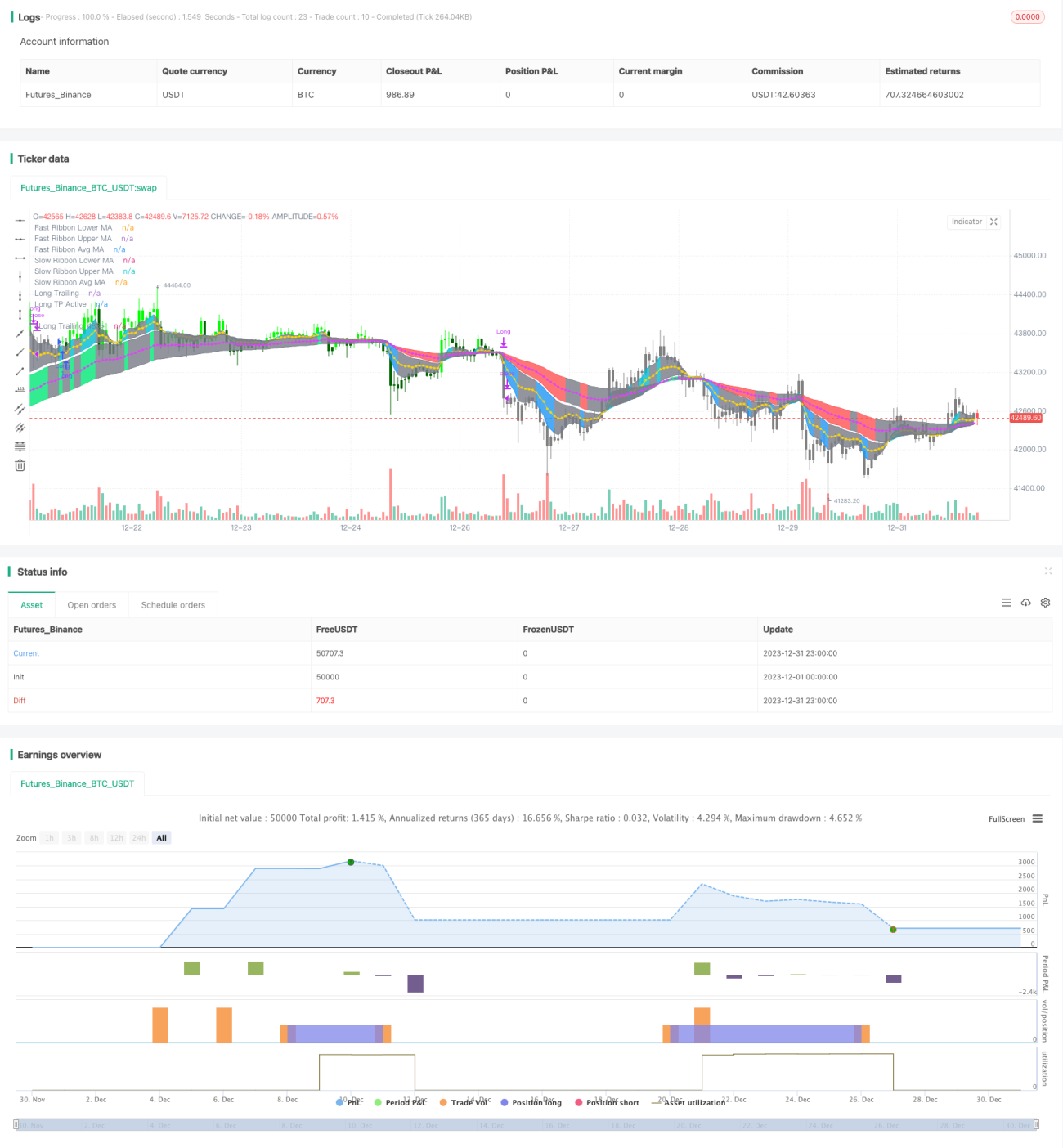
Strategie der Theorie des doppelten gleitenden Durchschnitts


Erstellungsdatum: 2024-01-30 17:13:10 zuletzt geändert: 2024-01-30 17:13:10
Kopie: 1 Klicks: 849
1
konzentrieren Sie sich auf
1617
Anhänger

Strategie der Theorie des doppelten gleitenden Durchschnitts

Überblick

Die Doppel-Gleichgewichtsmeinungsstrategie ist eine Trendverfolgungsstrategie. Sie erstellt eine Schnell- und eine Langleitergruppe durch Berechnung zweier Gruppen von Moving Averages und beurteilt die Richtung der Tendenz in Verbindung mit der Beziehung zwischen dem Preis und der Durchschnittliche Linie.

Die Strategie kombiniert die Richtung der schnellen und langsamen Linie, die Anzahl der Candle, die den Preis durchbrechen, um die Ein- und Ausstiegszeiten zu bestimmen.

Strategieprinzip

Die Doppel-Gleichgewichtsmeinungs-Strategie definiert kurzfristige und langfristige Trends durch die Berechnung von zwei Gruppen von Moving Averages.

  1. Die Schnell-Mittelliniengruppe, die Schnell-Ab-Mittellinien und Schnell-Auf-Mittellinien umfasst, um kurzfristige Trends darzustellen;
  2. Die langsam-mittlere Gruppe, die langsam absteigende und langsam steigende Mittellinien umfasst, stellt die langfristige Tendenz dar.

Die Strategie beurteilt die Rationalität von kurz- und langfristigen Trends sowie die spezifischen Ein- und Ausstiegszeiten anhand der Preisbeziehungen zwischen schnellen und langsamen Durchschnittslinien.

ZulassungsvoraussetzungenWie folgt:

  • Die Schnellbahnlinie ist bei einem Aufbruch der langsamen Schnellbahnlinie 2 K-Linien oder mehr als ein Mehrkopf-Eintritt.
  • Die Schnell-Abfahrtslinie wird mit 2 K-Linien oder mehr nach unten durchbrochen.

SpielbedingungenWie folgt:

  • Während der Mehrheitsposition spielt man unter der schnellen Durchschnittslinie als Mehrheitsspitze.
  • Während der Haltestelle mit leeren Händen spielt man auf der schnellen Mittellinie mit leeren Händen.

Darüber hinaus bietet die Strategie Stop Loss, Stop Loss und Stop Loss Tracking-Funktionen zur Risikokontrolle.

Analyse der Stärken

Die wichtigsten Vorteile einer Strategie der Gleichberechtigung sind:

  1. Durch die doppelte Gleichheitsbeurteilung kann der Marktlärm effektiv gefiltert und die Richtung der Trends festgehalten werden.
  2. In Kombination mit der schnellen Durchschnittslinie und der Preisbeziehung ist die Zuverlässigkeit des Signals höher.
  3. Die Strategie ist einfach, klar und verständlich und ist für den Einsatz in Quantifizierungsgeschäften geeignet.
  4. Risikokontrollmechanismen wie eingebaute Stopps, Stop Losses und Tracking Stop Losses können das Handelsrisiko effektiv kontrollieren.

Risikoanalyse

Eine Strategie der doppelten Gleichheit der Meinungen birgt auch Risiken, die sich in folgenden Punkten widerspiegeln:

  1. In einem Zustand von Erschütterung kann ein falsches Signal erzeugt werden, was zu unnötigen Transaktionen führt.
  2. Das System reagiert langsam auf unvorhergesehene Ereignisse (z. B. die Veröffentlichung von wichtigen Gewinn-/Gewinnmeldungen) und kann zu größeren Verlusten führen.
  3. Der Tracking-Stopp kann unter bestimmten Umständen durchbrochen werden, wodurch die Verluste vergrößert werden.

Um die oben genannten Risiken zu kontrollieren, können Verbesserungen durch Optimierung der Moving Average-Parameter oder Filterung in Kombination mit anderen Indikatoren vorgenommen werden.

Optimierungsrichtung

Die Strategie der doppelten Gleichheit der Meinungen kann in folgenden Dimensionen optimiert werden:

  1. Optimierung der Moving Average-Parameter und Anpassung der Durchschnittszyklus an unterschiedliche Zyklusbedingungen.
  2. Hinzufügen von anderen Indikatoren Filter, bilden eine Kombination von mehreren Indikatoren Strategie, erhöhen die Genauigkeit der Signale.
  3. Optimierung der Stop-Loss- und Stop-Stop-Einstellungen, Einstellung der Rücknahme-Temperature und Steuerung des Maximalverlusts.
    1. Einführung von Machine-Learning-Modellen, die Trends vorhersagen und die Eintrittstiming unterstützen.

Zusammenfassen

Die Doppel-Einheitlichkeitsstrategie ist insgesamt eine sehr praktische Trendverfolgungsstrategie. Die Urteilsregeln sind einfach, die Logik klar, die Risiken werden durch ein Doppel-Einheitlichkeitssystem kontrolliert, die Theorie ist solide. Der nächste Schritt kann in vielen Bereichen wie Parameteroptimierung, Risikokontrolle und anderen Bereichen verbessert werden, um die Ertragsfähigkeit und Stabilität der Strategie weiter zu verbessern.

Strategiequellcode
/*backtest
start: 2023-12-01 00:00:00
end: 2023-12-31 23:59:59
period: 1h
basePeriod: 15m
exchanges: [{"eid":"Futures_Binance","currency":"BTC_USDT"}]
*/

//@version=3

strategy(title="[Autoview][BackTest]Dual MA Ribbons R0.12 by JustUncleL", shorttitle="[BT]DualRibbons R0.12", overlay=true )

//study(title="[Autoview][Alerts]Dual MA Ribbons R0.12 by JustUncleL", shorttitle="[AL]DualRibbons R0.12", overlay=true)

//
//  Author:   JustUncleL
//  Revision: R0.12 Beta
//  Date:     30-Apr-2018
//
//  Description:
//  ============
//  This is an implementaion of a strategy based on two MA Ribbonn, a Fast Ribbon
//  and a Slow Ribbon.
//  The strategy revolves around a pair of scripts: One to generate alerts signals for
//  Autoview and one for Backtesting, to tune your settings.
//  The risk management options are performed within the script to set SL(StopLoss),
//  TP(TargetProfit), TSL(Trailing Stop Loss) and TTP (Trailing Target Profit).
//  The only requirement for Autoview is to Buy and Sell as directed by this script,
//  no complicated syntax is required.
//
//  The Dual Ribbons are designed to capture the inferred behaviour of traders and 
//  investors by using two groups of averages:
//  > Traders MA Ribbon: 
//    Lower MA and Upper MA  (Aqua=Uptrend, Blue=downtrend, Gray=Neutral), with
//    centre line Avg MA (Orange dotted line).
//  > Investors MAs Ribbon: 
//    Lower MA and Upper MA  (Green=Uptrend, Red=downtrend, Gray=Neutral), with
//    centre line Avg MA (Fuchsia dotted line).
//  > Anchor time frame (0=current). This is the time frame that the MAs are
//    calculated for. This way 60m MA Ribbons can be viewed on a 15 min chart to establish
//    tighter Stop Loss conditions. 
//
//   Trade Management options:
//   -------------------------
//   - Option to specify Backtest start and end time.
//   - Trailing Stop, with Activate Level (as % of price) and Trailing Stop (as % of price)
//   - Target Profit Level, (as % of price)
//   - Stop Loss Level, (as % of price)
//   - BUY green triandles and SELL dark red triangles
//   - Trade Order closed colour coded Label:
//       > Dark Red = Stop Loss Hit
//       > Green  = Target Profit Hit
//       > Purple = Trailing Stop Hit
//       > Orange = Opposite (Sell) Order Close
//
//   Trade Management Indication:
//   ----------------------------
//   - Trailing Stop Activate Price = Blue dotted line
//   - Trailing Stop Price =  Fuschia solid stepping line
//   - Target Profit Price = Lime '+' line
//   - Stop Loss Price = Red '+' line
//
//   Dealing With Renko Charts:
//   --------------------------
//   - If you choose to use Renko charts, make sure you have enabled the "IS This a RENKO Chart"
//     option, (I have not so far found a way to Detect the type of chart that is running).
//   - If you want non-repainting Renko charts you MUST use TRADITIONAL Renko Bricks. This
//     type of brick is fixed and will not change size.
//   - Also use Renko bricks with WICKS DISABLED. Wicks are not part of Renko, the whole
//     idea of using Renko bricks is not to see the wick noise.
//   - Set you chart Time Frame to the lowest possible one that will build enough bricks
//     to give a reasonable history, start at 1min TimeFrame. Renko bricks are not dependent
//     on time, they represent a movement in price. But the chart candlestick data is used
//     to create the bricks, so lower TF gives more accurate Brick creation.
//   - You want to size your bricks to 2/1000 of the pair price, so for ETHBTC the price is say 0.0805
//     then your Renko Brick size should be about 2*0.0805/1000 = 0.0002 (round up).
//   - You may find there is some slippage in value, but this can be accounted for in the Backtes
//     by setting your commission a bit higher, for Binance for example I use 0.2
//
//  References:
//  ===========
//  - MA Ribbon R#.# by JustUncleL
//  - "How to automate this strategy for free using a chrome extension" by CryptoRox
//
//  Revisions:
//  ==========
//  R0.12   - Beta 2 Version
//
//
//
// -----------------------------------------------------------------------------
// Copyright 2018 JustUncleL
//
// This program is free software: you can redistribute it and/or modify
// it under the terms of the GNU General Public License as published by
// the Free Software Foundation, either version 3 of the License, or
// any later version.
//
// This program is distributed in the hope that it will be useful,
// but WITHOUT ANY WARRANTY; without even the implied warranty of
// MERCHANTABILITY or FITNESS FOR A PARTICULAR PURPOSE.  See the
// GNU General Public License for more details.
// 
// The GNU General Public License can be found here
// <http://www.gnu.org/licenses/>.
//
// -----------------------------------------------------------------------------
//


//
// Use Alternate Anchor TF for MAs 
uRenko    = input(true, title="IS This a RENKO Chart")
//
anchor     = input(0,minval=0,maxval=1440,title="Alternate TimeFrame Multiplier (0=none)")
//
src          = close //input(close, title="EMA Source")
showRibbons  = input(true,title="Show Coloured MA Ribbons")
showAvgs     = input(true,title="Show Ribbon Median MA Lines")

//
// Fast Ribbon MAs
// Lower MA - type, length
typeF1    = input(defval="EMA", title="FAST MA Ribbon Type: ", options=["SMA", "EMA", "WMA", "VWMA", "SMMA", "DEMA", "TEMA", "LAGMA", "HullMA", "ZEMA", "TMA", "SSMA"])
lenF1     = input(defval=5, title="FAST Ribbon Lower MA Length", minval=1)
gammaF1   = 0.33 //input(defval=0.33,title="Fast MA - Gamma for LAGMA")

// Upper MA - type, length
typeF11   = typeF1 //input(defval="WMA", title="FAST Ribbon Upper MA Type: ", options=["SMA", "EMA", "WMA", "VWMA", "SMMA", "DEMA", "TEMA", "LAGMA", "HullMA", "ZEMA", "TMA", "SSMA"])
lenF11    = input(defval=25, title="FAST Ribbon Upper Length", minval=2)
gammaF11  = 0.77 //input(defval=0.77,title="Slow MA - Gamma for LAGMA")

// Slow Ribbon MAs
// Lower MA - type, length
typeS1   = input(defval="EMA", title="SLOW MA Ribbon Type: ", options=["SMA", "EMA", "WMA", "VWMA", "SMMA", "DEMA", "TEMA", "LAGMA", "HullMA", "ZEMA", "TMA", "SSMA"])
lenS1    = input(defval=28, title="SLOW Ribbon Lower MA Length", minval=1)
gammaS1  = 0.33 //input(defval=0.33,title="Fast MA - Gamma for LAGMA")

// Upper MA - type, length
typeS16   = typeS1 //input(defval="WMA", title="SLOW Ribbon Upper MA Type: ", options=["SMA", "EMA", "WMA", "VWMA", "SMMA", "DEMA", "TEMA", "LAGMA", "HullMA", "ZEMA", "TMA", "SSMA"])
lenS16    = input(defval=72, title="SLOW Ribbon Upper Length", minval=2)
gammaS16  = 0.77 //input(defval=0.77,title="Slow MA - Gamma for LAGMA")

// - Constants
gold = #FFD700

// - FUNCTIONS

// - variant(type, src, len, gamma)
// Returns MA input selection variant, default to SMA if blank or typo.

// SuperSmoother filter
// © 2013  John F. Ehlers
variant_supersmoother(src,len) =>
    a1 = exp(-1.414*3.14159 / len)
    b1 = 2*a1*cos(1.414*3.14159 / len)
    c2 = b1
    c3 = (-a1)*a1
    c1 = 1 - c2 - c3
    v9 = 0.0
    v9 := c1*(src + nz(src[1])) / 2 + c2*nz(v9[1]) + c3*nz(v9[2])
    v9
    
variant_smoothed(src,len) =>
    v5 = 0.0
    v5 := na(v5[1]) ? sma(src, len) : (v5[1] * (len - 1) + src) / len
    v5

variant_zerolagema(src,len) =>
    ema1 = ema(src, len)
    ema2 = ema(ema1, len)
    v10 = ema1+(ema1-ema2)
    v10
    
variant_doubleema(src,len) =>
    v2 = ema(src, len)
    v6 = 2 * v2 - ema(v2, len)
    v6

variant_tripleema(src,len) =>
    v2 = ema(src, len)
    v7 = 3 * (v2 - ema(v2, len)) + ema(ema(v2, len), len)               // Triple Exponential
    v7
    
//calc Laguerre
variant_lag(p,g) =>
    L0 = 0.0
    L1 = 0.0
    L2 = 0.0
    L3 = 0.0
    L0 := (1 - g)*p+g*nz(L0[1])
    L1 := -g*L0+nz(L0[1])+g*nz(L1[1])
    L2 := -g*L1+nz(L1[1])+g*nz(L2[1])
    L3 := -g*L2+nz(L2[1])+g*nz(L3[1])
    f = (L0 + 2*L1 + 2*L2 + L3)/6
    f

// return variant, defaults to SMA 
variant(type, src, len, g) =>
    type=="EMA"     ? ema(src,len) : 
      type=="WMA"   ? wma(src,len): 
      type=="VWMA"  ? vwma(src,len) : 
      type=="SMMA"  ? variant_smoothed(src,len) : 
      type=="DEMA"  ? variant_doubleema(src,len): 
      type=="TEMA"  ? variant_tripleema(src,len): 
      type=="LAGMA" ? variant_lag(src,g) :
      type=="HullMA"? wma(2 * wma(src, len / 2) - wma(src, len), round(sqrt(len))) :
      type=="SSMA"  ? variant_supersmoother(src,len) : 
      type=="ZEMA"  ? variant_zerolagema(src,len) : 
      type=="TMA"   ? sma(sma(src,len),len) : 
                      sma(src,len)

// - /variant 

// If have anchor specified, calculate the base multiplier.
//mult  = isintraday ? anchor==0 or interval<=0 or interval>=anchor or anchor>1440? 1 : round(anchor/interval) : 1
//mult := isdwm?  1 : mult  // Only available Daily or less
mult = anchor>0 ? anchor : 1 

//
high_  = uRenko? max(close,open) : high
low_   = uRenko? min(close,open) : low


//adjust MA lengths with Anchor Multiplier

//Fast MA Ribbon
emaF1 = variant(typeF1, src, lenF1*mult, gammaF1)
emaF11 = variant(typeF11, src, lenF11*mult,gammaF11)
emafast = (emaF1+emaF11)/2 // Average of Upper and Lower MAs
//
//Slow MA Ribbon
emaS1 = variant(typeS1,src, lenS1*mult,gammaS1)
emaS16 = variant(typeS16, src, lenS16*mult, gammaS16)
emaslow = (emaS1+emaS16)/2 // Average of Upper and Lower MAs
//
// Count crossover candles
xup = 0
xdn = 0
fup = 0
fdn = 0
sup = 0
sdn = 0
// 
xup := (emafast-emaslow)>0 and (emafast-emaslow)>(emafast[1]-emaslow[1]) ? nz(xup[1])+1 : 0
xdn := (emafast-emaslow)<0 and (emafast-emaslow)<(emafast[1]-emaslow[1]) ? nz(xdn[1])+1 : 0
fup := (emaF1-emaF11)>0 and (emaF1-emaF11)>(emaF1[1]-emaF11[1]) ? nz(fup[1])+1 : 0
fdn := (emaF1-emaF11)<0 and (emaF1-emaF11)<(emaF1[1]-emaF11[1]) ? nz(fdn[1])+1 : 0
sup := (emaS1-emaS16)>0 and (emaS1-emaS16)>(emaS1[1]-emaS16[1]) ? nz(sup[1])+1 : 0
sdn := (emaS1-emaS16)<0 and (emaS1-emaS16)<(emaS1[1]-emaS16[1]) ? nz(sdn[1])+1 : 0

//Fast EMA Final Color Rules
colFinal = fup>=2 ? aqua : fdn>=2 ? blue : gray
//Slow EMA Final Color Rules
colFinal2 = sup>=2 ? lime : sdn>=2 ? red : gray

//Fast EMA Plots
p1=plot(showRibbons?emaF1:na, title="Fast Ribbon Lower MA", style=line, linewidth=1, color=colFinal,transp=10)
p2=plot(showRibbons?emaF11:na, title="Fast Ribbon Upper MA", style=line, linewidth=1, color=colFinal,transp=10)
plot(showAvgs?emafast:na, title="Fast Ribbon Avg MA", style=circles,join=true, linewidth=1, color=gold,transp=10)

//
fill(p1,p2,color=colFinal, transp=90)

//Slow EMA Plots
p3=plot(showRibbons?emaS1:na, title="Slow Ribbon Lower MA", style=line, linewidth=1, color=colFinal2,transp=10)
p4=plot(showRibbons?emaS16:na, title="Slow Ribbon Upper MA", style=line, linewidth=1, color=colFinal2,transp=10)
plot(showAvgs?emaslow:na, title="Slow Ribbon Avg MA", style=circles,join=true, linewidth=1, color=fuchsia,transp=10)
//
fill(p3,p4, color=colFinal2, transp=90)

// Generate Buy Sell signals, 
buy = 0
sell=0
//
buy  := xup>=2 and sup>=2 and fup>=2 ? nz(buy[1])>0?buy[1]+1:1 : 0
sell := xdn>=2 and sdn>=2 and fdn>=2 ? nz(sell[1])>0?sell[1]+1 :1 : 0
//

//////////////////////////////////////////////////
//* Put Entry and special Exit conditions here *//
//////////////////////////////////////////////////
//////////////////////////////////////////////////////////////////////////////////////////
//*** This Trade Management Section of code is a modified version of that found in   ***//
//*** "How to automate this strategy for free using a chrome extension" by CryptoRox ***//
//*** Modifications made by JustUncleL.                                              ***// 
//////////////////////////////////////////////////////////////////////////////////////////
//


///////////////////////////////////////////////
//* Backtesting Period Selector | Component *//
///////////////////////////////////////////////

//* https://www.tradingview.com/script/eCC1cvxQ-Backtesting-Period-Selector-Component *//
//* https://www.tradingview.com/u/pbergden/ *//
//* Modifications made by JustUncleL*//

testStartYear = input(2018, "Backtest Start Year",minval=1980)
testStartMonth = input(1, "Backtest Start Month",minval=1,maxval=12)
testStartDay = input(1, "Backtest Start Day",minval=1,maxval=31)
testPeriodStart = timestamp(testStartYear,testStartMonth,testStartDay,0,0)

testStopYear = 9999 //input(9999, "Backtest Stop Year",minval=1980)
testStopMonth = 12 // input(12, "Backtest Stop Month",minval=1,maxval=12)
testStopDay = 31 //input(31, "Backtest Stop Day",minval=1,maxval=31)
testPeriodStop = timestamp(testStopYear,testStopMonth,testStopDay,0,0)

testPeriod() => true

///////////////////////////////////////////////
//* Place Entry and Special Exit Logic here *//
///////////////////////////////////////////////

AQUA = #00FFFFFF
BLUE = #0000FFFF
RED  = #FF0000FF
LIME = #00FF00FF
GRAY = #808080FF
DARKRED   = #8B0000FF
DARKGREEN = #006400FF

// Keep current state until opposite signal detected.
bsState = 0, bsState := nz(bsState[1])
bsState := buy==1 and bsState<=0? 1 : 
           sell==1 and bsState>=0? -1 : 
           bsState

//Entry Conditions, when state changes direction.
longLogic  = change(bsState) and bsState==1  and (barstate.isconfirmed or barstate.ishistory) 
shortLogic = change(bsState) and bsState==-1  and (barstate.isconfirmed or barstate.ishistory) 

// Exit on Sell signal
longExitC = 0
shortExitC = 0
longExitC   := (emafast<emaslow and close<emaslow)
                  and (barstate.isconfirmed or barstate.ishistory) ? nz(longExitC[1])+1 : 0
shortExitC  := (emafast>emaslow and close>emaslow)
                  and (barstate.isconfirmed or barstate.ishistory) ? nz(shortExitC[1])+1 : 0

// Exit condition for no SL.
longExit = change(longExitC) and longExitC==1
shortExit = change(shortExitC) and shortExitC==1


//////////////////////////
//* Strategy Component *//
//////////////////////////

fastExit  = input(false,title="Use Opposite Trade as a Close Signal")
clrBars   = input(true,title="Colour Candles to Trade Order state")

orderType = input("LongsOnly",title="What type of Orders", options=["Longs+Shorts","LongsOnly","ShortsOnly","Flip"])

//
isLong   = (orderType != "ShortsOnly")
isShort  = (orderType != "LongsOnly")
//
long = longLogic
short = shortLogic

if orderType=="Flip"
    long := shortLogic
    short := longLogic


////////////////////////////////
//======[ Signal Count ]======//
////////////////////////////////

sectionLongs = 0
sectionLongs := nz(sectionLongs[1])
sectionShorts = 0
sectionShorts := nz(sectionShorts[1])

if long and isLong
    sectionLongs := sectionLongs + 1
    sectionShorts := 0

if short and isShort
    sectionLongs := 0
    sectionShorts := sectionShorts + 1

longCondition  = (long and isLong)
shortCondition = (short and isShort)

////////////////////////////////
//======[ Entry Prices ]======//
////////////////////////////////

last_open_longCondition = na
last_open_shortCondition = na
last_open_longCondition := longCondition ? close : nz(last_open_longCondition[1])
last_open_shortCondition := shortCondition ? close : nz(last_open_shortCondition[1])

///////////////////////////////////////////////
//======[ Position Check (long/short) ]======//
///////////////////////////////////////////////

last_longCondition = na
last_shortCondition = na
last_longCondition  := longCondition ? time : nz(last_longCondition[1])
last_shortCondition := shortCondition ? time : nz(last_shortCondition[1])

in_longCondition  = last_longCondition > last_shortCondition
in_shortCondition = last_shortCondition > last_longCondition

/////////////////////////////////
//======[ Trailing Stop ]======//
/////////////////////////////////

isTS = input(true, "Trailing Stop")
ts = input(3.0, "Trailing Stop (%)", minval=0,step=0.1, type=float) /100

last_high = na
last_low = na
last_high_short = na
last_low_long = na
last_high := not in_longCondition ? na : in_longCondition and (na(last_high[1]) or high_ > nz(last_high[1])) ? high_ : nz(last_high[1])
last_high_short := not in_shortCondition ? na : in_shortCondition and (na(last_high[1]) or high_ > nz(last_high[1])) ? high_ : nz(last_high[1])
last_low := not in_shortCondition ? na : in_shortCondition and (na(last_low[1]) or low_ < nz(last_low[1])) ? low_ : nz(last_low[1])
last_low_long := not in_longCondition ? na : in_longCondition and (na(last_low[1]) or low_ < nz(last_low[1])) ? low_ : nz(last_low[1])

long_ts = isTS and not na(last_high) and (low_ <= last_high - last_high * ts) //and (last_high >= last_open_longCondition + last_open_longCondition * tsi)
short_ts = isTS and not na(last_low) and (high_ >= last_low + last_low * ts) //and (last_low <= last_open_shortCondition - last_open_shortCondition * tsi)


///////////////////////////////
//======[ Take Profit ]======//
///////////////////////////////

isTP = input(true, "Take Profit")
tp = input(3.0, "Take Profit (%)",minval=0,step=0.1,type=float) / 100
ttp = input(1.0, "Trailing Profit (%)",minval=0,step=0.1,type=float) / 100
ttp := ttp>tp ? tp : ttp

long_tp = isTP and (last_high >= last_open_longCondition + last_open_longCondition * tp)   and (low_ <= last_high - last_high * ttp)
short_tp = isTP and (last_low <= last_open_shortCondition - last_open_shortCondition * tp) and (high_ >= last_low + last_low * ttp)

/////////////////////////////
//======[ Stop Loss ]======//
/////////////////////////////

isSL = input(false, "Stop Loss")
sl = input(3.0, "Stop Loss (%)", minval=0,step=0.1, type=float) / 100
long_sl = isSL and (low_ <= last_open_longCondition - last_open_longCondition * sl)
short_sl = isSL and (high_ >= last_open_shortCondition + last_open_shortCondition * sl)

////////////////////////////////////
//======[ Stop on Opposite ]======//
////////////////////////////////////

//NOTE Short exit signal is non-repainting, no need to force it, if Pyramiding keep going
long_sos = (fastExit or (not isTS and not isSL)) and longExit
short_sos = (fastExit or (not isTS and not isSL)) and shortExit

/////////////////////////////////
//======[ Close Signals ]======//
/////////////////////////////////

// Create a single close for all the different closing conditions, all conditions here are non-repainting
longClose = isLong and (long_tp or long_sl or long_ts or long_sos) and not longCondition
shortClose = isShort and (short_tp or short_sl or short_ts or short_sos) and not shortCondition

in_closeLong = longClose
in_closeLong := not isLong? false : longClose ? true : longCondition? false : in_closeLong[1] 
in_closeShort = shortClose
in_closeShort := not isShort? false : shortClose ? true : shortCondition? false : in_closeShort[1] 

///////////////////////////////
//======[ Plot Colors ]======//
///////////////////////////////

longCloseCol = na
shortCloseCol = na
longCloseCol := long_tp ? green : long_sl ? maroon : long_ts ? purple : long_sos ? orange :longCloseCol[1]
shortCloseCol := short_tp ? green : short_sl ? maroon : short_ts ? purple : short_sos ? orange : shortCloseCol[1]
//
tpColor = isTP and in_longCondition ? lime : isTP and in_shortCondition ? lime : na
slColor = isSL and in_longCondition ? red : isSL and in_shortCondition ? red : na


//////////////////////////////////
//======[ Strategy Plots ]======//
//////////////////////////////////

plot(isTS and in_longCondition and isLong and not in_closeLong?
     last_high - last_high * ts : na, "Long Trailing", fuchsia, style=2, linewidth=2,offset=1)
plot(isTP and in_longCondition and isLong and not in_closeLong and last_high < last_open_longCondition + last_open_longCondition * tp ? 
     last_open_longCondition + last_open_longCondition * tp : na, "Long TP Active", tpColor, style=3,join=false, linewidth=2,offset=1)
plot(isTP and in_longCondition and isLong and not in_closeLong and last_high >= last_open_longCondition +  last_open_longCondition * tp ? 
     last_high - last_high * ttp : na, "Long Trailing", black, style=2, linewidth=2,offset=1)
plot(isSL and in_longCondition and isLong and not in_closeLong and last_low_long > last_open_longCondition - last_open_longCondition * sl ? 
     last_open_longCondition - last_open_longCondition * sl : na, "Long SL", slColor, style=3,join=false, linewidth=2,offset=1)
//
plot(isTS and in_shortCondition and isShort and not in_closeShort?
     last_low + last_low * ts : na, "Short Trailing", fuchsia, style=2, linewidth=2,offset=1)
plot(isTP and in_shortCondition and isShort and not in_closeShort and last_low > last_open_shortCondition - last_open_shortCondition * tp ? 
     last_open_shortCondition - last_open_shortCondition * tp : na, "Short TP Active", tpColor, style=3,join=false, linewidth=2,offset=1)
plot(isTP and in_shortCondition and isShort and not in_closeShort and last_low <= last_open_shortCondition -  last_open_shortCondition * tp ? 
     last_low + last_low * ttp : na, "Short Trailing", black, style=2, linewidth=2,offset=1)
plot(isSL and in_shortCondition and isShort and not in_closeShort and last_high_short < last_open_shortCondition + last_open_shortCondition * sl ? 
     last_open_shortCondition + last_open_shortCondition * sl : na, "Short SL", slColor, style=3,join=false, linewidth=2,offset=1)
//
bclr = not clrBars ? na : in_closeLong and in_closeShort ? GRAY : 
                          in_longCondition and not in_closeLong and isLong ? close<last_open_longCondition? DARKGREEN : LIME :
                          in_shortCondition and not in_closeShort and isShort ? close>last_open_shortCondition? DARKRED : RED : GRAY
barcolor(bclr,title="Trade State Bar Colouring")


///////////////////////////////
//======[ Alert Plots ]======//
///////////////////////////////

//plotshape(longCondition?close:na, title="Long", color=green, textcolor=green, transp=0, 
//          style=shape.triangleup, location=location.belowbar, size=size.small,text="LONG",offset=0)
//plotshape(longClose and not in_closeLong[1]?close:na, title="Long Close", color=longCloseCol, textcolor=white, transp=0, 
//          style=shape.labeldown, location=location.abovebar, size=size.small,text="Long\nClose",offset=0)

//plotshape(shortCondition?close:na, title="Short", color=red, textcolor=red, transp=0, 
//          style=shape.triangledown, location=location.abovebar, size=size.small,text="SHORT",offset=0)
//plotshape(shortClose and not in_closeShort[1]?close:na, title="Short Close", color=shortCloseCol, textcolor=white, transp=0, 
//          style=shape.labelup, location=location.belowbar, size=size.small,text="Short\nClose",offset=0)

// Autoview alert syntax - This assumes you are trading coins BUY and SELL on Binance Exchange
// WARNING*** Only use Autoview to automate a strategy after you've sufficiently backtested and forward tested the strategy.
// You can learn more about the syntax here:
//      http://autoview.with.pink/#syntax and you can watch this video here: https://www.youtube.com/watch?v=epN5Tjinuxw

// For the opens you will want to trigger BUY orders on LONGS (eg ETHBTC) with alert option "Once Per Bar Close"
// and SELL orders on SHORTS (eg BTCUSDT)
//      b=buy q=0.001 e=binance s=ethbtc t=market  ( LONG )
// or   b=sell q=0.001 e=binance s=btcusdt t=market ( SHORT )
//alertcondition(longCondition, "Open Long", "LONG")
//alertcondition(shortCondition, "Open Short", "SHORT")

// For the closes you will want to trigger these alerts on condition with alert option "Once Per Bar"
// (NOTE: with Renko you can only use "Once Per Bar Close" option)
//      b=sell q=99% e=binance s=ethbtc t=market  ( CLOSE LONGS )
// or   b=buy q=99% e=binance s=btcusdt t=market  ( CLOSE SHORTS )
// This gets it as it happens and typically results in a better exit live than in the backtest. 
// It works really well for counteracting some market slippage
//alertcondition(longClose and not in_closeLong[1], "Close Longs", "CLOSE LONGS")
//alertcondition(shortClose and not in_closeShort[1], "Close Shorts", "CLOSE SHORTS")

////////////////////////////////////////////
//======[ Strategy Entry and Exits ]======//
////////////////////////////////////////////

if testPeriod() and isLong
    strategy.entry("Long", 1, when=longCondition)
    strategy.close("Long", when=longClose and not in_closeLong[1])

if testPeriod() and isShort
    strategy.entry("Short", 0,  when=shortCondition)
    strategy.close("Short", when=shortClose and not in_closeShort[1])
    
// --- Debugs
//plotchar(longExit,location=location.bottom)
//plotchar(longCondition,location=location.bottom)
//plotchar(in_longCondition,location=location.bottom)
//plotchar(longClose,location=location.bottom)
//plotchar(in_closeLong,location=location.bottom)
// --- /Debugs

///////////////////////////////////
//======[ Reset Variables ]======//
///////////////////////////////////

if longClose or not in_longCondition or not isLong
    last_high := na
    last_high_short := na
    sectionLongs := 0
    
if longClose and isLong and not in_closeLong[1] and bsState==1
    bsState := 0
    
if shortClose or not in_shortCondition or not isShort
    last_low := na
    last_low_long := na
    sectionShorts := 0

if shortClose and isShort and not in_closeShort[1] and bsState==-1
    bsState := 0
    
    
//plotchar(bsState,location=location.bottom)
// EOF