Übertrend-Momentum-Volatilität-Doppelindikator-Timing-Strategie

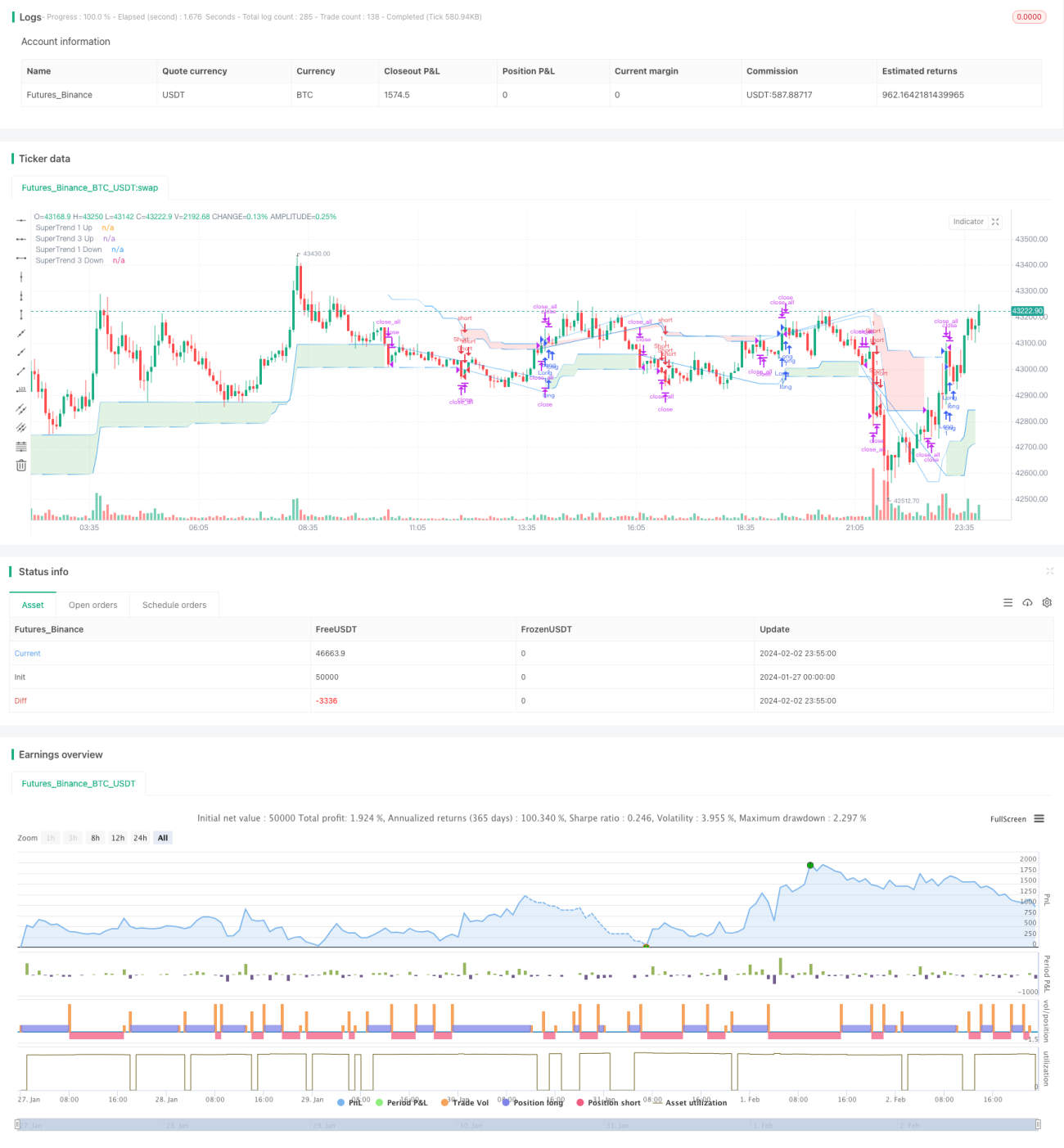
Übersicht
Diese Strategie kombiniert den Super-Trend-Indikator mit der Elliott-Wellen-Theorie und bildet ein robustes technisches Handelswerkzeug. Sie nutzt eine mehrstufige Trendanalyse, um eine umfassendere Marktperspektive zu bieten und potenzielle Trendumkehrungen sowie bedeutende Kursbewegungen frühzeitig zu erfassen.
Strategieprinzip
Das Kernkonzept liegt in ihrem mehrschichtigen Ansatz:
- Vier Super-Trend-Indikatoren werden verwendet, jeder mit unterschiedlichen ATR-Längen und Multiplikatoren, um den Trend von kurzfristig bis langfristig zu beurteilen.
- Durch die Kombination der Indikatoren werden robuste Long- und Short-Signale ermittelt.
- Unter Bezugnahme auf die Mustererkennungsmethode der Elliott-Wellen werden ähnliche Marktverhaltensmuster identifiziert, um die Handelssignale zu bestätigen.
Auf diese Weise werden mehrere Indikatoren genutzt und eine Mustererkennung hinzugefügt, was die Strategie robuster macht.
Vorteile
- Multi-Indikator-Design bietet eine umfassende Beurteilung.
- Von der Wellentheorie inspiriert, erhöht die Mustererkennung die Stabilität.
- Echtzeit-Anpassung der Richtung, um sich an Marktveränderungen anzupassen.
- Konfigurierbare Parameter, geeignet für verschiedene Märkte und Zeitrahmen.
Risikoanalyse
- Die Parametereinstellung hängt von Erfahrung ab; die optimale Parameterkombination muss durch Anpassung ermittelt werden.
- Das Multi-Indikator-Design ist komplizierter und erhöht die Rechenlast.
- Fehlsignale können nicht vollständig vermieden werden.
Durch Parameteroptimierung können schrittweise die optimalen Parameter bestimmt werden. Cloud-Computing kann die Rechenleistung verbessern. Das Setzen von Stop-Losses dient der Risikokontrolle.
Optimierungsmöglichkeiten
Die Optimierung kann in folgenden Bereichen erfolgen:
- Hinzufügen eines adaptiven Parameter-Anpassungsmoduls, das die Parameter dynamisch an die Marktbedingungen anpasst.
- Integration eines maschinellen Lernmodells zur Unterstützung der Beurteilung der Zuverlässigkeit von Handelssignalen.
- Einbeziehung externer Faktoren wie Stimmungsindikatoren und Nachrichtenereignisse zur Erkennung von Marktmustern.
- Unterstützung von Multi-Asset-Parametervorlagen zur Reduzierung des Testaufwands.
Dies würde die Strategieparameter intelligenter, die Beurteilung genauer und die praktische Anwendung bequemer machen.
Zusammenfassung
Die Strategie berücksichtigt sowohl die Trend- als auch die Musterdimension, was sowohl die Robustheit der Beurteilung als auch die Flexibilität der Strategie gewährleistet. Die Multi-Indikatoren und Parameter garantieren die Anwendbarkeit auf dem gesamten Markt. Die weitere Einführung intelligenter und automatisierter Methoden würde das praktische Niveau der Strategie erheblich steigern. Sie bietet nützliche Impulse und Anregungen für die Entwicklung des technischen Handels.
/*backtest
start: 2024-01-27 00:00:00
end: 2024-02-03 00:00:00
period: 5m
basePeriod: 1m
exchanges: [{"eid":"Futures_Binance","currency":"BTC_USDT"}]
*/

//@version=5
strategy("Elliott's Quadratic Momentum - Strategy [presentTrading]",shorttitle = "EQM Strategy [presentTrading]", overlay=true )

// Inputs for selecting trading direction- 1