Strategie basierend auf dem bidirektionalen Momentum-Index

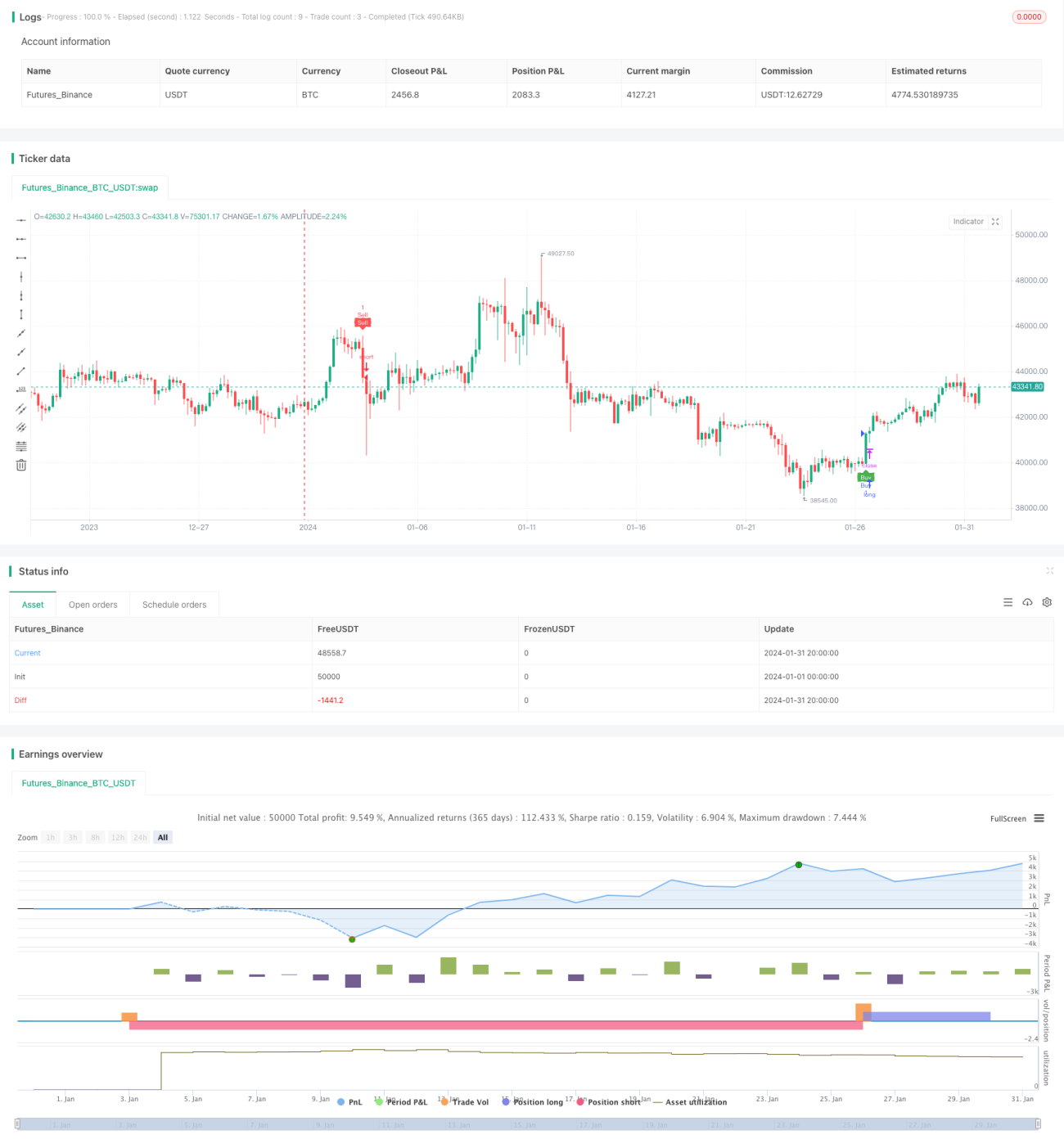
Übersicht
Diese Strategie berechnet den Directional Movement Index DI+ und DI- sowie den Average Directional Index ADX und kombiniert sie mit einem exponentiell gleitenden Durchschnitt (EMA), um Handelssignale zu generieren. Ein Kaufsignal entsteht, wenn DI+ DI- von unten nach oben kreuzt und der ADX über 20 liegt. Ein Verkaufssignal entsteht, wenn DI- DI+ von oben nach unten kreuzt und der ADX über 25 liegt. Das Stop-Loss-Signal ist, wenn DI- DI+ von unten nach oben kreuzt und der ADX über 30 liegt.
Strategieprinzip
-
Berechnung von DI+, DI- und ADX
- Aufruf der Funktion
ta.dmi()zur Berechnung von DI+, DI- und ADX - DI+/DI- zeigen die Richtung der Preisbewegung an
- ADX spiegelt die durchschnittliche Stärke der Preisbewegung wider
- Aufruf der Funktion
-
Berechnung des exponentiell gleitenden Durchschnitts (EMA)
- Aufruf der benutzerdefinierten Funktion
my_ema()zur Berechnung des EMA - EMA glättet die Preisdaten effektiv
- Aufruf der benutzerdefinierten Funktion
-
Generierung von Handelssignalen
- Kaufsignal: DI+ kreuzt DI- von unten nach oben, ADX > 20 und Schlusskurs > EMA
- Zeigt einen Aufwärtstrend mit signifikanter Preisbewegung an
- Verkaufssignal: DI- kreuzt DI+ von oben nach unten, ADX > 25 und Schlusskurs < EMA
- Zeigt einen Abwärtstrend mit signifikanter Preisbewegung an
- Kaufsignal: DI+ kreuzt DI- von unten nach oben, ADX > 20 und Schlusskurs > EMA
-
Stop-Loss für Trades
- Kauf-Stop-Loss: DI- kreuzt DI+ von unten nach oben und ADX > 30
- Zeigt eine Trendumkehr an
- Verkauf-Stop-Loss: DI+ kreuzt DI- von oben nach unten und ADX > 30
- Zeigt eine Trendumkehr an
- Kauf-Stop-Loss: DI- kreuzt DI+ von unten nach oben und ADX > 30
Zusammenfassend kombiniert diese Strategie Momentum- und Trendindikatoren und generiert Handelssignale, wenn der Preistrend stark ausgeprägt ist. Gleichzeitig werden Stop-Loss-Bedingungen festgelegt, um Verluste zu begrenzen.
Vorteile der Strategie
- Verwendung von beiden DI-Werten zur Vermeidung von Fehlsignalen
- Ein einzelner DI kann leicht fehlerhafte Signale erzeugen; die Kombination von DI+ und DI- stellt die Trendstärke sicher
- ADX-Bedingung stellt ausreichende Preisbewegung sicher
- Es wird nur bei erhöhter Volatilität gehandelt, um Seitwärtsmärkte zu vermeiden
- EMA-Bedingung in Kombination mit DI
- EMA erkennt effektiv mittel- bis langfristige Trends
- Strenge Stop-Loss-Bedingungen
- Rechtzeitige Verlustbegrenzung, um große Verluste zu vermeiden
Risikoanalyse
- Häufige Stop-Loss-Auslösung
- Bei stark schwankenden Märkten können Stop-Loss zu oft ausgelöst werden
- Parameterabhängigkeit
- Die Parameter von DI und ADX müssen optimiert werden, um die beste Kombination zu finden
- Niedrige Handelsfrequenz
- Strengere Handelsbedingungen reduzieren die Anzahl der Trades
Optimierung möglich durch Erweiterung des Stop-Loss-Spielraums, Anpassung der Parameterkombination oder Hinzufügen zusätzlicher Filterbedingungen, um die Handelsfrequenz zu erhöhen.
Optimierungsmöglichkeiten
- Parameteroptimierung
- Optimierung der DI- und ADX-Parameter, um die beste Kombination zu finden
- Hinzufügen von Filtern
- Z. B. Volumen, Divergenzen oder andere Bedingungen zur Signalfilterung
- Stop-Loss-Spielraum erweitern
- Die Stop-Loss-Bedingungen angemessen lockern, um häufige Auslösungen zu reduzieren
Zusammenfassung
Die Strategie integriert Momentum- und Trendanalyseindikatoren und erzeugt Handelssignale bei starken Preistrends. Strenge Stop-Loss-Bedingungen kontrollieren das Risiko. Durch Parameteroptimierung, Hinzufügen von Signalfiltern und angemessene Erweiterung des Stop-Loss-Spielraums kann die Effektivität der Strategie weiter verbessert werden.
/*backtest
start: 2024-01-01 00:00:00
end: 2024-01-31 23:59:59
period: 4h
basePeriod: 15m
exchanges: [{"eid":"Futures_Binance","currency":"BTC_USDT"}]
*/

// This Pine Script™ code is subject to the terms of the Mozilla Public License 2.0 at https://mozilla.org/MPL/2.0/
// © Tamil_FNO_Trader

//@version=5- 1