Trading Psychologische Kontroll-Balance-Strategie


Erstellungsdatum: 2024-02-21 14:33:04 zuletzt geändert: 2024-02-21 14:33:04
Kopie: 0 Klicks: 607
1
konzentrieren Sie sich auf
1617
Anhänger

Trading Psychologische Kontroll-Balance-Strategie

Überblick

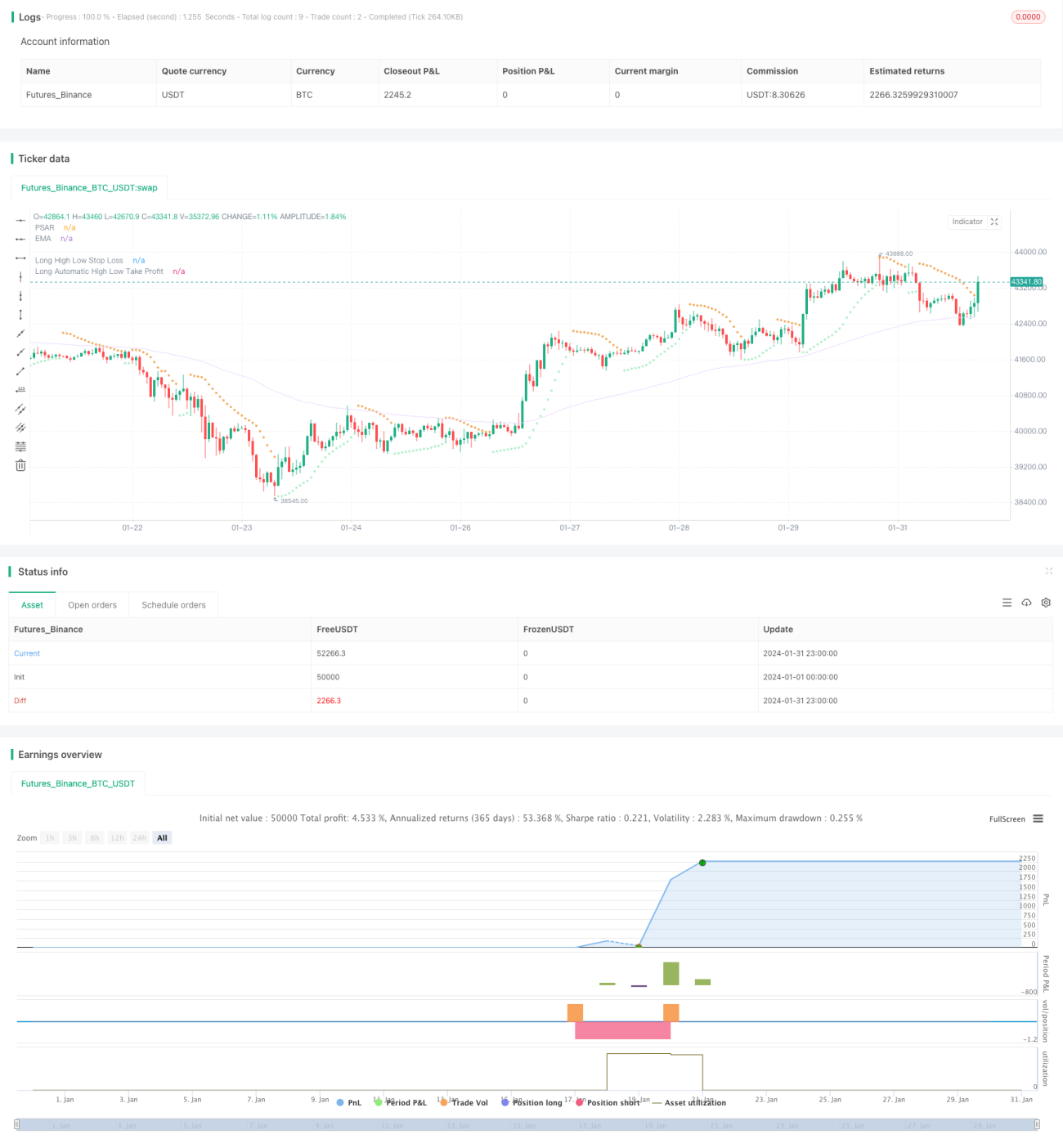
Der Zweck dieser Strategie ist es, die psychologische und Handelsleistung der Händler durch die Einstellung verschiedener Parameter auszugleichen, um eine stabilere Rendite zu erzielen. Sie verwendet Indikatoren wie die Durchschnittslinie, die Brin-Band und den Keltner-Kanal, um Markttrends und -schwankungen zu beurteilen, kombiniert mit dem PSAR-Indikator, um Umkehrsignale zu beurteilen, und mit dem TTM-Extrusionsindikator, um die Dynamik zu beurteilen. Die Handelssignale werden durch diese Kombinationen erzeugt.

Strategieprinzip

Die Hauptlogik der Strategie lautet:

  1. Beurteilung der Tendenz: Die Richtung der Preisentwicklung wird anhand der EMA-Durchschnittslinie beurteilt, wobei der Preis oberhalb der EMA als bullish und unterhalb als bearish gilt

  2. Umkehrung: PSAR-Punkte werden verwendet, um einen Preisumkehrpunkt zu ermitteln. PSAR-Punkte werden als Positivsignale oberhalb des Preises und als Negativsignale unterhalb des Preises angezeigt

  3. Beurteilung der Dynamik: Beurteilung der Volatilität und der Dynamik des Marktes mit dem TTM Squeeze. Der TTM Squeeze misst die Volatilität durch den Vergleich der Breite der Brin-Band und des Keltner-Kanals, wobei die Extraktion eine sehr geringe Volatilität bedeutet. Die Auflösung der Extraktion bedeutet eine Erhöhung der Volatilität und ein Signal, dass der Preis kurz vor einer größeren Richtungsbewegung steht

  4. Erzeugt Handelssignale: Wenn der Preis die EMA-Mittellinie, den PSAR-Punkt überschreitet und der TTM Squeeze-Indikator den Squeeze entlässt, erzeugt er ein Blicksignal; wenn der Preis die EMA-Mittellinie, den PSAR-Punkt unterschreitet und der TTM Squeeze-Indikator in den Squeeze geht, erzeugt er ein Blicksignal

  5. Stop-Loss-Methode: Ein Stop-Loss mit einem Hoch-Low-Punkt. Der Maximal- oder Minimalpreis des letzten Zeitraums wird multipliziert mit einem Set-Multiple als Stop-Loss-Punkt.

  6. Stop-Off-Methode: Stop-Off mit Risiko-Rendite-Verhältnis. Stop-Off-Parameter erhält man durch das Verhältnis von Stop-Loss-Distanz zum aktuellen Preis multipliziert mit dem eingestellten Risiko-Rendite-Verhältnis

Durch die Einstellung von Parametern können die Handelsfrequenz, die Positionsverwaltung, die Stop-Loss- und die Stop-Out-Punkte kontrolliert und die Handelspsychologie ausgeglichen werden.

Analyse der Stärken

Diese Strategie hat folgende Vorteile:

  1. Mehrindikatorische Beurteilung, bessere Signalgenauigkeit

  2. Umkehrung als Haupt, Schritt als Neben, Umkehrpunkt zu erfassen, um die Wahrscheinlichkeit zu verringern, dass ein Auf- und Absturz oder ein Absturz die Klinge tötet

  3. Der TTMSqueeze-Indikator kann Trendkorrekturen erkennen und verhindert ungültige Transaktionen während der Korrekturperiode.

  4. Hoch-Low-Stop-Methode ist einfach und praktisch, die Stop-Distance kann an den Markt angepasst werden

  5. Die Risikobetrag-Vergleichs-Stopp-Methode erlaubt die Anpassung der Gewinn- und Verlust-Relation in Zahlen.

  6. Flexible Einstellungen für verschiedene Parameter, die nach individuellen Risikopräferenzen verfeinert werden können

Risikoanalyse

Die Strategie birgt auch folgende Risiken:

  1. Mehrfache Kombination von Messwerten, die die Signalgenauigkeit erhöhen, aber auch die Wahrscheinlichkeit erhöhen, dass der Entry-Punkt übersprungen wird

  2. Die Strategie, bei der die Umkehrung vorherrscht, kann bei Trends schlecht abschneiden.

  3. Die High-Low-Stop-Losses werden manchmal überschritten und können das Risiko nicht vollständig umgehen.

  4. Risikobeträge können durch Preissprung oder -anpassung ausfallen

  5. Fehlgelegte Parameter können zu Verlusten oder häufigen Ausfällen führen

Optimierungsrichtung

Die Strategie kann optimiert werden durch:

  1. Hinzufügen oder Anpassung der Gewichte des Indikators, um das Signal genauer zu machen

  2. Optimierung der Kennzahlen für die Umkehrung und Trendbeurteilung, um die Gewinnwahrscheinlichkeit zu erhöhen

  3. Optimierung der Parameter für hohe und niedrige Stop-Losses, um die Stop-Losses zu optimieren

  4. Verschiedene Risiko-Rendite-Verhältnisse getestet, um optimale Ergebnisse zu erzielen

  5. Anpassung der Positionsparameter zur Verringerung der Einzelschäden

Zusammenfassen

Die Strategie als Ganzes kann durch eine Reihe von Indikatoren und Parameter-Anpassungen die Handelspsychologie wirksam ausgleichen und stabile positive Erträge erzielen. Obwohl noch ein gewisser Raum für Verbesserungen besteht, hat sie bereits einen praktischen Einsatzwert. Durch Marktfeedback und Parameter-Feinbearbeitung wird diese Strategie als ein wirksames Werkzeug zur Kontrolle der Handelspsychologie und langfristigen stabilen Gewinnung dienen.

Strategiequellcode
/*backtest
start: 2024-01-01 00:00:00
end: 2024-01-31 23:59:59
period: 1h
basePeriod: 15m
exchanges: [{"eid":"Futures_Binance","currency":"BTC_USDT"}]
*/


//@version=5
// This source code is subject to the terms of the Mozilla Public License 2.0 at https://mozilla.org/MPL/2.0/
// © simwai
strategy('Octopus Nest Strategy 🐙', shorttitle='🐙', overlay=true )

// -- Colors --
color maximumYellowRed = color.rgb(255, 203, 98) // yellow
color rajah = color.rgb(242, 166, 84) // orange
color magicMint = color.rgb(171, 237, 198)
color languidLavender = color.rgb(232, 215, 255)
color maximumBluePurple = color.rgb(181, 161, 226)
color skyBlue = color.rgb(144, 226, 244)
color lightGray = color.rgb(214, 214, 214)
color quickSilver = color.rgb(163, 163, 163)
color mediumAquamarine = color.rgb(104, 223, 153)
color carrotOrange = color.rgb(239, 146, 46)

// -- Inputs --
float src = input.source(close, 'Choose Source', group='General', inline='1')
bool isSignalLabelEnabled = input.bool(title='Show Signal Labels?', defval=true, group='General', inline='2')
bool isPsarAdaptive = input.bool(title='Is PSAR Adaptive?', defval=false, group='General', inline='2')

float highLowStopLossMultiplier = input.float(defval=0.98,  step=0.01, minval=0, maxval=1, title='Multiplier', group='High Low Stop Loss', inline='1')
float highLowStopLossBackupMultiplier = input.float(defval=0.98, step=0.01, minval=0, maxval=1, title='Backup Multiplier', group='High Low Stop Loss', inline='1')
int highLowStopLossLookback = input.int(defval=20, step=5, minval=1, title='Lookback', group='High Low Stop Loss', inline='2')
float automaticHighLowTakeProfitRatio = input.float(defval=1.125, step=0.1, minval=0, title='Risk Reward Ratio', group='Automatic High Low Take Profit', inline='2')

int emaLength = input.int(100, minval=2, title='Length', group='EMA', inline='1')
int ttmLength = input.int(title='Length', defval=20, minval=0, group='TTM Squeeze', inline='1')

float psarStart = input.float(0.02, 'Start', step=0.01, minval=0.0, group='PSAR', inline='1')
float psarInc = input.float(0.02, 'Increment', step=0.01, minval=0.01, group='PSAR', inline='1')
float psarMax = input.float(0.2, 'Max', step=0.05, minval=0.0, group='PSAR', inline='2')

startAFactor = input.float(0.02, 'Starting Acceleration Factor', step = 0.001, group='Adaptive PSAR', inline='1')
minStep = input.float(0.0, 'Min Step', step = 0.001, group='Adaptive PSAR', inline='1')
maxStep = input.float(0.02, 'Max Step', step = 0.001, group='Adaptive PSAR', inline='2')
maxAFactor = input.float(0.2, 'Max Acceleration Factor', step = 0.001, group='Adaptive PSAR', inline='2')  

hiloMode = input.string('On', 'HiLo Mode', options = ['Off', 'On'], group='Adaptive PSAR')
adaptMode = input.string('Kaufman', 'Adaptive Mode', options = ['Off', 'Kaufman', 'Ehlers'], group='Adaptive PSAR')
adaptSmth = input.int(5, 'Adaptive Smoothing Period', minval = 1, group='Adaptive PSAR')
filt = input.float(0.0, 'Filter in Pips', group='Adaptive PSAR', minval = 0)
minChng = input.float(0.0, 'Min Change in Pips', group='Adaptive PSAR', minval = 0)
SignalMode = input.string('Only Stops', 'Signal Mode', options = ['Only Stops', 'Signals & Stops'], group='Adaptive PSAR')

// -- Functions --
tr(_high, _low, _close) => math.max(_high - _low, math.abs(_high - _close[1]), math.abs(_low - _close[1]))

// -- Calculation --
var string lastTrade = 'initial'

float _low = low
float _high = high
float _close = close

// -- TTM Squeeze – Credits to @Greeny --
bband(ttmLength, mult) =>
    ta.sma(src, ttmLength) + mult * ta.stdev(src, ttmLength)
keltner(ttmLength, mult) =>
    ta.ema(src, ttmLength) + mult * ta.ema(tr(_high, _low, _close), ttmLength)

e1 = (ta.highest(_high, ttmLength) + ta.lowest(_low, ttmLength)) / 2 + ta.sma(src, ttmLength)
osc = ta.linreg(src - e1 / 2, ttmLength, 0)
diff = bband(ttmLength, 2) - keltner(ttmLength, 1)
osc_color = osc[1] < osc[0] ? osc[0] >= 0 ? #00ffff : #cc00cc : osc[0] >= 0 ? #009b9b : #ff9bff
mid_color = diff >= 0 ? color.green : color.red

// -- PSAR --
// Credits to @Bjorgum
calcBaseUnit() =>
    bool  isForexSymbol = syminfo.type     == 'forex'
    bool  isYenPair     = syminfo.currency == 'JPY'
    float result = isForexSymbol ? isYenPair ? 0.01 : 0.0001 : syminfo.mintick

// Credits to @loxx
_afact(mode,input, per, smooth) =>
    eff = 0., seff = 0.
    len = 0, sum = 0., max = 0., min = 1000000000.
    len := mode == 'Kaufman' ? math.ceil(per) : math.ceil(math.max(20, 5 * per))
    for i = 0 to len 
        if (mode == 'Kaufman') 
            sum += math.abs(input[i] - input[i + 1])
        else
            max := input[i] > max ? input[i] : max
            min := input[i] < min ? input[i] : min
    if (mode == 'Kaufman' and sum != 0) 
        eff := math.abs(input - input[len]) / sum
    else
        if (mode == 'Ehlers' and (max - min) > 0) 
            eff := (input - min) / (max - min)
    seff := ta.ema(eff, smooth)
    seff

hVal2 = nz(high[2]), hVal1 = nz(high[1]), hVal0 = high
lowVal2 = nz(low[2]), lowVal1 = nz(low[1]), lowVal0 = low
hiprice2 = nz(high[2]), hiprice1 = nz(high[1]), hiprice0 = high
loprice2 = nz(low[2]), loprice1 = nz(low[1]), loprice0 = low

upSig = 0., dnSig = 0.
aFactor = 0., step = 0., trend = 0.
upTrndSAR = 0., dnTrndSAR = 0.
length = (2 / maxAFactor - 1)

if (hiloMode == 'On') 
    hiprice0 := high
    loprice0 := low
else
    hiprice0 := src
    loprice0 := hiprice0

if bar_index == 1
    trend := 1
    hVal1 := hiprice1
    hVal0 := math.max(hiprice0, hVal1)
    lowVal1 := loprice1
    lowVal0 := math.min(loprice0, lowVal1)
    aFactor := startAFactor
    upTrndSAR := lowVal0
    dnTrndSAR := 0.
else
    hVal0 := hVal1
    lowVal0 := lowVal1
    trend := nz(trend[1])
    aFactor := nz(aFactor[1])
    inputs = 0.
    inprice = src
    if (adaptMode != 'Off')
        if (hiloMode == 'On') 
            inprice := src
        else 
            inprice := hiprice0
        if (adaptMode == 'Kaufman') 
            inputs := inprice
        else
            if (adaptMode == 'Ehlers') 
                if (nz(upTrndSAR[1]) != 0.)
                    inputs := math.abs(inprice - nz(upTrndSAR[1]))
                else
                    if (nz(dnTrndSAR[1]) != 0.) 
                        inputs := math.abs(inprice - nz(dnTrndSAR[1]))
        step := minStep + _afact(adaptMode, inputs, length, adaptSmth) * (maxStep - minStep)
    else 
        step := maxStep
        
    upTrndSAR := 0., dnTrndSAR := 0., upSig := 0., dnSig := 0.
    
    if (nz(trend[1]) > 0) 
        if (nz(trend[1]) == nz(trend[2]))
            aFactor := hVal1 > hVal2 ? nz(aFactor[1]) + step : aFactor
            aFactor := aFactor > maxAFactor ? maxAFactor : aFactor
            aFactor := hVal1 < hVal2 ? startAFactor : aFactor
        else 
            aFactor := nz(aFactor[1])
            
        upTrndSAR := nz(upTrndSAR[1]) + aFactor * (hVal1 - nz(upTrndSAR[1]))
        upTrndSAR := upTrndSAR > loprice1 ? loprice1 : upTrndSAR
        upTrndSAR := upTrndSAR > loprice2 ? loprice2 : upTrndSAR
    else
        if (nz(trend[1]) == nz(trend[2])) 
            aFactor := lowVal1 < lowVal2 ? nz(aFactor[1]) + step : aFactor
            aFactor := aFactor > maxAFactor ? maxAFactor : aFactor
            aFactor := lowVal1 > lowVal2 ? startAFactor : aFactor
        else
            aFactor := nz(aFactor[1])
            
        dnTrndSAR := nz(dnTrndSAR[1]) + aFactor * (lowVal1 - nz(dnTrndSAR[1]))
        dnTrndSAR := dnTrndSAR < hiprice1 ? hiprice1 : dnTrndSAR
        dnTrndSAR := dnTrndSAR < hiprice2 ? hiprice2 : dnTrndSAR
    
    hVal0 := hiprice0 > hVal0 ? hiprice0 : hVal0
    lowVal0 := loprice0 < lowVal0 ? loprice0 : lowVal0
        
    if (minChng > 0) 
        if (upTrndSAR - nz(upTrndSAR[1]) < minChng * calcBaseUnit() and upTrndSAR != 0. and nz(upTrndSAR[1]) != 0.)
            upTrndSAR := nz(upTrndSAR[1])
        if (nz(dnTrndSAR[1]) - dnTrndSAR < minChng * calcBaseUnit() and dnTrndSAR != 0. and nz(dnTrndSAR[1]) != 0.)
            dnTrndSAR := nz(dnTrndSAR[1])

    dnTrndSAR := trend < 0 and dnTrndSAR > nz(dnTrndSAR[1]) ? nz(dnTrndSAR[1]) : dnTrndSAR
    upTrndSAR := trend > 0 and upTrndSAR < nz(upTrndSAR[1]) ? nz(upTrndSAR[1]) : upTrndSAR
    
    if (trend < 0 and hiprice0 >= dnTrndSAR + filt * calcBaseUnit())
        trend := 1
        upTrndSAR := lowVal0
        upSig := SignalMode == 'Signals & Stops' ? lowVal0 : upSig
        dnTrndSAR := 0.
        aFactor := startAFactor
        lowVal0 := loprice0
        hVal0 := hiprice0
    else if (trend > 0 and loprice0 <= upTrndSAR - filt * calcBaseUnit())
        trend := -1
        dnTrndSAR := hVal0
        dnSig := SignalMode == 'Signals & Stops' ? hVal0 : dnSig
        upTrndSAR := 0.
        aFactor := startAFactor
        lowVal0 := loprice0
        hVal0 := hiprice0
    
psar = upTrndSAR > 0 ? upTrndSAR : dnTrndSAR
psar := isPsarAdaptive ? psar : ta.sar(psarStart, psarInc, psarMax) 
plot(psar, title='PSAR', color=src < psar ? rajah : magicMint, style=plot.style_circles)

// -- EMA --
float ema = ta.ema(src, emaLength)
plot(ema, title='EMA', color=languidLavender)

// -- Signals --
var string isTradeOpen = ''
var string signalCache = ''

bool enterLong = src > ema and ta.crossover(src, psar) and ta.crossover(osc, 0)
bool enterShort = src < ema and ta.crossunder(src, psar) and ta.crossunder(osc, 0)
// bool exitLong = ta.crossunder(src, ema)
// bool exitShort = ta.crossover(src, ema)

if (signalCache == 'long entry')
    signalCache := ''
    enterLong := true
else if (signalCache == 'short entry')
    signalCache := ''
    enterShort := true

if (isTradeOpen == '')
    if (enterLong)
        isTradeOpen := 'long'
    else if (enterShort)
        isTradeOpen := 'short'
else if (isTradeOpen == 'long')
    if (enterLong)
        enterLong := false
else if (isTradeOpen == 'short')
    if (enterShort)
        enterShort := false

plotshape((isSignalLabelEnabled and enterLong and (isTradeOpen == 'long')) ? psar : na, title='LONG', text='L', style=shape.labelup, color=mediumAquamarine, textcolor=color.white, size=size.tiny, location=location.absolute)
plotshape((isSignalLabelEnabled and enterShort and (isTradeOpen == 'short')) ? psar : na, title='SHORT', text='S', style=shape.labeldown, color=carrotOrange, textcolor=color.white, size=size.tiny, location=location.absolute)

// -- High Low Stop Loss and Take Profit --
bool isHighLowStopLossEnabled = true
bool isAutomaticHighLowTakeProfitEnabled = true
bool recalculateStopLossTakeProfit = false
bool isStrategyEntryEnabled = false
bool isLongEnabled = true
bool isShortEnabled = true
bool isStopLossTakeProfitRecalculationEnabled = true

bool longStopLossTakeProfitRecalculation = isStopLossTakeProfitRecalculationEnabled ? true : (lastTrade == 'short' or lastTrade == 'initial')
bool shortStopLossTakeProfitRecalculation = isStopLossTakeProfitRecalculationEnabled ? true : (lastTrade == 'long' or lastTrade == 'initial')

var float longHighLowStopLoss = 0
var float shortHighLowStopLoss = 0

float highLowStopLossLowest = ta.lowest(_low, highLowStopLossLookback)
float highLowStopLossHighest = ta.highest(_high, highLowStopLossLookback)

if (isHighLowStopLossEnabled)
    if (((enterLong and longStopLossTakeProfitRecalculation) or recalculateStopLossTakeProfit) and (isStrategyEntryEnabled ? not(strategy.position_size > 0) : true))
        if (highLowStopLossLowest == _low)
            longHighLowStopLoss := _high * highLowStopLossBackupMultiplier
        else if (highLowStopLossLowest > 0)
            longHighLowStopLoss := highLowStopLossLowest * highLowStopLossMultiplier
            
    if (((enterShort and shortStopLossTakeProfitRecalculation) or recalculateStopLossTakeProfit) and (isStrategyEntryEnabled ? not(strategy.position_size < 0) : true))
        if (highLowStopLossHighest == _high)
            shortHighLowStopLoss := _high * (1 + (1 - highLowStopLossBackupMultiplier))
        else if (highLowStopLossHighest > 0)
            shortHighLowStopLoss := highLowStopLossHighest * (1 + (1 - highLowStopLossMultiplier))
        
plot((isLongEnabled and isHighLowStopLossEnabled and (isTradeOpen == 'long')) ? longHighLowStopLoss : na, 'Long High Low Stop Loss', color=magicMint, style=plot.style_circles, trackprice=false)
plot((isShortEnabled and isHighLowStopLossEnabled and (isTradeOpen == 'short')) ? shortHighLowStopLoss : na, 'Short High Low Stop Loss ', color=rajah, style=plot.style_circles, trackprice=false)

// -- Automatic High Low Take Profit --
var float longAutomaticHighLowTakeProfit = na
var float shortAutomaticHighLowTakeProfit = na

if (isAutomaticHighLowTakeProfitEnabled)
    if (((enterLong and longStopLossTakeProfitRecalculation) or recalculateStopLossTakeProfit) and (isStrategyEntryEnabled ? not(strategy.position_size > 0) : true))
        longHighLowStopLossPercentage = 1 - (longHighLowStopLoss / _close)
        longAutomaticHighLowTakeProfit := _close * (1 + (longHighLowStopLossPercentage  * automaticHighLowTakeProfitRatio))
    if (((enterShort and shortStopLossTakeProfitRecalculation) or recalculateStopLossTakeProfit) and (isStrategyEntryEnabled ? not(strategy.position_size > 0) : true)) 
        shortHighLowStopLossPercentage = 1 - (_close / shortHighLowStopLoss)
        shortAutomaticHighLowTakeProfit := _close * (1 - (shortHighLowStopLossPercentage * automaticHighLowTakeProfitRatio))

plot((isAutomaticHighLowTakeProfitEnabled and isHighLowStopLossEnabled and (isTradeOpen == 'long')) ? longAutomaticHighLowTakeProfit : na, 'Long Automatic High Low Take Profit', color=magicMint, style=plot.style_circles, trackprice=false)
plot((isAutomaticHighLowTakeProfitEnabled and isHighLowStopLossEnabled and (isTradeOpen == 'short')) ? shortAutomaticHighLowTakeProfit : na, 'Short Automatic High Low Take Profit', color=rajah, style=plot.style_circles, trackprice=false)

// log.info('Automatic Long High Low Take Profit: ' + str.tostring(longAutomaticHighLowTakeProfit))
// log.info('Automatic Short High Low Take Profit: ' + str.tostring(shortAutomaticHighLowTakeProfit))

// log.info('Long High Low Stop Loss: ' + str.tostring(longHighLowStopLoss))
// log.info('Short High Low Stop Loss: ' + str.tostring(shortHighLowStopLoss))

bool longHighLowStopLossCondition = ta.crossunder(_close, longHighLowStopLoss)
bool shortHighLowStopLossCondition = ta.crossover(_close, shortHighLowStopLoss)

bool longAutomaticHighLowTakeProfitCondition = ta.crossover(_close, longAutomaticHighLowTakeProfit)
bool shortAutomaticHighLowTakeProfitCondition = ta.crossunder(_close, shortAutomaticHighLowTakeProfit)

bool exitLong = (longHighLowStopLossCondition or longAutomaticHighLowTakeProfitCondition) and strategy.position_size > 0
bool exitShort = (shortHighLowStopLossCondition or shortAutomaticHighLowTakeProfitCondition) and strategy.position_size < 0

plotshape((isSignalLabelEnabled and exitLong and (isTradeOpen == 'long')) ? psar : na, title='LONG EXIT', style=shape.circle, color=magicMint, size=size.tiny, location=location.absolute)
plotshape((isSignalLabelEnabled and exitShort and (isTradeOpen == 'short')) ? psar : na, title='SHORT EXIT', style=shape.circle, color=rajah, size=size.tiny, location=location.absolute)

// Long Exits
if (exitLong)
    strategy.close('long', comment=longAutomaticHighLowTakeProfitCondition ? 'EXIT_LONG_TP' : 'EXIT_LONG_SL')
    isTradeOpen := ''

// Short Exits
if (exitShort)
    strategy.close('short', comment=shortAutomaticHighLowTakeProfitCondition ? 'EXIT_SHORT_TP' : 'EXIT_SHORT_SL')
    isTradeOpen := ''

// Long Entries
if (enterLong and (strategy.position_size == 0))
    strategy.entry('long', strategy.long, comment='ENTER_LONG')

// Short Entries
if (enterShort and (strategy.position_size == 0))
    strategy.entry('short', strategy.short, comment='ENTER_SHORT')

// Save last trade state
if (enterLong or exitLong)
    lastTrade := 'long'
if (enterShort or exitShort)
    lastTrade := 'short'

barcolor(color=isTradeOpen == 'long' ? mediumAquamarine : isTradeOpen == 'short' ? carrotOrange : na)