Flaggenausbruchsstrategie

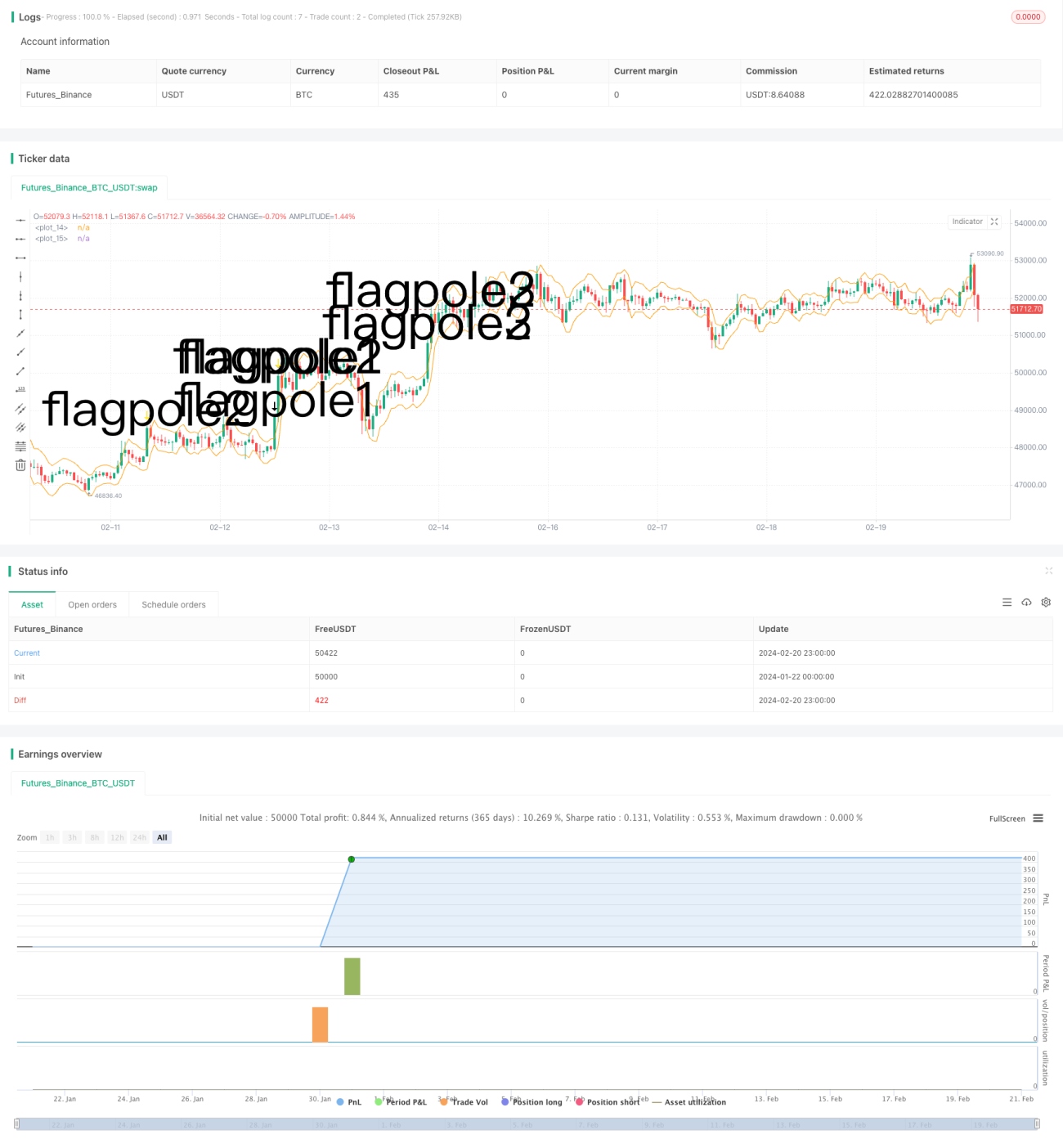
Übersicht
Die Flaggen-Ausbruchsstrategie ist eine technische Analysestrategie, die Flaggenmuster erkennt und zum Ausbruchspunkt einsteigt, um den Beginn eines Trends zu erfassen. Die Strategie nutzt den Average True Range (ATR)-Indikator als Hilfsmittel, um nach einem eindeutigen Flaggenmast den Flaggenbereich zu bestimmen und so Einstiegschancen zu filtern.
Strategieprinzip
Die Strategie gliedert sich in folgende Schritte:
- Bestimmung des Flaggenmastes: Es müssen neue Kurshochs und ein Ausbruch aus dem ATR-Kanal vorliegen.
- Bestimmung der Flaggenmast-Höhe: Messung des Abstands zwischen dem Hoch des Flaggenmastes und dem vorherigen SMA.
- Bestimmung des Flaggenbereichs: Der Tiefpunkt der Flagge beträgt 33% der Flaggenmast-Höhe und stellt die minimale Spanne der Flagge dar.
- Bestimmung der Flagge: Prüfung, ob die vorherigen 3 Kerzen vollständig innerhalb des Flaggenbereichs liegen.
- Einstieg: Bei Vorliegen einer Flagge wird eine Long-Position eröffnet.
- Ausstieg: Nach festgelegten 6 Kerzen wird die Position glattgestellt.
Bei der Bestimmung von Flaggenmast und Flagge nutzt die Strategie geschickt den ATR-Indikator, um eindeutige Ausbrüche zu erkennen, und begrenzt die Flaggenhöhe strikt auf 33% der Flaggenmast-Höhe, um viele Fehlsignale zu vermeiden. Zudem erhöht die Anforderung von drei aufeinanderfolgenden Kerzen, die eine Flagge bilden, die Zuverlässigkeit. Insgesamt ist die Strategie durchdacht und hat Vorteile beim Erfassen von Trendbeginn-Ausbrüchen.
Vorteile
Die Strategie bietet folgende Hauptvorteile:
- Die Nutzung der Flaggenstruktur zur Bestimmung des Trendbeginns ist eine klassische Methode der technischen Analyse mit hoher Erfolgsquote.
- Der ATR-Indikator und die strenge Bereichsbegrenzung reduzieren Fehlsignale erheblich und erhöhen die Einstiegsgenauigkeit.
- Der feste Ausstieg nach 6 Kerzen sichert einen Teil des Gewinns und vermeidet das Risiko von Trendumkehrungen.
- Die Strategieregeln sind klar und einfach umsetzbar, leicht zu verstehen und zu befolgen.
- Die Strategie kann in verschiedenen Marktphasen nach Chancen suchen und ist flexibel.
Risikoanalyse
Die Hauptrisiken der Strategie umfassen:
- Flaggenmuster können einen Trend nicht vollständig bestimmen; es gibt auch Fehlschläge.
- Der Ausstieg nach 6 Kerzen kann zu willkürlich sein und zu früh erfolgen.
- Bei stark schwankenden Märkten können leicht falsche Flaggen auftreten.
- Einzelne Verluste können nicht effektiv kontrolliert werden.
Um diese Risiken zu adressieren, können Stop-Loss-Strategien eingesetzt oder der Ausstiegsmechanismus optimiert werden, z.B. durch Gewinnmitnahmen bei Erreichen eines bestimmten Gewinnprozentsatzes. Auch die Kombination mit anderen Indikatoren kann helfen, Fehlsignale bei stark schwankenden Märkten zu vermeiden.
Optimierungsmöglichkeiten
Die Strategie kann in folgenden Bereichen optimiert werden:
- Kombination mit Indikatoren wie MACD oder KD, um Fehlsignale in Seitwärtsmärkten zu vermeiden.
- Parametrisierung des ATR-Multiplikators und der Ausstiegsperiode je nach Markttyp, um die Anpassungsfähigkeit zu erhöhen.
- Einsatz eines Trailing-Stops oder Berücksichtigung des Gewinn-Rückgangs-Verhältnisses für dynamische Ausstiege.
- Einsatz von maschinellen Lernmethoden zur genaueren Bestimmung der Flaggenhöhe.
- Bewertung der tatsächlichen Gewinnrate und des Risiko-Ertrags-Verhältnisses zur dynamischen Anpassung der Positionsgröße.
Zusammenfassung
Insgesamt nutzt die Flaggen-Ausbruchsstrategie technische Formationen zur Bestimmung des Trendbeginns – eine klassische Methode. Die Einstiegsregeln sind streng und filtern viele Fehlsignale. Allerdings gibt es noch Optimierungspotenzial bei der Risikokontrolle und dem Ausstiegsmechanismus. Durch eine gesamtheitliche Betrachtung kann die Strategie in verschiedenen Märkten stabil laufen. Nach gründlicher Validierung und Optimierung kann sie ein wertvoller Bestandteil eines quantitativen Handelssystems sein.
/*backtest
start: 2024-01-22 00:00:00
end: 2024-02-21 00:00:00
period: 1h
basePeriod: 15m
exchanges: [{"eid":"Futures_Binance","currency":"BTC_USDT"}]
*/

// © smith26
//This strategy enters on a bull flag and closes position 6 bars later.  Average true range is used instead of a moving average.
//The reason for ATR instead of MA is because with volatile securities, the flagpole must stand up a noticable "distance" above the trading range---which you can't determine with a MA alone.
//This is broken up into multiple parts: Defining a flagpole, defining the pole height, and defining the flag, which will be constrained to the top third (33%) of the pole height to be considered a flag.- 1