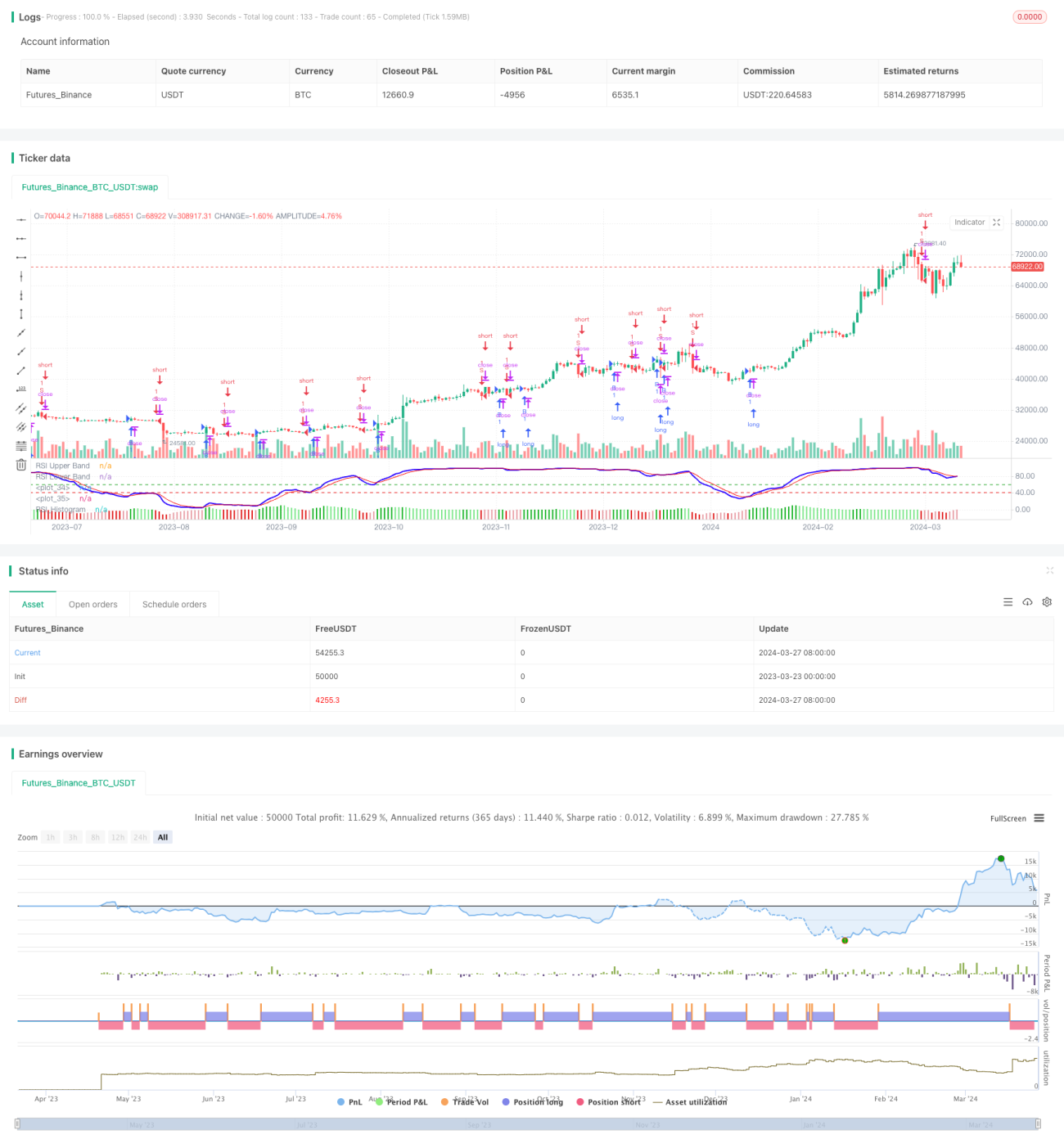
Modifizierte Relative Strength Index Trendfolgestrategie


Erstellungsdatum: 2024-03-29 16:16:37 zuletzt geändert: 2024-03-29 16:16:37
Kopie: 9 Klicks: 605
1
konzentrieren Sie sich auf
1617
Anhänger

Modifizierte Relative Strength Index Trendfolgestrategie

Überblick

Die Strategie basiert auf einem modifizierten, relativ starken Index (Modified RSI), um Markttrends zu erfassen. Die Hauptidee der Strategie ist es, die Kreuz- und Vertikale-Signale des Modified RSI-Indikators zu nutzen, um Markttrends zu beurteilen und entsprechend der Trendrichtung zu handeln.

Strategieprinzip

  1. Die EMA, die den Preis berechnet, als Eingabe für den modifizierten RSI
  2. Berechnung des modifizierten RSI
  3. Berechnen von Modified RSI EMA als Signallinie
  4. Berechnung der Differenz zwischen dem modifizierten RSI und der Signallinie als Quadratur
  5. Ein Kaufsignal wird erzeugt, wenn der Modified RSI über eine Signallinie fährt und der Quadratogramm größer als 0 ist
  6. Verkäufersignale werden erzeugt, wenn der Modified RSI unter der Signallinie durchläuft und die Vertikale kleiner als 0 ist

Strategische Vorteile

  1. Der modifizierte RSI zeigt Trends besser als der herkömmliche RSI
  2. Die Kombination von Modified RSI-Kreuzsignal und Rectangram-Signal filtert effektiv Falschsignale
  3. Anpassbar für verschiedene Märkte und Zeiten
  4. Einfache Prozedur, hohe Rechenleistung

Strategisches Risiko

  1. Der Modified RSI ist anfällig für falsche Signale in schwankenden Märkten.
  2. Der Trendwechsel könnte zurückbleiben
  3. Der einzelne Indikator wird von Preisklären gestört.

Richtung der Strategieoptimierung

  1. Kann mit anderen Trendindikatoren, wie beispielsweise Moving Averages, kombiniert werden, um die Signalsicherheit zu erhöhen
  2. Ein Stop-Loss-Stopp-Module kann hinzugefügt werden, um das Risiko eines einzelnen Handels zu kontrollieren.
  3. Optimierbare Parameter für unterschiedliche Marktmerkmale
  4. Positionsverwaltungsmodule können hinzugefügt werden, um Positionen dynamisch anzupassen

Zusammenfassen

Die Strategie nutzt die Eigenschaften des Modified RSI-Indikators, um ein Handelssystem aus der Sicht des Trendverfolgens zu bauen. Der Modified RSI-Indikator überwindet einige der Mängel des herkömmlichen RSI-Indikators und hat eine relativ starke Trendfangfähigkeit. Die Strategie für einen einzelnen Indikator weist jedoch oft Grenzen auf und muss in Kombination mit anderen technischen Mitteln verbessert werden.

Strategiequellcode
/*backtest
start: 2023-03-23 00:00:00
end: 2024-03-28 00:00:00
period: 1d
basePeriod: 1h
exchanges: [{"eid":"Futures_Binance","currency":"BTC_USDT"}]
*/

// This source code is subject to the terms of the Mozilla Public License 2.0 at https://mozilla.org/MPL/2.0/
// © YogirajDange

//@version=5


// Verical lines


// // Define the times
// t1 = timestamp(year, month, dayofmonth, 09, 15) // 9:15
// t2 = timestamp(year, month, dayofmonth, 11, 15) // 11:15
// t3 = timestamp(year, month, dayofmonth, 13, 15) // 1:15
// t4 = timestamp(year, month, dayofmonth, 15, 25) // 3:25

// // Check if the current bar is on the current day
// is_today = (year(time) == year(timenow)) and (month(time) == month(timenow)) and (dayofmonth(time) == dayofmonth(timenow))

// // Draw a vertical line at each time
// if is_today and (time == t1 or time == t2 or time == t3 or time == t4)
//     line.new(x1 = bar_index, y1 = low, x2 = bar_index, y2 = high, extend = extend.both, color=color.red, width = 1)

strategy('Modified RSI')
col_grow_above = input(#02ac11, "Above   Grow", group="Histogram", inline="Above")
col_fall_above = input(#6ee47d, "Fall", group="Histogram", inline="Above")
col_grow_below = input(#e5939b, "Below Grow", group="Histogram", inline="Below")
col_fall_below = input(#dd0000, "Fall", group="Histogram", inline="Below")
EMA_length = input.int(13, 'Price_EMA', minval=1)
RSI_length = input.int(14, 'RSI_Period', minval=1)
Avg_length = input.int(5, 'RSI_Avg_EMA', minval=1)
fastMA = ta.ema(close, EMA_length)
modrsi = ta.rsi(fastMA, RSI_length)
RSIAVG = ta.ema(modrsi, Avg_length)
plot(modrsi, color=color.rgb(38, 0, 255), linewidth=2)
plot(RSIAVG, color=color.rgb(247, 0, 0))
rsiUpperBand = hline(60, 'RSI Upper Band', color=#099b0e)
//hline(50, "RSI Middle Band", color=color.new(#787B86, 50))
rsiLowerBand = hline(40, 'RSI Lower Band', color=#e90101)

RSI_hist = modrsi - RSIAVG

//plot(RSI_hist,"RSI_Histogram", color = #c201e9, style = plot.style_columns,linewidth= 5)

plot(RSI_hist, title="RSI_Histogram", style=plot.style_columns, color=(RSI_hist>=0 ? (RSI_hist[1] < RSI_hist ? col_grow_above : col_fall_above) : (RSI_hist[1] < RSI_hist ? col_grow_below : col_fall_below)))


/////// Moving Averages 20 50 EMA

fast_ma = input.int(20, minval=2, title="Fast_EMA")
slow_ma = input.int(50, minval=2, title="Slow_EMA")

src = input.source(close, title="Source")

out = ta.ema(src, fast_ma)
out1 = ta.ema(src, slow_ma)

//plot(out, title="20 EMA", color=color.rgb(117, 71, 247), linewidth = 2)
//plot(out1, title="50 EMA", color=color.rgb(0, 0, 0), linewidth = 2)


longCondition = ((ta.crossover(modrsi, RSIAVG)) and (RSI_hist > 0))
if longCondition
    strategy.entry('B', strategy.long)

shortCondition = ((ta.crossunder(modrsi, RSIAVG)) and (RSI_hist < 0))
if shortCondition
    strategy.entry('S', strategy.short)