
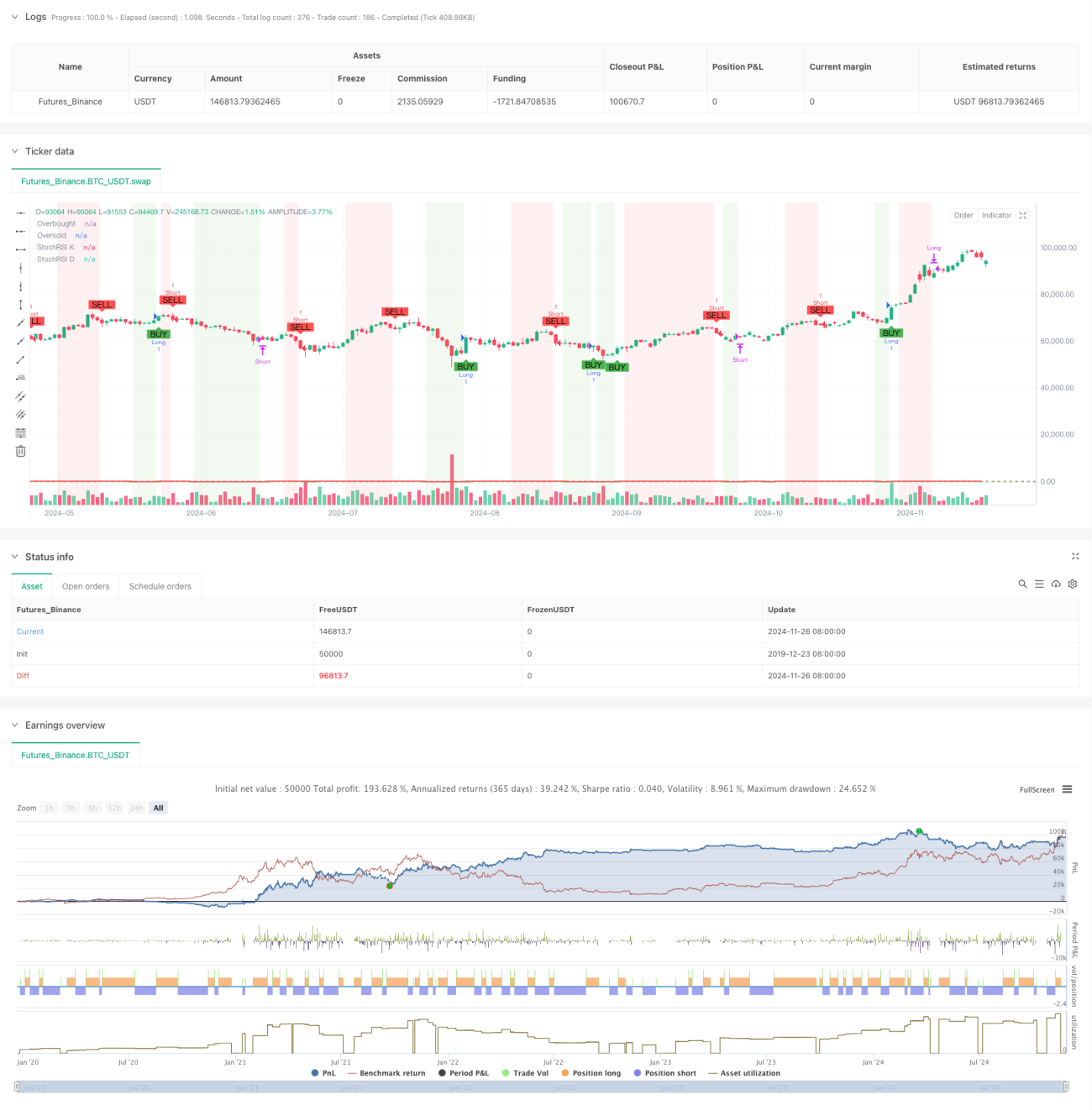
Überblick
Diese Strategie ist ein hybrides Handelssystem, das den Stochastic RSI (Stochastischer RSI) mit Candlestick-Formationen kombiniert. Das System analysiert die überkauften/überverkauften Niveaus des SRSI-Indikators und bestätigt sie mit der Preisentwicklung der Candlesticks, um vollautomatisch Handelssignale zu generieren. Die Strategie verwendet eine fortschrittliche Kombination technischer Indikatoren, die Merkmale von Trendfolge und contraren Trading-Ansätzen vereint und eine hohe Marktanpassungsfähigkeit aufweist.
Strategieprinzip
Die Kernlogik der Strategie basiert auf den folgenden Schlüsselelementen:
- Verwendung eines 14-Perioden-RSI als Grundlage zur Berechnung des Stochastic-RSI-Werts als primäre Signalquelle.
- Einstellung der K- und D-Linien des Stochastic RSI als 3-Perioden-Simple-Moving-Average, um die Signale zu glätten.
- Festlegung von 80 und 20 als überkaufte/überverkaufte kritische Werte zur Beurteilung des Marktzustands.
- Kombination der Beziehung zwischen Eröffnungs- und Schlusskurs des aktuellen Candlesticks zur Bestätigung der Marktrichtung.
- Wenn die K-Linie das überverkaufte Niveau nach oben durchbricht und eine bullische Kerze erscheint, wird ein Long-Signal ausgelöst.
- Wenn die K-Linie das überkaufte Niveau nach unten durchbricht und eine bärische Kerze erscheint, wird ein Short-Signal ausgelöst.
- Ein Stop-Loss wird aktiviert, wenn die K-Linie die überkauften/überverkauften Niveaus in die entgegengesetzte Richtung durchbricht.
Strategievorteile
- Hohe Signalzuverlässigkeit: Durch die doppelte Bestätigung von Stochastic RSI und Candlestick wird die Genauigkeit der Handelssignale deutlich erhöht.
- Umfassendes Risikomanagement: Klare Stop-Loss-Bedingungen ermöglichen eine effektive Kontrolle des Risikos pro Trade.
- Hohe Parameteranpassbarkeit: Wichtige Parameter können je nach Marktcharakteristik optimiert werden.
- Klare visuelle Rückmeldung: Handelsignale werden durch Hintergrundfarben und grafische Markierungen intuitiv dargestellt.
- Hoher Automatisierungsgrad: Von der Signalgenerierung bis zur Auftragsausführung vollautomatisch, wodurch menschliche Eingriffe minimiert werden.
Strategierisiken
- Risiko in Seitwärtsmärkten: In horizontalen Konsolidierungsmärkten können häufige falsche Ausbruchssignale auftreten.
- Verzögerungsrisiko: Die Berechnung gleitender Durchschnitte weist eine gewisse Verzögerung auf, sodass optimale Einstiegspunkte möglicherweise verpasst werden.
- Parameterempfindlichkeit: Unterschiedliche Parametereinstellungen beeinflussen die Strategieleistung erheblich und erfordern kontinuierliche Optimierung.
- Marktabhängigkeit: In stark volatilen Märkten können die Signale instabil sein.
- Systemrisiko: Bei bedeutenden Marktereignissen können Stop-Loss-Einstellungen unwirksam werden.
Optimierungsmöglichkeiten
- Einführung von Volumenindikatoren: Das Handelsvolumen könnte als zusätzliche Bestätigung für Signale dienen.
- Optimierung des Stop-Loss-Mechanismus: Verwendung von Trailing-Stop oder dynamischem ATR-Stop-Loss in Betracht ziehen.
- Trendfilter hinzufügen: Ein längerfristiger gleitender Durchschnitt als Trendfilter einbauen.
- Verbesserung der Signalfilterung: Berücksichtigung der Marktvolatilität und Anpassung der Parameter bei hoher Volatilität.
- Dynamische Parameteranpassung: Die überkauften/überverkauften Schwellenwerte an den Marktzustand anpassen.
Zusammenfassung
Diese Strategie konstruiert durch die Kombination von Stochastic RSI und Candlestick-Formationen ein robustes Handelssystem. Das System bietet bei einfacher Bedienung ein gutes Risikomanagement. Durch geeignete Parameteroptimierung und Signalfilterung kann sich die Strategie an unterschiedliche Marktbedingungen anpassen. Händlern wird empfohlen, vor dem Live-Einsatz ausreichende historische Backtests durchzuführen und die Parametereinstellungen an die spezifischen Marktmerkmale anzupassen.
- 1