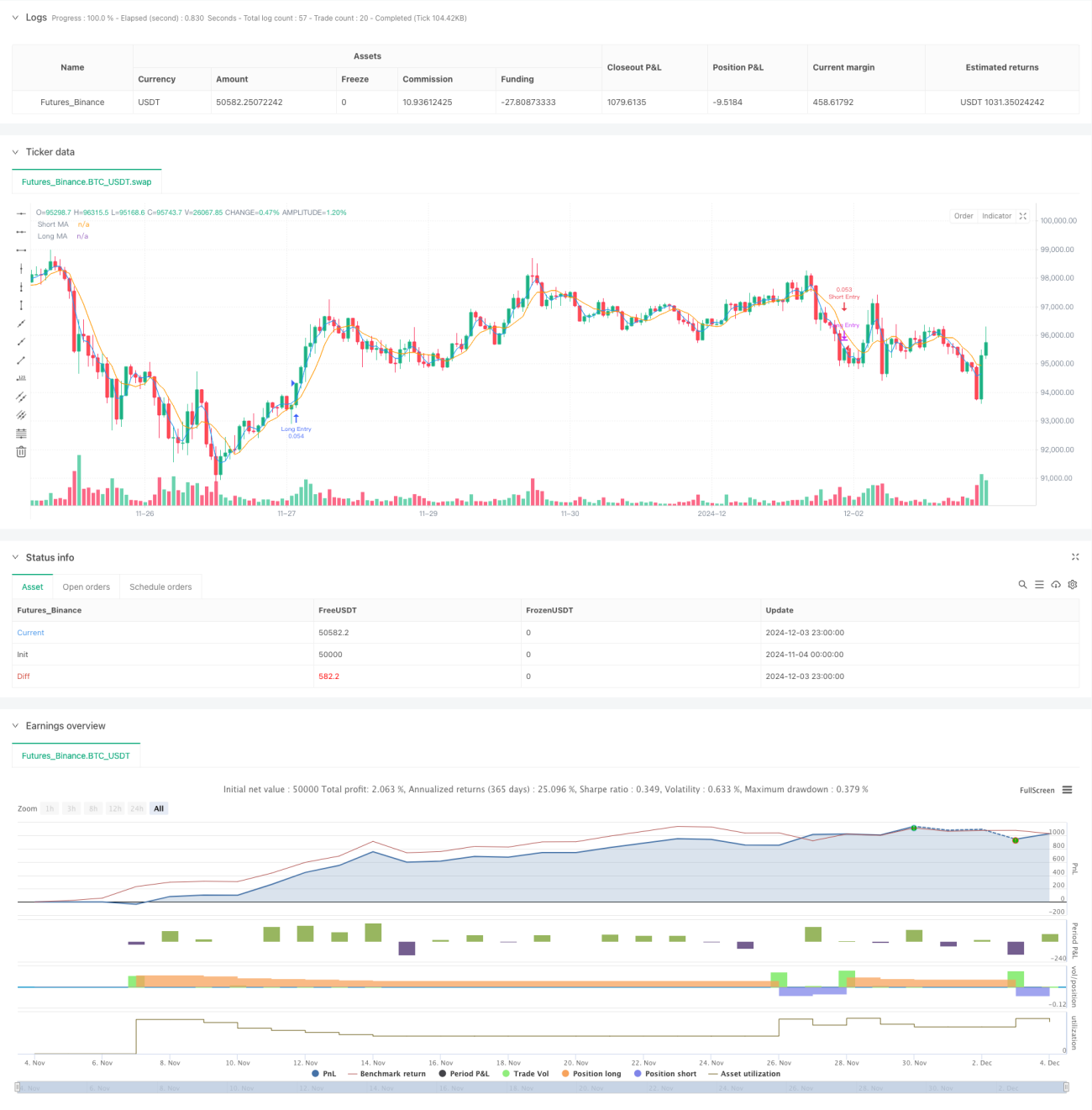
Mehrstufige ATR-Strategie für dynamischen Profithandel

ATR SMA TR MF TP SL MA AATR
Erstellungsdatum: 2024-12-05 16:49:57 zuletzt geändert: 2024-12-05 16:49:57
Kopie: 2 Klicks: 477
1
konzentrieren Sie sich auf
1617
Anhänger

Mehrstufige ATR-Strategie für dynamischen Profithandel

Überblick

Es handelt sich um eine mehrschichtige Handelsstrategie, die eine automatische Berechnung der durchschnittlichen realen Bandbreite (ATR) und eine dynamische Trenddetektion kombiniert. Die Strategie zeichnet sich vor allem durch ihre einzigartige 7-Stufen-Gewinnmechanik aus, die 4 ATR-basierte Ausstiegsniveaus und 3 feste Prozentsatzniveaus kombiniert. Diese hybride Methode ermöglicht es den Händlern, sich dynamisch an die Marktvolatilität anzupassen und gleichzeitig systematisch Gewinne in den Multi-Stream-Märkten zu erzielen.

Strategieprinzip

Im Zentrum der Strategie stehen folgende Schlüsselkomponenten:

  1. Augmentative Real Wavelength Calculation: Marktvolatilität wird gemessen, indem die wichtigsten Preisbewegungen berücksichtigt werden.
  2. Integration der dynamischen Faktoren: ATR-Anpassungen basierend auf den jüngsten Preisveränderungen, um sie anpassungsfähiger zu machen.
  3. Adaptive ATR-Berechnung: Anpassung der herkömmlichen ATR an den Momentumfaktor, um sie während der Schwankungen empfindlicher zu machen.
  4. Quantifizierung der Trendstärke: Die Stärke von Trends wird durch komplexe Algorithmen bewertet.
  5. Sieben-Stufen-Gewinnmechanismen: Einschließlich vier ATR-basierter Ausstiegsniveaus und drei festgelegter Prozentniveaus.

Strategische Vorteile

  1. Anpassungsfähigkeit: Durch dynamische ATR-Berechnung an unterschiedliche Marktbedingungen angepasst.
  2. Gute Risikomanagement: Die Multi-Level-Profit-Mechanismen bieten eine systematische Risikokontrolle.
  3. Hohe Flexibilität: Die Flugzeuge können in einem Luftverkehrsmarkt gleichermaßen effizient arbeiten.
  4. Anpassbarkeit der Parameter: Es werden mehrere anpassbare Parameter zur Verfügung gestellt, um den verschiedenen Handelsstilen gerecht zu werden.
  5. Systematische Umsetzung: klare Regeln für Ein- und Ausstieg und weniger emotionale Transaktionen.

Strategisches Risiko

  1. Parameter-Sensitivität: Fehlende Parameter-Einstellungen können zu überhändlerischen Handelsprozessen oder verpassten Chancen führen.
  2. Marktbedingte Abhängigkeit: In stark schwankenden oder horizontalen Märkten kann es schlecht laufen.
  3. Komplexitätsrisiken: Mehrstufige Gewinnmechanismen können die Umsetzung erschweren.
  4. Schlupfpunkt-Effekte: Mehrere Gewinner können durch Schlupfpunkte erheblich beeinflusst werden.
  5. Kapitalmanagement-Anforderungen: Es sind ausreichend Mittel erforderlich, um eine mehrschichtige Gewinnstrategie durchzuführen.

Richtung der Strategieoptimierung

  1. Dynamische Parameteranpassung: Parameter werden automatisch an die Marktlage angepasst.
  2. Marktumfeld-Filterung: Hinzufügen eines Marktumfeld-Erkennungsmechanismus.
  3. Risikomanagement verbessert: Einführung eines dynamischen Stop-Loss-Mechanismus.
  4. Ausführungsoptimierung: Vereinfachung der Gewinnmechanismen zur Verringerung der Ausfallpunkte.
  5. Das Feedback-Framework wurde verbessert: Mehr Faktoren für reale Transaktionen wurden hinzugefügt.

Zusammenfassen

Diese Strategie bietet den Händlern ein umfassendes Handelssystem durch die Kombination von ATR und mehrschichtigen Gewinnmechanismen. Ihr Vorteil besteht darin, sich an verschiedene Marktbedingungen anzupassen und gleichzeitig Risiken durch eine systematische Methode zu verwalten. Obwohl einige potenzielle Risiken vorhanden sind, kann die Strategie durch geeignete Optimierung und Risikomanagement zu einem effektiven Handelsinstrument werden.

Strategiequellcode
/*backtest
start: 2024-11-04 00:00:00
end: 2024-12-04 00:00:00
period: 1h
basePeriod: 1h
exchanges: [{"eid":"Futures_Binance","currency":"BTC_USDT"}]
*/

// This Pine Script™ code is subject to the terms of the Mozilla Public License 2.0 at https://mozilla.org/MPL/2.0/
// © PresentTrading

// The SuperATR 7-Step Profit Strategy is a multi-layered trading strategy that combines adaptive ATR and momentum-based trend detection 
// with a sophisticated 7-step take-profit mechanism. This approach utilizes four ATR-based exit levels and three fixed percentage levels, 
// enabling flexible and dynamic profit-taking in both long and short market positions.

//@version=5
strategy("SuperATR 7-Step Profit - Strategy [presentTrading] ", overlay=true, precision=3, commission_value= 0.1, commission_type=strategy.commission.percent, slippage= 1, currency=currency.USD, default_qty_type = strategy.percent_of_equity, default_qty_value = 10, initial_capital=10000)

// ————————
// User Inputs
// ————————
short_period = input.int(3, minval=1, title="Short Period")
long_period = input.int(7, minval=1, title="Long Period")
momentum_period = input.int(7, minval=1, title="Momentum Period")
atr_sma_period = input.int(7, minval=1, title="ATR SMA Period for Confirmation")
trend_strength_threshold = input.float(1.618, minval=0.0, title="Trend Strength Threshold", step=0.1)

// ————————
// Take Profit Inputs
// ————————
useMultiStepTP = input.bool(true, title="Enable Multi-Step Take Profit")

// ATR-based Take Profit Inputs
atrLengthTP = input.int(14, minval=1, title="ATR Length for Take Profit")
atrMultiplierTP1 = input.float(2.618, minval=0.1, title="ATR Multiplier for TP Level 1")
atrMultiplierTP2 = input.float(5.0, minval=0.1, title="ATR Multiplier for TP Level 2")
atrMultiplierTP3 = input.float(10.0, minval=0.1, title="ATR Multiplier for TP Level 3")
atrMultiplierTP4 = input.float(13.82, minval=0.1, title="ATR Multiplier for TP Level 4")

// Fixed Percentage Take Profit Inputs
tp_level_percent1 = input.float(3.0, minval=0.1, title="Fixed TP Level 1 (%)")
tp_level_percent2 = input.float(8.0, minval=0.1, title="Fixed TP Level 2 (%)")
tp_level_percent3 = input.float(17.0, minval=0.1, title="Fixed TP Level 3 (%)")

// Take Profit Percentages for Each Level
tp_percent_atr = input.float(10.0, minval=0.1, maxval=100, title="Percentage to Exit at Each ATR TP Level")
tp_percent_fixed = input.float(10.0, minval=0.1, maxval=100, title="Percentage to Exit at Each Fixed TP Level")


// —————————————
// Helper Functions
// —————————————

// Function to calculate True Range with enhanced volatility detection
calculate_true_range() =>
    prev_close = close[1]
    tr1 = high - low
    tr2 = math.abs(high - prev_close)
    tr3 = math.abs(low - prev_close)
    true_range = math.max(tr1, tr2, tr3)
    true_range

// ———————————————
// Indicator Calculations
// ———————————————

// Calculate True Range
true_range = calculate_true_range()

// Calculate Momentum Factor
momentum = close - close[momentum_period]
stdev_close = ta.stdev(close, momentum_period)
normalized_momentum = stdev_close != 0 ? (momentum / stdev_close) : 0
momentum_factor = math.abs(normalized_momentum)

// Calculate Short and Long ATRs
short_atr = ta.sma(true_range, short_period)
long_atr = ta.sma(true_range, long_period)

// Calculate Adaptive ATR
adaptive_atr = (short_atr * momentum_factor + long_atr) / (1 + momentum_factor)

// Calculate Trend Strength
price_change = close - close[momentum_period]
atr_multiple = adaptive_atr != 0 ? (price_change / adaptive_atr) : 0
trend_strength = ta.sma(atr_multiple, momentum_period)

// Calculate Moving Averages
short_ma = ta.sma(close, short_period)
long_ma = ta.sma(close, long_period)

// Determine Trend Signal
trend_signal = (short_ma > long_ma and trend_strength > trend_strength_threshold) ? 1 :
               (short_ma < long_ma and trend_strength < -trend_strength_threshold) ? -1 : 0

// Calculate Adaptive ATR SMA for Confirmation
adaptive_atr_sma = ta.sma(adaptive_atr, atr_sma_period)

// Determine if Trend is Confirmed with Price Action
trend_confirmed = (trend_signal == 1 and close > short_ma and adaptive_atr > adaptive_atr_sma) or (trend_signal == -1 and close < short_ma and adaptive_atr > adaptive_atr_sma)

// —————————————
// Trading Logic
// —————————————

// Entry Conditions
long_entry = trend_confirmed and trend_signal == 1
short_entry = trend_confirmed and trend_signal == -1

// Exit Conditions
long_exit = strategy.position_size > 0 and short_entry
short_exit = strategy.position_size < 0 and long_entry


// Execute Long Trades
if long_entry
    strategy.entry("Long Entry", strategy.long)
if long_exit
    strategy.close("Long Entry")

// Execute Short Trades
if short_entry
    strategy.entry("Short Entry", strategy.short)
if short_exit
    strategy.close("Short Entry")

// ————————————————
// Multi-Step Take Profit Logic
// ————————————————

if useMultiStepTP
    // Calculate ATR for Take Profit Levels
    atrValueTP = ta.atr(atrLengthTP)

    // Long Position Take Profit Levels
    if strategy.position_size > 0
        // ATR-based Take Profit Prices
        tp_priceATR1_long = strategy.position_avg_price + atrMultiplierTP1 * atrValueTP
        tp_priceATR2_long = strategy.position_avg_price + atrMultiplierTP2 * atrValueTP
        tp_priceATR3_long = strategy.position_avg_price + atrMultiplierTP3 * atrValueTP
        tp_priceATR4_long = strategy.position_avg_price + atrMultiplierTP4 * atrValueTP

        // Fixed Percentage Take Profit Prices
        tp_pricePercent1_long = strategy.position_avg_price * (1 + tp_level_percent1 / 100)
        tp_pricePercent2_long = strategy.position_avg_price * (1 + tp_level_percent2 / 100)
        tp_pricePercent3_long = strategy.position_avg_price * (1 + tp_level_percent3 / 100)

        // Set ATR-based Take Profit Exits
        strategy.exit("TP ATR 1 Long", from_entry="Long Entry", qty_percent=tp_percent_atr, limit=tp_priceATR1_long)
        strategy.exit("TP ATR 2 Long", from_entry="Long Entry", qty_percent=tp_percent_atr, limit=tp_priceATR2_long)
        strategy.exit("TP ATR 3 Long", from_entry="Long Entry", qty_percent=tp_percent_atr, limit=tp_priceATR3_long)
        strategy.exit("TP ATR 4 Long", from_entry="Long Entry", qty_percent=tp_percent_atr, limit=tp_priceATR4_long)

        // Set Fixed Percentage Take Profit Exits
        strategy.exit("TP Percent 1 Long", from_entry="Long Entry", qty_percent=tp_percent_fixed, limit=tp_pricePercent1_long)
        strategy.exit("TP Percent 2 Long", from_entry="Long Entry", qty_percent=tp_percent_fixed, limit=tp_pricePercent2_long)
        strategy.exit("TP Percent 3 Long", from_entry="Long Entry", qty_percent=tp_percent_fixed, limit=tp_pricePercent3_long)

    // Short Position Take Profit Levels
    if strategy.position_size < 0
        // ATR-based Take Profit Prices
        tp_priceATR1_short = strategy.position_avg_price - atrMultiplierTP1 * atrValueTP
        tp_priceATR2_short = strategy.position_avg_price - atrMultiplierTP2 * atrValueTP
        tp_priceATR3_short = strategy.position_avg_price - atrMultiplierTP3 * atrValueTP
        tp_priceATR4_short = strategy.position_avg_price - atrMultiplierTP4 * atrValueTP

        // Fixed Percentage Take Profit Prices
        tp_pricePercent1_short = strategy.position_avg_price * (1 - tp_level_percent1 / 100)
        tp_pricePercent2_short = strategy.position_avg_price * (1 - tp_level_percent2 / 100)
        tp_pricePercent3_short = strategy.position_avg_price * (1 - tp_level_percent3 / 100)

        // Set ATR-based Take Profit Exits
        strategy.exit("TP ATR 1 Short", from_entry="Short Entry", qty_percent=tp_percent_atr, limit=tp_priceATR1_short)
        strategy.exit("TP ATR 2 Short", from_entry="Short Entry", qty_percent=tp_percent_atr, limit=tp_priceATR2_short)
        strategy.exit("TP ATR 3 Short", from_entry="Short Entry", qty_percent=tp_percent_atr, limit=tp_priceATR3_short)
        strategy.exit("TP ATR 4 Short", from_entry="Short Entry", qty_percent=tp_percent_atr, limit=tp_priceATR4_short)

        // Set Fixed Percentage Take Profit Exits
        strategy.exit("TP Percent 1 Short", from_entry="Short Entry", qty_percent=tp_percent_fixed, limit=tp_pricePercent1_short)
        strategy.exit("TP Percent 2 Short", from_entry="Short Entry", qty_percent=tp_percent_fixed, limit=tp_pricePercent2_short)
        strategy.exit("TP Percent 3 Short", from_entry="Short Entry", qty_percent=tp_percent_fixed, limit=tp_pricePercent3_short)


// ——————————
// Plotting
// ——————————

plot(short_ma, color=color.blue, title="Short MA")
plot(long_ma, color=color.orange, title="Long MA")

// Plot Buy and Sell Signals
//plotshape(long_entry, title="Long Entry", style=shape.triangleup, location=location.belowbar, color=color.green, size=size.small, text="Buy")
//plotshape(short_entry, title="Short Entry", style=shape.triangledown, location=location.abovebar, color=color.red, size=size.small, text="Sell")

// Optional: Plot Trend Strength for analysis
// Uncomment the lines below to display Trend Strength on a separate chart pane
// plot(trend_strength, title="Trend Strength", color=color.gray)
// hline(trend_strength_threshold, title="Trend Strength Threshold", color=color.gray, linestyle=hline.style_dashed)
// hline(-trend_strength_threshold, title="Trend Strength Threshold", color=color.gray, linestyle=hline.style_dashed)