
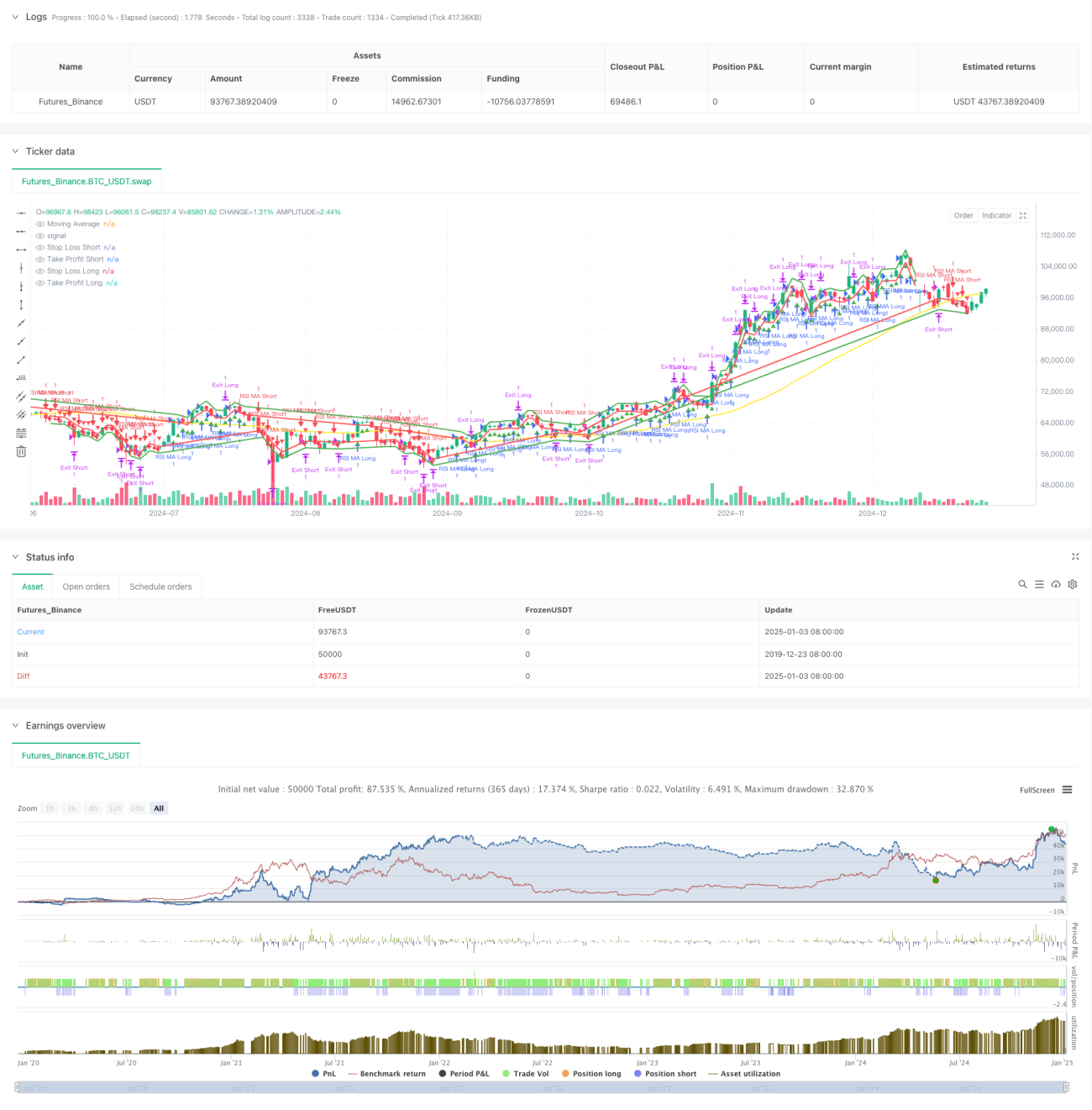
Übersicht
Diese Strategie ist ein Trendfolge-Handelssystem, das den Relative-Stärke-Index (RSI) und den einfachen gleitenden Durchschnitt (SMA) kombiniert. Die Strategie nutzt den gleitenden Durchschnitt, um die Markttrendrichtung zu bestimmen, und verwendet gleichzeitig den RSI zur Bestätigung der Dynamik. So werden Trades ausgeführt, wenn Trend und Dynamik in die gleiche Richtung weisen. Die Strategie verfügt über einen vollständigen Take-Profit- und Stop-Loss-Mechanismus, der eine effektive Risikokontrolle ermöglicht.
Strategieprinzip
Der Kern der Strategie basiert auf dem Zusammenspiel zweier technischer Indikatoren:
- Gleitender Durchschnitt (MA): Dient zur Bestimmung des Gesamttrends. Befindet sich der Kurs über dem MA, wird ein Aufwärtstrend angenommen, andernfalls ein Abwärtstrend.
- Relative-Stärke-Index (RSI): Dient zur Bestätigung der Kursdynamik. Liegt der RSI über einem festgelegten Schwellenwert (z. B. 55), wird eine Aufwärtsdynamik bestätigt; liegt er unter dem Schwellenwert (z. B. 45), wird eine Abwärtsdynamik bestätigt.
Logik der Signalerzeugung:
- Long-Bedingung: Kurs liegt über dem MA und der RSI ist größer als der Kaufs-Schwellenwert.
- Short-Bedingung: Kurs liegt unter dem MA und der RSI ist kleiner als der Verkaufs-Schwellenwert.
Die Risikosteuerung erfolgt über prozentuale Stop-Loss- und Take-Profit-Vorgaben, die als feste Prozentsätze des Einstiegskurses festgelegt werden.
Strategievorteile
- Signalstabilität: Durch die doppelte Bestätigung von Trend und Dynamik werden Fehlsignale wirksam reduziert.
- Umfassendes Risikomanagement: Die festgelegten prozentualen Stop-Loss- und Take-Profit-Werte ermöglichen eine effektive Kontrolle des Risikos pro Trade.
- Parametervielfalt: Schlüsselparameter wie MA-Periode und RSI-Schwellenwerte können je nach Marktcharakteristik optimiert werden.
- Klare Strategielogik: Die Handelsregeln sind einfach und intuitiv, leicht verständlich und umsetzbar.
- Hohe Anpassungsfähigkeit: Kann auf verschiedenen Zeitrahmen angewendet werden.
Strategierisiken
- Trendwenderisiko: An Trendwenden kann es zu einer Reihe von Stopps kommen.
- Seitwärtsmarktrisiko: In einer Seitwärtsbewegung kann es zu häufigen Trades und damit zu Verlusten kommen.
- Parameterabhängigkeit: Die optimalen Parameter können in verschiedenen Marktumgebungen stark variieren.
- Slippage-Risiko: Bei hoher Marktvolatilität kann es zu erheblichen Slippagen kommen.
- Nachlaufen technischer Indikatoren: Sowohl MA als auch RSI haben eine gewisse Verzögerung, was zu einem verspäteten Einstieg führen kann.
Optimierungsmöglichkeiten
- Dynamische Parameteroptimierung: Einführung eines adaptiven Parametermechanismus, der MA-Periode und RSI-Schwellenwerte dynamisch an die Marktvolatilität anpasst.
- Marktumgebungsfilter: Hinzufügen eines Volatilitätsfilters, der bei hoher Volatilität die Positionsgröße anpasst oder den Handel aussetzt.
- Multi-Timeframe-Analyse: Einbeziehung eines längerfristigen Trends zur Bestätigung, um die Genauigkeit der Handelsrichtung zu erhöhen.
- Stop-Loss-Optimierung: Einführung eines Trailing-Stop-Loss, um Gewinne besser zu schützen.
- Signalfilterung: Hinzufügen von Zusatzindikatoren wie Volumen, um die Signale zuverlässiger zu machen.
Zusammenfassung
Die Strategie kombiniert Trend- und Dynamikindikatoren zu einem logisch klaren und risikokontrollierten Handelssystem. Trotz einiger inhärenter Risiken zeigt die Strategie bei angemessener Parametereinstellung und Risikosteuerung eine gute Praxistauglichkeit. Die weiteren Optimierungsansätze konzentrieren sich auf die dynamische Anpassung der Parameter, die Erkennung des Marktumfelds und die Verbesserung der Signalqualität, um die Stabilität und Rentabilität der Strategie weiter zu steigern.
- 1