
Übersicht
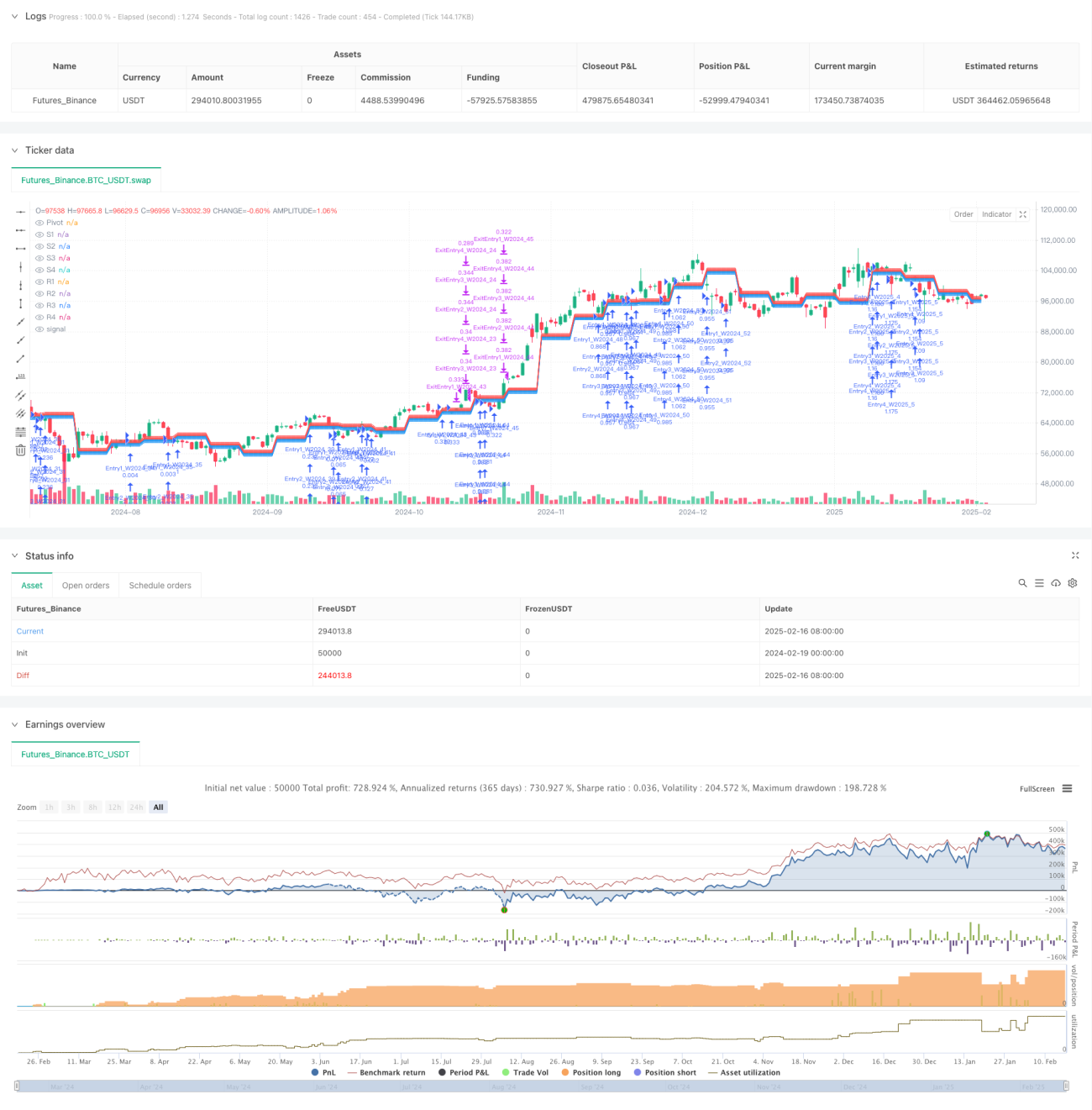
Diese Strategie ist ein Mean-Reversion-Handelssystem, das auf wöchentlichen Pivot-Punkten basiert. Es ermittelt durch Berechnung der wöchentlichen Unterstützungsniveaus (S1–S4) und Widerstandsniveaus (R1–R4) die Einstiegs- und Ausstiegspunkte für den Handel. Die Strategie wendet einen gestaffelten Positionsaufbau an, bei dem zu verschiedenen Unterstützungsniveaus mehrfach gekauft wird und die Gewinne auf den entsprechenden Widerstandsniveaus realisiert werden. Diese Methode nutzt die Volatilitätseigenschaften des Marktes optimal aus und zeigt in Seitwärtsmärkten eine hervorragende Performance.
Strategieprinzip
Der Kern der Strategie ist die Berechnung des wöchentlichen Pivot-Punkts aus dem Höchst-, Tiefst- und Schlusskurs der Vorwoche. Anschließend werden basierend auf einem vorgegebenen Punkteabstand mehrere Unterstützungs- und Widerstandsniveaus bestimmt. Wird ein Unterstützungsniveau berührt, erfolgt ein Kauf, und auf dem entsprechenden Widerstandsniveau wird ein Gewinnziel gesetzt. Die Berechnungsformel lautet:
Pivot-Punkt = (Höchstkurs der Vorwoche + Tiefstkurs der Vorwoche + Schlusskurs der Vorwoche) / 3
Die Strategie erlaubt maximal vier gleichzeitig gehaltene Positionen, jede mit einem eigenen Unterstützungs- und Widerstandsniveau. Alle Positionen werden zu Beginn jeder Woche auf neue Handelsniveaus neu berechnet. Dieses Design gewährleistet sowohl Kontinuität im Handel als auch Anpassungsfähigkeit an Marktveränderungen.
Strategievorteile
- Klare Handelslogik, leicht verständlich und umsetzbar
- Gestaffelter Positionsaufbau senkt das Risiko pro Trade
- Nutzung von Unterstützungs-/Widerstandsniveaus auf Wochenebene reduziert den Einfluss von Intraday-Rauschen
- Parameter können flexibel an unterschiedliche Markteigenschaften angepasst werden
- Risikosteuerung durch prozentuale Positionsgröße
- Kein zeitlicher Zwangsausstieg – bietet ausreichend Raum für Gewinnentfaltung
Strategierisiken
- Kein Stop-Loss gesetzt, was in starken Trendmärkten zu erheblichen Drawdowns führen kann
- Mehrere Positionen können viel Kapital binden
- In hochvolatilen Märkten können Fehlsignale auftreten
- Ungünstige Festlegung der Unterstützungsniveaus kann zu unpassenden Einstiegspositionen führen
Zur Risikominderung wird empfohlen, einen Trendfilter hinzuzufügen, der nur in Aufwärtstrends eröffnet; gleichzeitig könnte ein dynamischer Stop-Loss auf Basis des ATR implementiert werden.
Optimierungsmöglichkeiten
- Einführung einer Volumenbestätigung zur Verbesserung der Zuverlässigkeit von Einstiegssignalen
- Integration von technischen Indikatoren wie RSI zur Überkauft-/Überverkauft-Filterung
- Entwicklung eines Multi-Timeframe-Bestätigungsmechanismus zur Reduzierung von Fehlsignalen
- Optimierung des Positionsmanagements mit dynamischer Anpassung der Positionsgröße an die Marktvolatilität
- Hinzufügen einer Korrelationsanalyse, um gleichzeitige Positionen in hochkorrelierten Märkten zu vermeiden
Zusammenfassung
Diese Strategie ist ein Mean-Reversion-System auf Basis der klassischen technischen Analyse, das Handelsmöglichkeiten durch Rückkehr von wöchentlichen Unterstützungs-/Widerstandsniveaus nutzt. Das Design ist einfach und dennoch flexibel, ideal für Anwendung in volatilen Märkten. Durch geeignete Parameteroptimierung und Risikomanagement kann die Strategie in verschiedenen Marktumgebungen eine stabile Performance erzielen. Händler sollten vor dem Live-Einsatz die Parametereinstellungen gründlich testen und je nach spezifischen Markteigenschaften anpassen.
- 1