Adaptive Bollinger-Band-Gitter-Strategie

Übersicht
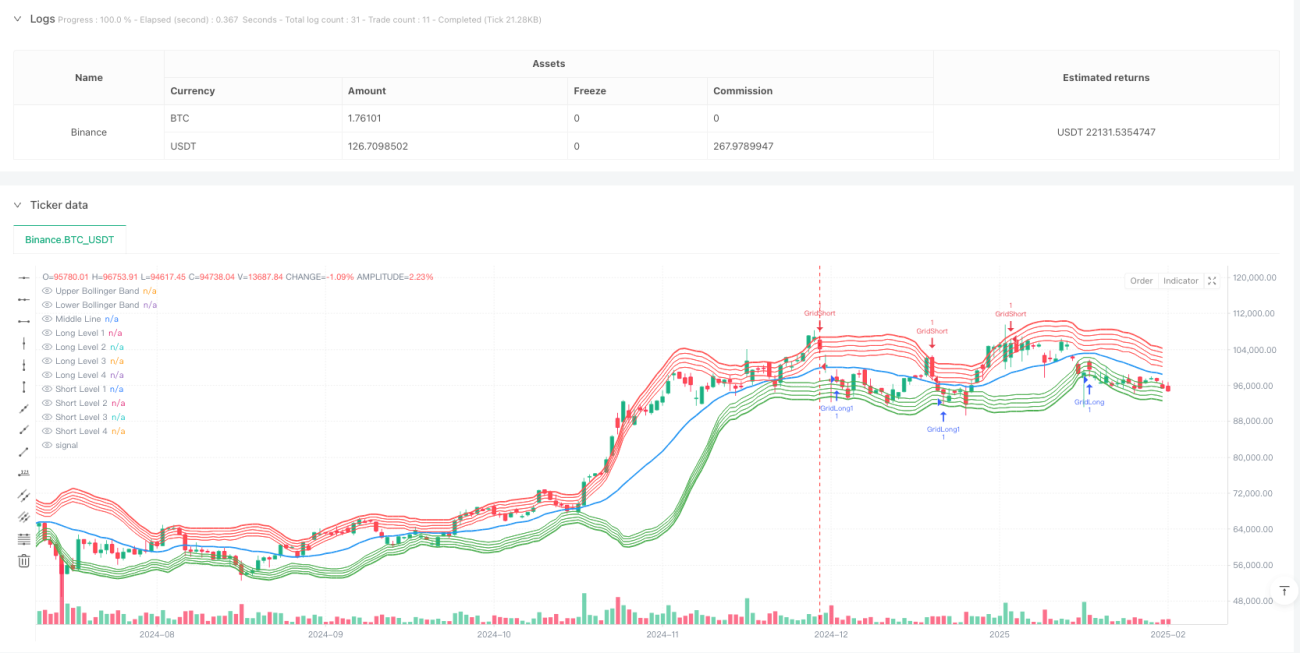
Dies ist eine fortgeschrittene Grid-Trading-Strategie, die auf dem Bollinger-Bänder-Indikator basiert. Die Strategie nutzt die obere und untere Begrenzung sowie die Mittellinie der Bollinger-Bänder, um die Positionen des Grids dynamisch zu bestimmen und den Grid-Abstand automatisch an die Marktvolatilität anzupassen. Wenn der Preis eine Grid-Linie durchbricht, führt das System entsprechende Long- oder Short-Trades aus und realisiert so einen vollautomatischen Grid-Handel.
Strategieprinzip
Die Strategie verwendet einen gleitenden Durchschnitt von 20 Perioden als Mittellinie der Bollinger-Bänder und eine Bandbreite von 2 Standardabweichungen. Auf Basis der Bollinger-Bänder werden zwischen den oberen und unteren Bändern 4 Grid-Stufen mit einem Grid-Abstand von 1 % festgelegt. Wenn der Preis eine Grid-Linie nach oben durchbricht, führt das System einen Long-Trade aus; bei einem Durchbruch nach unten wird ein Short-Trade ausgeführt. Dieses Design ermöglicht es der Strategie, in Seitwärtsmärkten kontinuierlich Gewinne zu erzielen.
Vorteile der Strategie
- Dynamische Anpassung – Die Grid-Positionen verschieben sich mit den Bollinger-Bändern, sodass sich die Strategie an verschiedene Marktbedingungen anpassen kann.
- Kontrollierbares Risiko – Die Bollinger-Bänder begrenzen den Handelsbereich und verhindern eine übermäßige Positionshaltung in extremen Marktphasen.
- Hoher Automatisierungsgrad – Das System führt Trades automatisch aus, ohne manuelles Eingreifen.
- Bidirektionaler Handel – Ermöglicht Gewinne sowohl in steigenden als auch in fallenden Märkten.
- Anpassbare Parameter – Grid-Abstand und Anzahl der Stufen können je nach Bedarf flexibel angepasst werden.
Risiken der Strategie
- Trendmarkt-Risiko – In einseitigen Trendmärkten kann es zu größeren Drawdowns kommen.
- Risiko des Kapitalmanagements – Mehrere gleichzeitig ausgelöste Grids können zu einer Übergewichtung der Positionen führen.
- Slippage-Risiko – Bei starker Marktvolatilität kann der Ausführungskurs vom Grid-Preis abweichen.
- Technisches Risiko – Bollinger-Bänder können falsche Ausbruchssignale liefern.
Lösungen:
- Festlegung einer maximalen Gesamtpositionsgrenze
- Einführung eines Trendfilters
- Optimierung des Auftragsausführungsmechanismus
- Hinzufügen eines Bestätigungssignalfilters
Optimierungsmöglichkeiten der Strategie
- Adaptiver Grid-Abstand – Dynamische Anpassung des Grid-Abstands an die Volatilität.
- Integration von Preis-Volumen-Beziehungen – Optimierung des Einstiegszeitpunkts durch Einbeziehung des Volumenindikators.
- Optimierung des Stop-Loss-Mechanismus – Entwicklung flexiblerer Stop-Loss-Ansätze.
- Optimierung des Kapitalmanagements – Umsetzung eines risikobasierten Positionsmanagements.
- Zusammenwirken mehrerer Zeitrahmen – Einführung eines Mehrfachzeitrahmen-Bestätigungsmechanismus.
Zusammenfassung
Durch die Kombination von Bollinger-Bändern und Grid-Handel realisiert diese Strategie ein automatisiertes Handelssystem, das sowohl Flexibilität als auch Stabilität bietet. Der Kernvorteil der Strategie liegt in ihrer Fähigkeit, sich an verschiedene Marktbedingungen anzupassen und gleichzeitig durch Parameteranpassungen eine Risikokontrolle zu ermöglichen. Obwohl inhärente Risiken bestehen, kann durch kontinuierliche Optimierung und Verbesserung ein robusteres Handelssystem aufgebaut werden.
- 1