Mehrkanalige adaptive Turtle-Trading-Strategie kombiniert mit dynamischer Stop-Loss-Strategie

DC Donchian Channel ATR Turtle-trading
Erstellungsdatum: 2025-03-04 10:15:33 zuletzt geändert: 2025-03-04 10:16:07
Kopie: 0 Klicks: 866
2
konzentrieren Sie sich auf
319
Anhänger

Mehrkanalige adaptive Turtle-Trading-Strategie kombiniert mit dynamischer Stop-Loss-Strategie Mehrkanalige adaptive Turtle-Trading-Strategie kombiniert mit dynamischer Stop-Loss-Strategie

Überblick

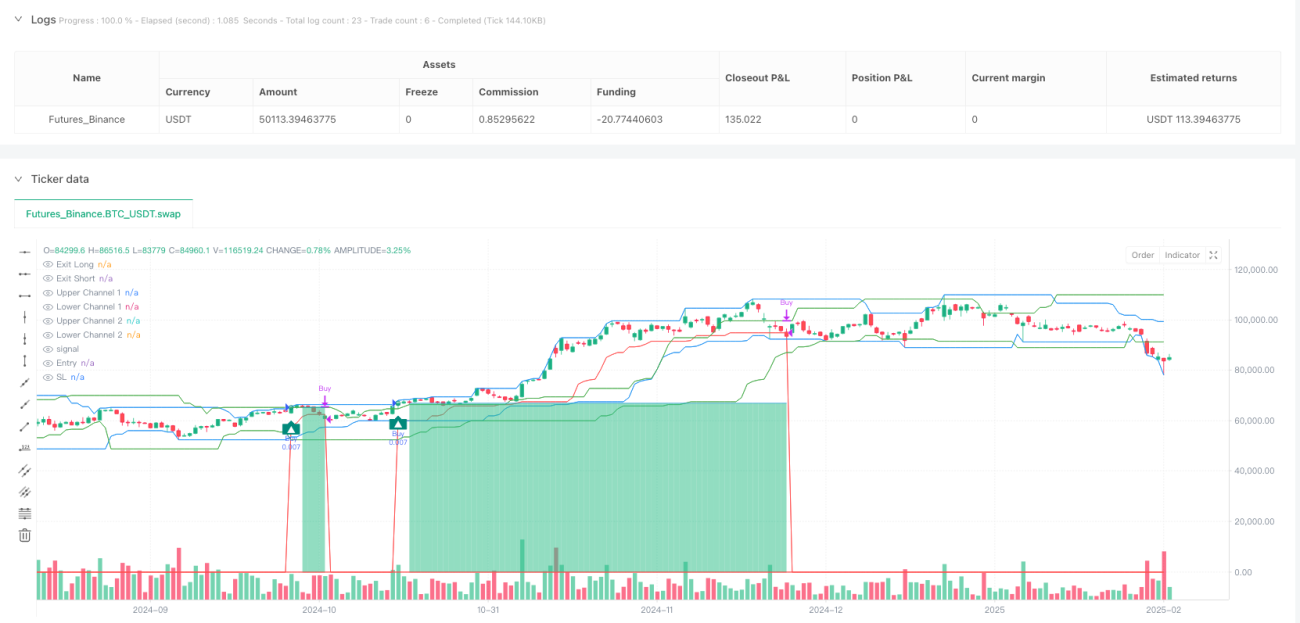
Die Multi-Channel-Adaptive-Sea-Trading-Strategie ist ein modernes Trend-Tracking-System, das auf den klassischen Regeln des Seesaw-Tradings basiert und umfassend optimiert und erweitert wurde. Die Kernstrategie verwendet ein doppeltes Donchian-Kanal-System, um Marktdurchbrüche zu identifizieren und durch dynamisch angepasste Ausstiegskanäle eine genaue Stop-Loss-Position bereitzustellen. Die Strategie wurde mit einem zweistufigen Bestätigungsmechanismus konzipiert: Kanal 1 dient zur Erfassung von kurzfristigen Preisdurchbrüchen, Kanal 2 dient als Bestätigungsfilter, um falsche Signale zu reduzieren.

Strategieprinzip

Die Strategie basiert auf den Kernprinzipien des klassischen Seabird-Handelssystems, aber mit modernen Zwei-Channel-Bestätigungsmechanismen und einem dynamischen Stop-Loss-System:

  1. Zwei-Kanal-Breakthrough-Bestätigung

    • Kanal 1 ((Standard 20 Perioden): Berechnung der Höchst- und Tiefstpreise innerhalb einer bestimmten Periode, die eine obere und untere Grenze bilden.
    • Kanal 2 ((Default 20 Perioden, Abweichung 20): als zweite Ebene Bestätigung, falsche Signale durch Abweichung nach rechts zu reduzieren.
    • Nur wenn der Preis die Grenze von Kanal 1 überschreitet und von Kanal 2 bestätigt wird, wird ein gültiges Signal erzeugt.
  2. Dynamik aus dem Kanal

    • Der Tangjian-Kanal mit kürzerer Periode (Default 10) wird als dynamischer Stopp verwendet.
    • Bei mehrköpfigen Positionen ist der Ausstiegspunkt der niedrigste Punkt des Ganges; bei leeren Positionen ist der Ausstiegspunkt der höchste Punkt des Ganges.
    • Die vollständige Bestätigung der K-Linie ist erforderlich, bevor ein Ausstieg durchgeführt wird, um einen vorzeitigen Ausstieg aufgrund von Preisschall zu vermeiden.
  3. Eintritts- und Ausstiegslogik

    • Multiple Entry: Wenn der Schlusskurs den vorherigen Höchstwert von Channel 1 überschreitet und höher ist als der vorherige Höchstwert von Channel 2.
    • Eintritt mit Leerlauf: Wenn der Schlusskurs den vorläufigen Tiefstpreis des Kanals 1 überschreitet und unter dem vorläufigen Tiefstpreis des Kanals 2 liegt.
    • Mehrfach-Ausgang: Der Preis fällt über den niedrigsten Preis des Ausstiegskanals oder erreicht einen optionalen Stop-Percentage.
    • Leerlauf: Der Preis durchbricht den Höchstpreis des Ausstiegskanals oder erreicht einen optionalen Stop-Percentage.
  4. Vermögensverwaltung

    • Der Standardwert ist 1% des Kontogeldes pro Transaktion, der sich je nach Rückmeldung anpassen lässt.
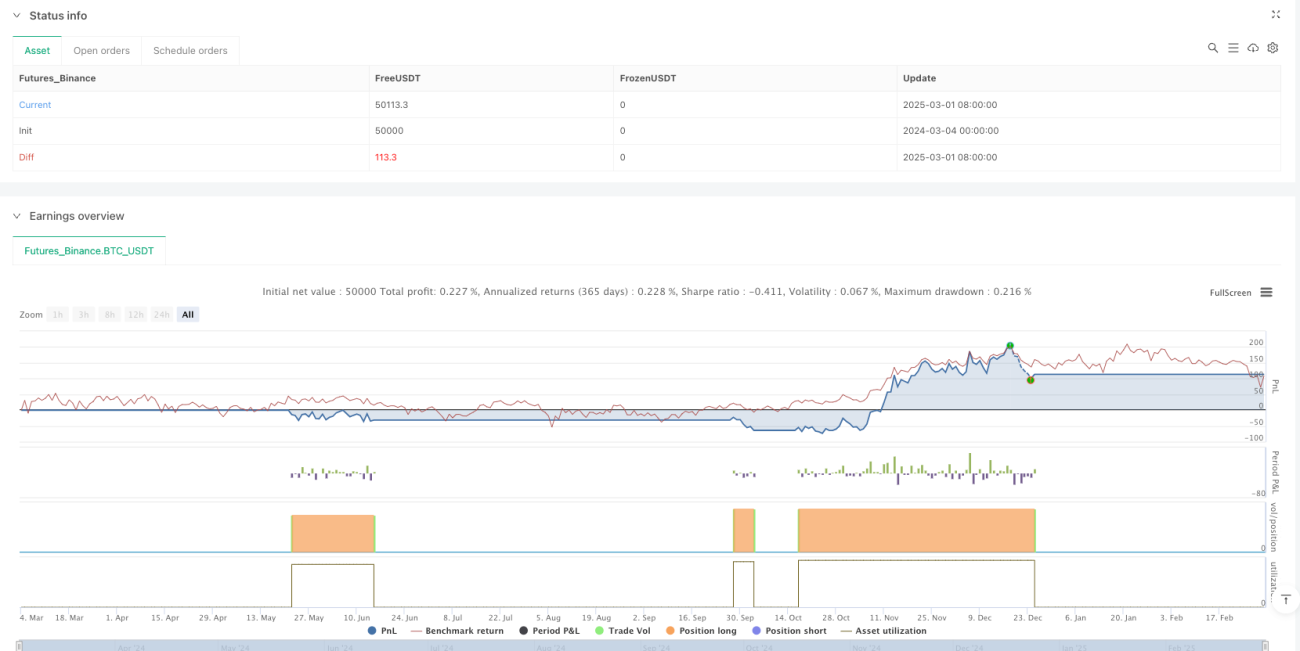
    • Sicherstellen, dass die maximale Rücknahme nicht mehr als 10% beträgt, um die Risiken zu kontrollieren.
    • Berücksichtigen Sie die Provisionen (default 0.1%) und die Gleitpunkte (default 5), um dem realen Umfeld näher zu kommen.

Strategische Vorteile

  1. Verbesserte Signalqualität: Die Zwei-Kanal-Bestätigungsmechanik reduziert die Anzahl der falschen Durchbrüche erheblich und verbessert die Signalqualität und -genauigkeit.buy = buy_fast and close > upper_slow[1]Undsel = sel_fast and close < lower_slow[1]Das ist die Art und Weise, wie das Design erscheint.

  2. Dynamische RisikomanagementDie Strategie verwendet einen adaptiven Ausstiegskanal, der die Stop-Loss-Position an die Dynamik der Marktstruktur anpasst. Wenn sich der Markt vorteilhaft bewegt, folgt der Stop-Loss-Platz automatisch und sperrt einen Teil der Gewinne ein. Dies geschieht durchexit_buy_level:= math.max(nz(exit_buy_level,10e-10), lower_exit)erreichen.

  3. Vollständige FinanzverwaltungDie Strategie beinhaltet professionelle Regeln für die Vermögensverwaltung, die die Risikobereitschaft für jede Transaktion durch eine Prozentsatzverteilung kontrollieren.

  4. Visualisierung der TransaktionsverwaltungStrategie: Die Eintrittspunkte, Stop-Loss-Punkte und Stop-Off-Punkte sind klar auf den Diagrammen markiert, um den Händlern zu helfen, die Handelslogik und die Risiken zu verstehen.

Strategisches Risiko

  1. Schwache MarktentwicklungDer Analysecode zeigt, dass die Doppelkanal-Systeme zwar weniger Falschmeldungen auslösen, aber immer noch mehrere kleine Verlustgeschäfte in Märkten mit unklaren Trends auslösen.

  2. ParameterempfindlichkeitStrategie-Performance ist stark abhängig von den Einstellungen für die Kanal-Zyklus- und Verlagerungsmenge. Unterschiedliche Märkte und Zeitrahmen benötigen unterschiedliche Parameterkombinationen, die eine ausreichende Rückmessung und Optimierung erfordern. Die Parameter werden durch Eingabe in den Code eingegeben_period_dc1_period_dc2Und_period_offDas ist die einzige Möglichkeit, diese wichtigen Variablen zu kontrollieren.

  3. Rückstandsrisiken: Dynamische Stop-Loss-Kanäle können in stark schwankenden Märkten nicht schnell genug reagieren, was zu einer Ausweitung der Rücknahme führt.barstate.isconfirmedDie beste Ausgangszeit könnte in einem hochschwankenden Umfeld verpasst werden.

  4. Übermäßige Abhängigkeit von historischen ModellenDie Strategie geht davon aus, dass die historische Durchbruchsmethode auch in Zukunft wirksam sein wird, aber die Merkmale des Marktes können sich mit der Zeit ändern und die Strategie beeinflussen.

Richtung der Strategieoptimierung

  1. Trendfilter hinzufügenDie Code-Analyse zeigt, dass die aktuelle Strategie keine Beurteilung der Gesamtmarkttrends hat. Es wird empfohlen, Trendindikatoren wie beispielsweise Moving Averages, ADX oder MACD zu verwenden, um die Strategie bei starken Trends zu aktivieren und die Sensitivität bei schwachen Trends oder in bewegten Märkten zu verringern.

  2. Anpassung an die DurchgangszyklenDerzeit verwendet die Strategie einen festen Zykluswert. Die Optimierungsrichtung ist die Einführung von Adaptionskanalzyklen, die auf der ATR oder der Marktfluktuation basieren, um die Strategie besser an unterschiedliche Marktumgebungen anzupassen. Dies kann durch Modifizierung erfolgen_period_dc1Und_period_dc2Die Berechnungsmethode ist umsetzbar.

  3. Optimierung der AusstiegsmechanismenDie Code-Exit-Logik beruht ausschließlich auf dem Tangjian-Kanal. Es wird empfohlen, eine schrittweise Exit-Strategie zu implementieren, z. B. die Positionen eines Teils der Position nach Erreichen eines gewissen Gewinns zu platzieren und für den Rest einen lockeren Nachschub zu setzen.

  4. Zeit-FilterEs ist wichtig, dass Sie die Zeit des Handels filtern, um Zeiten zu vermeiden, in denen die Märkte wenig oder sehr volatil sind. Besonders für den Kryptowährungsmarkt, in dem 24-Stunden-Handel stattfindet, können bestimmte Zeiten besser geeignet sein, um Geschäfte zu tätigen.

  5. Integration der EmotionsindikatorenIntegration von Marktstimmungskennzahlen wie Transaktionsvolumen, Volatilität oder Kapitalfluss, um Ein- und Ausstiegsentscheidungen zu verstärken. Beispielsweise erhöht das Gewicht auf brechende Signale mit hohem Transaktionsvolumen oder reduziert die Handelsfrequenz in einem Umfeld mit außergewöhnlich niedriger Volatilität.

Zusammenfassen

Die Multi-Channel-Automatische-Beige-Trading-Strategie ist ein modernes, umfassendes Trend-Tracking-System, das viele der Herausforderungen der traditionellen Beige-Trading-Regel durch ein Dual-Channel-Bestätigungsmechanismus und dynamische Stop-Losses löst. Die Strategie eignet sich besonders für mittel- und langfristige Trend-Händler und ist stabiler auf höheren Zeitrahmen wie H4 oder Tageszeilen. Die erfolgreiche Integration von 3 Commas in die Strategie macht sie zu einer idealen Option für automatisierte Trades und reduziert die emotionalen Störungen durch Menschen.

Obwohl die Performance in einem turbulenten Markt schwach sein kann, kann die Gesamtperformance durch die richtige Parameteroptimierung und zusätzliche Trendfilter deutlich verbessert werden. Das Geldmanagementmodul der Strategie stellt sicher, dass das Risiko effektiv kontrolliert wird, während das dynamische Stop-Loss-System hilft, die erzielten Gewinne zu schützen.

Dies ist eine Strategie, die von Händlern in Betracht gezogen werden sollte, die Trends unter verschiedenen Marktbedingungen erfassen möchten, insbesondere wenn sie in Kombination mit anderen Marktanalyse-Tools verwendet werden. Denken Sie daran, dass jede Strategie an die persönliche Risikobereitschaft und die Handelsziele angepasst werden muss und dass vor dem Einsatz der tatsächlichen Gelder ausreichend Rückmeldung und Simulation des Handels erforderlich ist.

Strategiequellcode
/*backtest
start: 2024-03-04 00:00:00
end: 2025-03-02 08:00:00
period: 1d
basePeriod: 1d
exchanges: [{"eid":"Futures_Binance","currency":"BTC_USDT"}]
*/

// This Pine Script™ code is subject to the terms of the Mozilla Public License 2.0 at https://mozilla.org/MPL/2.0/
// © 3Commas

//@version=6
// Strategy configuration: sets properties for the strategy like title, overlay, pyramiding, calculation mode, and risk parameters.
strategy(title                        = "[3Commas] Turtle Strategy"
       , overlay                      = true
       , pyramiding                   = 0  
       , calc_on_order_fills          = false
       , calc_on_every_tick           = true
       , default_qty_type             = strategy.percent_of_equity
       , default_qty_value            = 1
       , initial_capital              = 10000
       , slippage                     = 5
       , commission_type              = strategy.commission.percent
       , commission_value             = 0.1
       , use_bar_magnifier            = true
       , fill_orders_on_standard_ohlc = true
     )

// ――――――――――――――――――――――――――――――――――――――――――――――――――――――――――――――――――――――――――――――――――――――――――――――――――――――――――――――――――――
// 🟦 Inputs
// ――――――――――――――――――――――――――――――――――――――――――――――――――――――――――――――――――――――――――――――――――――――――――――――――――――――――――――――――――――

// Define menu options for strategy testing
var menu_buy       = "🟢 Long"
var menu_sel       = "🔴 Short"
var menu_buy_sell  = "🟢 Long & 🔴 Short"  
var menu_none      = "🟤 None"
var group_settings = '🟦 Settings'
var group_test     = '🟦 Strategy Tester'

// Input parameters for the channels and exit period
_period_dc1  = input.int(20, "Period Channel 1"    , group = group_settings, inline = '' , display = display.none, tooltip ='Channel 1 Period.')
_period_dc2  = input.int(20, "Period Channel 2    ", group = group_settings, inline = '2', display = display.none, tooltip ='Channel 2 Period and offset to the right.')
_period_off  = input.int(20, "Offset"              , group = group_settings, inline = '2', display = display.none)
_period_exit = input.int(10, "Period Exit"         , group = group_settings, inline = '' , display = display.none, tooltip ='Exit Period (Trailing).')

// Input parameters for strategy testing options
_test_pos_type  = input.string(       title= 'Strategy          '    , group=group_test, inline = 'o' , defval  = menu_buy_sell, options=[menu_buy_sell, menu_buy, menu_sel, menu_none], tooltip = 'Order Type direction in which trades are executed.')
_tp_use         = input.bool  (false, title= "Take Profit %"         , group=group_test, inline = 'tp', tooltip = 'When activated, the entered value will be used as the Take Profit in percentage from the entry price level.')
_tp_percent     = input.float (20   , title= ""                      , group=group_test, inline = 'tp', display = display.none)


// ――――――――――――――――――――――――――――――――――――――――――――――――――――――――――――――――――――――――――――――――――――――――――――――――――――――――――――――――――――
// 🟦 Logic
// ――――――――――――――――――――――――――――――――――――――――――――――――――――――――――――――――――――――――――――――――――――――――――――――――――――――――――――――――――――

// Calculate take profit levels if enabled; otherwise set to not available (na)
tp_buy = _tp_use?close * (1 + _tp_percent / 100) : na 
tp_sel = _tp_use?close * (1 - _tp_percent / 100) : na

// Calculate fast and slow channel extremes and exit levels
upper_fast = ta.highest(high, _period_dc1)
lower_fast = ta.lowest (low , _period_dc1)
upper_slow = ta.highest(high, _period_dc2)[_period_off]
lower_slow = ta.lowest (low , _period_dc2)[_period_off]
upper_exit = ta.highest(high, _period_exit)
lower_exit = ta.lowest (low , _period_exit)

// Determine if there is a crossover or crossunder for fast and slow channels
buy_fast = ta.crossover (close, upper_fast[1]) and barstate.isconfirmed
sel_fast = ta.crossunder(close, lower_fast[1]) and barstate.isconfirmed
buy_slow = ta.crossover (close, upper_slow[1]) and barstate.isconfirmed
sel_slow = ta.crossunder(close, lower_slow[1]) and barstate.isconfirmed

// Initialize variables to track if we are in a long or short position
var inbuy  = false
var insel  = false

// Conditions to enter long or short positions based on fast signals and slow channel confirmation
buy  = buy_fast and close>upper_slow[1] and not inbuy
sel  = sel_fast and close<lower_slow[1] and not insel

// Update position flags if a trade is executed
inbuy := buy? true:inbuy
insel := sel? true:insel

// Plot shapes on the chart for long and short signals using circles and labels
plotshape(buy ?close:na, title="Label Long" , style=shape.circle   , location= location.absolute, color=color.new(color.teal, 0), text='' , textcolor=color.white, size= size.auto, offset=0, editable=true)
plotshape(sel ?close:na, title="Label Short", style=shape.circle   , location= location.absolute, color=color.new(color.red , 0), text='' , textcolor=color.white, size= size.auto, offset=0, editable=true)
plotshape(buy ?close:na, title="Label Long" , style=shape.labelup  , location= location.belowbar, color=color.new(color.teal, 0), text='▲', textcolor=color.white, size= size.auto, offset=0, editable=true)
plotshape(sel ?close:na, title="Label Short", style=shape.labeldown, location= location.abovebar, color=color.new(color.red , 0), text='▼', textcolor=color.white, size= size.auto, offset=0, editable=true)

// Initialize take profit, stop loss, and exit levels for both long and short positions
var tp = float(na)
var sl = float(na)
var exit_buy_level = float(na)
var exit_sel_level = float(na)

// Set take profit levels when a new long or short signal is triggered
if buy
    tp := tp_buy

if sel
    tp := tp_sel

// For long positions, update the exit level based on the lowest exit channel
if inbuy
    exit_buy_level:= math.max(nz(exit_buy_level,10e-10), lower_exit)
    sl:= exit_buy_level

// For short positions, update the exit level based on the highest exit channel
if insel 
    exit_sel_level:= math.min(nz(exit_sel_level,10e+10), upper_exit)
    sl:= exit_sel_level    

// Check for exit conditions when price crosses the exit levels
exit_buy_pos = ta.crossunder(close,exit_buy_level) 
exit_sel_pos = ta.crossover (close,exit_sel_level)        

// Confirm exit conditions when in a position
exit_buy_close = inbuy and exit_buy_pos and barstate.isconfirmed
exit_sel_close = insel and exit_sel_pos and barstate.isconfirmed

// Check for take profit exit conditions for long and short positions
buy_tp_exit = (inbuy[1]  and high>= tp and not buy)
sel_tp_exit = (insel[1]  and low <= tp and not sel)

// Plot channel bands and exit levels on the chart (set to not display by default)
plot(upper_fast    , title="Upper Channel 1", color=color.blue , display = display.none)
plot(lower_fast    , title="Lower Channel 1", color=color.blue , display = display.none)
plot(upper_slow    , title="Upper Channel 2", color=color.green, display = display.none)
plot(lower_slow    , title="Lower Channel 2", color=color.green, display = display.none)
plot(exit_buy_level, title="Exit Long"      , color=color.red  , display = display.none, style = plot.style_linebr)
plot(exit_sel_level, title="Exit Short"     , color=color.red  , display = display.none, style = plot.style_linebr)

// ――――――――――――――――――――――――――――――――――――――――――――――――――――――――――――――――――――――――――――――――――――――――――――――――――――――――――――――――――――
// 🟦 Strategy Tester
// ――――――――――――――――――――――――――――――――――――――――――――――――――――――――――――――――――――――――――――――――――――――――――――――――――――――――――――――――――――


// Conditions for testing buy and sell signals
test_buy =  buy
test_sel = sel
test_tp  = tp
test_sl  = sl

// Track the average entry price for the current position
test_en = strategy.position_avg_price

// Determine if the stop loss should be adjusted based on the current position and entry price
savestop = (strategy.position_size>0 and test_sl>test_en) or (strategy.position_size<0 and test_sl<test_en)

// Execute strategy entries based on the test conditions and selected position type
if test_buy and _test_pos_type != menu_sel and _test_pos_type != menu_none
    strategy.entry ("Buy" , strategy.long)
if test_sel and _test_pos_type != menu_buy and _test_pos_type != menu_none
    strategy.entry ("Sell", strategy.short)

// Close positions based on exit signals
if exit_buy_close
    strategy.close("Buy") 

if exit_sel_close
    strategy.close("Sell")

// Set strategy exits using take profit conditions; stop loss is not used in these exits
strategy.exit("Exit Buy" , "Buy" , limit= test_tp, stop = na)
strategy.exit("Exit Sell", "Sell", limit= test_tp, stop = na)

// Define colors for plotting stop loss lines based on the savestop condition
test_sl_col = savestop?color.new(color.teal,50 ):color.new(color.red ,50)
// Check if there is no trade, based on changes in entry price or if entry price is not available
notrade = test_en!=test_en[1] or na(test_en)

// Plot entry price, stop loss, and take profit on the chart
plot_en = plot(notrade?na:test_en, title = 'Entry', color = color.new(color.blue,50 ), style = plot.style_linebr)
plot_sl = plot(notrade?na:test_sl, title = 'SL'   , color = test_sl_col                , style = plot.style_linebr)
plot_tp = plot(notrade?na:test_tp, title = 'TP'   , color = color.new(color.teal,100), style = plot.style_linebr)

// Fill the background between the take profit and entry lines
fill(plot_tp, plot_en, test_tp, test_en, notrade?na:color.new(color.teal,50 ), notrade?na:color.new(color.teal,100), fillgaps = false, title = 'Trade Background')
// Fill the background between the entry and stop loss lines
fill(plot_en, plot_sl, test_en, test_sl, notrade?na:savestop?color.new(color.teal ,100):color.new(color.red ,100), notrade?na:savestop?color.new(color.teal ,50):color.new(color.red ,50 ), fillgaps = false, title = 'Trade Background')

// Reset variables when an exit condition is met for a long position
if exit_buy_close or buy_tp_exit
    exit_buy_level:= float(na)
    tp            := float(na)
    sl            := float(na) 
    inbuy         := false

// Reset variables when an exit condition is met for a short position
if exit_sel_close or sel_tp_exit
    exit_sel_level:= float(na)
    tp            := float(na)
    sl            := float(na) 
    insel         := false  

// ――――――――――――――――――――――――――――――――――――――――――――――――――――――――――――――――――――――――――――――――――――――――――――――――――――――――――――――――――――
// 🟦 3Commas Integration  
// ――――――――――――――――――――――――――――――――――――――――――――――――――――――――――――――――――――――――――――――――――――――――――――――――――――――――――――――――――――

// This section integrates the strategy with 3Commas DCA Bot signals.

// Tutorial text for integration instructions
var c3_tuto =  "Here you can enable the table to review the messages to be sent to the bot, as well as change the background color and text color."
              +'\n\n🤖 𝗛𝗼𝘄 𝘁𝗼 𝘂𝘀𝗲 𝗗𝗖𝗔 𝗕𝗼𝘁 𝗦𝗶𝗴𝗻𝗮𝗹𝘀'
              +'\n      ¯¯¯¯¯¯¯¯¯¯¯¯¯¯¯¯¯¯¯¯¯¯¯¯'
              +  '\n🔹Verify Messages: Ensure the message matches the one specified by the DCA Bot.'
              +'\n\n🔹Multi-Pair Configuration: For multi-pair setups, enable the option to add the symbol in the correct format.'
              +'\n\n🔹Signal Settings: Enable whether you want to receive long or short signals (Entry | TP | SL), copy and paste the the messages for the DCA Bots configured in 3Commas.'        
              +'\n\n🔹Alert Setup:'         
              +'\n\n- When creating an alert, set the condition to the indicator and choose "alert() function call only."'                  
              +'\n\n- Enter any desired Alert Name.'                                           
              +'\n\n- Open the Notifications tab, enable Webhook URL, and paste the Webhook URL from 3Commas.'                         
              +'\n\n- For more details, refer to the 3Commas section: "How to use TradingView Custom Signals."'  
              +"\n\n🔹Finalize Alerts: Click Create, you're done! Alerts will now be sent automatically in the correct format to 3Commas."

// Predefined JSON messages for bot signals for both entry and exit in long and short positions
var c3_text_buy_entry = '{  "message_type": "bot",  "bot_id": 15743097,  "email_token": "b9ed9d7d-7777-42ed-a0a6-608f4ecedf82",  "delay_seconds": 0}'
var c3_text_sel_entry = '{  "message_type": "bot",  "bot_id": 15743017,  "email_token": "b9ed9d7d-7777-42ed-a0a6-608f4ecedf82",  "delay_seconds": 0}'
var c3_text_buy_exit  = '{  "action": "close_at_market_price",  "message_type": "bot",  "bot_id": 15743097,  "email_token": "b9ed9d7d-7777-42ed-a0a6-608f4ecedf82",  "delay_seconds": 0}'
var c3_text_sel_exit  = '{  "action": "close_at_market_price",  "message_type": "bot",  "bot_id": 15743017,  "email_token": "b9ed9d7d-7777-42ed-a0a6-608f4ecedf82",  "delay_seconds": 0}'

// Define emojis for visual signals
var emog  = '🟢'
var emor  = '🔴'
var emof  = '🏁'
var read = 'Check Messages, Please Read 👉'

// Input settings for the integration table and signal customization
group_c3            = '🟦 DCA Bot Signals'  
_c3_tuto            = input.bool  (false            , title=  read                    , group=group_c3, inline='h', display = display.none, tooltip = c3_tuto)
_c3_size            = input.string('Normal'         , title= ' ↳ Size'                , group=group_c3, inline='' , display = display.none, options=['Tiny','Small','Normal','Large','Huge'])
_c3_pos             = input.string('Bottom Center'  , title= ' ↳ Position'            , group=group_c3, inline='' , display = display.none, options=['Top Left','Top Center','Top Right','Middle Left','Middle Center','Middle Right','Bottom Left','Bottom Center','Bottom Right'])
_c3_col1            = input.color(#1F1F1F         , title= ' ↳ Colors    '          , group=group_c3, inline='c', display = display.none)
_c3_col2            = input.color(color.white     , title= ''                       , group=group_c3, inline='c', display = display.none)
_c3_buy_entry       = input.bool  (true             , title= emog+' Buy Entry       ' , group=group_c3, inline='b', display = display.none, tooltip= 'Enable this options to send Buy Entry, Take Profit (TP), and Stop Loss (SL) signals to 3Commas.')
_c3_buy_tp          = input.bool  (true             , title=      'TP'                , group=group_c3, inline='b', display = display.none)
_c3_buy_sl          = input.bool  (true             , title=      'SL'                , group=group_c3, inline='b', display = display.none)
_c3_text_buy_entry  = input.string(c3_text_buy_entry, title= ' ↳ Deal Entry'          , group=group_c3, inline= '', display = display.none, tooltip= 'Long DCA Bot: Copy and paste the message for the deal start signal of the DCA Bot you created in 3Commas.')
_c3_text_buy_exit   = input.string(c3_text_buy_exit , title= ' ↳ Deal Exit'           , group=group_c3, inline= '', display = display.none, tooltip= 'Long DCA Bot: Copy and paste the message to close order at Market Price of the DCA Bot you created in 3Commas.')
_c3_sel_entry       = input.bool  (true             , title= emor+' Sell Entry       ', group=group_c3, inline='s', display = display.none, tooltip= 'Enable this options to send Sell Entry, Take Profit (TP), and Stop Loss (SL) signals to 3Commas.')
_c3_sel_tp          = input.bool  (true             , title=      'TP'                , group=group_c3, inline='s', display = display.none)
_c3_sel_sl          = input.bool  (true             , title=      'SL'                , group=group_c3, inline='s', display = display.none)
_c3_text_sel_entry  = input.string(c3_text_sel_entry, title= ' ↳ Deal Entry'          , group=group_c3, inline= '', display = display.none, tooltip= 'Short DCA Bot: Copy and paste the message for the deal start signal of the DCA Bot you created in 3Commas.')
_c3_text_sel_exit   = input.string(c3_text_sel_exit , title= ' ↳ Deal Exit'           , group=group_c3, inline= '', display = display.none, tooltip= 'Short DCA Bot: Copy and paste the message to close order at Market Price of the DCA Bot you created in 3Commas.')
_c3_entry_bot_use   = input.bool  (false            , title= 'DCA Bot Multi-Pair'     , group=group_c3, inline= '', display = display.none, tooltip = 'You must activate it if you want to use the signals in a DCA Bot Multi-pair \n\nIn the text box you must enter (using the 3Commas format) the symbol in which you are creating the alert, you can check the format of each symbol when you create the bot.\n\nBefore creating the alert, verify that the message is the same as the one specified in the DCA bot, using the summary option.')
_c3_entry_bot_mult  = input.string('USDT_BTC'       , title= ' ↳ Symbol'              , group=group_c3, inline= '', display = display.none)

// Function to determine label size based on the selected menu option
LabelSize (size_menu_)=>
    switch size_menu_
        'Auto'   => size.auto
        'Tiny'   => size.tiny
        'Small'  => size.small
        'Normal' => size.normal
        'Large'  => size.large
        'Huge'   => size.huge

// Function to determine table position based on the selected menu option
TablePosition (pos_menu_)=>
    switch pos_menu_ 
        'Top Left'      => position.top_left      
        'Top Center'    => position.top_center    
        'Top Right'     => position.top_right     
        'Middle Left'   => position.middle_left   
        'Middle Center' => position.middle_center 
        'Middle Right'  => position.middle_right  
        'Bottom Left'   => position.bottom_left    
        'Bottom Center' => position.bottom_center  
        'Bottom Right'  => position.bottom_right

// Function to trim the JSON message and add the pair if multi-pair is enabled
TrimPair(txt_, multipair_, pair_) =>
    trim  = txt_
    check =  str.contains(trim,'delay_seconds') and 
             str.contains(trim,'email_token'  ) and 
             str.contains(trim,'bot_id'       ) and 
             str.contains(trim,'message_type' )
    if check
        del   = array.get(str.split(trim, '"delay_seconds": 0'), 1)
        trim := str.replace(trim, del, '', 0)
        pair  = ', "pair": '+ '"' + str.replace_all(pair_, ' ', '')+ '"'
        trim := trim + (multipair_? pair: '') + '}'  
    trim 

// Function to format JSON for a nicer display by adding new lines and spacing
JsonFormat(json_)=>
    nice  = json_
    check =  str.contains(nice,'delay_seconds') and 
             str.contains(nice,'email_token'  ) and 
             str.contains(nice,'bot_id'       ) and 
             str.contains(nice,'message_type' )
    if check 
        nice := str.replace_all(nice, ' ', ''    )
        nice := str.replace_all(nice, ',', ',\n ')
        nice := str.replace_all(nice, '{', '{\n ')
        nice := str.replace_all(nice, '}', '\n}' )
        nice := str.replace_all(nice, ':', ': '  )
    nice    

// Define conditions to send signals based on entry and exit signals
c3_en_buy =  _c3_buy_entry and buy
c3_ex_buy = (_c3_buy_tp and buy_tp_exit) or (_c3_buy_sl and exit_buy_close)

c3_en_sel =  _c3_sel_entry and sel
c3_ex_sel = (_c3_sel_tp and sel_tp_exit) or (_c3_sel_sl and exit_sel_close)

// Format the messages for both entry and exit, applying multi-pair configuration if enabled
var c3_buy_dealstart   = JsonFormat(TrimPair(_c3_text_buy_entry, _c3_entry_bot_use, _c3_entry_bot_mult))
var c3_buy_closemarket = JsonFormat(TrimPair(_c3_text_buy_exit , _c3_entry_bot_use, _c3_entry_bot_mult))
var c3_sel_dealstart   = JsonFormat(TrimPair(_c3_text_sel_entry, _c3_entry_bot_use, _c3_entry_bot_mult))
var c3_sel_closemarket = JsonFormat(TrimPair(_c3_text_sel_exit , _c3_entry_bot_use, _c3_entry_bot_mult))

// Send alerts for buy and sell entries and exits based on conditions
switch
    c3_en_buy => alert(c3_buy_dealstart  , alert.freq_once_per_bar)
    c3_ex_buy => alert(c3_buy_closemarket, alert.freq_once_per_bar)

switch
    c3_en_sel => alert(c3_sel_dealstart  , alert.freq_once_per_bar)
    c3_ex_sel => alert(c3_sel_closemarket, alert.freq_once_per_bar)  
 
// Create a table with the signal messages for user review
if barstate.isfirst and _c3_tuto 
    var bg =  _c3_col1
    var tx =  _c3_col2
    var gr = color.green
    var re = color.red 
    var hw = 'How to use 3Commas DCA Bot Signals 🤖'
    var ms = '🤖 DCA Bot Signals Messages '
    var ds = 'Deal start signal'
    var me = 'Close order at Market Price'
    var c3_table = table.new(TablePosition (_c3_pos), 6, 6, border_width=1, frame_width=1,border_color = color.new(color.black,0), frame_color = color.new(color.black,0))  
    table.cell(c3_table, 1, 1, ms                  , text_color=tx, text_halign=text.align_center, text_size = LabelSize(_c3_size), bgcolor = bg)
    table.cell(c3_table, 1, 2, ds                  , text_color=tx, text_halign=text.align_center, text_size = LabelSize(_c3_size), bgcolor = bg, width=0)
    table.cell(c3_table, 1, 3, me                  , text_color=tx, text_halign=text.align_center, text_size = LabelSize(_c3_size), bgcolor = bg, width=0)
    table.cell(c3_table, 2, 1, 'Long Bot Messages' , text_color=gr, text_halign=text.align_center, text_size = LabelSize(_c3_size), bgcolor = bg)
    table.cell(c3_table, 2, 2, c3_buy_dealstart    , text_color=tx, text_halign=text.align_left  , text_size = LabelSize(_c3_size), bgcolor = bg, text_font_family= font.family_monospace)
    table.cell(c3_table, 2, 3, c3_buy_closemarket  , text_color=tx, text_halign=text.align_left  , text_size = LabelSize(_c3_size), bgcolor = bg, text_font_family= font.family_monospace)
    table.cell(c3_table, 3, 1, 'Short Bot Messages', text_color=re, text_halign=text.align_center, text_size = LabelSize(_c3_size), bgcolor = bg)
    table.cell(c3_table, 3, 2, c3_sel_dealstart    , text_color=tx, text_halign=text.align_left  , text_size = LabelSize(_c3_size), bgcolor = bg, text_font_family= font.family_monospace)
    table.cell(c3_table, 3, 3, c3_sel_closemarket  , text_color=tx, text_halign=text.align_left  , text_size = LabelSize(_c3_size), bgcolor = bg, text_font_family= font.family_monospace)