Adaptive dynamische KDJ-Indikatorstrategie mit mehreren Zeitrahmen

MTF-ADK ATR EMA KDJ TSL
Erstellungsdatum: 2025-04-03 14:27:21 zuletzt geändert: 2025-04-03 15:13:59
Kopie: 0 Klicks: 429
2
konzentrieren Sie sich auf
319
Anhänger

Adaptive dynamische KDJ-Indikatorstrategie mit mehreren Zeitrahmen Adaptive dynamische KDJ-Indikatorstrategie mit mehreren Zeitrahmen

Überblick

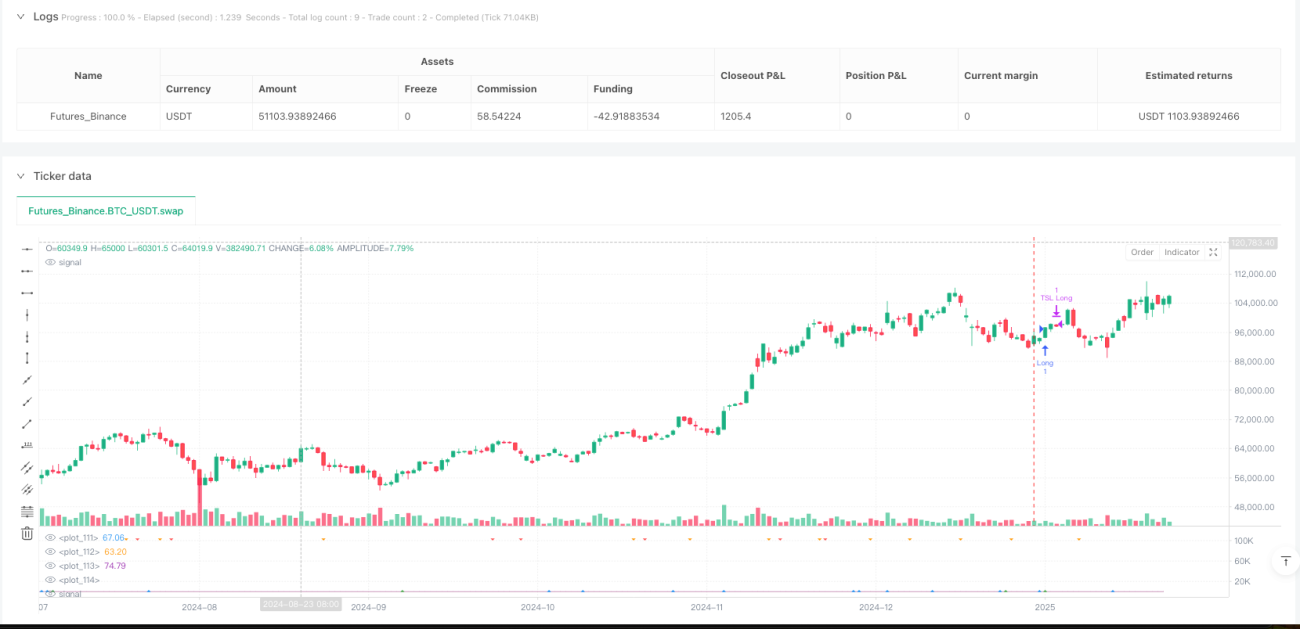
Es handelt sich um eine innovative Multi-Time-Framework-Adaptive-KDJ-Schock-Indikator-Strategie, die durch die dynamische Anpassung der Indikatorparameter und die Analyse von Markttrends über mehrere Zeiträume ein genaueres und flexibleres Handelssignal bietet. Die Strategie kombiniert Volatilitäts-basierte Längeberechnung, Gewichtsverteilung über mehrere Zeiträume und Adaptive-Trend-Urteil, um den Händlern ein komplexes und leistungsfähiges Analyse-Tool zur Verfügung zu stellen.

Strategieprinzip

Die Kernprinzipien der Strategie umfassen folgende Schlüsseltechnologien:

  1. Multi-Zeitrahmen-Analyse: drei Zeitrahmen von 1, 5 und 15 Minuten gleichzeitig
  2. Berechnung der adaptiven Swing-Längen: Indikatorparameter, die sich dynamisch an Marktfluktuationen anpassen
  3. Dynamische Gewichtsverteilung: Verteilung von Gewichtskoeffizienten für verschiedene Zeitrahmen
  4. Trendbeurteilungsmechanismus: Bestimmung der Richtung des Markttrends durch Berechnung des Durchschnitts der Smooth AvgTotal
  5. Intelligente Signalerzeugung: Kombination von Hauptsignal und Erwartungssignal zur Verbesserung der Signalgenauigkeit

Strategische Vorteile

  1. Hohe Flexibilität: Anpassbare Zeitrahmen und Gewichtskonfigurationen
  2. Dynamische Anpassungsfähigkeit: Anpassung der Indikatorparameter an die Marktschwankungen
  3. Mehrdimensionale Analyse: Zusammenfassung von Informationen über mehrere Zeitrahmen
  4. Niedrig verzögerte Signale: beinhaltet Hauptsignale und erwartete Signale
  5. Eingebettete Trendfilter: Verringerung von Fehlsignalen bei ungünstigen Marktbedingungen

Strategisches Risiko

  1. Gefahr einer Parameterüberfülle
  2. Mehrfache Zeitrahmen können die Signalkomplexität erhöhen
  3. Die Signalzuverlässigkeit kann unter extremen Marktbedingungen gesenkt werden
  4. Zusätzliche Bestätigung der Kennzahlen für die Bestätigungssignale erforderlich

Richtung der Strategieoptimierung

  1. Einführung eines dynamisch angepassten Gewichts für eine maschinelle Lernalgorithmus
  2. Zusätzliche Filterbedingungen hinzugefügt
  3. Optimierung der Stop-Loss-Mechanismen
  4. Entwicklung von Anpassungsfähigkeit zwischen den Arten

Zusammenfassen

Der Multi-Time-Framework passt sich an die Strategie des KDJ-Schockindikators an und bietet den Händlern ein flexibles, dynamisches und mehrdimensionales Marktanalyse-Tool mit signifikanten technischen Vorteilen und potenziellen Möglichkeiten zur Leistungssteigerung.

Strategiequellcode
/*backtest
start: 2025-01-01 00:00:00
end: 2025-01-25 00:00:00
period: 1d
basePeriod: 1d
exchanges: [{"eid":"Futures_Binance","currency":"BTC_USDT"}]
*/

// This Pine Script™ is subject to the Mozilla Public License 2.0 (https://mozilla.org/MPL/2.0/)
// © Lausekopf

//@version=5
strategy("Adaptive KDJ (MTF)", overlay=false)

// Dropdown for the swing length calculation method
method = input.int(1, title="Calculation Method", options=[1, 2, 3], tooltip="1: Volatility Based\n2: Inverse Volatility\n3: Fixed Length")

// Fixed length for method 3
fixedLength = input.int(9, title="Fixed KDJ Length", minval=3, maxval=15)

// Timeframes
tf1 = input.timeframe("1", title="Timeframe 1")
tf2 = input.timeframe("5", title="Timeframe 2")
tf3 = input.timeframe("15", title="Timeframe 3")

// Timeframe weighting
weightOption = input.int(1, title="Timeframe Weighting", options=[1, 2, 3, 4, 5])
weightTF1 = weightOption == 1 ? 0.5 : weightOption == 2 ? 0.4 : weightOption == 3 ? 0.33 : weightOption == 4 ? 0.2 : 0.1
weightTF2 = 0.33
weightTF3 = 1.0 - (weightTF1 + weightTF2)

// EMA smoothing length
smoothingLength = input.int(5, title="EMA Smoothing Length", minval=1, maxval=50)

// Trend calculation period
trendLength = input.int(40, title="Trend Calculation Period", minval=5, maxval=50)

// KDJ function
f_kdj(len, srcHigh, srcLow, srcClose) =>
    roundedLen = int(math.round(len))
    high_max = ta.highest(srcHigh, roundedLen)
    low_min = ta.lowest(srcLow, roundedLen)
    rsv = 100 * (srcClose - low_min) / (high_max - low_min)
    k = ta.sma(rsv, 3)
    d = ta.sma(k, 3)
    j = 3 * k - 2 * d
    [k, d, j]

// Swing length function
f_swingLength(tf) =>
    atrLen = 14
    volatility = request.security(syminfo.tickerid, tf, ta.atr(atrLen) / close)
    var float length = na
    if method == 1
        length := volatility > 0.03 ? 3 : volatility > 0.002 ? 14 : 15
    if method == 2
        length := 18
    if method == 3
        length := fixedLength
    length

// Calculate swing lengths for each timeframe
swingLength1 = f_swingLength(tf1)
swingLength2 = f_swingLength(tf2)
swingLength3 = f_swingLength(tf3)

// Calculate KDJ values
[k1, d1, j1] = f_kdj(swingLength1, request.security(syminfo.tickerid, tf1, high), request.security(syminfo.tickerid, tf1, low), request.security(syminfo.tickerid, tf1, close))
[k2, d2, j2] = f_kdj(swingLength2, request.security(syminfo.tickerid, tf2, high), request.security(syminfo.tickerid, tf2, low), request.security(syminfo.tickerid, tf2, close))
[k3, d3, j3] = f_kdj(swingLength3, request.security(syminfo.tickerid, tf3, high), request.security(syminfo.tickerid, tf3, low), request.security(syminfo.tickerid, tf3, close))

// Weighted averages
avgK = (k1 * weightTF1 + k2 * weightTF2 + k3 * weightTF3)
avgD = (d1 * weightTF1 + d2 * weightTF2 + d3 * weightTF3)
avgJ = (j1 * weightTF1 + j2 * weightTF2 + j3 * weightTF3)
smoothAvgK = ta.ema(avgK, smoothingLength)
smoothAvgD = ta.ema(avgD, smoothingLength)
smoothAvgJ = ta.ema(avgJ, smoothingLength)
smoothAvgTotal = ta.ema((avgK + avgD + avgJ) / 3, smoothingLength)

// Trend determination
trendAvg = ta.sma(smoothAvgTotal, trendLength)
isUptrend = trendAvg > 60
isDowntrend = trendAvg < 40

// Dynamic signal thresholds
buyLevel = isUptrend ? 40 : isDowntrend ? 15 : 25
sellLevel = isUptrend ? 85 : isDowntrend ? 60 : 75

// Buy/Sell signals
buySignal = smoothAvgJ < buyLevel and ta.crossover(smoothAvgK, smoothAvgD)
sellSignal = smoothAvgJ > sellLevel and ta.crossunder(smoothAvgK, smoothAvgD)

// Anticipated signals
anticipateBuy = (smoothAvgK - smoothAvgK[1]) > 0 and (smoothAvgD - smoothAvgD[1]) < 0 and math.abs(smoothAvgK - smoothAvgD) < 5
anticipateSell = (smoothAvgK - smoothAvgK[1]) < 0 and (smoothAvgD - smoothAvgD[1]) > 0 and math.abs(smoothAvgK - smoothAvgD) < 5

// Entry conditions
longEntryCondition = (buySignal or anticipateBuy) and smoothAvgTotal < 22
shortEntryCondition = (sellSignal or anticipateSell) and smoothAvgTotal > 78

// Entry orders
strategy.entry("Long", strategy.long, when=longEntryCondition)
strategy.entry("Short", strategy.short, when=shortEntryCondition)

// Trailing Stop-Loss
atrMultiplierTSL = 2.5
atrValueTSL = ta.atr(12) * atrMultiplierTSL
strategy.exit("TSL Long", from_entry="Long", trail_points=atrValueTSL / syminfo.mintick, stop=open * 0.9972)
strategy.exit("TSL Short", from_entry="Short", trail_points=atrValueTSL / syminfo.mintick, stop=open * 1.0028)

// Plot signals
plotshape(series=buySignal, location=location.bottom, style=shape.triangleup, color=color.green, size=size.small)
plotshape(series=sellSignal, location=location.top, style=shape.triangledown, color=color.red, size=size.small)
plotshape(series=anticipateBuy, location=location.bottom, style=shape.triangleup, color=color.blue, size=size.tiny, offset=-1)
plotshape(series=anticipateSell, location=location.top, style=shape.triangledown, color=color.orange, size=size.tiny, offset=-1)

// Plot KDJ lines
plot(smoothAvgK, color=color.blue, linewidth=1)
plot(smoothAvgD, color=color.orange, linewidth=1)
plot(smoothAvgJ, color=color.purple, linewidth=1)
plot(smoothAvgTotal, color=color.white, linewidth=1)

// Alert for impending signals
alertcondition(anticipateBuy or anticipateSell, title='Impending KDJ Crossover', message='Possible KDJ crossover detected!')
// This Pine Script™ code is subject to the terms of the Mozilla Public License 2.0 at https://mozilla.org/MPL/2.0/
// © Lausekopf