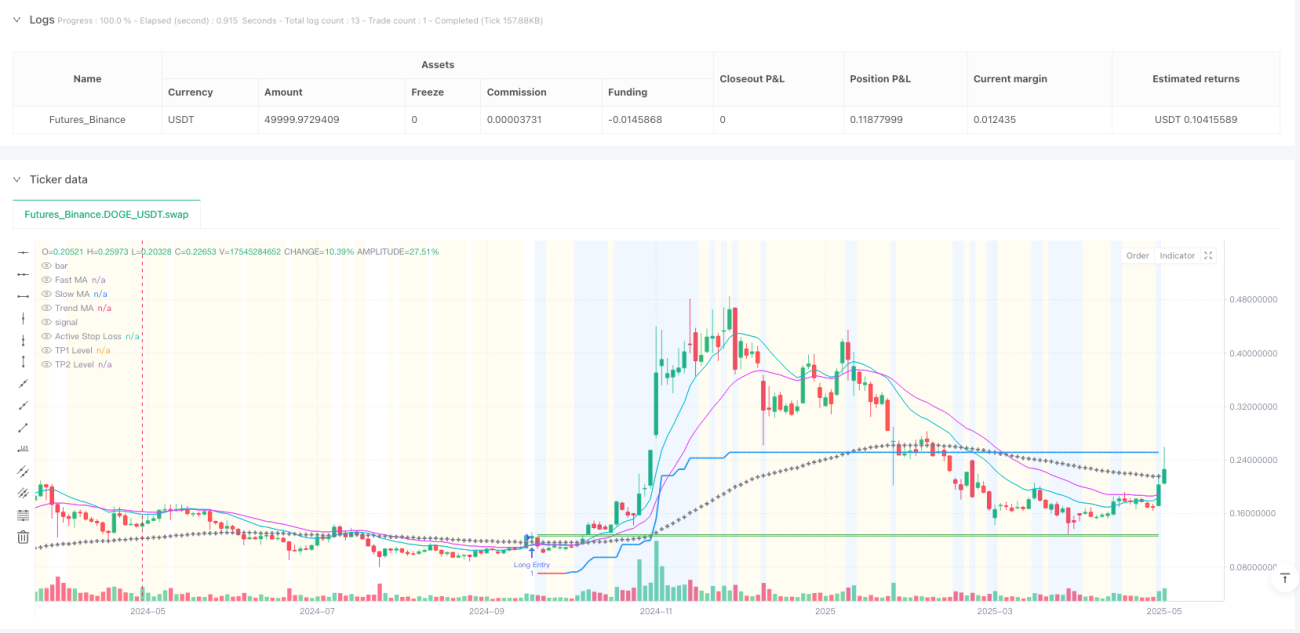
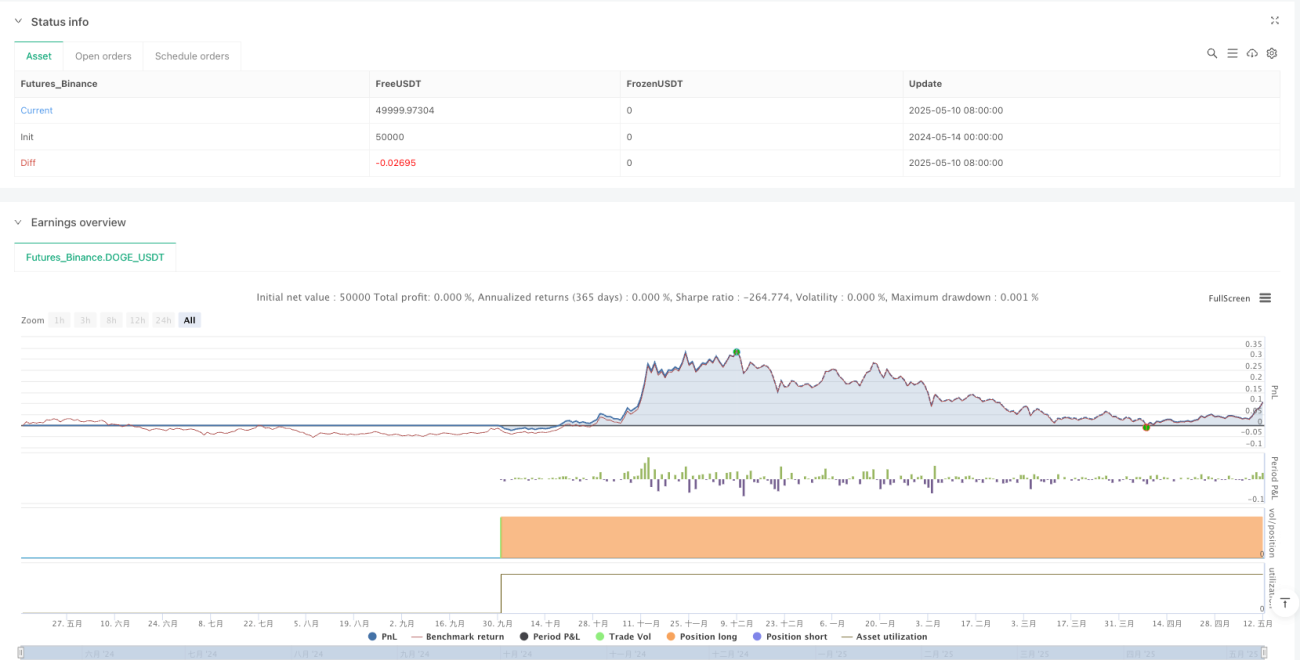
Die Strategie nutzt die Kreuzung der schnellen Moving Average (MA) und der schnellen Moving Average als Hauptsignal-Trigger, kombiniert mit mehreren Schlüsselfiltern und präzisen Risikomanagement-Tools, um kleine, aber schnelle Preisbewegungen zu erfassen. Die Strategie ist äußerst konfigurierbar und ermöglicht dem Benutzer die Flexibilität, die Arten von Mittellinien (EMA, SMA, WMA, HMA, VWMA) und ihre Periodensparameter zu wählen, um sich an die Bedürfnisse von Handelsgeschäften in verschiedenen Marktrhythmen anzupassen.
Die Kernlogik der Strategie besteht aus folgenden Schlüsselbereichen:
EintrittszeichenDie Eintrittsbedingungen werden hauptsächlich durch die Kreuzung/Überschreitung von schnellen und langsamen Durchschnittslinien ausgelöst. Der Benutzer kann den Durchschnittslinientyp (EMA, SMA, WMA, HMA, VWMA) und die Zeitspanne flexibel konfigurieren, um die Signalempfindlichkeit an unterschiedliche Marktbedingungen anzupassen.
TrendfilterStrategie: Optional langfristige Moving Averages als Filter für große Trends verwenden, um sicherzustellen, dass der Handel nur in Richtung der großen Trends erfolgt, und um einen rückläufigen Short-Line-Handel in stark orientierten Märkten zu vermeiden.
Filter bestätigt:
Risikomanagementpaket:
PositionsverwaltungDie Verwendung einer festen Anzahl von Positionsgrößen, um die Positionsgröße für jeden Handel genau zu kontrollieren, ist entscheidend für die einheitliche Risikoanwendung und die Generierung von API-Befehlen in Hochfrequenzumgebungen.
Durch die tiefgreifende Analyse des Codes hat diese Strategie folgende deutliche Vorteile:
Hohe KonfigurationsfähigkeitDer Benutzer kann verschiedene Parameter, einschließlich der Art und der Periode der Gewinnlinie, der Filter-Einstellungen und der Risikomanagement-Parameter, flexibel anpassen, damit die Strategie an verschiedene Marktumgebungen und Handelsstile angepasst werden kann.
Mehrstufige FiltermechanismenDie Anwendungsbereiche sind: Kombination von Trends, Volatilität und Volumenfilter, um Fehlsignale und Marktgeräusche zu reduzieren und die Qualität des Handels zu verbessern.
Gutes RisikomanagementDie Strategie beinhaltet mehrere Stop-Loss-Mechanismen (Anfangs, Nachverfolgung, Ausgleich von Verlusten) und ein doppeltes Gewinnziel, um eine genaue Risikokontrolle und Gewinnschutz zu gewährleisten.
API-freundlich gestaltetEin klar definierter Ein- und Ausstiegslogik erzeugt eindeutige Signale, die eine Integration mit externen Handelssystemen ermöglichen und eine nahezu sofortige Auftragsausführung ermöglichen.
Präzise PositionskontrolleDie Größe der Positionen mit einer festen Anzahl vereinfacht die Belastung der API-Endpunkte und macht die Automatisierung zuverlässiger.
Äußerst anpassungsfähigDurch Parameteranpassung kann die Strategie von einem Hochfrequenz-Short-Line-Trading-Modus zu einem längerfristigen Trend-Tracking-Modus umgestellt werden, der sich an unterschiedliche Marktbedingungen und individuelle Handelspräferenzen anpasst.
Obwohl die Strategie so gut konzipiert ist, gibt es einige potenzielle Risiken und Herausforderungen:
Risiken der ParameteroptimierungDa die Strategie viele konfigurierbare Parameter enthält, kann eine Überoptimierung zu einem guten Feedback führen, der jedoch schlechter abschneidet. Investoren sollten dieses Risiko durch Verifizierung auf außerhalb der Stichprobe befindlichen Daten oder durch Forward-Testing vermeiden.
Auswirkungen auf die TransaktionskostenHigh-Frequency-Trading bedeutet, dass eine große Anzahl von Transaktionen, kumulierte Provisionen und Slippage die Nettoprofitabilität erheblich beeinträchtigen können. Diese Kosten müssen vor der Verwendung genau berechnet werden.
Signalqualitätsschwankungen: Die Zuverlässigkeit von Mesoline-Cross-Signalen kann unter verschiedenen Marktbedingungen variieren, insbesondere in Märkten mit Quer- oder Hochvolatilität.
Technologische AbhängigkeitAls API-Ready-Strategie hängt ihre Wirksamkeit teilweise von der Ausführungsgeschwindigkeit und der technischen Stabilität ab. Systemverzögerungen oder Störungen können zu verlorenen Gelegenheiten oder Ausführungsfehlern führen.
Einschränkung der GrößeEs kann sein, dass eine feste Anzahl von Positionen nicht für alle Konten geeignet ist. Kleine Konten können zu viel Risiko eingehen, während große Konten möglicherweise nicht in der Lage sind, die Mittel optimal zu nutzen.
Aufgrund der Strategiegestaltung und der potenziellen Risiken sind folgende Optimierungsmöglichkeiten möglich:
AnpassungsparameterDie Strategie ist so konzipiert, dass sie sich automatisch an die jeweiligen Marktbedingungen anpasst, um die Anpassung der Strategie in verschiedenen Marktphasen zu verbessern.
Intelligente Filter verbessertDie Integration von zusätzlichen Marktstatusindikatoren (z. B. Marktstruktur, Identifizierung von Schwankungsmustern oder Relevanz von relevanten Vermögenswerten) verbessert die Filtergenauigkeit weiter.
Dynamische PositionsverwaltungAnstelle einer festen Anzahl von Positionen wird eine dynamische Position berechnet, die auf der Größe des Kontos, der aktuellen Volatilität und der jüngsten Strategie basiert, um eine intelligentere Geldverwaltung zu ermöglichen.
Mehrfache ZeitrahmenbestätigungEs ist wichtig, dass die Signalüberprüfung in verschiedenen Zeitrahmen durchgeführt wird, um sicherzustellen, dass die Handelsrichtung mit der größeren Marktstruktur übereinstimmt und unnötige Geschäfte reduziert werden.
Integration von maschinellem LernenDie Analyse der historischen Signalleistung mit Hilfe von Machine Learning-Algorithmen, um die Erfolgswahrscheinlichkeit zukünftiger Signale zu prognostizieren, und die Prioritätsausführung von High-Skill-Transactions.
Management von HandelsgesprächenDer Markt ist in der Lage, sich mit den wichtigsten Marktsegmenten zu verbinden, um die Marktentwicklung zu verbessern und zu verbessern.
Relevanz-FilterEs wurde eine Analyse der Relevanz der relevanten Märkte für den Handel mit mehreren Vermögenswerten durchgeführt, um eine übermäßige Exposition gegenüber bestimmten Risikofaktoren zu vermeiden.
Die Adaptive Equilibrium-Cross-Volatility-Tracking Quantitative Trading Strategy ist ein voll funktionsfähiges Hochfrequenz-Trading-System, das Signale durch Equilibrium-Cross-Trigger in Kombination mit einer Vielzahl von Schlüsselfiltern und präzisen Risikomanagement-Tools ausführt und speziell für die Erfassung kleiner, aber schneller Preisschwankungen entwickelt wurde. Die Stärke der Strategie liegt in ihrer hohen Konfigurationsfähigkeit und einem ausgefeilten Risikomanagement-Framework, das es Händlern ermöglicht, die Handelsparameter entsprechend der individuellen Risikoverfügbarkeit und der Marktbedingungen zu optimieren.
Für Hochfrequenz-Händler bietet die Strategie eine klare Logik für Ein- und Ausgänge sowie die nahtlose Integration mit externen Ausführungsplattformen, was für schnelle Entscheidungen in einem schnelllebigen Markt entscheidend ist. Bei der Verwendung dieser Strategie sollte jedoch besonders auf das Risiko von Akkumulation und Überoptimierung der Handelskosten geachtet werden, um die Robustheit und Profitabilität der Strategie im realen Handel zu gewährleisten.
Letztendlich stellt die Strategie eine ausgewogene Methode dar, die die Stärke von technischen Indikatoren und Risikomanagement-Tools nutzt, während sie genügend Flexibilität hat, um sich an veränderte Marktbedingungen anzupassen. Durch sorgfältige Parameteranpassungen und kontinuierliche Überwachungsverbesserungen kann diese Strategie zu einem wertvollen Bestandteil eines quantifizierten Portfolios werden.
/*backtest
start: 2024-05-14 00:00:00
end: 2025-05-12 08:00:00
period: 2d
basePeriod: 2d
exchanges: [{"eid":"Futures_Binance","currency":"DOGE_USDT"}]
*/
//@version=5
// © ArrowTrade x:ArrowTrade
// --- STRATEGY DEFINITION ---
strategy(
title="Arrow's Flexible MA Cross Strategy [API Ready]", // Added branding
shorttitle="ArrowFlex", // Added branding
overlay=true,
initial_capital=1000, // Example capital, user should adjust
commission_type=strategy.commission.percent,
commission_value=0.036, // Example commission, user MUST adjust to their broker/exchange
slippage=2, // Example slippage (in ticks), user should adjust based on asset/broker
process_orders_on_close=true, // Calculates/executes on bar close. Set to false for intrabar (use with caution & specific logic)
pyramiding=0, // No pyramiding allowed (one entry per direction)
default_qty_type=strategy.fixed // Defaulting to fixed quantity
// Removed default_qty_value from here
)
// ================================================================================
// Strategy Description (for TradingView Public Library & Users)
// ================================================================================
// © ArrowTrade
//
// A configurable Moving Average Crossover strategy designed for flexibility and
// API integration.
//
// Features:
// - MA Crossover Entries: Uses configurable Fast/Slow MA crossovers for signals.
// - Trend Filter: Optional longer-term MA filter to trade only with the trend.
// - Volatility Filter: Optional ATR filter to avoid low-volatility periods.
// - Volume Filter: Optional Volume filter to confirm entries with sufficient volume.
// - Stop Loss Options:
// - Initial Volatility Stop (ATR-based)
// - ATR Trailing Stop
// - Break-Even Stop (activated by TP1 hit or ATR distance)
// - Take Profit Options:
// - Two independent TP levels (percentage-based).
// - Configurable partial close percentage at TP1.
// - Position Sizing: Fixed quantity per trade (adjustable).
//
// Intended Use:
// While configurable for various styles (scalping to trend-following by adjusting
// parameters), this strategy is built with API automation in mind. The clear
// entry and exit logic facilitates integration with external execution platforms
// via webhooks or other methods. Parameters can be tightened (shorter MAs,
// tighter stops/TPs, specific filters) for higher-frequency signals suitable
// for scalping.
//
// Disclaimer:
// Backtesting results are hypothetical and do not guarantee future performance.
// Market conditions change constantly. Always perform your own due diligence,
// forward testing, and rigorous risk management before trading live with any
// strategy. Ensure you adjust inputs like commission, slippage, and position
// size to accurately reflect your specific broker/exchange and risk profile.
// ================================================================================
// === INPUTS (Grouped and Ordered by Importance/Function) ===
// --- 1. Core Signal & Trend Filter ---
grp_signal = "1. Core Signal & Trend Filter"
signalSource = input.source(high, title="Signal Source", group=grp_signal, tooltip="Price source for calculating the signal MAs (e.g., close, hl2, ohlc4). 'hlc3' or 'ohlc4' can provide smoother signals.")
signalMaType = input.string("EMA", title="Signal MA Type", options=["EMA", "SMA", "WMA", "HMA", "VWMA"], group=grp_signal, tooltip="Type of Moving Average used for the fast/slow signal lines (EMA reacts faster, SMA smoother, HMA reduces lag).")
signalFastLen = input.int(12, title="Fast MA Period", minval=2, maxval=100, step=1, group=grp_signal, tooltip="Period for the shorter-term signal MA. Shorter periods lead to more frequent signals (potentially more noise/scalping).")
signalSlowLen = input.int(25, title="Slow MA Period", minval=3, maxval=200, step=1, group=grp_signal, tooltip="Period for the longer-term signal MA. Must be greater than Fast MA Period. Defines the crossover signal.")
useTrendFilter = input.bool(true, title="Enable Trend Filter", group=grp_signal, tooltip="If enabled, entry signals are only taken in the direction of the longer-term trend defined by the Trend MA.")
trendMaType = input.string("EMA", title="Trend MA Type", options=["EMA", "SMA", "WMA", "HMA", "VWMA"], group=grp_signal, tooltip="Type of Moving Average used for the trend filter.")
trendMaLen = input.int(100, title="Trend MA Period", minval=50, maxval=500, step=10, group=grp_signal, tooltip="Period for the Trend MA. Significantly longer than signal MAs typically. Higher values filter more aggressively.")
trendMaSource = input.source(hl2, title="Trend MA Source", group=grp_signal, tooltip="Price source for the Trend MA calculation.")
// --- 2. Risk Management: Stop Loss ---
grp_stop = "2. Risk Management: Stop Loss"
useVolatilityStop = input.bool(true, title="Enable Initial Volatility Stop", group=grp_stop, tooltip="Sets the initial stop loss based on Average True Range (ATR) at the time of entry.")
volStopAtrPeriod = input.int(7, title=" Initial Stop ATR Period", minval=1, maxval=50, step=1, group=grp_stop, tooltip="ATR lookback period for calculating the initial stop distance.")
volStopAtrMultiplier = input.float(5, title=" Initial Stop ATR Multiplier", minval=0.5, maxval=10, step=0.1, group=grp_stop, tooltip="Multiplier for the ATR value to determine stop distance (Stop = Entry +/- ATR * Multiplier). Lower values = tighter initial stop.")
useTrailingStop = input.bool(true, title="Enable ATR Trailing Stop", group=grp_stop, tooltip="If enabled, the stop loss will trail behind price based on current ATR, potentially locking in profits. Can override the initial/BE stop if it moves favorably.")
trailAtrPeriod = input.int(15, title=" Trailing ATR Period", minval=1, maxval=50, step=1, group=grp_stop, tooltip="ATR lookback period for calculating the trailing distance.")
trailAtrMultiplier = input.float(4.0, title=" Trailing ATR Multiplier", minval=0.5, maxval=10, step=0.1, group=grp_stop, tooltip="Multiplier for the current ATR to determine trailing distance. Lower values trail tighter.")
useBreakEvenStop = input.bool(false, title="Enable Break-Even Stop", group=grp_stop, tooltip="If enabled, moves the stop loss to entry price (plus a small profit buffer) once a certain condition is met.")
beActivationChoice = input.string("TP1 Reached", title=" BE Activation Condition", options=["TP1 Reached", "ATR Distance Moved"], group=grp_stop, tooltip="When should the Break-Even Stop activate? When TP1 is hit, or when price moves a certain ATR distance from entry?")
beActivationAtrMult = input.float(1.5, title=" BE Activation ATR Multiplier", minval=0.1, maxval=5, step=0.1, group=grp_stop, tooltip="Used only if 'ATR Distance Moved' is selected. BE activates if price moves (Entry +/- ATR * Multiplier). Uses 'Initial Stop ATR Period'.")
beProfitTicks = input.int(2, title=" BE Profit Buffer (Ticks)", minval=0, maxval=50, step=1, group=grp_stop, tooltip="Moves the stop to Entry Price +/- this many ticks (e.g., to cover commissions). Set to 0 for exact entry price.")
// --- 3. Risk Management: Take Profit ---
grp_tp = "3. Risk Management: Take Profit (TP)"
useTp1 = input.bool(true, title="Enable TP1", group=grp_tp, tooltip="Enable the first Take Profit level.")
tp1Pct = input.float(1.5, title=" TP1 Target (%)", minval=0.1, maxval=20, step=0.1, group=grp_tp, tooltip="First TP target as a percentage distance from the entry price. Should be less than TP2 %.")
tp1QtyPercent = input.int(50, title=" TP1 Close Quantity (%)", minval=1, maxval=100, step=5, group=grp_tp, tooltip="Percentage of the original position size to close when TP1 is hit.")
useTp2 = input.bool(true, title="Enable TP2", group=grp_tp, tooltip="Enable the second (final) Take Profit level.")
tp2Pct = input.float(3.0, title=" TP2 Target (%)", minval=0.2, maxval=30, step=0.1, group=grp_tp, tooltip="Second TP target as a percentage distance from the entry price. Closes the remaining position.")
// --- 4. Additional Filters ---
grp_filters = "4. Additional Filters"
useAtrFilter = input.bool(true, title="Enable ATR Volatility Filter", group=grp_filters, tooltip="If enabled, avoids entries during periods of very low volatility (ATR below a moving average of ATR). Helps filter choppy/sideways markets.")
atrFilterPeriod = input.int(14, title=" ATR Filter Period", minval=1, maxval=50, step=1, group=grp_filters, tooltip="Lookback period for calculating the current ATR and its average for the filter.")
atrFilterMultiplier = input.float(0.5, title=" ATR Filter Threshold Multiplier", minval=0.1, maxval=5, step=0.1, group=grp_filters, tooltip="Entry requires current ATR to be >= (Average ATR * Multiplier). Lower values filter more aggressively.")
useVolumeFilter = input.bool(true, title="Enable Volume Filter", group=grp_filters, tooltip="If enabled, requires the volume of the entry bar to be above a moving average of volume. Acts as confirmation.")
volumeLookback = input.int(30, title=" Volume MA Period", minval=2, maxval=100, step=1, group=grp_filters, tooltip="Lookback period for calculating the average volume.")
volumeMultiplier = input.float(1.0, title=" Min Volume Ratio (vs Avg)", minval=0.1, maxval=5, step=0.1, group=grp_filters, tooltip="Entry requires current volume to be >= (Average Volume * Multiplier). Values >= 1 require above-average volume.")
// --- 5. Position Sizing ---
grp_size = "5. Position Sizing"
// Define the quantity input with its own default value
qtyValue = input.float(0.01, title="Position Size (Fixed Qty)", minval=0.0001, step=0.0001, group=grp_size, tooltip="Fixed quantity (contracts/shares/lots) per trade. Adjust based on your account size, risk tolerance, and the asset being traded. Can be overridden by API.")
// === FUNCTIONS ===
f_ma(maType, src, len) =>
float result = na
if maType == "SMA"
result := ta.sma(src, len)
else if maType == "EMA"
result := ta.ema(src, len)
else if maType == "WMA"
result := ta.wma(src, len)
else if maType == "HMA"
result := ta.hma(src, len)
else if maType == "VWMA"
result := ta.vwma(src, len)
result
// === CORE CALCULATIONS ===
// Parameter Sanity Check
if signalSlowLen <= signalFastLen and barstate.islast
runtime.error("Signal Slow MA Period must be greater than Fast MA Period!")
// 1. Moving Averages
float fastMA = f_ma(signalMaType, signalSource, signalFastLen)
float slowMA = f_ma(signalMaType, signalSource, signalSlowLen)
float trendMA = useTrendFilter ? f_ma(trendMaType, trendMaSource, trendMaLen) : na
// 2. ATR Values
float atrValueStop = ta.atr(volStopAtrPeriod)
float atrValueTrail = ta.atr(trailAtrPeriod)
float atrValueFilter = ta.atr(atrFilterPeriod)
float atrValueBE = ta.atr(volStopAtrPeriod)
// 3. Filter Conditions
bool trendFilterOK_L = not useTrendFilter or (not na(trendMA) and signalSource > trendMA)
bool trendFilterOK_S = not useTrendFilter or (not na(trendMA) and signalSource < trendMA)
float avgAtrFilter = ta.sma(atrValueFilter, atrFilterPeriod)
bool volatilityFilterOK = not useAtrFilter or (not na(atrValueFilter) and not na(avgAtrFilter) and atrValueFilter >= avgAtrFilter * atrFilterMultiplier)
float avgVolume = ta.sma(volume, volumeLookback)
bool volumeFilterOK = not useVolumeFilter or (not na(volume) and not na(avgVolume) and volume >= avgVolume * volumeMultiplier)
bool finalFilterOK_L = trendFilterOK_L and volatilityFilterOK and volumeFilterOK
bool finalFilterOK_S = trendFilterOK_S and volatilityFilterOK and volumeFilterOK
// 4. Entry Signals
bool longCross = not na(fastMA) and not na(slowMA) and ta.crossover(fastMA, slowMA)
bool shortCross = not na(fastMA) and not na(slowMA) and ta.crossunder(fastMA, slowMA)
bool longEntrySignal = longCross and finalFilterOK_L
bool shortEntrySignal = shortCross and finalFilterOK_S
// === STRATEGY EXECUTION LOGIC ===
// --- State Variables (persisted between bars) ---
var float entryPriceVar = na
var float initialStopPrice = na
var float currentStopPrice = na
var float trailStopLevel = na
var bool isBEActive = false
var bool tp1Reached = false
var float qtyToCloseTp1_Var = na
// --- Position Status ---
bool inLong = strategy.position_size > 0
bool inShort = strategy.position_size < 0
bool inTrade = strategy.position_size != 0
// --- Reset State Variables on Trade Exit ---
if not inTrade and inTrade[1]
entryPriceVar := na
initialStopPrice := na
currentStopPrice := na
trailStopLevel := na
isBEActive := false
tp1Reached := false
qtyToCloseTp1_Var := na
// --- Handle New Entries ---
if longEntrySignal and not inTrade
strategy.entry("Long Entry", strategy.long, qty=qtyValue) // Use qtyValue from input
if shortEntrySignal and not inTrade
strategy.entry("Short Entry", strategy.short, qty=qtyValue) // Use qtyValue from input
// --- Manage Stops and Take Profits for Open Positions ---
if inTrade
// Initialize state on the bar immediately AFTER entry
if na(entryPriceVar)
entryPriceVar := strategy.position_avg_price
float positionQty = strategy.position_size
if not na(positionQty) and tp1QtyPercent > 0 and useTp1
qtyToCloseTp1_Var := math.abs(positionQty * tp1QtyPercent / 100)
else
qtyToCloseTp1_Var := 0.0
if useVolatilityStop and not na(atrValueStop)
initialStopPrice := entryPriceVar + (inLong ? -1 : 1) * atrValueStop * volStopAtrMultiplier
currentStopPrice := initialStopPrice
else
initialStopPrice := na
currentStopPrice := na
if useTrailingStop and not na(atrValueTrail)
trailStopLevel := entryPriceVar + (inLong ? -1 : 1) * atrValueTrail * trailAtrMultiplier
else
trailStopLevel := na
isBEActive := false
tp1Reached := false
// --- Calculations within the trade (if entry price is set) ---
if not na(entryPriceVar)
// 1. Calculate TP Levels for the current bar
float tp1LevelL = na, float tp2LevelL = na, float tp1LevelS = na, float tp2LevelS = na
if useTp1
tp1LevelL := entryPriceVar * (1 + tp1Pct / 100)
tp1LevelS := entryPriceVar * (1 - tp1Pct / 100)
if useTp2
tp2LevelL := entryPriceVar * (1 + tp2Pct / 100)
tp2LevelS := entryPriceVar * (1 - tp2Pct / 100)
// 2. Check and Activate Break-Even Stop
if useBreakEvenStop and not isBEActive and not na(currentStopPrice)
float beTriggerL = na, float beTriggerS = na
if beActivationChoice == "TP1 Reached" and useTp1
if not na(tp1LevelL)
beTriggerL := tp1LevelL
if not na(tp1LevelS)
beTriggerS := tp1LevelS
else if beActivationChoice == "ATR Distance Moved" and not na(atrValueBE)
beTriggerL := entryPriceVar + atrValueBE * beActivationAtrMult
beTriggerS := entryPriceVar - atrValueBE * beActivationAtrMult
float beTargetLevel = entryPriceVar + (inLong ? 1 : -1) * beProfitTicks * syminfo.mintick
if not na(beTriggerL) and not na(beTargetLevel) and inLong and high >= beTriggerL and beTargetLevel > currentStopPrice
currentStopPrice := beTargetLevel
isBEActive := true
if not na(beTriggerS) and not na(beTargetLevel) and inShort and low <= beTriggerS and beTargetLevel < currentStopPrice
currentStopPrice := beTargetLevel
isBEActive := true
// 3. Update Trailing Stop
if useTrailingStop and not na(currentStopPrice) and not na(atrValueTrail)
float newTrailStopL = low - atrValueTrail * trailAtrMultiplier
float newTrailStopS = high + atrValueTrail * trailAtrMultiplier
float prevTrail = trailStopLevel[1]
float calculatedNewTrail = na
if inLong
calculatedNewTrail := na(prevTrail) ? newTrailStopL : math.max(prevTrail, newTrailStopL)
if not na(calculatedNewTrail)
trailStopLevel := calculatedNewTrail
if not na(trailStopLevel) and trailStopLevel > currentStopPrice
currentStopPrice := trailStopLevel
if inShort
calculatedNewTrail := na(prevTrail) ? newTrailStopS : math.min(prevTrail, newTrailStopS)
if not na(calculatedNewTrail)
trailStopLevel := calculatedNewTrail
if not na(trailStopLevel) and trailStopLevel < currentStopPrice
currentStopPrice := trailStopLevel
// --- Execute Exits ---
// 4. Apply Stop Loss Exit
if not na(currentStopPrice)
bool isTrailingActiveNow = useTrailingStop and not na(trailStopLevel) and currentStopPrice == trailStopLevel
string stop_comment = isBEActive ? "BE Stop" : (isTrailingActiveNow ? "Trail Stop" : "Vol Stop")
if inLong
strategy.exit("SL Exit L", from_entry="Long Entry", stop=currentStopPrice, comment=stop_comment + " L")
if inShort
strategy.exit("SL Exit S", from_entry="Short Entry", stop=currentStopPrice, comment=stop_comment + " S")
// 5. Apply Take Profit Exits
// TP1 Exit (Partial Quantity)
if useTp1 and not tp1Reached and not na(qtyToCloseTp1_Var) and qtyToCloseTp1_Var > 0
if inLong and not na(tp1LevelL)
strategy.exit("TP1 Exit L", from_entry="Long Entry", qty=qtyToCloseTp1_Var, limit=tp1LevelL, comment="TP1 Hit L")
if high >= tp1LevelL
tp1Reached := true
if inShort and not na(tp1LevelS)
strategy.exit("TP1 Exit S", from_entry="Short Entry", qty=qtyToCloseTp1_Var, limit=tp1LevelS, comment="TP1 Hit S")
if low <= tp1LevelS
tp1Reached := true
// TP2 Exit (Remaining Quantity)
if useTp2
if inLong and not na(tp2LevelL)
strategy.exit("TP2 Exit L", from_entry="Long Entry", limit=tp2LevelL, comment="TP2 Hit L")
if inShort and not na(tp2LevelS)
strategy.exit("TP2 Exit S", from_entry="Short Entry", limit=tp2LevelS, comment="TP2 Hit S")
// === PLOTTING ===
// 1. Moving Averages
plot(fastMA, "Fast MA", color=color.new(color.aqua, 0), linewidth=1)
plot(slowMA, "Slow MA", color=color.new(color.fuchsia, 0), linewidth=1)
plot(useTrendFilter and not na(trendMA) ? trendMA : na, "Trend MA", color=color.new(color.gray, 0), linewidth=2, style=plot.style_cross)
// 2. Active Stop Loss Level
color stopColor = color.new(color.red, 0)
bool isTrailingActivePlot = useTrailingStop and not na(trailStopLevel) and not na(currentStopPrice) and currentStopPrice == trailStopLevel
if isBEActive
stopColor := color.new(color.orange, 0)
else if isTrailingActivePlot
stopColor := color.new(color.blue, 0)
plot(inTrade and not na(currentStopPrice) ? currentStopPrice : na, "Active Stop Loss", stopColor, style=plot.style_linebr, linewidth=2)
// 3. Take Profit Levels
float plot_tp1LevelL = na, float plot_tp1LevelS = na, float plot_tp2LevelL = na, float plot_tp2LevelS = na
if not na(entryPriceVar)
if useTp1
plot_tp1LevelL := entryPriceVar * (1 + tp1Pct / 100)
plot_tp1LevelS := entryPriceVar * (1 - tp1Pct / 100)
if useTp2
plot_tp2LevelL := entryPriceVar * (1 + tp2Pct / 100)
plot_tp2LevelS := entryPriceVar * (1 - tp2Pct / 100)
plot(inTrade and useTp1 and not na(inLong ? plot_tp1LevelL : plot_tp1LevelS) ? (inLong ? plot_tp1LevelL : plot_tp1LevelS) : na, "TP1 Level", color=color.new(color.green, 30), style=plot.style_linebr, linewidth=1)
plot(inTrade and useTp2 and not na(inLong ? plot_tp2LevelL : plot_tp2LevelS) ? (inLong ? plot_tp2LevelL : plot_tp2LevelS) : na, "TP2 Level", color=color.new(color.green, 0), style=plot.style_linebr, linewidth=1)
// 4. Entry Signal Markers
plotshape(longEntrySignal, title="Long Entry Signal", location=location.belowbar, color=color.new(color.green, 0), style=shape.triangleup, size=size.small)
plotshape(shortEntrySignal, title="Short Entry Signal", location=location.abovebar, color=color.new(color.red, 0), style=shape.triangledown, size=size.small)
// 5. Background Color Filters
bgcolor(useTrendFilter and not na(trendMA) and inTrade ? (inLong ? color.new(color.blue, 90) : color.new(color.red, 90)) : na, title="Trend Filter Active")
bgcolor(useAtrFilter and not volatilityFilterOK ? color.new(color.gray, 85) : na, title="Low Volatility Filter Active")
bgcolor(useVolumeFilter and not volumeFilterOK ? color.new(color.yellow, 90) : na, title="Low Volume Filter Active")