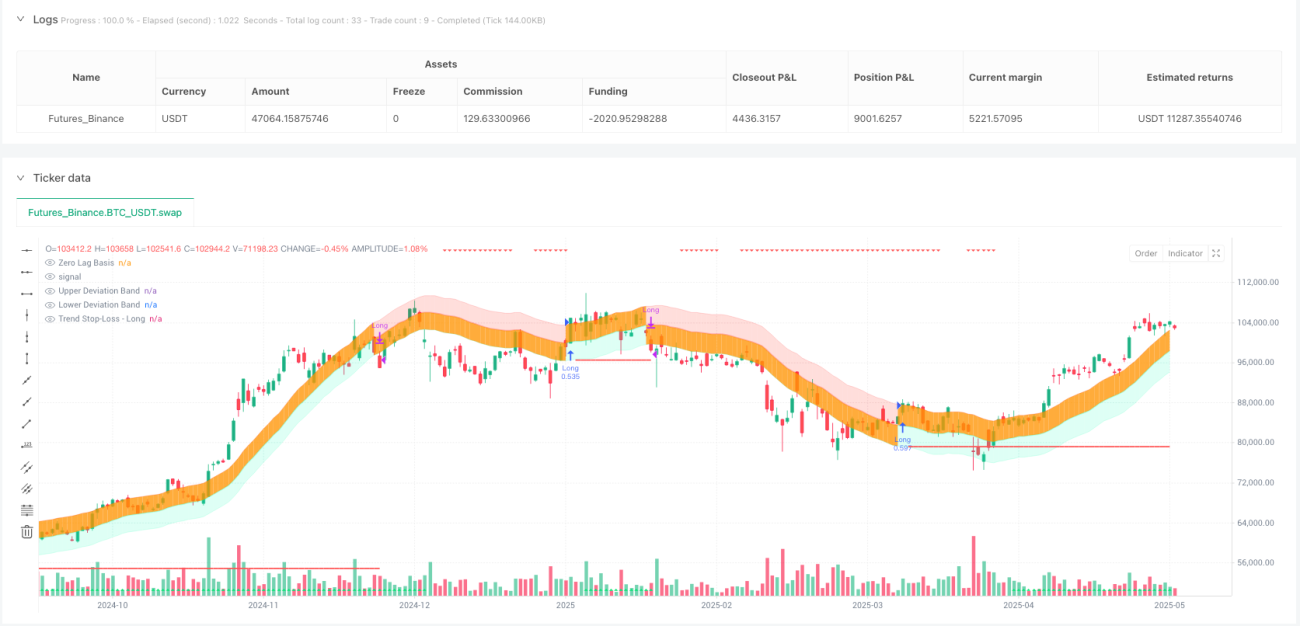
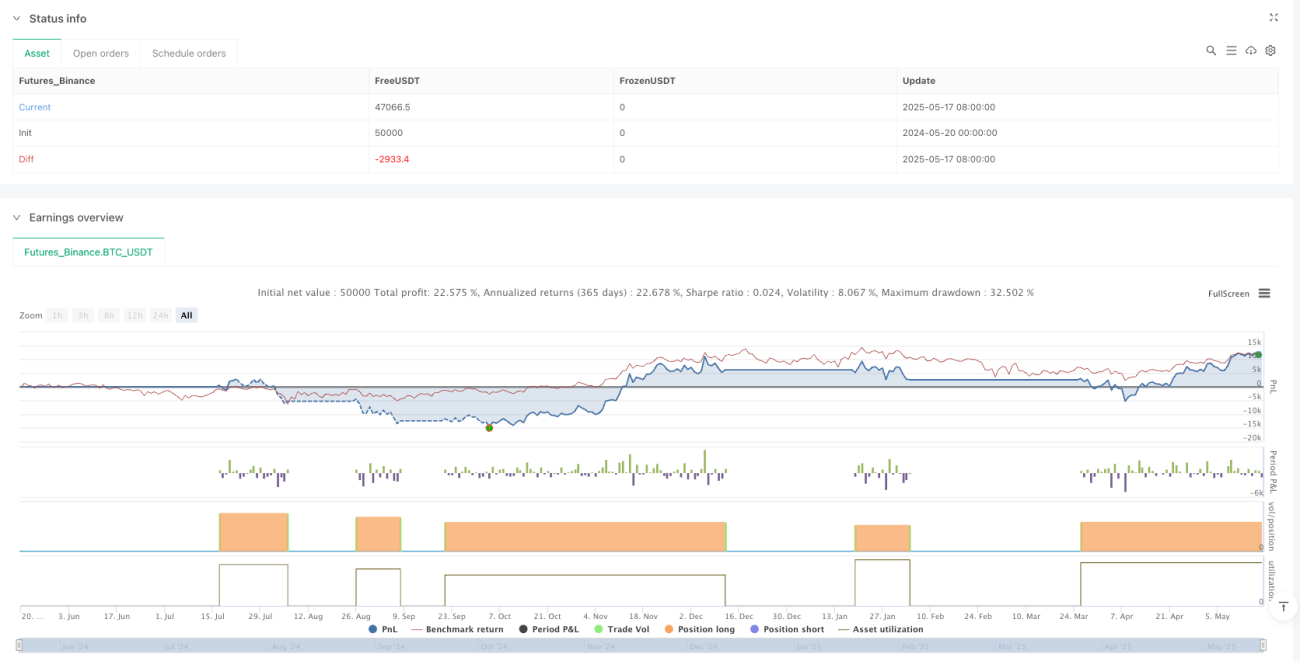
Die Multiple Time Frame Zero Delay Trend Signal Trading Strategie ist ein quantitatives Handelssystem, das auf dem Zero Delay Index Moving Average (ZLEMA) basiert, um die Verzögerung des traditionellen Moving Averages zu reduzieren und ein schnelleres und genaueres Trenderkennungssignal zu liefern. Die Strategie kombiniert nicht nur einen Volatilitätskanal, um Trendänderungen zu erkennen, sondern integriert auch verschiedene flexible Ausstiegsmechanismen, darunter Risikoberichterstattung, Ausgangsprofit-Ziel-Ausgang, ATR-basierte Stop-Loss-Stopps, dynamische Verfolgung von Stop-Loss- und Ausgangslinien usw.
Die Kernprinzipien der Strategie basieren auf dem Zero-Latency Index Moving Average (ZLEMA), einem technischen Indikator, der die Reaktionsgeschwindigkeit von Moving Averages durch Beseitigung oder Verringerung der Verzögerung von Preisdaten verbessert. Die konkreten Implementierungsschritte lauten:
Berechnung mit NullverzögerungStrategie: ZLEMA wird zunächst berechnetzlema = ta.ema(src + (src - src[lag]), length)Erfüllung, darunterlagDiese Methode reduziert die Rückstände bei herkömmlichen EMAs effektiv.
Trend-Erkennung:
zlemaUpTrendUndzlemaDownTrendVariable realisiertVielfältige Zulassungsbedingungen:
Komplett dynamische Ausgangs-Systeme:
Die Multiple-Time-Frame-Zero-Lateness-Trendsignal-Trading-Strategie hat folgende wesentliche Vorteile:
Verringerung der SignalverzögerungDie ZLEMA-Technologie reduziert die Verzögerung bei herkömmlichen Moving Averages und ermöglicht eine zeitnahere Trenderkennung und eine frühere Erfassung des Trendbeginns.
Umfassendes RisikomanagementsystemDie integrierten Risikokontrollmechanismen umfassen mehrere Ebenen, von Fixed Stop, ATR-Dynamic Stop, Tracking Stop bis hin zu Loss-Balance Stop, um die unterschiedlichen Marktbedingungen zu schützen.
Flexibilität bei der Auswahl der HandelsrichtungSie können als Multi-Strategie oder als Zwei-Wege-Strategie konfiguriert werden, um sich an unterschiedliche Marktpräferenzen und regulatorische Umgebungen anzupassen.
WiedereintrittsverfahrenZLEMA Zero Line Re-Entry: Erlaubt die Rückkehr nach kurzer Rückführung in einem starken Trend, um den Trendgewinn zu maximieren.
Strategie für den Austritt aus der DiversifikationEs bietet verschiedene Ausstiegsmöglichkeiten für verschiedene Marktsituationen, die sowohl durch Gewinnziele als auch durch die Verfolgung von Stop-Loss-Prämien ausgeschaltet werden können.
Visuelle Unterstützung: Intuitive Darstellung von Handelssignalen und Risikomanagementpositionen durch visuelle Elemente wie Trendschatten, Stop-Loss-Linien, Stop-Stop-Linien und Trendindikatoren.
Detaillierte LeistungsstatistikenDie integrierte Handelsstatistik zeigt die wichtigsten Kennzahlen wie Gewinnraten, Nettoerträge und maximale Auszahlungen an, um die Strategie zu bewerten und zu optimieren.
Obwohl die Strategie so konzipiert ist, gibt es einige potenzielle Risiken, die zu beachten sind:
ParameterempfindlichkeitZLEMA-Länge und ATR-Multiplikation beeinflussen die Strategie-Performance erheblich, und eine falsche Einstellung kann zu zu viel oder zu wenig Signal führen.
Falsche Signale für den erschütternden MarktIn einem wackligen Markt, in dem es keine eindeutige Tendenz gibt, können häufige falsche Signale erzeugt werden, die zu anhaltenden Verlusten führen.
TrendumkehrrisikoObwohl die Strategie verschiedene Ausstiegsmechanismen entwickelt hat, kann es bei einer starken Trendwende passieren, dass der Ausstieg zu spät erfolgt und größere Verluste entstehen.
Risiko einer Über-AnpassungDie Kombination mehrerer Parameter kann zu einer Überanpassung an historische Daten führen, die in einem zukünftigen Marktumfeld schlechter abschneiden.
Langzeitsignale sind seltenWenn die ZLEMA-Länge länger ist, kann die Strategie weniger Handelssignale erzeugen, was die Effizienz der Kapitalnutzung beeinträchtigt.
Die Herausforderung, die Breite zu stoppenDer ATR-basierte Stopp kann in hochflüchtigen Märkten zu breit sein, was zu einem zu hohen Einzelschaden führt, während er in niedrigflüchtigen Märkten zu eng sein kann, was zu häufigen Triggern führt.
Die Methoden zur Minderung dieser Risiken umfassen: strenge Parameterrückprüfungen und Vorwärtsprüfungen, die Vermeidung von Transaktionen in turbulenten Märkten in Verbindung mit Marktsituationsindikatoren, die Einführung strenger Regeln für die Geldverwaltung und die regelmäßige Optimierung der Strategieparameter, um sie an Marktveränderungen anzupassen.
Die Strategie bietet mehrere Optimierungsmöglichkeiten, um die Leistung weiter zu verbessern:
Dynamische Parameter werden angepasstEntwicklung eines Anpassungsmechanismus, der die ZLEMA-Länge und die ATR-Multiplikation automatisch an die Marktvolatilität anpasst, um die Anpassungsfähigkeit der Strategie an unterschiedliche Marktumgebungen zu verbessern.
Marktzustand-FilterEinführung von Marktsituationsindikatoren (z. B. ADX, Volatilitätsindikatoren), die nur unter günstigen Marktbedingungen gehandelt werden, um häufige Transaktionen in ineffizienten und schwankenden Märkten zu vermeiden.
Mehrfache ZeitrahmenbestätigungDas Ergebnis ist: Eintritt in eine Trendrichtung, die mit einer höheren Zeitrahmenrichtung kombiniert ist, erhöht die Erfolgsrate, wenn sie nur in der Richtung der großen Trendrichtung übereinstimmt.
Bestätigung des Transaktionsvolumens: Integration von Handelsvolumenindikatoren als Hilfsbestätigung, z. B. Trendwechselsignale werden nur bei steigendem Handelsvolumen bestätigt.
Maschinelle LernoptimierungEs ist möglich, dass ein Modell mit einer Maschinellehralgorithmus die optimale Kombination von Parametern und Einstiegsmomenten sucht, um vor allem zu ermitteln, welche Signale mit größerer Wahrscheinlichkeit erfolgreich sind.
Saison- und ZeitfilterDas ist ein sehr interessantes Beispiel für das, was man in der Praxis tun kann, wenn man sich mit einem gewissen Risiko befasst.
Vermögensbezogene AnalyseEinführung von Relevanz-Analysen für relevante Assets, um die Signalsicherheit bei gleichzeitiger Bestätigung von mehreren Assets zu erhöhen.
Diese Optimierungsrichtungen können nicht nur die Stabilität und Profitabilität der Strategie erhöhen, sondern auch das Risiko senken, um sie besser für verschiedene Marktumgebungen und persönliche Risikopräferenzen zu geeigneten.
Die Multiple-Time-Frame Zero-Lateness-Trendsignal-Handelsstrategie ist ein umfassendes und flexibles quantitatives Handelssystem, das durch Zero-Lateness-Index-Moving Average (ZLEMA) -Technologie und Volatilitätskanäle eine schnelle und genaue Trenderkennung ermöglicht und in Kombination mit einer mehrschichtigen dynamischen Risikomanagement-Mechanik die Kapitalsicherheit schützt. Die Strategie kann sowohl Eintrittschancen zu Beginn eines Trends erfassen als auch die Erträge durch Wiedereintrittsmechanismen bei der Entwicklung eines Trends maximieren und gleichzeitig mehrere Ausstiegsstrategien anbieten, die sich an unterschiedliche Marktumgebungen anpassen.
Die wichtigsten Vorteile der Strategie liegen in der Verringerung der Signalverzögerung, der Bereitstellung eines umfassenden Risikomanagementsystems und der flexiblen Optionen für die Handelskonfiguration. Die Benutzer müssen jedoch auf potenzielle Risiken wie Parameter-Sensitivität, falsche Signale in den Schaukelmärkten und übermäßige Anpassung achten. Die Strategie kann durch Optimierungen wie Marktzustandsfilterung, Multi-Time-Framework-Bestätigung und Anpassung dynamischer Parameter weiter verbessert werden.
Als ein auf technischen Kennzahlen basierendes quantitatives Handelssystem eignet sich die Strategie besonders für den mittel- und langfristigen Trendhandel und ist für verschiedene Finanzmärkte geeignet. Jede Strategie muss jedoch individuell an die individuellen Handelsziele, die Risikobereitschaft und die Marktpräferenzen angepasst werden und in Verbindung mit strengen Geldmanagementprinzipien für den tatsächlichen Handel angewendet werden.
//@version=6
// Quant Trading Pro www.quanttradingpro.com
// #1 Strategy Optimizer on the chrome extension store Quant Trading Strategy Optimizer
strategy(title="Quant Trading Zero Lag Trend Signals (MTF) Strategy", shorttitle="QT0️⃣Zero Lag Signals Strategy", overlay=true,
commission_type=strategy.commission.percent,
commission_value=0.1,
slippage=3,
default_qty_type=strategy.percent_of_equity,
default_qty_value=100,
initial_capital=1000,
margin_long=0,
margin_short=0)
// === INPUT PARAMETERS ===
// 📌 1️⃣ Main Calculations
length = input.int(70, title="Length", minval=70, maxval=7000)
mult = input.float(1.2, "Band Multiplier", group="Main Calculations")
// === 📊 Trade Data Toggles ===
showFloatingTable = input.bool(true, "Show Floating Stats Table?", group="Trade Data")
showTradeLog = input.bool(false, "Show Trade Log Labels on Chart?", group="Trade Data")
enableCSVExport = input.bool(false, "Enable CSV Export", group="Trade Data")
// 📌 ZLEMA Trend Confirmation for Entries
useZlemaTrendConfirm = input.bool(false, "Use ZLEMA Trend Confirmation for entry?", group="Entry Conditions")
reEnterOnLongTrend = input.bool(false, "Re-Enter on Long Trend continuation", group="Entry Conditions")
// 📌 2️⃣ Short Trades
allowShortTrades = input.bool(false, "Allow Short Trades?", group="Short Trades")
// 📌 Performance Settings
useProfitTarget = input.bool(false, "Use Profit Target?", group="Performance Settings")
profitTargetRR = input.float(2.0, "Profit Target (Risk-Reward Ratio)", group="Performance Settings")
// 📌 4️⃣ Dynamic TP/SL (Each Setting with Its Parameters Directly Below)
useATRStopTP = input.bool(false, "Use ATR-Based Stop-Loss & Take-Profit?", group="Dynamic TP/SL")
atrLength = input.int(14, "ATR Length", group="Dynamic TP/SL")
atrMultiplier = input.float(1.5, "Stop-Loss ATR Multiplier", group="Dynamic TP/SL")
profitATRMultiplier = input.float(2.5, "Profit Target ATR Multiplier", group="Dynamic TP/SL")
useTrailingStop = input.bool(false, "Use ATR Trailing Stop?", group="Dynamic TP/SL")
trailStopMultiplier = input.float(1.5, "Trailing Stop ATR Multiplier", group="Dynamic TP/SL")
useBreakEven = input.bool(false, "Use Break-Even Stop-Loss?", group="Dynamic TP/SL")
breakEvenRR = input.float(1.5, "Move SL to Break-Even After RR", group="Dynamic TP/SL")
useTrendExit = input.bool(false, "Use Trend-Based Take Profit (EMA Exit)?", group="Dynamic TP/SL")
emaExitLength = input.int(9, "EMA Exit Length", group="Dynamic TP/SL")
// 📌 Debug Options
showZlemaDebug = input.bool(false, "Show ZLEMA Trend Debug?", group="Debug")
// ============================================================
// === 1️⃣ CALCULATIONS (Indicators, Trend, ATR, Stop/TP) ===
// ============================================================
src = close
lag = math.floor((length - 1) / 2)
zlema = ta.ema(src + (src - src[lag]), length)
volatility = ta.highest(ta.atr(length), length * 3) * mult
var trend = 0
if ta.crossover(close, zlema + volatility)
trend := 1
if ta.crossunder(close, zlema - volatility)
trend := -1
atrValue = ta.atr(atrLength)
emaExit = ta.ema(close, emaExitLength)
var float stopLossLongLevel = na
var float profitTargetLongLevel = na
var float stopLossShortLevel = na
var float profitTargetShortLevel = na
var int lastEntryBarIndex = na
var float lastEntryPrice = na
// ✅ Corrected ZLEMA DownTrend Logic: Ensure ZLEMA has decreased for 5 consecutive bars
// ✅ ZLEMA Increasing for 5 Bars → Bullish Trend (Green Triangle Up at the Bottom)
zlemaUpTrend = zlema > zlema[1] and zlema[1] > zlema[2] and zlema[2] > zlema[3] and zlema[3] > zlema[4]
// ✅ ZLEMA Decreasing for 5 Bars → Bearish Trend (Red Triangle Down at the Top)
zlemaDownTrend = zlema < zlema[1] and zlema[1] < zlema[2] and zlema[2] < zlema[3] and zlema[3] < zlema[4]
if ta.crossover(trend, 0) // Long Entry
stopLossLongLevel := useATRStopTP ? close - (atrValue * atrMultiplier) : zlema - volatility
profitTargetLongLevel := useProfitTarget ? (close + ((close - stopLossLongLevel) * profitTargetRR)) : na
if ta.crossunder(trend, 0) // Short Entry
stopLossShortLevel := useATRStopTP ? close + (atrValue * atrMultiplier) : zlema + volatility
profitTargetShortLevel := useProfitTarget ? (close - ((stopLossShortLevel - close) * profitTargetRR)) : na
// ATR-Based Stop-Loss Levels for Trade Exits
var float atrStopLossLong = na
var float atrStopLossShort = na
if useATRStopTP
if strategy.position_size > 0 // Long Position
atrStopLossLong := na(atrStopLossLong) or strategy.position_size[1] == 0 ? close - (atrValue * atrMultiplier) : math.max(nz(atrStopLossLong[1]), close - (atrValue * atrMultiplier)) // Prevents SL from decreasing
if strategy.position_size < 0 // Short Position
atrStopLossShort := na(atrStopLossShort) or strategy.position_size[1] == 0 ? close + (atrValue * atrMultiplier) : math.min(nz(atrStopLossShort[1]), close + (atrValue * atrMultiplier)) // Prevents SL from increasing
// ATR-Based Take-Profit Levels
var float atrTakeProfitLong = na
var float atrTakeProfitShort = na
if useATRStopTP
if strategy.position_size > 0 // Long Position
atrTakeProfitLong := strategy.position_avg_price + (atrValue * profitATRMultiplier) // Dynamic TP Based on ATR
if strategy.position_size < 0 // Short Position
atrTakeProfitShort := strategy.position_avg_price - (atrValue * profitATRMultiplier) // Dynamic TP Based on ATR
// ATR Trailing Stop Levels for Trade Exits and Visualization
var float trailStopLongLine = na
var float trailStopShortLine = na
if useTrailingStop
if strategy.position_size > 0 // Long Position
trailStopLongLine := na(trailStopLongLine) or strategy.position_size[1] == 0 ? close - (atrValue * trailStopMultiplier) :
math.max(nz(trailStopLongLine[1]), close - (atrValue * trailStopMultiplier))
if strategy.position_size < 0 // Short Position
trailStopShortLine := na(trailStopShortLine) or strategy.position_size[1] == 0 ? close + (atrValue * trailStopMultiplier) :
math.min(nz(trailStopShortLine[1]), close + (atrValue * trailStopMultiplier))
// ============================================================
// === 2️⃣ ENTRY & EXIT LOGIC (Conditions for Trading) ===
// ============================================================
// ✅ Entry Conditions for Long Trades
longCondition = ta.crossover(trend, 0) and close > zlema + volatility
canEnterLong = strategy.position_size == 0 or strategy.position_size[1] < 0 // Allows long entry right after short exit
if useZlemaTrendConfirm
longCondition := longCondition and zlemaUpTrend // Ensure ZLEMA Uptrend is true for long entries
// 🔥 Enforce that `longCondition` CANNOT be true if `zlemaUpTrend` is false
if useZlemaTrendConfirm and not zlemaUpTrend
longCondition := false
// ✅ Entry Conditions for Short Trades
shortCondition = allowShortTrades and ta.crossunder(trend, 0) and close < zlema - volatility
canEnterShort = strategy.position_size == 0 or strategy.position_size[1] > 0 // Allows short entry right after long exit
if useZlemaTrendConfirm
shortCondition := shortCondition and zlemaDownTrend // Ensure ZLEMA Downtrend is true for short entries
// ✅ Long Re-Entry Condition: ZLEMA is green, position is flat, price closed below and now above ZLEMA
reEntryLongCondition = reEnterOnLongTrend and
trend == 1 and
trend[1] == 1 and // ✅ Previous bar must also be in bullish trend (prevents triggering on trend change)
strategy.position_size == 0 and
close[1] < zlema[1] and
close > zlema
// ✅ Debugging: Display `longCondition` and `zlemaUpTrend` values only if the checkbox is checked
if showZlemaDebug and ta.crossover(trend, 0)
label.new(x=bar_index, y=low,
text="LongCondition: " + str.tostring(longCondition) +
"\nZLEMA UpTrend: " + str.tostring(zlemaUpTrend),
color=color.white, textcolor=color.black, size=size.small, style=label.style_label_down)
// ============================================================
// === 3️⃣ TRADE EXECUTIONS (Entries, ATR SL/TP, Trailing Stop, Trend Exit) ===
// ============================================================
// 📌 Entry Conditions
if (canEnterLong and longCondition) or reEntryLongCondition
lastEntryBarIndex := bar_index
lastEntryPrice := close
// 🛠️ Reset all SL/TP levels on Long Entry or Re-Entry
if reEntryLongCondition
// Trend-Based SL/TP
stopLossLongLevel := useATRStopTP ? na : zlema - volatility
profitTargetLongLevel := useProfitTarget and not useATRStopTP ? (close + ((close - stopLossLongLevel) * profitTargetRR)) : na
// ATR-Based SL/TP
atrStopLossLong := useATRStopTP ? close - (atrValue * atrMultiplier) : na
atrTakeProfitLong := useATRStopTP ? close + (atrValue * profitATRMultiplier) : na
// Trailing Stop
trailStopLongLine := useTrailingStop ? close - (atrValue * trailStopMultiplier) : na
strategy.entry(id="Long", direction=strategy.long, comment=reEntryLongCondition ? "Re-Entry Long" : "Bullish Trend Change")
if canEnterShort and shortCondition
lastEntryBarIndex := bar_index
lastEntryPrice := close
strategy.entry(id="Short", direction=strategy.short, comment="Bearish Trend Change")
// 📌 ATR-Based Stop-Loss Exits (Ensures SL Always Triggers Correctly)
if useATRStopTP and strategy.position_size > 0
if low <= atrStopLossLong
strategy.close("Long", comment="ATR SL Hit - Long")
if useATRStopTP and strategy.position_size < 0
if high >= atrStopLossShort
strategy.close("Short", comment="ATR SL Hit - Short")
// 📌 ATR-Based Stop-Loss & Take-Profit Exits (Ensures TP Always Executes)
if useATRStopTP and strategy.position_size > 0 and high >= atrTakeProfitLong
strategy.close("Long", comment="ATR TP Hit - Long")
if useATRStopTP and strategy.position_size < 0 and low <= atrTakeProfitShort
strategy.close("Short", comment="ATR TP Hit - Short")
// 📌 Profit Target Exits (Ensures TP Always Executes Independently)
if useProfitTarget and strategy.position_size > 0 and high >= profitTargetLongLevel
strategy.close("Long", comment="Profit Target Hit - Long")
if useProfitTarget and strategy.position_size < 0 and low <= profitTargetShortLevel
strategy.close("Short", comment="Profit Target Hit - Short")
// 📌 Stop-Loss for Profit Target Trades (Ensures Stop-Loss Works with TP)
if useProfitTarget and strategy.position_size > 0 and low <= stopLossLongLevel
strategy.close("Long", comment="Stop-Loss Hit - Long")
if useProfitTarget and strategy.position_size < 0 and high >= stopLossShortLevel
strategy.close("Short", comment="Stop-Loss Hit - Short")
// 📌 ATR Trailing Stop Loss (Ensures It Works Alongside Other Exits)
if useTrailingStop and strategy.position_size > 0 and low <= trailStopLongLine
strategy.close("Long", comment="Trailing Stop Hit - Long")
if useTrailingStop and strategy.position_size < 0 and high >= trailStopShortLine
strategy.close("Short", comment="Trailing Stop Hit - Short")
// 📌 Trend-Based Exit (Closes Position When Trend Reverses)
if strategy.position_size > 0 and ta.crossunder(trend, 0)
strategy.close("Long", comment="Trend Change to Bearish")
if strategy.position_size < 0 and ta.crossover(trend, 0)
strategy.close("Short", comment="Trend Change to Bullish")
// 📌 Break-Even Stop-Loss (Adjusts Stop to Entry Price at Set Risk-Reward Ratio)
if useBreakEven and strategy.position_size > 0 and high >= strategy.position_avg_price + (strategy.position_avg_price - atrStopLossLong) * breakEvenRR
atrStopLossLong := strategy.position_avg_price
if useBreakEven and strategy.position_size < 0 and low <= strategy.position_avg_price - (atrStopLossShort - strategy.position_avg_price) * breakEvenRR
atrStopLossShort := strategy.position_avg_price
// 📌 EMA Exit (Closes Position if Price Crosses EMA)
if useTrendExit and strategy.position_size > 0 and low < emaExit
strategy.close("Long", comment="Exit on EMA")
if useTrendExit and strategy.position_size < 0 and high > emaExit
strategy.close("Short", comment="Exit on EMA")
// ============================================================
// === 4️⃣ VISUALIZATIONS (Trend Shading, Stop-Loss, TP, ATR TS) ===
// ============================================================
// 🟢🔴 Restore Bullish/Bearish Trend Shading
zlemaColor = trend == 1 ? color.new(#00ffbb, 70) : color.new(#ff1100, 70)
m = plot(series=zlema, title="Zero Lag Basis", linewidth=2, color=zlemaColor)
upper = plot(zlema + volatility, style=plot.style_linebr, color=color.new(#ff1100, 90), title="Upper Deviation Band")
lower = plot(zlema - volatility, style=plot.style_linebr, color=color.new(#00ffbb, 90), title="Lower Deviation Band")
fill(plot1=m, plot2=upper, color=(trend == -1 ? color.new(#ff1100, 80) : na), title="Bearish Fill")
fill(plot1=m, plot2=lower, color=(trend == 1 ? color.new(#00ffbb, 80) : na), title="Bullish Fill")
// ✅ Plot a lime green TriangleUp at the bottom when ZLEMA has been going UP for 5 bars
plotshape(series=zlemaUpTrend ? low - ta.atr(5) * 0.5 : na,
location=location.bottom, style=shape.triangleup,
color=color.lime, title="ZLEMA Uptrend Detected")
// ✅ Plot a red TriangleDown at the top when ZLEMA has been going DOWN for 5 bars
plotshape(series=zlemaDownTrend ? high + ta.atr(5) * 0.5 : na,
location=location.top, style=shape.triangledown,
color=color.red, title="ZLEMA Downtrend Detected")
// 🔴 Default Stop-Loss Lines (Red) - Only Show If ATR SL/TP Is Not Used
plot(series=(not useATRStopTP and strategy.position_size > 0) ? stopLossLongLevel : na,
style=plot.style_linebr, color=color.red, linewidth=2, title="Trend Stop-Loss - Long")
plot(series=(not useATRStopTP and strategy.position_size < 0) ? stopLossShortLevel : na,
style=plot.style_linebr, color=color.red, linewidth=2, title="Trend Stop-Loss - Short")
// 🟠 ATR Trailing Stop Loss Line (Thin Orange Line) - Only Draw When Checkbox is Checked
plot(series=(useTrailingStop and strategy.position_size > 0) ? trailStopLongLine : na,
style=plot.style_linebr, color=color.new(color.orange, 70), linewidth=1, title="ATR Trailing Stop - Long")
plot(series=(useTrailingStop and strategy.position_size < 0) ? trailStopShortLine : na,
style=plot.style_linebr, color=color.new(color.orange, 70), linewidth=1, title="ATR Trailing Stop - Short")
// ✅ ATR-Based Stop-Loss Visualization (Ensures Line Stays Until Trade Closes)
plot(series=(useATRStopTP and strategy.position_size > 0) ? atrStopLossLong : na,
style=plot.style_linebr, color=color.new(color.red, 50), linewidth=2, title="ATR-Based Stop-Loss - Long")
plot(series=(useATRStopTP and strategy.position_size < 0) ? atrStopLossShort : na,
style=plot.style_linebr, color=color.new(color.red, 50), linewidth=2, title="ATR-Based Stop-Loss - Short")
// ✅ ATR-Based Take-Profit Visualization (Ensures Line Stays Until Trade Closes)
plot(series=(useATRStopTP and strategy.position_size > 0) ? atrTakeProfitLong : na,
style=plot.style_linebr, color=color.new(color.green, 50), linewidth=2, title="ATR-Based Take-Profit - Long")
plot(series=(useATRStopTP and strategy.position_size < 0) ? atrTakeProfitShort : na,
style=plot.style_linebr, color=color.new(color.green, 50), linewidth=2, title="ATR-Based Take-Profit - Short")
// ✅ Standard Profit Target Visualization (Only Active if ATR SL/TP is NOT Used)
plot(series=(useProfitTarget and not useATRStopTP and strategy.position_size > 0) ? profitTargetLongLevel : na,
style=plot.style_linebr, color=color.green, linewidth=2, title="Profit Target - Long")
plot(series=(useProfitTarget and not useATRStopTP and strategy.position_size < 0) ? profitTargetShortLevel : na,
style=plot.style_linebr, color=color.green, linewidth=2, title="Profit Target - Short")
// === 📋 FLOATING TABLE: STRATEGY PERFORMANCE & SETTINGS ===
// === Track first and last trade times ===
var int firstTradeTime = na
var int lastTradeTime = na
if strategy.opentrades > 0 and na(firstTradeTime)
firstTradeTime := time
if strategy.closedtrades > 0
lastTradeTime := time
// === Format trade date strings safely ===
firstDateStr = "N/A"
lastDateStr = "N/A"
if not na(firstTradeTime)
firstDateStr := str.tostring(month(firstTradeTime)) + "/" + str.tostring(dayofmonth(firstTradeTime)) + "/" + str.tostring(year(firstTradeTime) % 100)
if not na(lastTradeTime)
lastDateStr := str.tostring(month(lastTradeTime)) + "/" + str.tostring(dayofmonth(lastTradeTime)) + "/" + str.tostring(year(lastTradeTime) % 100)