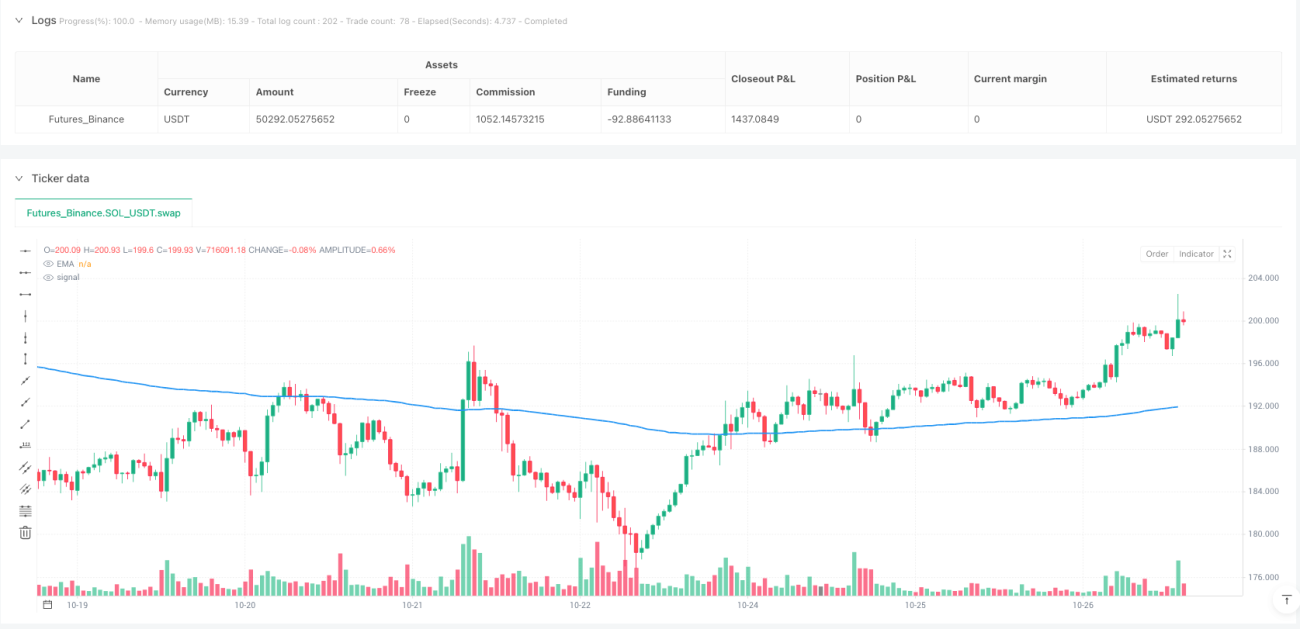
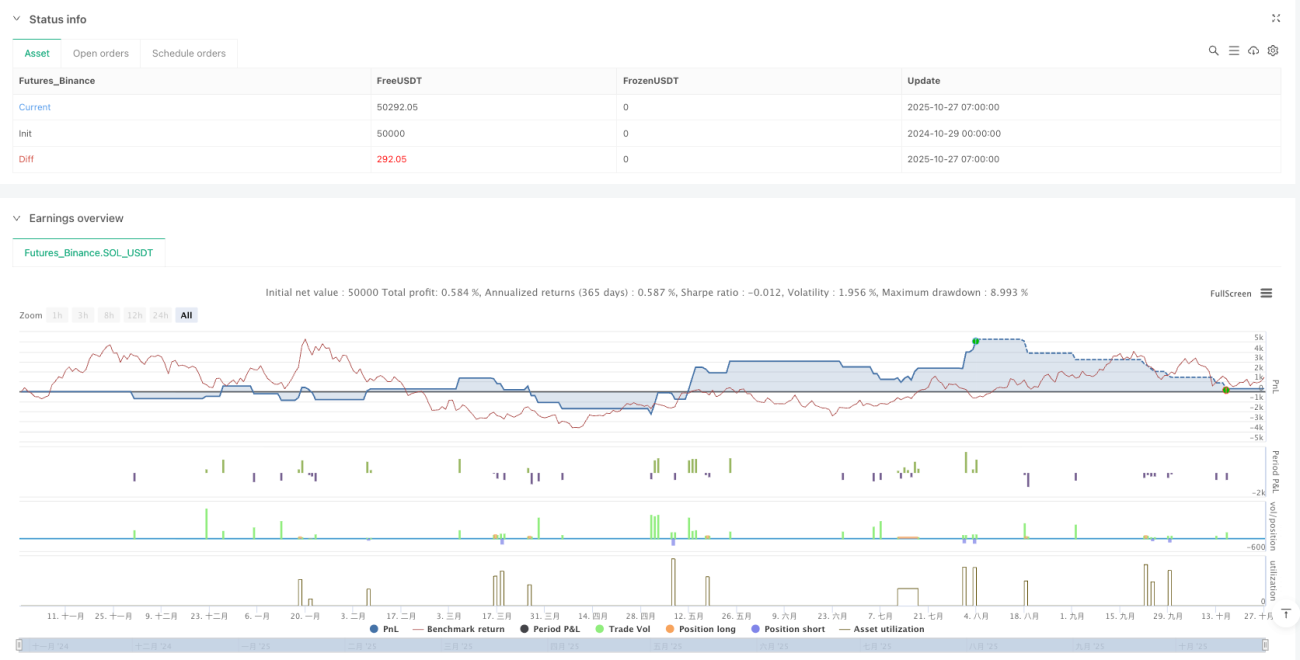
Diese Strategie verwendet die 200-Tage-EMA, um die Richtung des großen Trends zu bestimmen, und sucht dann nach Durchbruchmöglichkeiten an den wichtigen Widerstands- / Unterstützungspunkten.Die Kernlogik ist einfach und grob: Die Bullen suchen nach einem Durchbruch der Abwärtstrendlinie, die Bären suchen nach einem Durchbruch der Aufwärtstrendlinie, die leer sind.
Die Daten sprechen: Strategie mit 5+5 Hubspot-Detektion, um sicherzustellen, dass die Signale nicht übertragen werden. Die 20-Zyklus-Rückblick-Fenster beschränken den historischen Datenbereich und vermeiden Überübung. Dies ist keine Theorie, sondern reine Analyse des Preisverhaltens.
Der Stoppschaden wird an der oberen und unteren Stelle der K-Linie eingestellt. Das Ziel des Stoppschadens ist das Dreifache des Stoppschadenabstands.Das bedeutet, dass Sie langfristig profitabel sind, auch wenn Sie nur 30% gewinnen.
Spezifische Ausführung: Nach mehrfachen Durchbrüchen ist Stop = Vor-Low, Stop = Einstiegspreis + 3 × ((Einstiegspreis - Vor-Low)). Hohlkopf umgekehrt. Die Risikokontrolle ist standardmäßig auf 1% des Kontogeldes gesetzt und kann zwischen 0,1% und 10% angepasst werden.
Das größte Problem mit der traditionellen technischen Analyse ist, dass sie zu subjektiv ist. Diese Strategie verwendet Algorithmen, um automatisch die wichtigsten Höhen und Tiefen zu identifizieren:
Das Ergebnis: vollkommen objektiv, ohne Übermalungen und reproduzierbar.
Das erste Filter: EMA-Trends mit Vorurteilen.Der Preis macht nur mehrere Durchbrüche über der 200-Tage-EMA und nur kurze Durchbrüche darunter. Dieser Trick filtert direkt 80% der rückläufigen Geschäfte.
Die zweite Ebene der Filterung: Die Bestätigung der Effektivität der Trendlinie.Das System verlangt, dass zwei geeignete Achsenpunkte gefunden werden müssen, um eine Trendlinie zu zeichnen. “Trendlinien”, die nicht durch ausreichend Daten unterstützt werden, werden direkt ignoriert.
Wirkungsvolle Einsätze: Die Wirkungslosigkeit der Signale in den bewegten Städten wurde deutlich reduziert, und die Durchbruchsmöglichkeiten in den Trendstädten wurden genau erfasst.
Sie können zwischen zwei Positionsmodellen wählen:
Mathematische Formel: Größe der Position = (Kontokapital × Risikoprozent) ÷ Stop-Loss-Distanz
Diese Strategie ist wissenschaftlicher als 90% aller Strategien auf dem Markt. Bei einem Verlust wird automatisch abgebaut und bei einem Gewinn schrittweise erhöht.
Die Strategie ist nicht allumfassend und funktioniert in folgenden Fällen schlecht:
Parameter-Sensitivitäts-Erinnerung:
Die beste Anwendung:
Empfehlungen zur Optimierung der Parameter:
Risikotipp: Die historische Rücksage ist kein Hinweis auf zukünftige Gewinne. Jede Strategie kann kontinuierlich verlieren. Es wird empfohlen, die Umgebung zu simulieren und die Strategie-Logik zu verstehen, bevor sie in die reale Welt investiert wird.
/*backtest
start: 2024-10-29 00:00:00
end: 2025-10-27 08:00:00
period: 1h
basePeriod: 1h
exchanges: [{"eid":"Futures_Binance","currency":"SOL_USDT"}]
*/
//@version=5
strategy("Trendline Breakout Strategy", overlay=true, max_lines_count=500, max_labels_count=500, max_boxes_count=500)
// === INPUTS ===
ema_len = input.int(200, "EMA Length", minval=1, group="Trend Detection")
src = input.source(close, "EMA Source", group="Trend Detection")
lookback = input.int(20, "Lookback Window for Pivots (bars)", minval=5, group="Trend Detection")
left_bars = input.int(5, "Pivot Left Sensitivity (bars)", minval=1, group="Trend Detection")
right_bars = input.int(5, "Pivot Right Sensitivity (bars)", minval=1, group="Trend Detection")
qty_mode = input.string("Risk Percent", "Position Sizing Mode", options=["Risk Percent", "Fixed Contracts"], group="Position Sizing")
risk_pct = input.float(1.0, "Risk % of Equity", minval=0.1, maxval=10.0, step=0.1, group="Position Sizing")
fixed_size = input.int(1, "Fixed Contract Size", minval=1, group="Position Sizing")
show_trendline = input.bool(true, "Show Trendline", group="Visuals")
enable_prints = input.bool(true, "Enable Info Table", group="Visuals")
// === CORE LOGIC ===
// EMA Calculation
ema = ta.ema(src, ema_len)
bias_bull = close > ema
bias_bear = close < ema
// Pivot Detection (confirmed, no repainting)
ph = ta.pivothigh(high, left_bars, right_bars)
pl = ta.pivotlow(low, left_bars, right_bars)
// Arrays to store historical pivots (limited to prevent memory issues)
var array<float> ph_values = array.new<float>()
var array<int> ph_bars = array.new<int>()
var array<float> pl_values = array.new<float>()
var array<int> pl_bars = array.new<int>()
// Update pivot highs array
if not na(ph)
array.push(ph_values, ph)
array.push(ph_bars, bar_index - right_bars)
if array.size(ph_values) > 100
array.shift(ph_values)
array.shift(ph_bars)
// Update pivot lows array
if not na(pl)
array.push(pl_values, pl)
array.push(pl_bars, bar_index - right_bars)
if array.size(pl_values) > 100
array.shift(pl_values)
array.shift(pl_bars)
// Function to find two most recent pivots within lookback
get_two_pivots(arr_vals, arr_bars) =>
int p1_bar = na
float p1_val = na
int p2_bar = na
float p2_val = na
for j = array.size(arr_bars) - 1 to 0
int pb = array.get(arr_bars, j)
if pb < bar_index - lookback
break
if na(p1_bar)
p1_bar := pb
p1_val := array.get(arr_vals, j)
else if na(p2_bar)
p2_bar := pb
p2_val := array.get(arr_vals, j)
break // Only need the two most recent
[p1_bar, p1_val, p2_bar, p2_val]
// Get pivots for bullish bias
int p1h_bar = na
float p1h_val = na
int p2h_bar = na
float p2h_val = na
if bias_bull
[tmp1, tmp2, tmp3, tmp4] = get_two_pivots(ph_values, ph_bars)
p1h_bar := tmp1
p1h_val := tmp2
p2h_bar := tmp3
p2h_val := tmp4
// Get pivots for bearish bias
int p1l_bar = na
float p1l_val = na
int p2l_bar = na
float p2l_val = na
if bias_bear
[tmp5, tmp6, tmp7, tmp8] = get_two_pivots(pl_values, pl_bars)
p1l_bar := tmp5
p1l_val := tmp6
p2l_bar := tmp7
p2l_val := tmp8
// Validate trendlines
bull_valid = bias_bull and not na(p1h_bar) and not na(p2h_bar) and p2h_bar < p1h_bar and p2h_val > p1h_val // Descending: older high > newer high
bear_valid = bias_bear and not na(p1l_bar) and not na(p2l_bar) and p2l_bar < p1l_bar and p2l_val < p1l_val // Ascending: older low < newer low
// Calculate trendline Y at current bar
float bull_y = na
if bull_valid and p1h_bar != p2h_bar
float slope = (p1h_val - p2h_val) / (p1h_bar - p2h_bar)
bull_y := p1h_val + slope * (bar_index - p1h_bar)
float bear_y = na
if bear_valid and p1l_bar != p2l_bar
float slope = (p1l_val - p2l_val) / (p1l_bar - p2l_bar)
bear_y := p1l_val + slope * (bar_index - p1l_bar)
// Breakout conditions (confirmed on close, no repainting)
long_breakout = bull_valid and ta.crossover(close, bull_y)
short_breakout = bear_valid and ta.crossunder(close, bear_y)
// === POSITION SIZING AND ENTRIES ===
var float entry_price = na
var float sl_price = na
var float tp_price = na
if long_breakout and strategy.position_size == 0
entry_price := close
sl_price := low[1]
float risk = entry_price - sl_price
if risk > 0
strategy.entry("Long", strategy.long, qty = qty_mode == "Fixed Contracts" ? float(fixed_size) : (strategy.equity * risk_pct / 100) / risk)
tp_price := sl_price + 3 * risk
strategy.exit("Long Exit", "Long", stop=sl_price, limit=tp_price)
if short_breakout and strategy.position_size == 0
entry_price := close
sl_price := high[1]
float risk = sl_price - entry_price
if risk > 0
strategy.entry("Short", strategy.short, qty = qty_mode == "Fixed Contracts" ? float(fixed_size) : (strategy.equity * risk_pct / 100) / risk)
tp_price := sl_price - 3 * risk
strategy.exit("Short Exit", "Short", stop=sl_price, limit=tp_price)
// === VISUAL LABELS ===
if long_breakout
label.new(bar_index, low, text="Long\nEntry: " + str.tostring(entry_price, "#.##") + "\nSL: " + str.tostring(sl_price, "#.##") + "\nTP: " + str.tostring(tp_price, "#.##") + "\nReason: Trendline Breakout",
style=label.style_label_up, color=color.green, textcolor=color.white, size=size.small)
if short_breakout
label.new(bar_index, high, text="Short\nEntry: " + str.tostring(entry_price, "#.##") + "\nSL: " + str.tostring(sl_price, "#.##") + "\nTP: " + str.tostring(tp_price, "#.##") + "\nReason: Trendline Breakout",
style=label.style_label_down, color=color.red, textcolor=color.white, size=size.small)
// === INFO TABLE ===
if enable_prints and barstate.islast
var table info_table = table.new(position.top_right, 2, 4, bgcolor=color.white, border_width=1)
table.cell(info_table, 0, 0, "Bias", text_color=color.black, bgcolor=color.gray)
table.cell(info_table, 1, 0, bias_bull ? "Bull" : "Bear", text_color=bias_bull ? color.green : color.red)
table.cell(info_table, 0, 1, "Trendline", text_color=color.black, bgcolor=color.gray)
table.cell(info_table, 1, 1, bull_valid or bear_valid ? (bull_valid ? "Descending" : "Ascending") : "None", text_color=color.black)
table.cell(info_table, 0, 2, "Position", text_color=color.black, bgcolor=color.gray)
table.cell(info_table, 1, 2, strategy.position_size > 0 ? "Long" : strategy.position_size < 0 ? "Short" : "Flat", text_color=color.black)
table.cell(info_table, 0, 3, "P&L", text_color=color.black, bgcolor=color.gray)
table.cell(info_table, 1, 3, str.tostring(strategy.netprofit, "#.##"), text_color=strategy.netprofit >= 0 ? color.green : color.red)
// === EMA PLOT ===
plot(ema, "EMA", color=color.blue, linewidth=2)
// === ALERTS ===
alertcondition(long_breakout, title="Long Entry Alert", message="Bullish bias: Price broke above descending trendline. Enter Long.")
alertcondition(short_breakout, title="Short Entry Alert", message="Bearish bias: Price broke below ascending trendline. Enter Short.")
alertcondition(strategy.position_size[1] != 0 and strategy.position_size == 0, title="Exit Alert", message="Position closed at SL or TP.")
// === COMMENTS AND LIMITATIONS ===
// Comments:
// - Pivots are detected using ta.pivothigh/low with user-defined sensitivity to identify "significant" swings.
// - Trendlines are redrawn only when bias is active and valid (two qualifying pivots found).
// - Entries/exits use strategy.entry/exit for backtesting; position size closes opposite trades automatically.
// - No repainting: All pivots require 'right_bars' confirmation; breakouts checked on bar close.
// - Variable names: Descriptive (e.g., p1h_bar for most recent pivot high bar).
//
// Limitations:
// - Trendline uses the two *most recent* pivot highs/lows within lookback; may not always connect the absolute highest/lowest if more pivots exist.
// - Pivot sensitivity (left/right bars) approximates "significant" swings—too low may include noise, too high may miss turns.
// - Only one trendline per bias; does not handle multiple parallel lines or complex channels.
// - Position sizing assumes equity-based risk; in "Fixed Contracts" mode, risk % varies with SL distance.
// - Lookback window limits historical context—short windows may yield few/no valid trendlines on low-volatility periods.
// - Strategy does not filter for overall trend strength beyond EMA bias; add filters (e.g., volume) for production use.