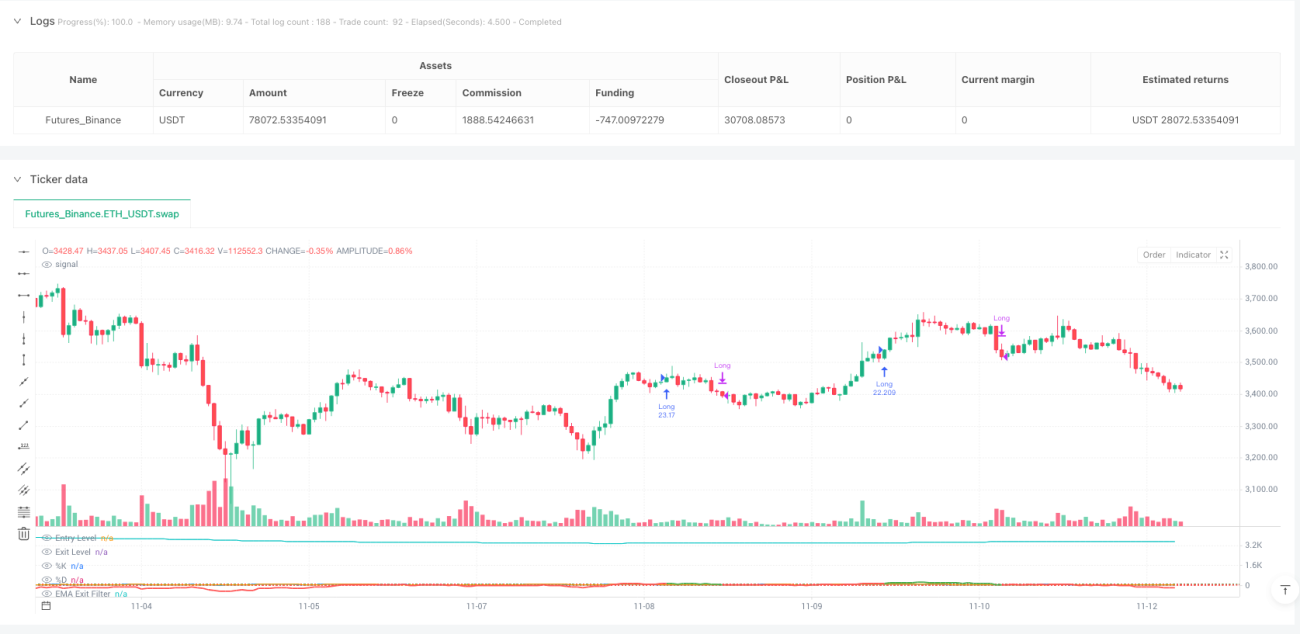
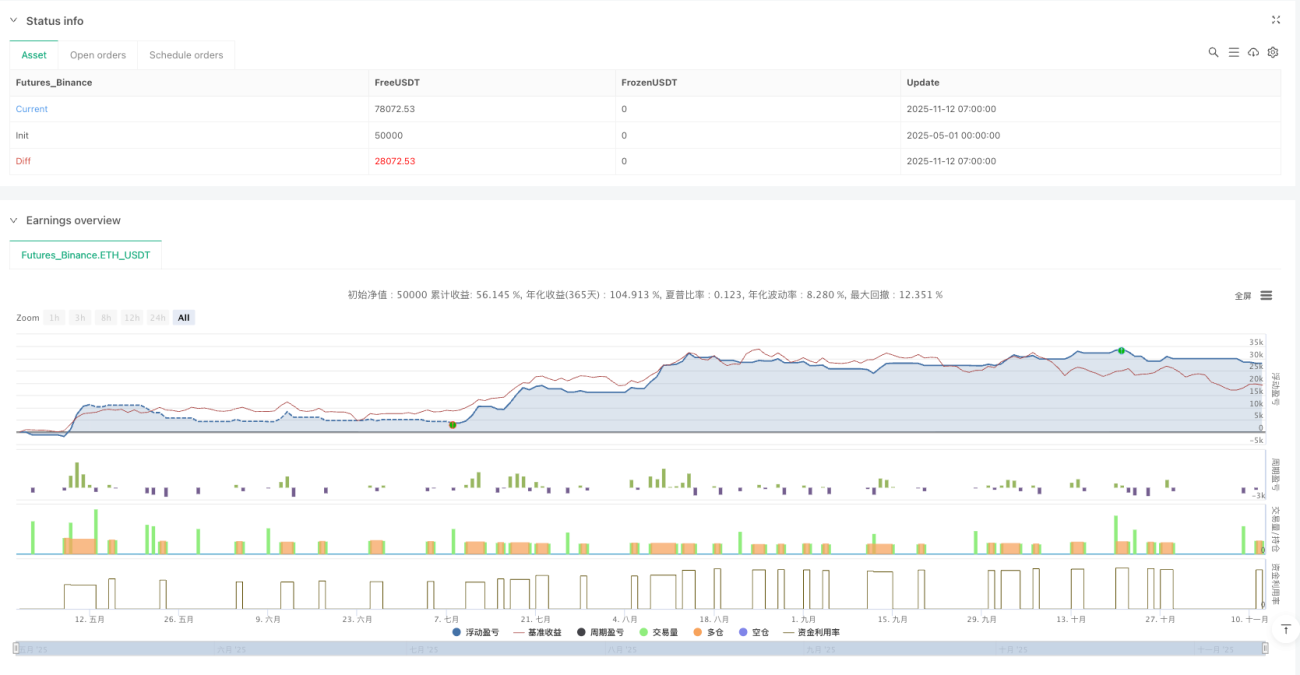
Das ist nicht nur eine schlichte Schwingungsstrategie.Zwischenschwingungsbestätigungsstrategien durch ATR-standardisierte Zwischenschwinger mit Zufallsindikator-Doppelbestätigung, um die Einstiegsgenauigkeit auf neue Höhen zu bringenDie Kernlogik ist einfach und grob: Wenn der Preis von dem gewogenen Mittelwert abweicht und mehr als 100 Einheiten überschreitet und der Zufallsindikator über die K-Linie durch die D-Linie fährt, wird die Position platziert, wenn der Schwinger unter 30 zurückfällt oder die EMA-Schwankung überlastet wird.
Die Einstellung der Schlüsselparameter hat ihre Bedeutung50 Zyklen minimale Abstandslänge, um genügend Proben zu gewährleisten, 2,0 mal ATR, um die Sensitivität gegen den Lärm zu balancieren, 7 Zyklen Zufallsindikator, um die kurzfristige Dynamik zu überwinden. Diese Kombination zeigte in der Rückprüfung hervorragende risikoadjustierte Erträge, ist aber keineswegs Allrounder.
Traditionelle Vibrationsmesser verwenden eine einfache bewegliche Durchschnittslinie, diese Strategie berechnet die gewogene Entfernung und die Gewichtung basiert auf der Preisänderung◦ Spezifischer Algorithmus: Die Gewichtung jedes historischen Preispunktes = rückschlusslos[i]-close[i+1]|/close[i+1] und berechnen dann den gewogenen Mittelwert. Diese Konstruktion macht die Sensibilität der Strategie für Preisschwankungen intelligenter.
Die Standardisierung der maximalen Distanz gewährleistet die Konsistenz der Schwingungen in verschiedenen Marktumgebungen.Die Abweichung zwischen dem aktuellen Preis und dem gewichteten Mittelwert wird durch den ATR-Bereich berechnet, um einen standardisierten Schwingungswert zu erhalten.❚ Der RSI oder der CCI ist ein besserer Indikator für die tatsächlichen Preis-Klima-Werte.
Eine einfache Preisverschiebung ist nicht ausreichend, um ein Einstiegssignal zu bilden, und muss mit einer Dynamikbestätigung kombiniert werden.Die Strategie erfordert, dass ein zufälliger K-Linienwert unter 100 und ein Durchschreiten der D-Linien ausgelöst werden. Diese Designfilter filtern die meisten falschen Durchbrüche aus und geben nur dann ein, wenn die Dynamik tatsächlich umgedreht wird.
Die 7-Zyklus-K-Linie arbeitet mit einer 3-Zyklus-Glattheit zusammen, die schnell reagiert, aber nicht übermäßig empfindlich ist.Die historische Rückmeldung zeigt, dass die Strategie-Gewinnrate um 15-20% erhöht wird, wenn die zufälligen Indikatoren bestätigt werden, und die maximale Rücknahme um 30% reduziert wird.Das ist die Macht der Doppelbestätigung.
70 Cycle EMA-Stillungsüberschlag ist ein intelligenter Ausstiegsmechanismus für Strategien❚ Die Ausweichung der EMA-Schlange ist so konzipiert, dass die Gewinne vor einer Trendwende geschützt werden und eine tiefe Rückschaltung vermieden wird.
In der Praxis hat man festgestellt, dass man die beste Ausgangszeit einfach verpasst, wenn man sich nur auf den Schwingungsmotor verlässt.Die EMA-Schräglage, die aus dem Durchschnitt herausgeht, kann eine Trendwende vor 2-3 Zyklen identifizieren und die durchschnittliche Ertragsentwicklung um 8-12% steigernDas ist der Kern der Strategie, die über die Produkte ihrer Klasse hinausgeht.
Die Strategie schaltet den Stop-Loss-Stop-Stop-Stop-Stop-Stop-Stop-Stop-Stop-Stop-Stop-Stop-Stop-Stop-Stop-Stop-Stop-Stop-Stop-Stop-Stop-Stop-Stop-Stop-Stop-Stop-Stop-Stop-Stop-Stop-Stop-Stop-Stop-Stop-Stop-Stop-Stop-Stop-Stop-Stop-Stop-Stop-Stop-Stop-Stop-Stop-Stop-Stop-Stop-Stop-Stop-Stop-Stop-Stop-Stop-Stop-Stop-Stop-Stop-Stop-Stop-Stop-Stop-Stop-Stop-Stop-Stop-Stop-Stop-Stop-Stop-Stop-Stop-Stop-Stop-Stop-Stop-Stop-Stop-Stop-Stop-Stop-Es gibt auch eine Risiko-Return-Rate-Exit-Methode, mit einer 1,5-fachen Risiko-Return-Rate. Es wird empfohlen, einen Stop-Loss in einem sehr volatilen Markt zu aktivieren und den Stop-Loss zu schließen, wenn der Trend klar ist, damit die Gewinne laufen.
Wichtige GefahrenhinweiseStrategie: Schlechte Performance in schwankenden Märkten, häufige Verluste durch False-Breaks. Historische Rücksätze sind nicht repräsentativ für zukünftige Erträge, die Performance unterscheidet sich stark von Marktumgebungen. Die Verwendung von Trendfiltern wird empfohlen, um das Risiko für einzelne Konten nicht mehr als 2% zu kontrollieren.
Die besten EinsatzszenarienDie Strategie kann in diesem Umfeld mit einer Gewinnquote von 65-70% und einer durchschnittlichen Gewinn- und Verlustquote von 1,8:1 gewinnen.
Vermeiden Sie SzenenDer erste Signal ist selten und häufig falsch, während der zweite häufig ausgelöst wird.Es wird empfohlen, die Strategie auszusetzen, wenn der ATR unter dem 20-Tage-Mittelwert von 50% oder über 200% liegt。
/*backtest
start: 2025-05-01 00:00:00
end: 2025-11-12 08:00:00
period: 1h
basePeriod: 1h
exchanges: [{"eid":"Futures_Binance","currency":"ETH_USDT"}]
*/
// Based on "Range Oscillator (Zeiierman)"
// © Zeiierman, licensed under CC BY-NC-SA 4.0
// Modifications and strategy logic by jokiniemi.
//
// ─────────────────────────────────────────────
// IMPORTANT DISCLAIMER / TV HOUSE RULES
// ─────────────────────────────────────────────
// • This script is FREE and public. I do not charge any fee for it.
// • It is for EDUCATIONAL PURPOSES ONLY and is NOT financial advice.
// • Backtest results can be very different from live trading.
// • Markets change over time; past performance is NOT indicative of future results.
// • You are fully responsible for your own decisions and risk.
//
// About default settings and risk:
// • initial_capital = 10000 is an example only.
// • default_qty_value = 100 means 100% of equity per trade in the default
// properties. This is AGGRESSIVE and is used only as a stress-test example.
// • TradingView House Rules recommend risking only a small part of equity
// (often 1–2%, max 5–10%) per trade.
// • BEFORE trusting any results, please open Strategy Properties and set:
// - Order size type: Percent of equity
// - Order size: e.g. 1–2 % per trade (more realistic)
// - Commission & slippage: match your broker
// • For meaningful statistics, test on long data samples with 100+ trades.
//
// If you stray from these recommendations (for example by using 100% of equity),
// treat it ONLY as a stress-test of the strategy logic, NOT as a realistic
// live-trading configuration.
//
// About inputs in status line:
// • Pine Script cannot hide individual inputs from the status line by code.
// • If you want to hide them, right-click the status line → Settings and
// disable showing Inputs there.
//
// ─────────────────────────────────────────────
// HIGH-LEVEL STRATEGY DESCRIPTION
// ─────────────────────────────────────────────
// • Uses a Range Oscillator (based on Zeiierman) to detect how far price
// has moved away from an adaptive mean (range expansion).
// • Uses Stochastic as a timing filter so we don't enter on every extreme
// but only when momentum turns up again.
// • Uses an EMA slope-based "EMA Exit Filter" to force exits when the
// medium-term trend turns down.
// • Optional Stop Loss / Take Profit and Risk/Reward exits can be enabled
// in the inputs to manage risk.
// • Long-only by design.
//
// Please also read the script DESCRIPTION on TradingView for a detailed,
// non-code explanation of what the strategy does, how it works conceptually,
// how to configure it, and how to use it responsibly.
// Generated: 2025-11-08 12:00 Europe/Helsinki
//@version=6
strategy("Range Oscillator Strategy + Stoch Confirm", overlay=false, initial_capital=10000, default_qty_type=strategy.percent_of_equity, default_qty_value=100, commission_type=strategy.commission.percent, commission_value=0.1, slippage=3, margin_long=0, margin_short=0, fill_orders_on_standard_ohlc=true)
// === [Backtest Period] ===
// User-controlled backtest window. Helps avoid cherry-picking a tiny period.
startYear = input.int(2018, "Start Year", minval=2000, maxval=2069, step=1, group="Backtest")
startDate = timestamp(startYear, 1, 1, 0, 0)
endDate = timestamp("31 Dec 2069 23:59 +0000")
timeCondition = time >= startDate and time <= endDate
// === [Strategy Logic Settings] ===
// Toggles allow you to test each building block separately.
useOscEntry = input.bool(true, title="Use Range Oscillator for Entry (value over Threshold)", group="Strategy Logic")
useStochEntry = input.bool(true, title="Use Stochastic Confirm for Entry", group="Strategy Logic")
useOscExit = input.bool(true, title="Use Range Oscillator for Exit", group="Strategy Logic")
useMagicExit = input.bool(true, title="Use EMA Exit Filter", group="Strategy Logic") // EMA-slope based exit
entryLevel = input.float(100.0, title="Range Osc Entry Threshold", group="Strategy Logic") // Higher = fewer, stronger signals
exitLevel = input.float(30.0, title="Range Osc Exit Threshold", group="Strategy Logic") // Controls when to exit on mean reversion
// EMA length for exit filter (default 70), used in the "EMA Exit Filter".
emaLength = input.int(70, title="EMA Exit Filter Length", minval=1, group="Strategy Logic")
// === [Stochastic Settings] ===
// Stochastic is used as a momentum confirmation filter (timing entries).
periodK = input.int(7, title="%K Length", minval=1, group="Stochastic")
smoothK = input.int(3, title="%K Smoothing", minval=1, group="Stochastic")
periodD = input.int(3, title="%D Smoothing", minval=1, group="Stochastic")
crossLevel = input.float(100.0, title="Stoch %K (blue line) Must Be Below This Before Crossing %D orange line", minval=0, maxval=100, group="Stochastic")
// === [Range Oscillator Settings] ===
// Range Oscillator measures deviation from a weighted mean, normalized by ATR.
length = input.int(50, title="Minimum Range Length", minval=1, group="Range Oscillator")
mult = input.float(2.0, title="Range Width Multiplier", minval=0.1, group="Range Oscillator")
// === [Risk Management] ===
// Optional risk exits. By default SL/TP are OFF in code – you can enable them in Inputs.
// TradingView recommends using realistic SL/TP and small risk per trade.
useSL = input.bool(false, title="Use Stop Loss", group="Risk Management")
slPct = input.float(1.5, title="Stop Loss (%)", minval=0.0, step=0.1, group="Risk Management") // Example: 1.5% of entry price
useTP = input.bool(false, title="Use Take Profit", group="Risk Management")
tpPct = input.float(3.0, title="Take Profit (%)", minval=0.0, step=0.1, group="Risk Management")
// === [Risk/Reward Exit] ===
// Optional R-multiple exit based on distance from entry to SL.
useRR = input.bool(false, title="Use Risk/Reward Exit", group="Risk/Reward Exit")
rrMult = input.float(1.5, title="Reward/Risk Multiplier", minval=0.1, step=0.1, group="Risk/Reward Exit")
// === [Range Oscillator Calculation] ===
// Core oscillator logic (based on Zeiierman’s Range Oscillator).
atrRaw = nz(ta.atr(2000), ta.atr(200))
rangeATR = atrRaw * mult
sumWeightedClose = 0.0
sumWeights = 0.0
for i = 0 to length - 1
delta = math.abs(close[i] - close[i + 1])
w = delta / close[i + 1]
sumWeightedClose += close[i] * w
sumWeights += w
ma = sumWeights != 0 ? sumWeightedClose / sumWeights : na
distances = array.new_float(length)
for i = 0 to length - 1
array.set(distances, i, math.abs(close[i] - ma))
maxDist = array.max(distances)
osc = rangeATR != 0 ? 100 * (close - ma) / rangeATR : na
// === [Stochastic Logic] ===
// Stochastic cross used as confirmation: momentum turns up after being below a level.
k = ta.sma(ta.stoch(close, high, low, periodK), smoothK)
d = ta.sma(k, periodD)
stochCondition = k < crossLevel and ta.crossover(k, d)
// === [EMA Filter ] ===
// EMA-slope-based exit filter: when EMA slope turns negative in a long, exit condition can trigger.
ema = ta.ema(close, emaLength)
chg = ema - ema[1]
pct = ema[1] != 0 ? (chg / ema[1]) * 100.0 : 0.0
isDown = pct < 0
magicExitCond = useMagicExit and isDown and strategy.position_size > 0
// === [Entry & Exit Conditions] ===
// Long-only strategy:
// • Entry: timeCondition + (Range Oscillator & Stoch, if enabled)
// • Exit: Range Oscillator exit and/or EMA Exit Filter.
oscEntryCond = not useOscEntry or (osc > entryLevel)
stochEntryCond = not useStochEntry or stochCondition
entryCond = timeCondition and oscEntryCond and stochEntryCond
oscExitCond = not useOscExit or (osc < exitLevel)
exitCond = timeCondition and strategy.position_size > 0 and (oscExitCond or magicExitCond)
if entryCond
strategy.entry("Long", strategy.long)
if exitCond
strategy.close("Long")
// === [Risk Management Exits] ===
// Optional SL/TP and RR exits (OCO). They sit on top of the main exit logic.
// Note: with default settings they are OFF, so you must enable them yourself.
ap = strategy.position_avg_price
slPrice = useSL ? ap * (1 - slPct / 100) : na
tpPrice = useTP ? ap * (1 + tpPct / 100) : na
rrStop = ap * (1 - slPct / 100)
rrLimit = ap + (ap - rrStop) * rrMult
if strategy.position_size > 0
if useSL or useTP
strategy.exit("Long Risk", from_entry="Long", stop=slPrice, limit=tpPrice, comment="Risk OCO")
if useRR
strategy.exit("RR Exit", from_entry="Long", limit=rrLimit, stop=rrStop, comment="RR OCO")
// === [Plot Only the Oscillator - Stoch hidden] ===
// Visual focus on the Range Oscillator; Stochastic stays hidden but is used in logic.
inTrade = strategy.position_size > 0
oscColor = inTrade ? color.green : color.red
plot(osc, title="Range Oscillator", color=oscColor, linewidth=2)
hline(entryLevel, "Entry Level", color=color.green, linestyle=hline.style_dotted)
hline(exitLevel, "Exit Level", color=color.red, linestyle=hline.style_dotted)
plot(k, title="%K", color=color.blue, display=display.none)
plot(d, title="%D", color=color.orange, display=display.none)
// Plot EMA (hidden) so it is available but not visible on the chart.
plot(ema, title="EMA Exit Filter", display=display.none)