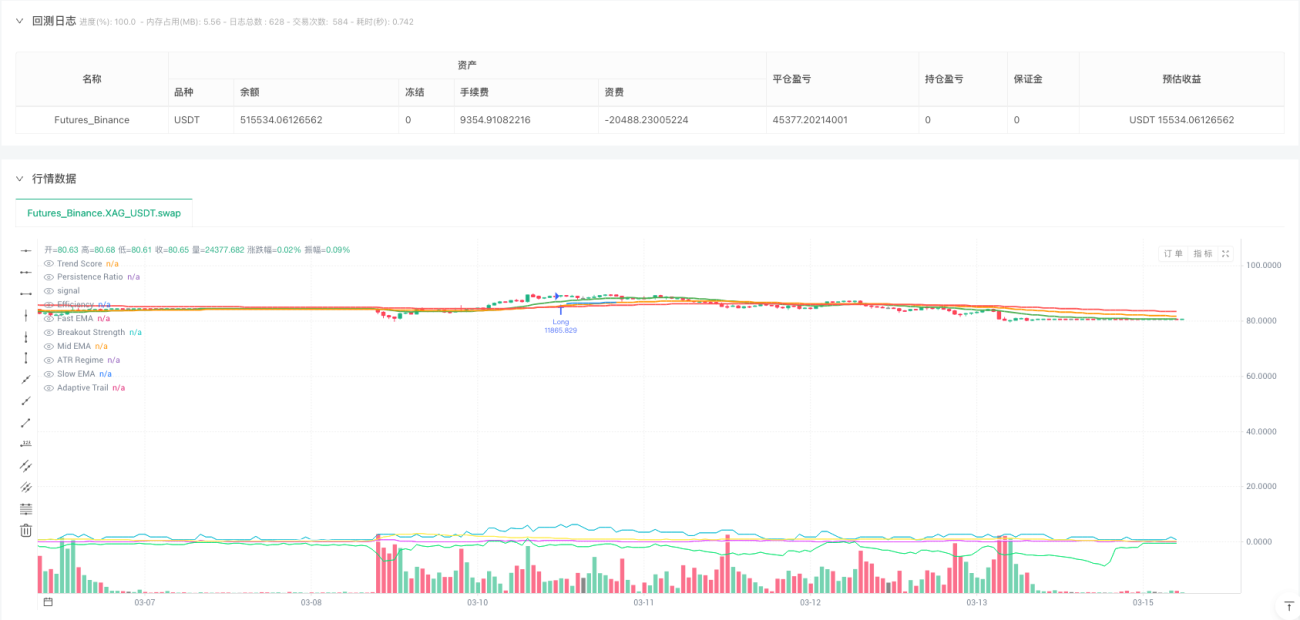
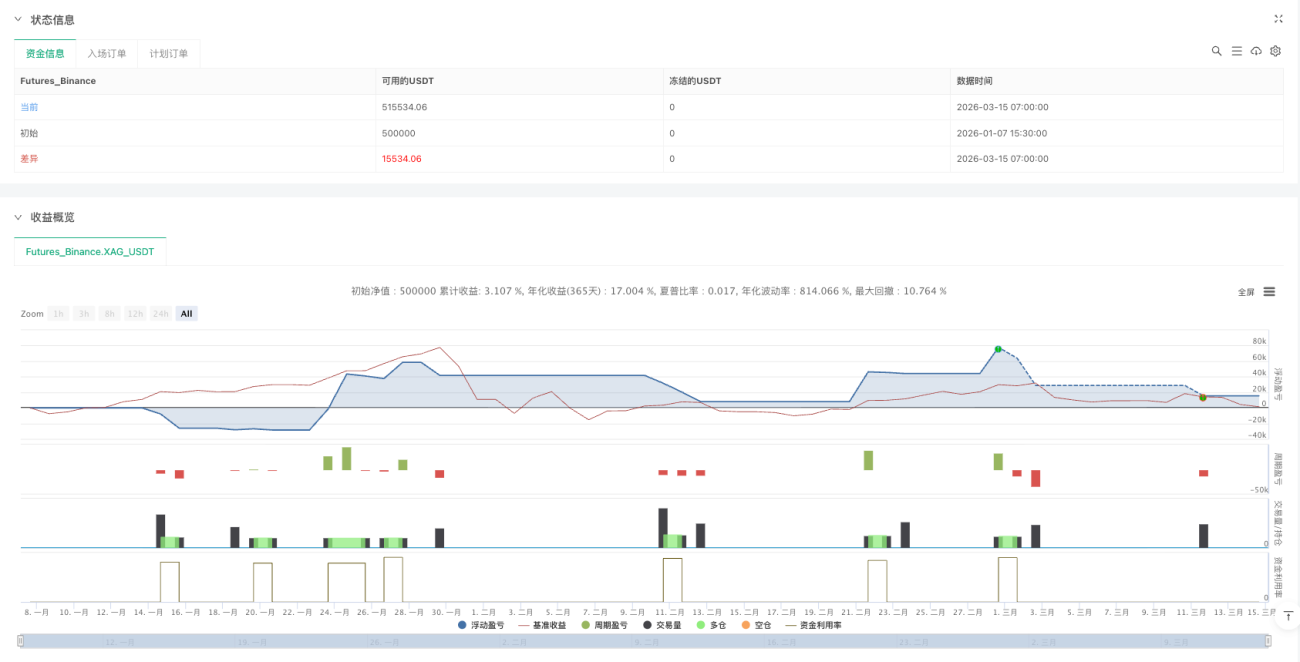
EMA, ATR, MOMENTUM, EFFICIENCY, BREAKOUT
Lassen Sie sich nicht von der oberflächlichen 18/50/120-Drei-Gleichgewicht-Einstellung täuschen. Im Zentrum dieser Strategie steht ein Trend-Verifizierungssystem mit acht unabhängigen Dimensionen, bei denen jeder eine eindeutige numerische Norm hat. Die Qualität der Trends wird nicht durch eine einfache Gold- und Todesvorhalle beurteilt, sondern durch ein gewichtetes Bewertungsmechanismus (mindestens 5,0 Punkte für die Einstiegs- und unter 2,5 Punkte für die Ausstiegsphase).
Das Problem mit der traditionellen Mittellinienstrategie besteht darin, dass es zu viele Falschsignale gibt. Dieses System wird durch mehrfache Filterung der Eintrittsrate auf neue Höhen gebracht, wie z. B. die Effizienz der Pfadläufe (mindestens 33%), die Leistungsbeständigkeit (K-Linienquote um mehr als 57%) und die Schwankungsrate (ATR-Wert von mehr als 95%).
Die Strategie sieht vor, dass die Breakout-Stärke 0,15 mal ATR erreichen muss, was bedeutet, dass die Breakout-Stärke mehr als 15% der jüngsten durchschnittlichen Schwankungen übersteigt, um als gültiges Signal angesehen zu werden.
Der Rückschlag-Retake-Mechanismus ist noch subtiler: Der Kurs muss mindestens 0,9 mal ATR tief zurückschlagen, um dann wieder auf die Mittellinie zu gelangen, wo die Intensität 0,15 mal ATR beträgt. Diese Konstruktion filtert die falschen Überbrüche auf der Oberfläche effektiv und fängt nur die Trendstarts ein, die wirklich finanziert sind.
Die 2-fache Leverage-Einstellung erscheint aggressiv, aber mit einem 2% harten Stop und 2.8-fachen ATR-Dynamic-Tracking ist das tatsächliche Risiko kontrollierbar. Noch wichtiger ist die Gewinnschließung von 20.8-fachen ATR, die automatisch den Stop-Loss erhöht, wenn der Flügel dieses Niveau erreicht, um sicherzustellen, dass die Gewinne im großen Trend nicht zurückgeworfen werden.
Das Design mit einer vollständigen K-Leitung verhindert Hochfrequenz-Eingänge und eine Abkühlzeit von fünf K-Leitungen verhindert emotionale Kontinuität. Diese Rhythmuskontrolle ist wichtiger als reine technische Kennzahlen.
Trend-Fortsetzung-Eintritt: gilt für bereits festgelegte starke Trends, erfordert einen Durchbruch + Steigung + Effizienz + Dynamik, um die gesamte Norm zu erreichen. Zurücksetzen: Zurücksetzen für gesunde Trends, erfordert ausreichend Tiefe und Wiedereroberung der Stärke. Früheres Trend-Eintritt: Erfasst die goldene 14-K-Linie-Fensterperiode, in der sich der Trend umwandelt.
Der Vorteil dieses Multi-Modus-Designs besteht darin, dass keine Trends zu verpassen sind, und jeder Modus hat strenge Qualitätsstandards. Es ist kein Netz, sondern ein Präzisionsscharfschütze.
Die Effizienz des Weges wird berechnet als der Anteil der Nettoverschiebung an der kumulierten Verschiebung innerhalb von 18 Zyklen, wobei ein Trend von weniger als 33% nicht berührt wird. Dieser Indikator kann falsche Trends in schwankenden Verhältnissen effektiv erkennen und verhindert, dass sie in Querkursen wiederholt abgebrochen werden.
Die Dynamik-Kontinuität erfordert eine K-Linie von mehr als 57%, die mit 12 Zyklen positiv ist. Diese Doppel-Verifizierung gewährleistet die intrinsische Stärke des Trends und nicht nur den oberflächlichen Durchbruch des Preises.
Diese Strategie ist deutlich tendenziell und löst häufig Ausstiegssignale aus, wenn die ATR-Status unter 80% liegt und die Effizienz unter 25% liegt. Die Konstruktion, die das Ausstiegsverbot vorschreibt, zeigt, dass die Strategie eindeutige Anforderungen an die Marktumgebung stellt.
Das größte Risiko besteht in der Verzögerung der Trendwechselphase. Obwohl frühe Warnungen wie schnelle EMA-Kreuzungen vorliegen, kann es bei einer schnellen Umkehrung immer noch zu einem großen Rückzug kommen. Es wird empfohlen, in Wachstumsaktien oder Kryptowährungsmärkten mit hoher Volatilität zu arbeiten und eine Anwendung auf niedrige Volatilitätsvarianten wie Großkasten-Blu-Caps zu vermeiden.
Risikotipp: Die historische Rückführung ist nicht repräsentativ für zukünftige Erträge, die Strategie birgt das Risiko einer fortlaufenden Verlustentwicklung, das Risiko muss streng verwaltet werden, und die Performance unterscheidet sich erheblich zwischen verschiedenen Marktbedingungen.
/*backtest
start: 2026-01-07 15:30:00
end: 2026-03-15 08:00:00
period: 1h
basePeriod: 1h
exchanges: [{"eid":"Futures_Binance","currency":"XAG_USDT","balance":500000}]
*/
//@version=5
strategy("Quant Trend Engine Long Only v2 - Manual Leverage Fixed", overlay=true)
// === Core lengths ===
fastLen = input.int(18, "Fast EMA")
midLen = input.int(50, "Mid EMA")
slowLen = input.int(120, "Slow EMA")
smoothLen = input.int(3, "EMA Smoothing")
pullbackLen = input.int(8, "Pullback Lookback")
breakoutLen = input.int(20, "Breakout Length")
effLen = input.int(18, "Efficiency Length")
persistLen = input.int(7, "Persistence Length")
momLen = input.int(12, "Momentum Length")
slopeLen = input.int(10, "Slope Length")
atrLen = input.int(14, "ATR Length")
atrBaseLen = input.int(40, "ATR Baseline Length")
// === Thresholds ===
minScore = input.float(5.0, "Minimum Entry Score", step=0.25)
exitScore = input.float(2.5, "Weak Trend Exit Score", step=0.25)
minSepPerc = input.float(0.30, "Min EMA Separation %", step=0.05)
minSlowSlopePerc = input.float(0.03, "Min Slow Slope %", step=0.01)
minEff = input.float(0.33, "Min Efficiency", step=0.01)
minAtrRegime = input.float(0.95, "Min ATR Regime", step=0.05)
minBreakoutAtr = input.float(0.15, "Min Breakout ATR Strength", step=0.05)
pullbackAtrMult = input.float(0.90, "Pullback Distance ATR", step=0.05)
reclaimAtrMult = input.float(0.15, "Reclaim Distance ATR", step=0.05)
cooldownBars = input.int(5, "Cooldown Bars After Exit")
// === Risk ===
leverage = input.float(2.0, "Leverage", step=0.1, minval=0.1)
hardStopPerc = input.float(2.0, "Hard Stop %", step=0.1)
trailAtrMult = input.float(2.8, "ATR Trail Mult", step=0.1)
profitLockAtrMult = input.float(20.8, "Profit Lock ATR Mult", step=0.1)
// === Smoothed EMAs ===
fast = ta.ema(ta.ema(close, fastLen), smoothLen)
mid = ta.ema(ta.ema(close, midLen), smoothLen)
slow = ta.ema(ta.ema(close, slowLen), smoothLen)
// === Regime structure ===
bullStack = fast > mid and mid > slow
sepPerc = slow != 0 ? math.abs(fast - slow) / slow * 100 : 0.0
sepOk = sepPerc >= minSepPerc
fastSlope = fast[slopeLen] != 0 ? (fast - fast[slopeLen]) / fast[slopeLen] * 100 : 0.0
midSlope = mid[slopeLen] != 0 ? (mid - mid[slopeLen]) / mid[slopeLen] * 100 : 0.0
slowSlope = slow[slopeLen] != 0 ? (slow - slow[slopeLen]) / slow[slopeLen] * 100 : 0.0
slopeOk = slowSlope >= minSlowSlopePerc and midSlope > 0 and fastSlope > 0
// === Path efficiency ===
netMove = math.abs(close - close[effLen])
stepMove = 0.0
for i = 1 to effLen
stepMove += math.abs(close[i - 1] - close[i])
efficiency = stepMove != 0 ? netMove / stepMove : 0.0
effOk = efficiency >= minEff
// === Momentum persistence ===
upBars = 0.0
for i = 0 to persistLen - 1
upBars += close[i] > close[i + 1] ? 1 : 0
persistRatio = persistLen > 0 ? upBars / persistLen : 0.0
momRaw = close[momLen] != 0 ? (close - close[momLen]) / close[momLen] * 100 : 0.0
momOk = momRaw > 0 and persistRatio >= 0.57
// === Volatility regime ===
atr = ta.atr(atrLen)
atrBase = ta.sma(atr, atrBaseLen)
atrRegime = atrBase != 0 ? atr / atrBase : 0.0
atrOk = atrRegime >= minAtrRegime
// === Breakout quality ===
hh = ta.highest(high, breakoutLen)[1]
breakoutDist = close - hh
breakoutStrength = atr != 0 ? breakoutDist / atr : 0.0
breakoutOk = close > hh and breakoutStrength >= minBreakoutAtr
// === Pullback / reclaim logic ===
pullbackLow = ta.lowest(low, pullbackLen)
distFromFastAtr = atr != 0 ? (fast - pullbackLow) / atr : 0.0
deepEnoughPullback = distFromFastAtr >= pullbackAtrMult
reclaimFast = close > fast and close[1] <= fast[1]
reclaimMid = close > mid and close[1] <= mid[1]
reclaimStrength = atr != 0 ? (close - fast) / atr : 0.0
reclaimOk = (reclaimFast or reclaimMid) and reclaimStrength >= reclaimAtrMult
// === Transition memory ===
bullCross = ta.crossover(fast, mid) or ta.crossover(fast, slow) or ta.crossover(mid, slow)
barsSinceBullCross = ta.barssince(bullCross)
recentTrendBirth = barsSinceBullCross >= 0 and barsSinceBullCross <= 14
// === Weighted score ===
trendScore = 0.0
trendScore += bullStack ? 1.50 : 0.0
trendScore += sepOk ? 0.90 : 0.0
trendScore += slopeOk ? 1.10 : 0.0
trendScore += effOk ? 1.00 : 0.0
trendScore += atrOk ? 0.80 : 0.0
trendScore += momOk ? 1.00 : 0.0
trendScore += breakoutOk ? 1.25 : 0.0
trendScore += reclaimOk ? 1.10 : 0.0
// === Entry models ===
trendContinuationEntry = bullStack and breakoutOk and slopeOk and effOk and momOk
pullbackReentry = bullStack and sepOk and slopeOk and deepEnoughPullback and reclaimOk and effOk
earlyTrendEntry = recentTrendBirth and bullStack and sepOk and slopeOk and atrOk and momOk
// === Cooldown ===
var int lastExitBar = na
cooldownOk = na(lastExitBar) or bar_index - lastExitBar > cooldownBars
// === Final entry ===
enterLong = strategy.position_size == 0 and cooldownOk and trendScore >= minScore and close > slow and (trendContinuationEntry or pullbackReentry or earlyTrendEntry)
// === Manual leveraged sizing only ===
equity = math.max(strategy.equity, 0)
positionValue = equity * leverage
qty = positionValue > 0 ? positionValue / (close * syminfo.pointvalue) : 0.0
// === Entry tracking / mandatory 1 full candle hold ===
var int entryBarIndex = na
justOpened = strategy.position_size > 0 and strategy.position_size[1] == 0
if justOpened
entryBarIndex := bar_index
canExitNow = strategy.position_size > 0 and not na(entryBarIndex) and bar_index > entryBarIndex
// === Entry order ===
if enterLong and qty > 0
strategy.entry("Long", strategy.long, qty=qty)
// === Risk logic ===
hardStopPrice = strategy.position_size > 0 ? strategy.position_avg_price * (1 - hardStopPerc / 100) : na
var float trailStop = na
var float highSinceEntry = na
highSinceEntry := strategy.position_size > 0 ? (na(highSinceEntry) ? high : math.max(highSinceEntry, high)) : na
rawTrail = strategy.position_size > 0 ? close - atr * trailAtrMult : na
profitLock = strategy.position_size > 0 ? highSinceEntry - atr * profitLockAtrMult : na
combinedTrail = strategy.position_size > 0 ? math.max(rawTrail, profitLock) : na
trailStop := strategy.position_size > 0 ? (na(trailStop) ? combinedTrail : math.max(trailStop, combinedTrail)) : na
// === Exit logic ===
bearCross = ta.crossunder(fast, mid) or ta.crossunder(fast, slow)
structureBreak = close < mid and fast < mid
scoreWeak = trendScore <= exitScore
momentumFailure = persistRatio < 0.40 and momRaw < 0
regimeFailure = atrRegime < 0.80 and efficiency < 0.25
exitLong = strategy.position_size > 0 and canExitNow and (bearCross or structureBreak or scoreWeak or momentumFailure or regimeFailure)
// Only allow stop/trailing exits after 1 full candle has passed
if strategy.position_size > 0 and canExitNow
strategy.exit("Risk Exit", from_entry="Long", stop=math.max(hardStopPrice, trailStop))
justClosed = strategy.position_size[1] > 0 and strategy.position_size == 0
if justClosed
lastExitBar := bar_index
trailStop := na
highSinceEntry := na
entryBarIndex := na
if exitLong
strategy.close("Long")
// === Plots ===
plot(fast, color=color.green, linewidth=2, title="Fast EMA")
plot(mid, color=color.orange, linewidth=2, title="Mid EMA")
plot(slow, color=color.red, linewidth=2, title="Slow EMA")
plot(strategy.position_size > 0 ? trailStop : na, color=color.blue, linewidth=2, title="Adaptive Trail")
plot(trendScore, title="Trend Score", color=color.aqua)
plot(efficiency, title="Efficiency", color=color.fuchsia)
plot(atrRegime, title="ATR Regime", color=color.yellow)
plot(breakoutStrength, title="Breakout Strength", color=color.lime)
plot(persistRatio, title="Persistence Ratio", color=color.white)