Dual Pressure Quantitative Trading Strategy

Overview
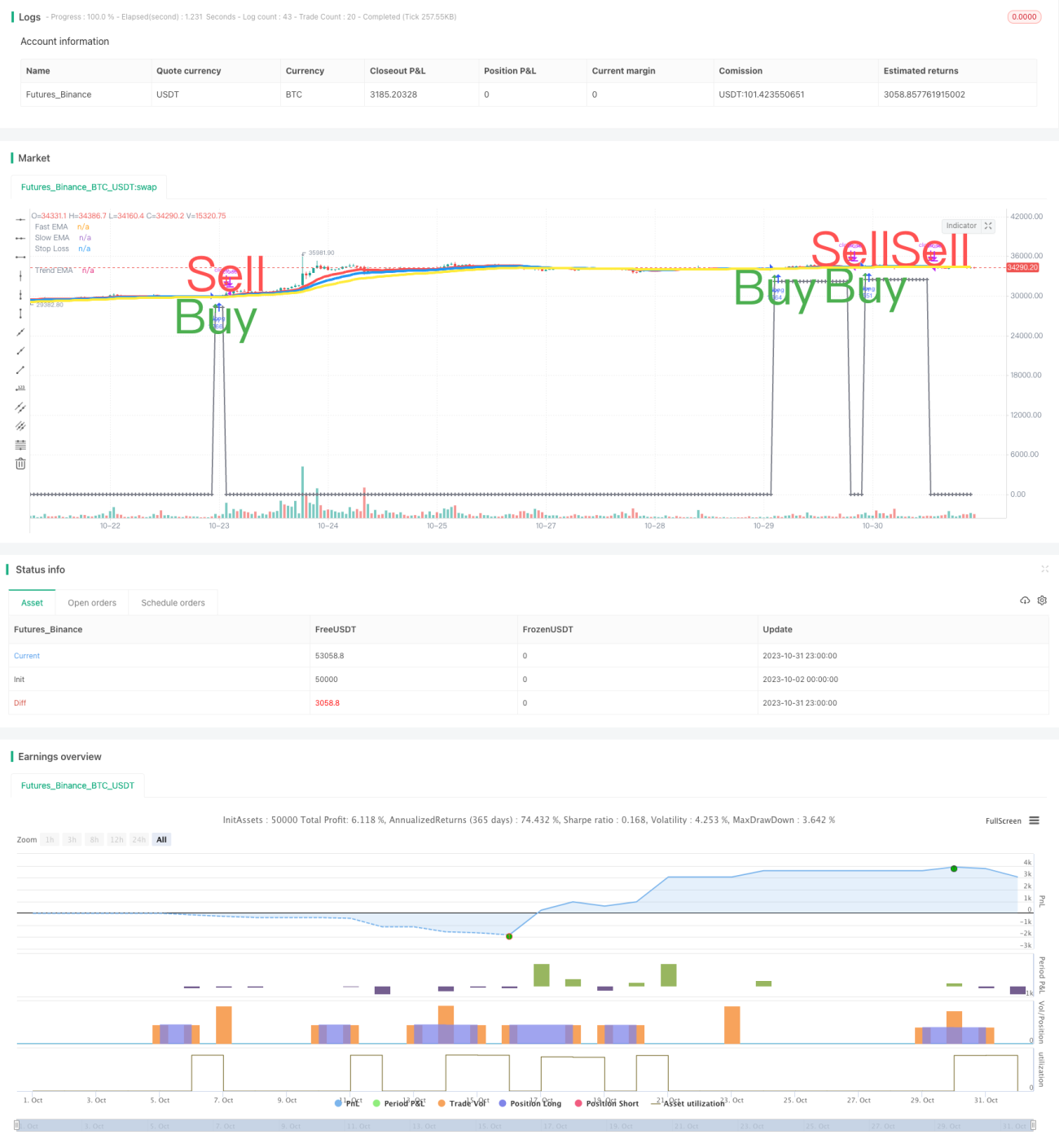
The Dual Pressure quantitative trading strategy is a trend following strategy that combines Stochastic and volume indicators. It mainly uses the Stochastic K and D lines together with volume indicators to generate buy and sell signals, complemented by moving average crosses for additional signals.
Strategy Logic
Buy Signals
The main buy signal triggers when:
-
Both K and D lines cross below oversold area (e.g. 20) and turn up, and both K and D are rising
-
Volume is above a threshold (e.g. 1.4 times average volume)
-
Close is above open (white candle)
Additional buy signals can come from:
-
Golden cross: Fast EMA crosses above slow EMA, both rising
-
Both K and D rise from low into middle zone (e.g. from below 20 to 20-80)
Sell Signals
Main sell signals trigger when:
-
Both K and D enter overbought area (e.g. above 80)
-
Death cross: Fast EMA crosses below slow EMA
-
K crosses below D, and both K and D are falling
Stop Loss
A percentage (e.g. 6%) below buy price is set as stop loss level. Falling below triggers stop loss.
Advantage Analysis
- Dual stochastic avoids false signals
- Volume filters noise and ensures trend
- Multiple signals combined improve accuracy
- Moving averages assist overall trend
- Stop loss controls risk
Advantage 1: Dual Stochastic Avoids False Signals
Single stochastic can generate many false signals. The dual stochastic combination filters false signals and improves reliability.
Advantage 2: Volume Filters Noise and Ensures Trend
The volume condition filters low volume non-trending spots and reduces risk of being trapped.
Advantage 3: Multiple Signals Improve Accuracy
Multiple indicators must align to trigger real trading signals. This improves signal reliability.
Advantage 4: Moving Averages Assist Overall Trend
Rules like dual moving averages ensure signals align with overall trend. This avoids counter-trend trades.
Advantage 5: Stop Loss Controls Risk
The stop loss logic realizes profits and controls loss on single trades.
Risk Analysis
- Parameters need careful optimization, improper settings lead to poor performance
- Stop loss placement must consider gap risk
- Liquidity risk should be monitored for trading instruments
- Lookback issue between different timeframes
Risk 1: Parameters Need Careful Optimization
The strategy has multiple parameters. They need optimization for different instruments, otherwise performance suffers.
Risk 2: Stop Loss Placement Must Consider Gap Risk
The stop loss point should account for price gapping scenarios. It should not be too close to buy price.
Risk 3: Monitor Liquidity Risk
For illiquid instruments, volume rules may filter too many signals. Volume thresholds need to be relaxed.
Risk 4: Lookback Issue Between Timeframes
Misalignment between signals on different timeframes may happen. Signals must be verified to match.
Enhancement Opportunities
The strategy can be enhanced in areas like:
-
Optimize parameters for robustness
-
Introduce machine learning for adaptive parameters
-
Improve stop loss strategy to reduce stop loss rate
-
Add filters to reduce trade frequency
-
Explore conditional orders or profit taking to improve reward
Opportunity 1: Optimize Parameters for Robustness
Methods like genetic algorithms can systematically optimize parameters for stability across market regimes.
Opportunity 2: Introduce Machine Learning for Adaptive Parameters
Models can assess market conditions and adjust parameters accordingly, achieving dynamic optimization.
Opportunity 3: Improve Stop Loss Strategy to Reduce Stop Loss Rate
Better stop loss algorithms can reduce unnecessary stops while maintaining risk control.
Opportunity 4: Add Filters to Reduce Trade Frequency
Strengthening filters can reduce trade frequency, lower costs, and improve per trade returns.
Opportunity 5: Explore Conditional Orders or Profit Taking
According to market conditions, conditional orders or profit taking strategies can better maximize profit while controlling risk.
Conclusion
The strategy balances trend, risk control, costs and other aspects. The core advantages are dual stochastic plus volume for trend and stop loss for risk control. Next steps are to enhance robustness, adaptive parameters, stop loss optimization etc. to yield steady profits in more market regimes.
/*backtest
start: 2023-10-02 00:00:00
end: 2023-11-01 00:00:00
period: 1h
basePeriod: 15m
exchanges: [{"eid":"Futures_Binance","currency":"BTC_USDT"}]
*/

//@version=3
// SW SVE - Stochastic+Vol+EMAs [Sergio Waldoke]
// Script created by Sergio Waldoke (BETA VERSION v0.5, fine tuning PENDING)
// Stochastic process is the main source of signals, reinforced on buying by Volume. Also by Golden Cross.- 1