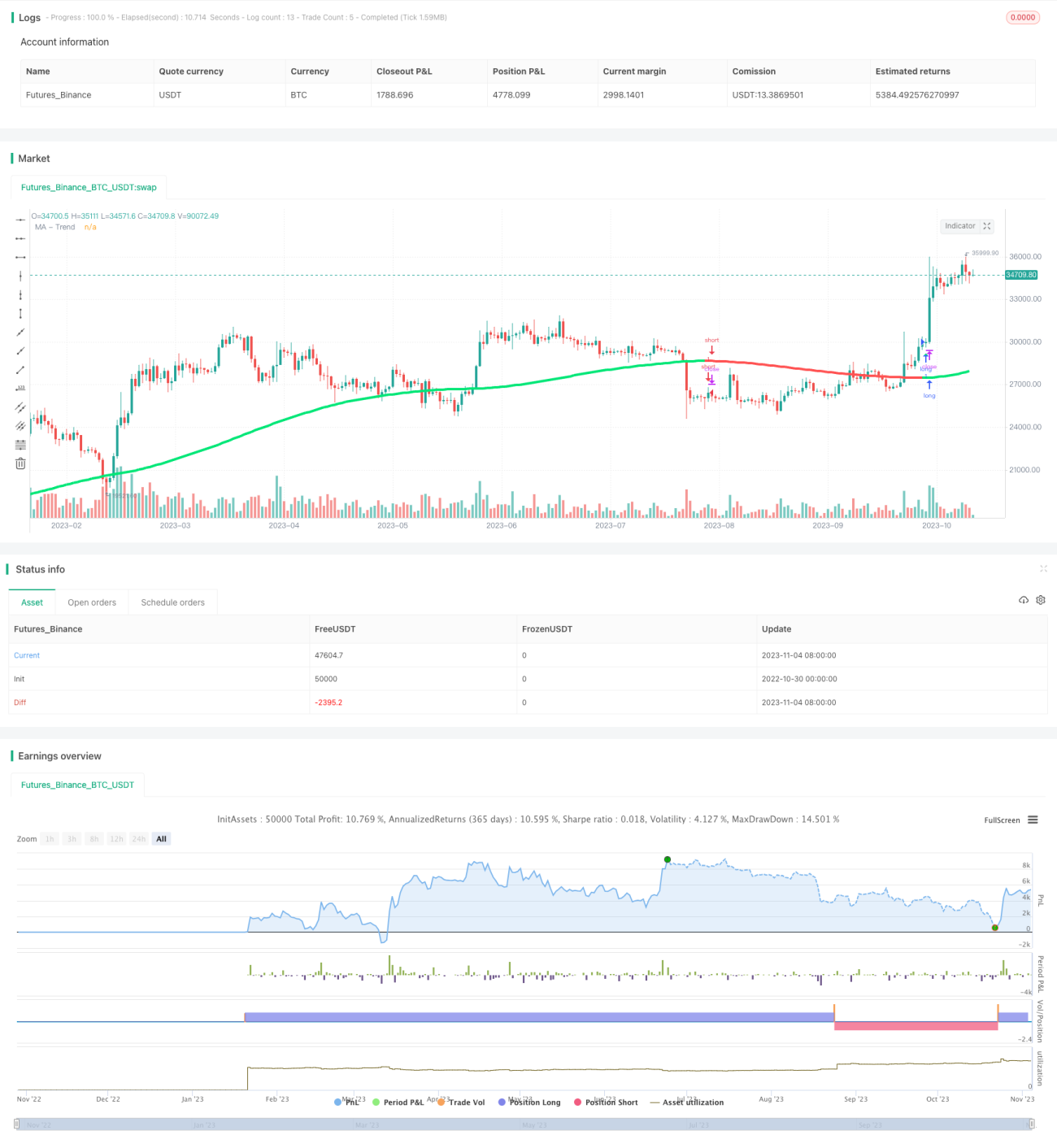
This strategy combines multiple moving averages to implement a simple trend following strategy. It also has the functionality of filtering out noise.
The strategy first smoothes the closing price, with the option of using Heiken Ashi closing price. It then calls the smoothMA function to overlay multiple smoothed moving averages. The smoothMA function first calls the variant function, which can generate various types of moving averages like SMA, EMA, DEMA etc. After variant function generates the specified moving average, smoothMA recursively calls variant multiple times to overlay the smoothing. This results in a moving average with high level of smoothness. It generates buy signals when the smoothed MA goes up and sell signals when it goes down.
Consider combining other indicators like MACD, KDJ to improve signal accuracy. Optimize MA parameters to reduce lag. Use reasonable stop loss to control single trade loss. Also control trade frequency to minimize transaction costs.
The strategy follows trends via multi-overlay of moving averages, effectively filtering market noise. The advantages are simplicity and flexibility. But relying solely on MAs has limited profitability. Consider combining with other indicators, managing risks and optimizing parameters to improve efficiency.
/*backtest
start: 2022-10-30 00:00:00
end: 2023-11-05 00:00:00
period: 1d
basePeriod: 1h
exchanges: [{"eid":"Futures_Binance","currency":"BTC_USDT"}]
*/
//@version=4
// Copyright (c) 2007-present Jurik Research and Consulting. All rights reserved.
// Copyright (c) 2018-present, Alex Orekhov (everget)
// Thanks to everget for code for more advanced moving averages
// Smooth Moving Average [STRATEGY] @PuppyTherapy script may be freely distributed under the MIT license.
strategy( title="Smooth Moving Average [STRATEGY] @PuppyTherapy", overlay=true )
// ---- CONSTANTS ----
lsmaOffset = 1
almaOffset = 0.85
almaSigma = 6
phase = 2
power = 2
// ---- GLOBAL FUNCTIONS ----
kama(src, len)=>
xvnoise = abs(src - src[1])
nfastend = 0.666
nslowend = 0.0645
nsignal = abs(src - src[len])
nnoise = sum(xvnoise, len)
nefratio = iff(nnoise != 0, nsignal / nnoise, 0)
nsmooth = pow(nefratio * (nfastend - nslowend) + nslowend, 2)
nAMA = 0.0
nAMA := nz(nAMA[1]) + nsmooth * (src - nz(nAMA[1]))
t3(src, len)=>
xe1_1 = ema(src, len)
xe2_1 = ema(xe1_1, len)
xe3_1 = ema(xe2_1, len)
xe4_1 = ema(xe3_1, len)
xe5_1 = ema(xe4_1, len)
xe6_1 = ema(xe5_1, len)
b_1 = 0.7
c1_1 = -b_1*b_1*b_1
c2_1 = 3*b_1*b_1+3*b_1*b_1*b_1
c3_1 = -6*b_1*b_1-3*b_1-3*b_1*b_1*b_1
c4_1 = 1+3*b_1+b_1*b_1*b_1+3*b_1*b_1
nT3Average_1 = c1_1 * xe6_1 + c2_1 * xe5_1 + c3_1 * xe4_1 + c4_1 * xe3_1
// The general form of the weights of the (2m + 1)-term Henderson Weighted Moving Average
getWeight(m, j) =>
numerator = 315 * (pow(m + 1, 2) - pow(j, 2)) * (pow(m + 2, 2) - pow(j, 2)) * (pow(m + 3, 2) - pow(j, 2)) * (3 * pow(m + 2, 2) - 11 * pow(j, 2) - 16)
denominator = 8 * (m + 2) * (pow(m + 2, 2) - 1) * (4 * pow(m + 2, 2) - 1) * (4 * pow(m + 2, 2) - 9) * (4 * pow(m + 2, 2) - 25)
denominator != 0
? numerator / denominator
: 0
hwma(src, termsNumber) =>
sum = 0.0
weightSum = 0.0
termMult = (termsNumber - 1) / 2
for i = 0 to termsNumber - 1
weight = getWeight(termMult, i - termMult)
sum := sum + nz(src[i]) * weight
weightSum := weightSum + weight
sum / weightSum
get_jurik(length, phase, power, src)=>
phaseRatio = phase < -100 ? 0.5 : phase > 100 ? 2.5 : phase / 100 + 1.5
beta = 0.45 * (length - 1) / (0.45 * (length - 1) + 2)
alpha = pow(beta, power)
jma = 0.0
e0 = 0.0
e0 := (1 - alpha) * src + alpha * nz(e0[1])
e1 = 0.0
e1 := (src - e0) * (1 - beta) + beta * nz(e1[1])
e2 = 0.0
e2 := (e0 + phaseRatio * e1 - nz(jma[1])) * pow(1 - alpha, 2) + pow(alpha, 2) * nz(e2[1])
jma := e2 + nz(jma[1])
variant(src, type, len ) =>
v1 = sma(src, len) // Simple
v2 = ema(src, len) // Exponential
v3 = 2 * v2 - ema(v2, len) // Double Exponential
v4 = 3 * (v2 - ema(v2, len)) + ema(ema(v2, len), len) // Triple Exponential
v5 = wma(src, len) // Weighted
v6 = vwma(src, len) // Volume Weighted
v7 = na(v5[1]) ? sma(src, len) : (v5[1] * (len - 1) + src) / len // Smoothed
v8 = wma(2 * wma(src, len / 2) - wma(src, len), round(sqrt(len))) // Hull
v9 = linreg(src, len, lsmaOffset) // Least Squares
v10 = alma(src, len, almaOffset, almaSigma) // Arnaud Legoux
v11 = kama(src, len) // KAMA
ema1 = ema(src, len)
ema2 = ema(ema1, len)
v13 = t3(src, len) // T3
v14 = ema1+(ema1-ema2) // Zero Lag Exponential
v15 = hwma(src, len) // Henderson Moving average thanks to @everget
ahma = 0.0
ahma := nz(ahma[1]) + (src - (nz(ahma[1]) + nz(ahma[len])) / 2) / len //Ahrens Moving Average
v16 = ahma
v17 = get_jurik( len, phase, power, src)
type=="EMA"?v2 : type=="DEMA"?v3 : type=="TEMA"?v4 : type=="WMA"?v5 : type=="VWMA"?v6 :
type=="SMMA"?v7 : type=="Hull"?v8 : type=="LSMA"?v9 : type=="ALMA"?v10 : type=="KAMA"?v11 :
type=="T3"?v13 : type=="ZEMA"?v14 : type=="HWMA"?v15 : type=="AHMA"?v16 : type=="JURIK"?v17 : v1
smoothMA(c, maLoop, type, len) =>
ma_c = 0.0
if maLoop == 1
ma_c := variant(c, type, len)
if maLoop == 2
ma_c := variant(variant(c ,type, len),type, len)
if maLoop == 3
ma_c := variant(variant(variant(c ,type, len),type, len),type, len)
if maLoop == 4
ma_c := variant(variant(variant(variant(c ,type, len),type, len),type, len),type, len)
if maLoop == 5
ma_c := variant(variant(variant(variant(variant(c ,type, len),type, len),type, len),type, len),type, len)
ma_c
// Smoothing HA Function
smoothHA( o, h, l, c ) =>
hao = 0.0
hac = ( o + h + l + c ) / 4
hao := na(hao[1])?(o + c / 2 ):(hao[1] + hac[1])/2
hah = max(h, max(hao, hac))
hal = min(l, min(hao, hac))
[hao, hah, hal, hac]
// ---- Main Selection ----
haSmooth = input(false, title=" Use HA as source ? " )
length = input(60, title=" MA1 Length", minval=1, maxval=1000)
maLoop = input(2, title=" Nr. of MA1 Smoothings ", minval=1, maxval=5)
type = input("EMA", title="MA Type", options=["SMA", "EMA", "DEMA", "TEMA", "WMA", "VWMA", "SMMA", "Hull", "LSMA", "ALMA", "KAMA", "ZEMA", "HWMA", "AHMA", "JURIK", "T3"])
// ---- BODY SCRIPT ----
[ ha_open, ha_high, ha_low, ha_close ] = smoothHA(open, high, low, close)
_close_ma = haSmooth ? ha_close : close
_close_smoothed_ma = smoothMA( _close_ma, maLoop, type, length)
maColor = _close_smoothed_ma > _close_smoothed_ma[1] ? color.lime : color.red
plot(_close_smoothed_ma, title= "MA - Trend", color=maColor, transp=85, linewidth = 4)
long = _close_smoothed_ma > _close_smoothed_ma[1] and _close_smoothed_ma[1] < _close_smoothed_ma[2]
short = _close_smoothed_ma < _close_smoothed_ma[1] and _close_smoothed_ma[1] > _close_smoothed_ma[2]
plotshape( short , title="Short", color=color.red, transp=80, style=shape.triangledown, location=location.abovebar, size=size.small)
plotshape( long , title="Long", color=color.lime, transp=80, style=shape.triangleup, location=location.belowbar, size=size.small)
//* Backtesting Period Selector | Component *//
//* Source: https://www.tradingview.com/script/eCC1cvxQ-Backtesting-Period-Selector-Component *//
testStartYear = input(2018, "Backtest Start Year",minval=1980)
testStartMonth = input(1, "Backtest Start Month",minval=1,maxval=12)
testStartDay = input(1, "Backtest Start Day",minval=1,maxval=31)
testPeriodStart = timestamp(testStartYear,testStartMonth,testStartDay,0,0)
testStopYear = 9999 //input(9999, "Backtest Stop Year",minval=1980)
testStopMonth = 12 // input(12, "Backtest Stop Month",minval=1,maxval=12)
testStopDay = 31 //input(31, "Backtest Stop Day",minval=1,maxval=31)
testPeriodStop = timestamp(testStopYear,testStopMonth,testStopDay,0,0)
testPeriod() => time >= testPeriodStart and time <= testPeriodStop ? true : false
if testPeriod() and long
strategy.entry( "long", strategy.long )
if testPeriod() and short
strategy.entry( "short", strategy.short )