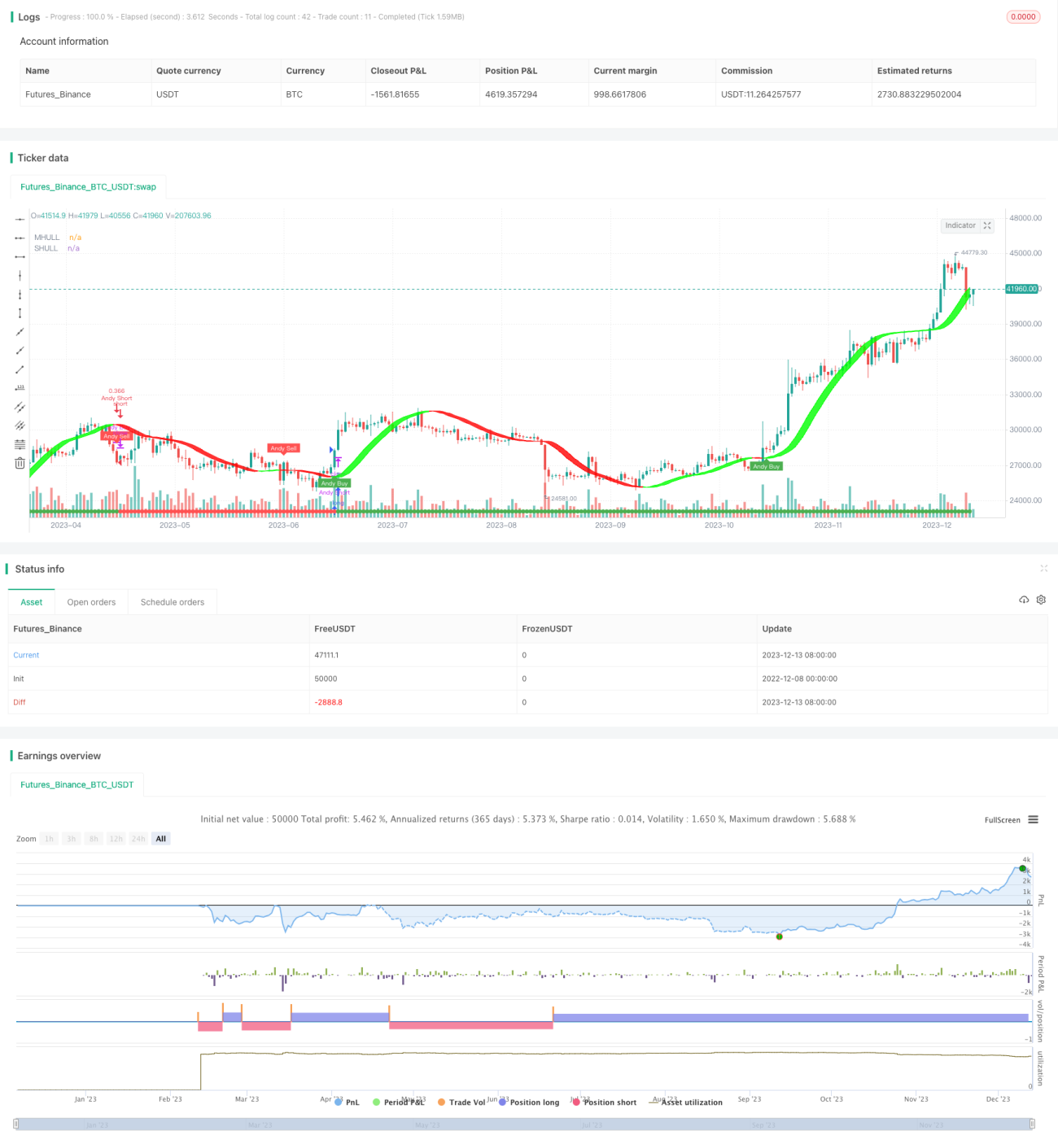
The Dynamic Momentum Oscillator (DMO) Trading Strategy is a 15-minute short-term trading strategy based on momentum oscillator indicators. This strategy combines multiple technical indicators to generate highly accurate trading signals, which can effectively assist novice traders in making buy and sell decisions within a short period of time, control risks, and increase profitability.
This strategy first uses the Doinchian Channel to determine the main trend direction of the market. A breakout above the upper band of the channel is a bullish signal, while a breakout below the lower band is a bearish signal. Secondly, the strategy adopts one of the three Hull Moving Average variants in combination with an adaptive ATR channel for more precise trend judgment. When the fast line crosses above the middle line, it is a buy signal, and when it crosses below, it is a sell signal. Finally, with the aid of the Halftrend indicator for additional filtration of false signals, the reliability of the trading signals can be further improved. Upon receipt of relatively reliable trading signals, the strategy will then enter corresponding long or short positions.
The biggest advantage of the DMO strategy lies in the organic combination of multiple indicators. Different indicators can verify each other to filter out false signals, making each trading signal more accurate and reliable. In addition, the Doinchian channel’s way of judging the main trend is simple and straightforward, and the means of filtering signals with the Halftrend line is also relatively conventional. Overall it is easy to understand with a low learning curve for beginners. Compared with single indicators, DMO can achieve higher win rates and profitability given the same number of trades.
Although the DMO strategy is relatively stable and reliable, any quantitative trading strategy is bound to carry certain risks. Specifically, when the fast line crosses below the middle line, it may still be a false signal without verification from other indicators. In addition, like all short-term strategies, DMO also faces risks associated with overtrading. If sudden market events occur that render indicators ineffective, improper stop loss settings can also lead to greater losses. To mitigate risks, it is advisable to appropriately adjust the parameters of medium and long term indicators, combine them with higher timeframe indicators for verification, and increase the stop loss distance to strictly control single trade losses.
The DMO strategy can be optimized in the following aspects: first, adjust the parameters of the Hull MA to balance the smoothing effect and sensitivity of the moving averages; second, improve the Doinchian channel logic, such as adjusting channel parameters or adding additional restrictions; third, try other indicators to replace the Halftrend for better filtration, such as Bollinger Bands, KDJ, etc.; fourth, specify appropriate trading intervals based on the characteristics of different trading instruments, for example changing it to a 5-minute or 30-minute strategy. These optimization measures can help customize the DMO strategy according to market conditions and instrument characteristics to enhance stability.
DMO is a short-term strategy that optimizes the combination of multiple indicators. It integrates Doinchian Channel, Hull MA and Halftrend to effectively determine market trends and generate precise trading signals. With relatively simple and intuitive techniques and easy operation, it can serve as an introductory strategy for beginners. Compared to single indicators, DMO can achieve higher win rates and profitability. Through measures like parameter tuning, combination improvements and interval specification, the DMO strategy has the potential to achieve longer-term superior performance with enhanced stability.
/*backtest
start: 2022-12-08 00:00:00
end: 2023-12-14 00:00:00
period: 1d
basePeriod: 1h
exchanges: [{"eid":"Futures_Binance","currency":"BTC_USDT"}]
*/
// This source code is subject to the terms of the Mozilla Public License 2.0 at https://mozilla.org/MPL/2.0/
// © kgynofomo
//@version=5
strategy(title="[Salavi] | Andy Super Pro Strategy [BTC|M15]",overlay = true, pyramiding = 1,initial_capital = 10000, default_qty_type = strategy.cash,default_qty_value = 10000)
//Doinchian Trend Ribbon
dlen = input.int(defval=30, minval=10)
dchannel(len) =>
float hh = ta.highest(len)
float ll = ta.lowest(len)
int trend = 0
trend := close > hh[1] ? 1 : close < ll[1] ? -1 : nz(trend[1])
trend
dchannelalt(len, maintrend) =>
float hh = ta.highest(len)
float ll = ta.lowest(len)
int trend = 0
trend := close > hh[1] ? 1 : close < ll[1] ? -1 : nz(trend[1])
maintrend == 1 ? trend == 1 ? #00FF00ff : #00FF009f : maintrend == -1 ? trend == -1 ? #FF0000ff : #FF00009f : na
maintrend = dchannel(dlen)
donchian_bull = maintrend==1
donchian_bear = maintrend==-1
//Hulls
src = input(hlc3, title='Source')
modeSwitch = input.string('Hma', title='Hull Variation', options=['Hma', 'Thma', 'Ehma'])
length = input(55, title='Length')
lengthMult = input(1.0, title='Length multiplier ')
useHtf = false
htf = '240'
switchColor = true
candleCol = false
visualSwitch = true
thicknesSwitch = 1
transpSwitch = 40
//FUNCTIONS
//HMA
HMA(_src, _length) =>
ta.wma(2 * ta.wma(_src, _length / 2) - ta.wma(_src, _length), math.round(math.sqrt(_length)))
//EHMA
EHMA(_src, _length) =>
ta.ema(2 * ta.ema(_src, _length / 2) - ta.ema(_src, _length), math.round(math.sqrt(_length)))
//THMA
THMA(_src, _length) =>
ta.wma(ta.wma(_src, _length / 3) * 3 - ta.wma(_src, _length / 2) - ta.wma(_src, _length), _length)
//SWITCH
Mode(modeSwitch, src, len) =>
modeSwitch == 'Hma' ? HMA(src, len) : modeSwitch == 'Ehma' ? EHMA(src, len) : modeSwitch == 'Thma' ? THMA(src, len / 2) : na
//OUT
_hull = Mode(modeSwitch, src, int(length * lengthMult))
HULL = useHtf ? request.security(syminfo.ticker, htf, _hull) : _hull
MHULL = HULL[0]
SHULL = HULL[2]
//COLOR
hullColor = switchColor ? HULL > HULL[2] ? #00ff00 : #ff0000 : #ff9800
hull_bull = HULL > HULL[2]
bull_start = hull_bull and hull_bull[1]==false
hull_bear = HULL < HULL[2]
bear_start = hull_bear and hull_bear[1]==false
barcolor(color=candleCol ? switchColor ? hullColor : na : na)
//halftrend
amplitude = input(title='Amplitude', defval=2)
channelDeviation = input(title='Channel Deviation', defval=2)
// showArrows = input(title='Show Arrows', defval=true)
// showChannels = input(title='Show Channels', defval=true)
var int trend = 0
var int nextTrend = 0
var float maxLowPrice = nz(low[1], low)
var float minHighPrice = nz(high[1], high)
var float up = 0.0
var float down = 0.0
float atrHigh = 0.0
float atrLow = 0.0
float arrowUp = na
float arrowDown = na
atr2 = ta.atr(100) / 2
dev = channelDeviation * atr2
highPrice = high[math.abs(ta.highestbars(amplitude))]
lowPrice = low[math.abs(ta.lowestbars(amplitude))]
highma = ta.sma(high, amplitude)
lowma = ta.sma(low, amplitude)
if nextTrend == 1
maxLowPrice := math.max(lowPrice, maxLowPrice)
if highma < maxLowPrice and close < nz(low[1], low)
trend := 1
nextTrend := 0
minHighPrice := highPrice
minHighPrice
else
minHighPrice := math.min(highPrice, minHighPrice)
if lowma > minHighPrice and close > nz(high[1], high)
trend := 0
nextTrend := 1
maxLowPrice := lowPrice
maxLowPrice
if trend == 0
if not na(trend[1]) and trend[1] != 0
up := na(down[1]) ? down : down[1]
arrowUp := up - atr2
arrowUp
else
up := na(up[1]) ? maxLowPrice : math.max(maxLowPrice, up[1])
up
atrHigh := up + dev
atrLow := up - dev
atrLow
else
if not na(trend[1]) and trend[1] != 1
down := na(up[1]) ? up : up[1]
arrowDown := down + atr2
arrowDown
else
down := na(down[1]) ? minHighPrice : math.min(minHighPrice, down[1])
down
atrHigh := down + dev
atrLow := down - dev
atrLow
ht = trend == 0 ? up : down
var color buyColor = color.blue
var color sellColor = color.red
htColor = trend == 0 ? buyColor : sellColor
// htPlot = plot(ht, title='HalfTrend', linewidth=2, color=htColor)
// atrHighPlot = plot(showChannels ? atrHigh : na, title='ATR High', style=plot.style_circles, color=color.new(sellColor, 0))
// atrLowPlot = plot(showChannels ? atrLow : na, title='ATR Low', style=plot.style_circles, color=color.new(buyColor, 0))
// fill(htPlot, atrHighPlot, title='ATR High Ribbon', color=color.new(sellColor, 90))
// fill(htPlot, atrLowPlot, title='ATR Low Ribbon', color=color.new(buyColor, 90))
HalfTrend_buySignal = not na(arrowUp) and trend == 0 and trend[1] == 1
HalfTrend_sellSignal = not na(arrowDown) and trend == 1 and trend[1] == 0
// plotshape(showArrows and buySignal ? atrLow : na, title='Arrow Up', style=shape.triangleup, location=location.absolute, size=size.tiny, color=color.new(buyColor, 0))
// plotshape(showArrows and sellSignal ? atrHigh : na, title='Arrow Down', style=shape.triangledown, location=location.absolute, size=size.tiny, color=color.new(sellColor, 0))
//ema
filter_ema = ta.ema(close,200)
ema_bull = close>filter_ema
ema_bear = close<filter_ema
atr_length = input.int(7)
atr = ta.atr(atr_length)
atr_rsi_length = input.int(50)
atr_rsi = ta.rsi(atr,atr_rsi_length)
atr_valid = atr_rsi>50
longCondition = bull_start and atr_valid
shortCondition = bear_start and atr_valid
Exit_long_condition = shortCondition
Exit_short_condition = longCondition
if longCondition
strategy.entry("Andy Buy",strategy.long, limit=close,comment="Andy Buy Here")
if Exit_long_condition
strategy.close("Andy Buy",comment="Andy Buy Out")
// strategy.entry("Andy fandan Short",strategy.short, limit=close,comment="Andy 翻單 short Here")
// strategy.close("Andy fandan Buy",comment="Andy short Out")
if shortCondition
strategy.entry("Andy Short",strategy.short, limit=close,comment="Andy short Here")
// strategy.exit("STR","Long",stop=longstoploss)
if Exit_short_condition
strategy.close("Andy Short",comment="Andy short Out")
// strategy.entry("Andy fandan Buy",strategy.long, limit=close,comment="Andy 翻單 Buy Here")
// strategy.close("Andy fandan Short",comment="Andy Buy Out")
inLongTrade = strategy.position_size > 0
inLongTradecolor = #58D68D
notInTrade = strategy.position_size == 0
inShortTrade = strategy.position_size < 0
// bgcolor(color = inLongTrade?color.rgb(76, 175, 79, 70):inShortTrade?color.rgb(255, 82, 82, 70):na)
plotshape(close!=0,location = location.bottom,color = inLongTrade?color.green:inShortTrade?color.red:na)
plotshape(longCondition, title='Buy', text='Andy Buy', style=shape.labelup, location=location.belowbar, color=color.new(color.green, 0), textcolor=color.new(color.white, 0), size=size.tiny)
plotshape(shortCondition, title='Sell', text='Andy Sell', style=shape.labeldown, location=location.abovebar, color=color.new(color.red, 0), textcolor=color.new(color.white, 0), size=size.tiny)
Fi1 = plot(MHULL, title='MHULL', color=hullColor, linewidth=thicknesSwitch, transp=50)
Fi2 = plot(SHULL, title='SHULL', color=hullColor, linewidth=thicknesSwitch, transp=50)
fill(Fi1, Fi2, title='Band Filler', color=hullColor, transp=transpSwitch)