Pivot Point and Fibonacci Retracement Based Automatic Trend Following Strategy

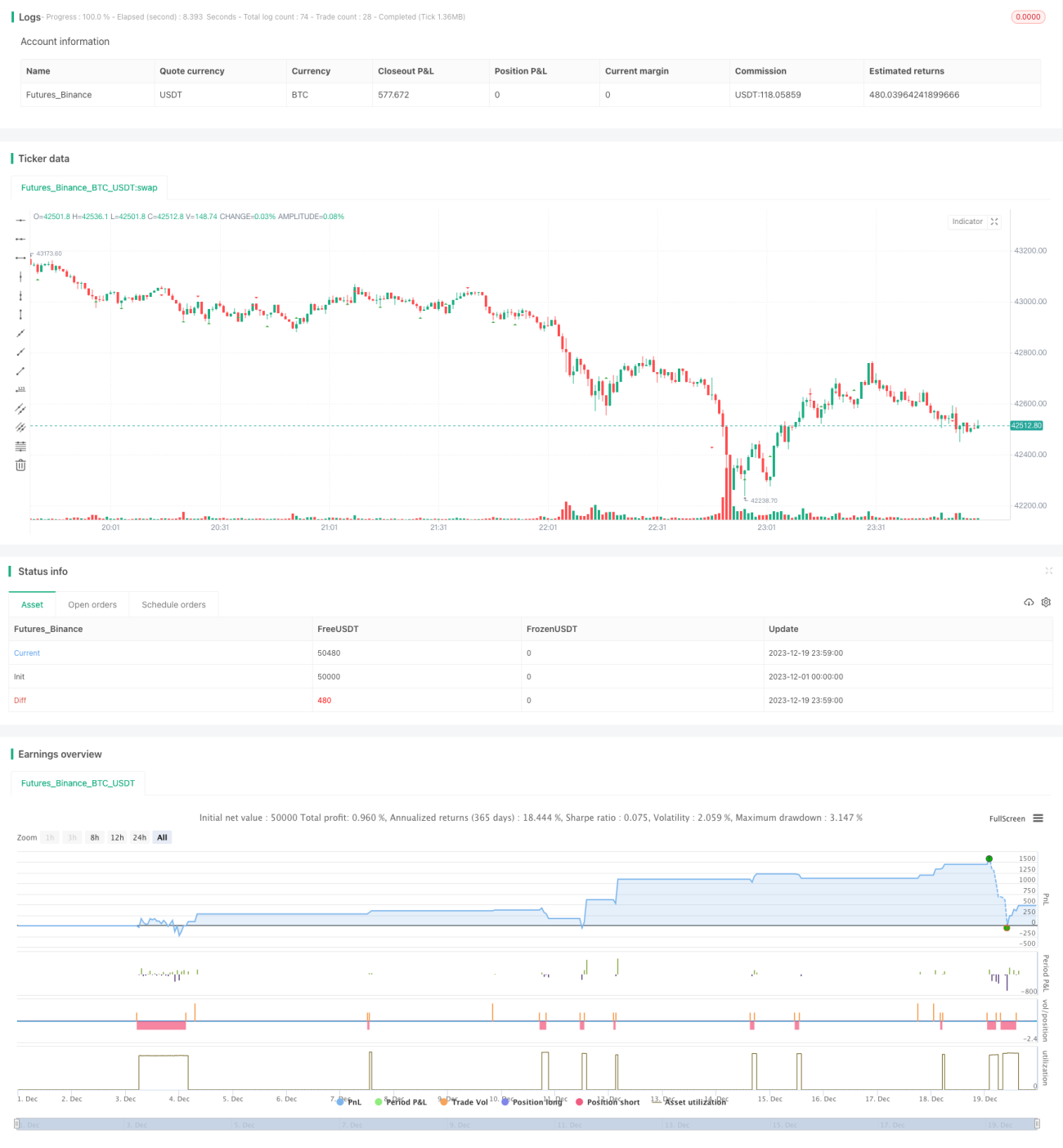
Overview
This strategy automatically identifies ABC patterns in stock prices based on pivot points and Fibonacci retracement ratios, and generates long/short signals. It uses pivot points to determine price waves and calculates Fibonacci retracement ratios between ABC waves. If the ratios meet certain criteria, trading signals are generated.
Strategy Logic
- Calculate the stock's pivot high and low points
- Judge if the price has fallen from the previous high point or risen from the previous low point
- Calculate the Fibonacci retracement ratio between the current wave and previous wave
- If the retracement ratios of both up and down waves are within proper ranges, determine a potential ABC pattern
- After ABC pattern confirmation, set stop loss at Point C for long, and Point A for short. Set take profit at 1.5 times the price wave range.
Advantage Analysis
- Pivot points identify key support/resistance levels to improve signal accuracy
- Fibonacci retracements catch trend turning points by identifying ABC patterns
- Clear profit/loss rules avoid huge losses
Risk Analysis
- Pivot points and Fibonacci retracements cannot ensure perfect identification of every trend turning point. Misjudgements may occur.
- Point C and Point A stops can be broken through, leading to larger losses
- Parameters like Fibonacci retracement ratio ranges need further optimization
Optimization Directions
- Incorporate more technical indicators to assist ABC pattern confirmation, improving signal accuracy
- Optimize Fibonacci retracement ratio ranges to suit more market conditions
- Utilize machine learning methods to train ABC pattern recognition models
Conclusion
This strategy identifies ABC patterns for generating long/short signals at trend turning points, based on pivot point confirmation of key support/resistance levels, and Fibonacci retracement ratio calculations. The logic is simple and clean, with sensible profit/loss rules that effectively control risks. However, certain misjudgement risks remain, requiring further optimizations and improvements to suit more market conditions.
- 1