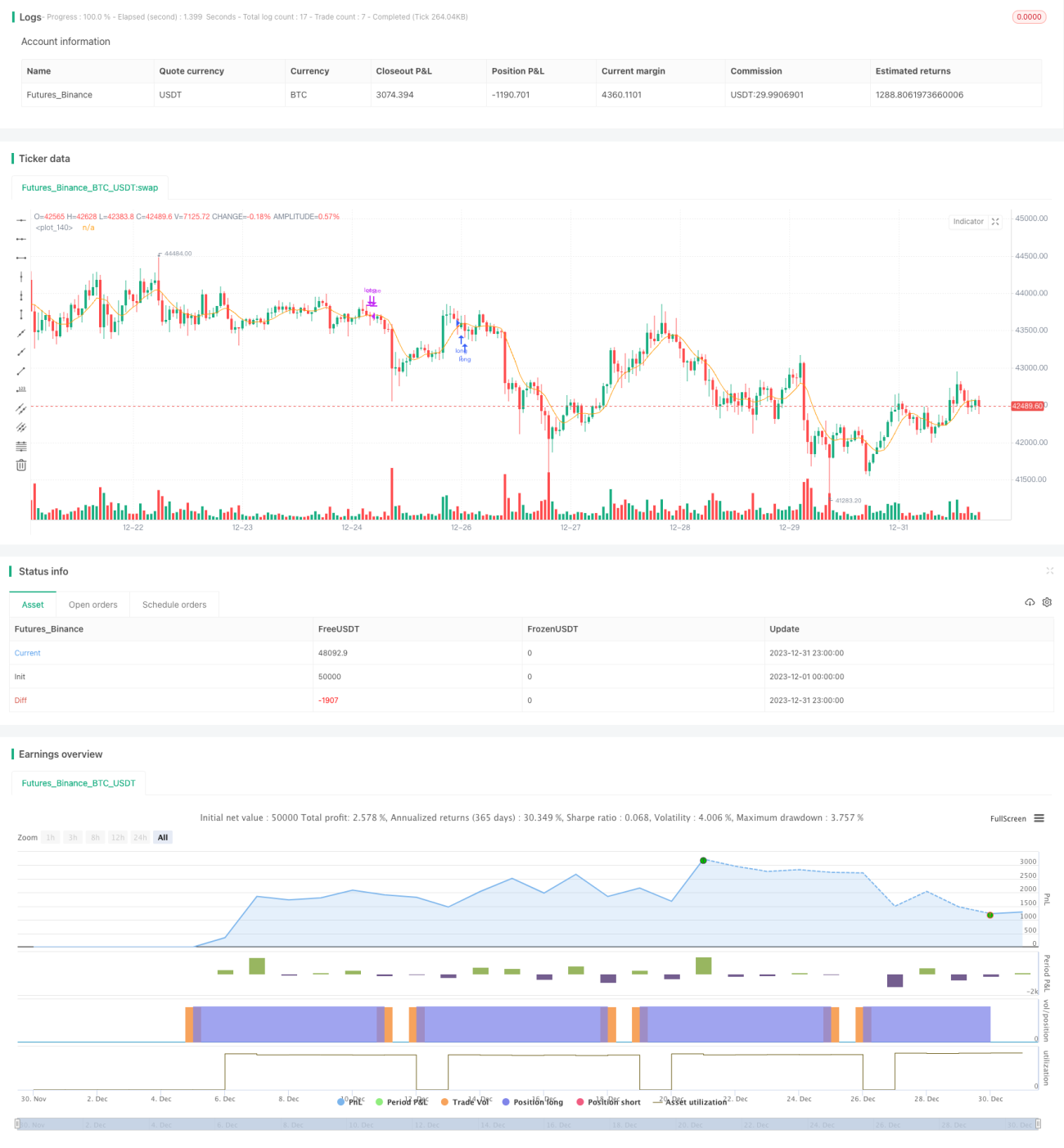
This strategy utilizes multiple moving average indicators and combines entry and exit timing based on trading hours to implement quantitative trading.
This strategy incorporates 9 types of moving averages including SMA, EMA, WMA etc. For long entry, the close price crosses above the selected moving average while the previous close was below the moving average. For short entry, the close price crosses below the moving average while the previous close was above. All trades are entered on Monday open only. Exit rules are either fixed take profit/stop loss or close all positions before Sunday close.
This strategy combines the essence of multiple moving averages and users can pick different parameters based on varying market conditions. It only enters when a trend is confirmed, avoiding whipsaws. Also, it limits entries to Monday only and exits on Sunday close with stop loss/take profit, capping maximum trades per week and controlling trading risk.
The strategy relies mainly on moving averages to determine trend, thus faces the risk of being caught in reversals. Also, limiting entries to Monday only means missed profitable opportunities if a good setup appears later in the week.
To address these risks, dynamic average parameters could be used to shorten length during ranging periods. Also additional entry days could be allowed, like on Wednesday or Thursday.
The strategy can be improved in the following ways:
Add adaptive stop loss/take profit algorithms to dynamically adjust levels.
Incorporate machine learning models to better gauge trend in choppy markets.
Refine entry and exit logic to capture more trading opportunities.
This strategy combines multiple moving average indicators to determine trend direction and caps maximum weekly trades with Monday entry and Sunday exit rules. Strict stop loss/take profit further limits maximum loss per trade. In summary, it provides robust enhancements in both trend determination and risk control dimensions for quantitative trading.
/*backtest
start: 2023-12-01 00:00:00
end: 2023-12-31 23:59:59
period: 1h
basePeriod: 15m
exchanges: [{"eid":"Futures_Binance","currency":"BTC_USDT"}]
*/
// This source code is subject to the terms of the Mozilla Public License 2.0 at https://mozilla.org/MPL/2.0/
// © exlux99
//@version=5
strategy('Time MA strategy ', overlay=true)
longEntry = input.bool(true, group="Type of Entries")
shortEntry = input.bool(false, group="Type of Entries")
//==========DEMA
getDEMA(src, len) =>
dema = 2 * ta.ema(src, len) - ta.ema(ta.ema(src, len), len)
dema
//==========HMA
getHULLMA(src, len) =>
hullma = ta.wma(2 * ta.wma(src, len / 2) - ta.wma(src, len), math.round(math.sqrt(len)))
hullma
//==========KAMA
getKAMA(src, len, k1, k2) =>
change = math.abs(ta.change(src, len))
volatility = math.sum(math.abs(ta.change(src)), len)
efficiency_ratio = volatility != 0 ? change / volatility : 0
kama = 0.0
fast = 2 / (k1 + 1)
slow = 2 / (k2 + 1)
smooth_const = math.pow(efficiency_ratio * (fast - slow) + slow, 2)
kama := nz(kama[1]) + smooth_const * (src - nz(kama[1]))
kama
//==========TEMA
getTEMA(src, len) =>
e = ta.ema(src, len)
tema = 3 * (e - ta.ema(e, len)) + ta.ema(ta.ema(e, len), len)
tema
//==========ZLEMA
getZLEMA(src, len) =>
zlemalag_1 = (len - 1) / 2
zlemadata_1 = src + src - src[zlemalag_1]
zlema = ta.ema(zlemadata_1, len)
zlema
//==========FRAMA
getFRAMA(src, len) =>
Price = src
N = len
if N % 2 != 0
N := N + 1
N
N1 = 0.0
N2 = 0.0
N3 = 0.0
HH = 0.0
LL = 0.0
Dimen = 0.0
alpha = 0.0
Filt = 0.0
N3 := (ta.highest(N) - ta.lowest(N)) / N
HH := ta.highest(N / 2 - 1)
LL := ta.lowest(N / 2 - 1)
N1 := (HH - LL) / (N / 2)
HH := high[N / 2]
LL := low[N / 2]
for i = N / 2 to N - 1 by 1
if high[i] > HH
HH := high[i]
HH
if low[i] < LL
LL := low[i]
LL
N2 := (HH - LL) / (N / 2)
if N1 > 0 and N2 > 0 and N3 > 0
Dimen := (math.log(N1 + N2) - math.log(N3)) / math.log(2)
Dimen
alpha := math.exp(-4.6 * (Dimen - 1))
if alpha < .01
alpha := .01
alpha
if alpha > 1
alpha := 1
alpha
Filt := alpha * Price + (1 - alpha) * nz(Filt[1], 1)
if bar_index < N + 1
Filt := Price
Filt
Filt
//==========VIDYA
getVIDYA(src, len) =>
mom = ta.change(src)
upSum = math.sum(math.max(mom, 0), len)
downSum = math.sum(-math.min(mom, 0), len)
out = (upSum - downSum) / (upSum + downSum)
cmo = math.abs(out)
alpha = 2 / (len + 1)
vidya = 0.0
vidya := src * alpha * cmo + nz(vidya[1]) * (1 - alpha * cmo)
vidya
//==========JMA
getJMA(src, len, power, phase) =>
phase_ratio = phase < -100 ? 0.5 : phase > 100 ? 2.5 : phase / 100 + 1.5
beta = 0.45 * (len - 1) / (0.45 * (len - 1) + 2)
alpha = math.pow(beta, power)
MA1 = 0.0
Det0 = 0.0
MA2 = 0.0
Det1 = 0.0
JMA = 0.0
MA1 := (1 - alpha) * src + alpha * nz(MA1[1])
Det0 := (src - MA1) * (1 - beta) + beta * nz(Det0[1])
MA2 := MA1 + phase_ratio * Det0
Det1 := (MA2 - nz(JMA[1])) * math.pow(1 - alpha, 2) + math.pow(alpha, 2) * nz(Det1[1])
JMA := nz(JMA[1]) + Det1
JMA
//==========T3
getT3(src, len, vFactor) =>
ema1 = ta.ema(src, len)
ema2 = ta.ema(ema1, len)
ema3 = ta.ema(ema2, len)
ema4 = ta.ema(ema3, len)
ema5 = ta.ema(ema4, len)
ema6 = ta.ema(ema5, len)
c1 = -1 * math.pow(vFactor, 3)
c2 = 3 * math.pow(vFactor, 2) + 3 * math.pow(vFactor, 3)
c3 = -6 * math.pow(vFactor, 2) - 3 * vFactor - 3 * math.pow(vFactor, 3)
c4 = 1 + 3 * vFactor + math.pow(vFactor, 3) + 3 * math.pow(vFactor, 2)
T3 = c1 * ema6 + c2 * ema5 + c3 * ema4 + c4 * ema3
T3
//==========TRIMA
getTRIMA(src, len) =>
N = len + 1
Nm = math.round(N / 2)
TRIMA = ta.sma(ta.sma(src, Nm), Nm)
TRIMA
src = input.source(close, title='Source', group='Parameters')
len = input.int(17, minval=1, title='Moving Averages', group='Parameters')
out_ma_source = input.string(title='MA Type', defval='ALMA', options=['SMA', 'EMA', 'WMA', 'ALMA', 'SMMA', 'LSMA', 'VWMA', 'DEMA', 'HULL', 'KAMA', 'FRAMA', 'VIDYA', 'JMA', 'TEMA', 'ZLEMA', 'T3', 'TRIM'], group='Parameters')
out_ma = out_ma_source == 'SMA' ? ta.sma(src, len) : out_ma_source == 'EMA' ? ta.ema(src, len) : out_ma_source == 'WMA' ? ta.wma(src, len) : out_ma_source == 'ALMA' ? ta.alma(src, len, 0.85, 6) : out_ma_source == 'SMMA' ? ta.rma(src, len) : out_ma_source == 'LSMA' ? ta.linreg(src, len, 0) : out_ma_source == 'VWMA' ? ta.vwma(src, len) : out_ma_source == 'DEMA' ? getDEMA(src, len) : out_ma_source == 'HULL' ? ta.hma(src, len) : out_ma_source == 'KAMA' ? getKAMA(src, len, 2, 30) : out_ma_source == 'FRAMA' ? getFRAMA(src, len) : out_ma_source == 'VIDYA' ? getVIDYA(src, len) : out_ma_source == 'JMA' ? getJMA(src, len, 2, 50) : out_ma_source == 'TEMA' ? getTEMA(src, len) : out_ma_source == 'ZLEMA' ? getZLEMA(src, len) : out_ma_source == 'T3' ? getT3(src, len, 0.7) : out_ma_source == 'TRIM' ? getTRIMA(src, len) : na
plot(out_ma)
long = close> out_ma and close[1] < out_ma and dayofweek==dayofweek.monday
short = close< out_ma and close[1] > out_ma and dayofweek==dayofweek.monday
stopPer = input.float(10.0, title='LONG Stop Loss % ', group='Fixed Risk Management') / 100
takePer = input.float(30.0, title='LONG Take Profit %', group='Fixed Risk Management') / 100
stopPerShort = input.float(5.0, title='SHORT Stop Loss % ', group='Fixed Risk Management') / 100
takePerShort = input.float(10.0, title='SHORT Take Profit %', group='Fixed Risk Management') / 100
longStop = strategy.position_avg_price * (1 - stopPer)
longTake = strategy.position_avg_price * (1 + takePer)
shortStop = strategy.position_avg_price * (1 + stopPerShort)
shortTake = strategy.position_avg_price * (1 - takePerShort)
// strategy.risk.max_intraday_filled_orders(2) // After 10 orders are filled, no more strategy orders will be placed (except for a market order to exit current open market position, if there is any).
if(longEntry)
strategy.entry("long",strategy.long,when=long )
strategy.exit('LONG EXIT', "long", limit=longTake, stop=longStop)
strategy.close("long",when=dayofweek==dayofweek.sunday)
if(shortEntry)
strategy.entry("short",strategy.short,when=short )
strategy.exit('SHORT EXIT', "short", limit=shortTake, stop=shortStop)
strategy.close("short",when=dayofweek==dayofweek.sunday)