Dual Moving Average Trend Tracking Strategy

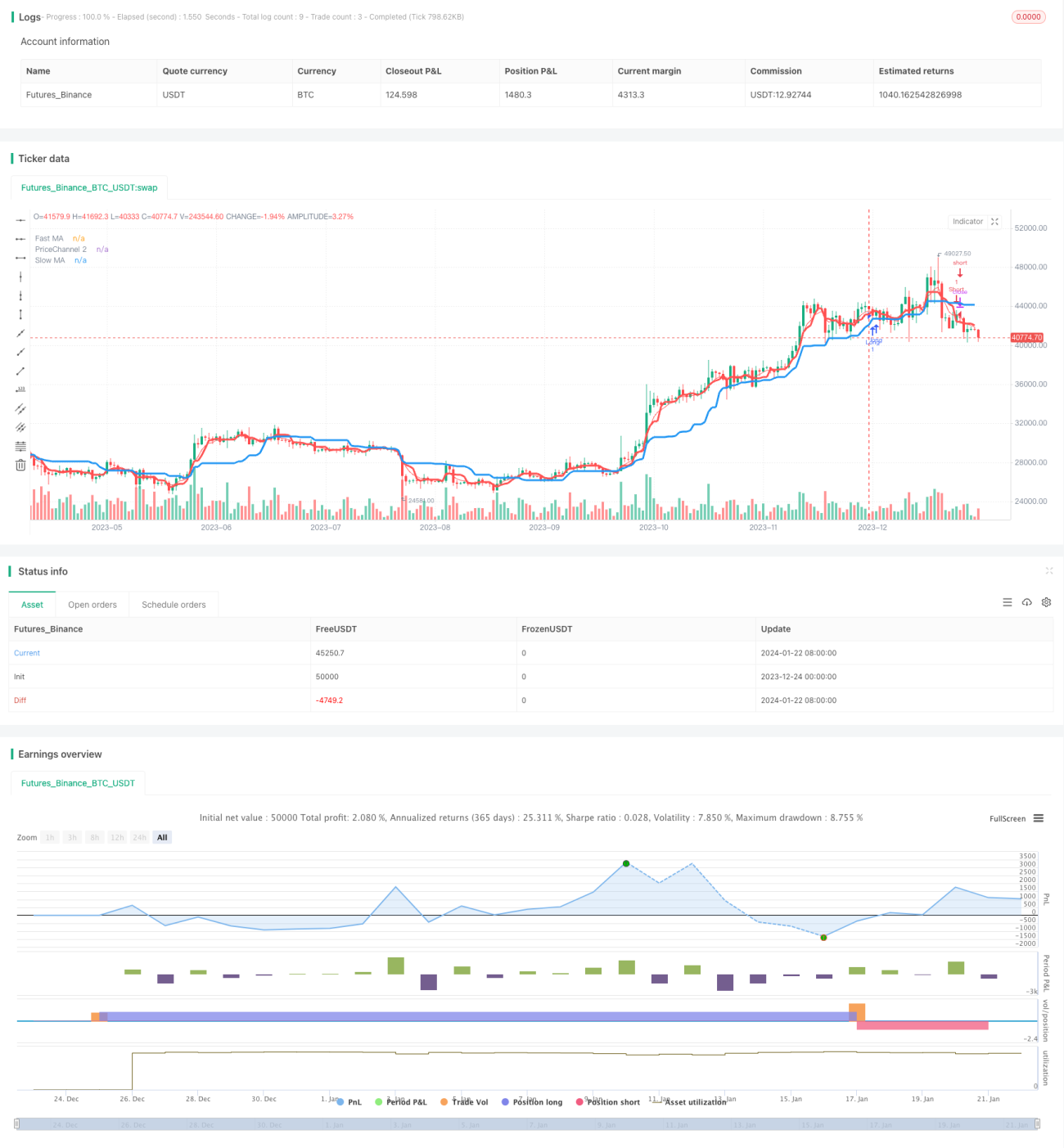
Overview
The Dual Moving Average Trend Tracking strategy is a strategy that uses a combination of fast and slow moving averages to determine market trend, and generates trading signals when the trend direction changes. It combines moving average indicators and price channel indicators to identify the trend, which can effectively filter out market noise and determine the trend direction.
Strategy Logic
The Dual Moving Average Trend Tracking strategy uses two moving averages - a fast moving average (5 periods) and a slow moving average (21 periods). The fast MA is used to generate trading signals while the slow MA is used to determine the market trend direction. When the fast MA crosses above the slow MA, a buy signal is generated. When the fast MA crosses below the slow MA, a sell signal is generated.
The strategy also uses a price channel indicator to assist in determining the trend. The price channel is determined by the moving averages of highest and lowest prices. When prices break through the channel, it indicates a trend reversal. This strategy uses two price channels with periods of 21 and 5 respectively, matching the MA periods.
When determining buy and sell signals, the strategy requires consecutive red/green candles to appear (user adjustable) as an additional filter condition. This helps avoid wrong signals during market consolidations.
In summary, the logic for determining trend in this strategy is:
- Use price channel to determine the higher timeframe trend direction
- Use fast MA to determine short-term trend and generate trading signals
- Combine additional candle filter to avoid wrong signals during consolidations
By judging trend across timeframes, market noise can be effectively filtered and trend direction confirmed.
Advantage Analysis
The Dual Moving Average Trend Tracking Strategy has the following advantages:
- The dual MA system can effectively identify trends and determine the major trend direction
- The fast MA generates trading signals to timely capture trend reversals
- The price channel determines higher timeframe trend to avoid being misled by short-term market noise
- The red/green candle filters lower the probability of wrong signals during consolidations
- Adjustable parameters allow optimization for different markets to improve robustness
- Stop loss strategies can be added to effectively control risk per trade
In conclusion, this strategy has relatively good overall stability and performs well in strong trending markets.
Risk Analysis
The Dual Moving Average Trend Tracking Strategy also has some risks, mainly:
- During prolonged consolidations, it is prone to generating wrong signals and consecutive small losses
- Improper parameter settings may lag trading signals and miss best entry opportunities
- Without effective stop loss, per trade risk is difficult to control
Corresponding measures to reduce risks include:
- Adjust red/green candle filter settings to lower trade frequency in consolidating markets
- Optimize fast MA parameters to ensure timely trading signal generation
- Add moving or percentage stop loss to strictly control per trade loss
Optimization Directions
There is room for further optimization of the strategy, mainly in directions like:
- Incorporate volatility indicators like ATR to auto adjust stop loss
- Utilize machine learning to auto optimize parameters
- Add neural network modules to determine trend direction
- Build ensemble systems combining multiple indicators and filters
These optimization directions can further improve the stability, adaptiveness and intelligence level of the strategy.
Conclusion
In conclusion, the Dual Moving Average Trend Tracking strategy is a relatively robust trend following strategy. It combines moving averages and price channels to determine trend direction and strength, generating trading signals with the fast MA. The additional candle filters also help avoid wrong signals. The adjustable parameters allow adaptation to different market environments. There is also ample room for further optimizations to build a reliable, intelligent automated trading strategy.
/*backtest
start: 2023-12-24 00:00:00
end: 2024-01-23 00:00:00
period: 1d
basePeriod: 1h
exchanges: [{"eid":"Futures_Binance","currency":"BTC_USDT"}]
*/

//@version=2
strategy(title = "Noro's Trend MAs Strategy v1.8", shorttitle = "Trend MAs str 1.8", overlay=true, default_qty_type = strategy.percent_of_equity, default_qty_value=100.0, pyramiding=0)

//Settings- 1