Peanut 123 Reversal and Breakout Range Short-term Trading Strategy

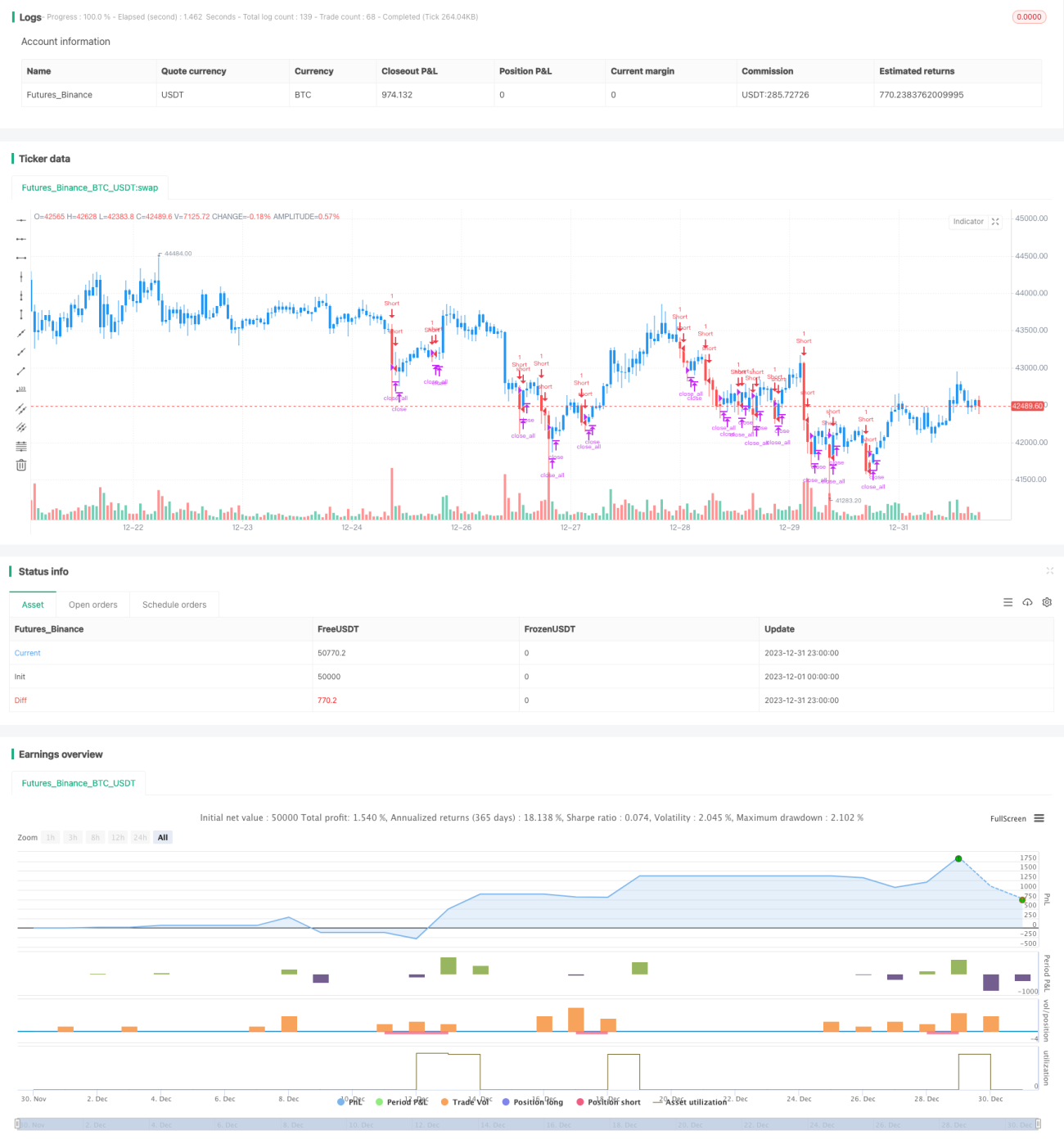
Overview
The Peanut 123 Reversal and Breakout Range Short-term Trading Strategy is a combination strategy that incorporates the signals from a reversal strategy and a breakout strategy sub-strategies to generate more powerful trading signals.
Strategy Logic
The strategy consists of two sub-strategies:
-
Peanut 123 Reversal Strategy
It is an adapted reversal strategy based on the system introduced on P183 of Ulf Jensen's book. It goes long when the close price rises for 2 consecutive days and the 9-day Stochastic Slow line is below 50; It goes short when the close price falls for 2 consecutive days and the 9-day Stochastic Fast line is above 50.
-
Breakout Range Short Strategy
It is a short-term strategy that uses the breakout of the lowest price in a certain look_bak period as the signal. It goes short when the price breaks below the lowest low in the look_bak period.
The combination strategy takes into account the signals from both sub-strategies. It generates actual trading signals only when the two sub-strategies give signals in the same direction. No trading signals will be generated if the two sub-strategies give opposite signals.
Advantage Analysis
The strategy combines the advantages of both reversal and breakout sub-strategies and considers more factors. It can filter out some noise trades and improve win rate.
-
The reversal strategy captures short-term reversal opportunities and makes profit during fluctuations.
-
The breakout strategy catches the short-term trend after the breakout.
-
By combining the signals of two sub-strategies, more effective trading signals can be generated and noise can be filtered out.
Risk Analysis
The strategy also has the following risks:
-
Reversals may not happen, there are risks of failed reversals.
-
Breakouts can also be false breakouts, there are risks of chasing highs and lows.
-
Neither of the sub-strategies can ensure effectiveness when used alone, combining them may also fail.
To address these risks, methods like optimizing parameters, adjusting the weighting of sub-strategies, choosing different products for arbitrage can be used to reduce risks.
Optimization Directions
There is room for further optimization of the strategy:
-
Optimize the parameters of the two sub-strategies to better adapt to different cycles and different products.
-
Increase other types of sub-strategies, such as machine learning prediction strategies, to incorporate more factors.
-
Dynamically adjust the weighting of the two sub-strategies to give more weight to the better-performed one in different market environments.
-
Conduct combination arbitrage by selecting products with little correlation but certain commonality.
Summary
The Peanut 123 Reversal and Breakout Range Short-term Trading Strategy integrates the reversal and breakout sub-strategies at the strategy level. To some extent, it combines the advantages of the two sub-strategies while having space for further optimization. It provides new ideas for strategy design - conducting integration and combination at the strategy level while preserving the independence of sub-strategies, in order to discover more effective trading opportunities.
/*backtest
start: 2023-12-01 00:00:00
end: 2023-12-31 23:59:59
period: 1h
basePeriod: 15m
exchanges: [{"eid":"Futures_Binance","currency":"BTC_USDT"}]
*/

//@version=4
////////////////////////////////////////////////////////////
//  Copyright by HPotter v1.0 01/07/2019
// This is combo strategies for get a cumulative signal. - 1