
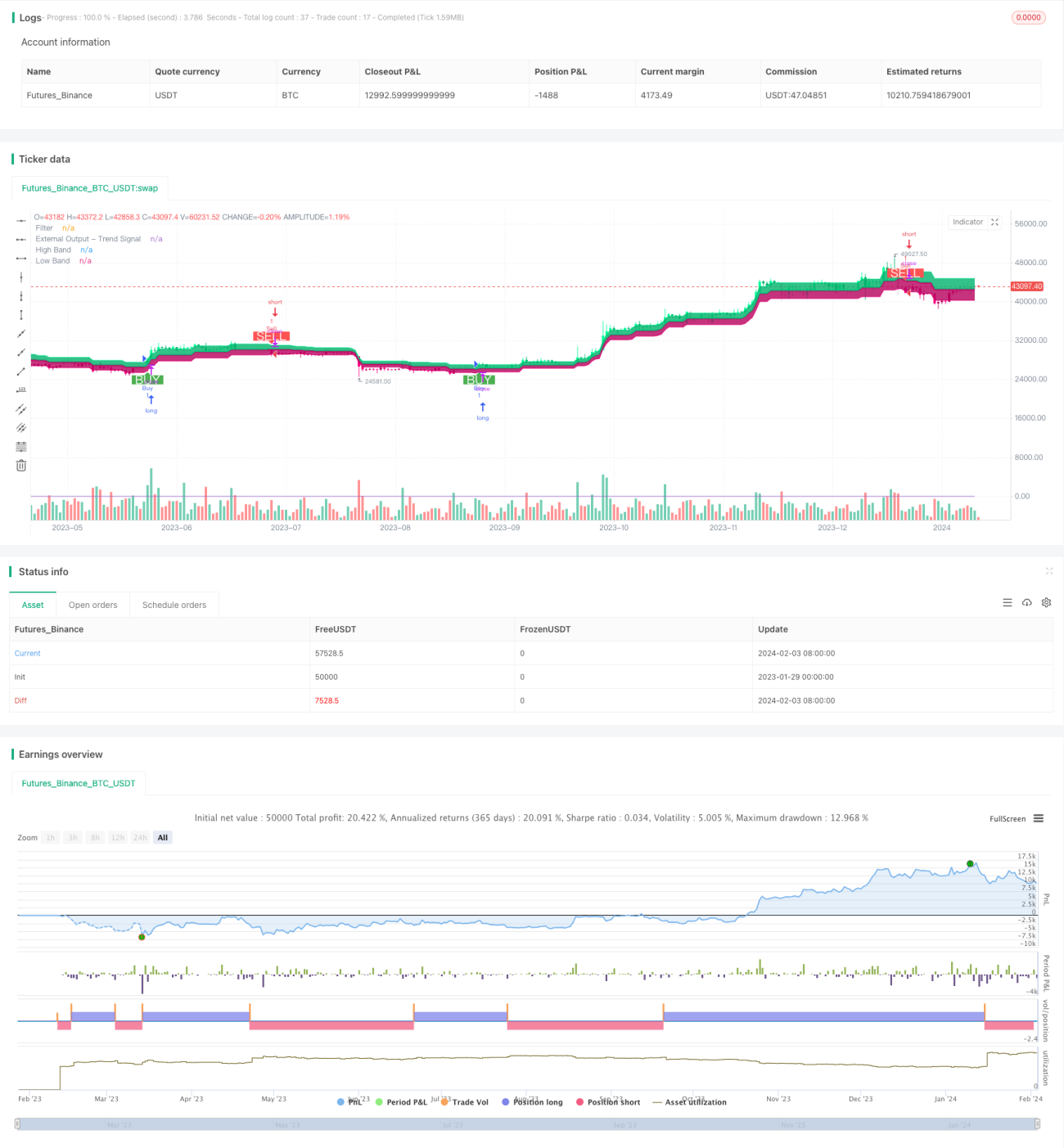
The Dual Range Filter Trend Tracking Strategy is a quantitative trading strategy that utilizes dual EMA range filtering to identify trend direction and track trends. This strategy combines dual moving average filtering and ATR range calculation to effectively recognize mid-to-long term trend direction and lock in profits with trailing stop loss.
The core of this strategy is the dual EMA range filtering. It calculates the ATR range of candlesticks and smoothes it, then uses two EMAs to locate the position of candlesticks within the range to determine if it is currently in a trend. When the price breaks through the range, it signals a change in the trend.
Specifically, the strategy first calculates the ATR range size of the candlesticks, and then smoothes it with two EMAs. The ATR range represents the normal fluctuation range of the candlesticks. When the price exceeds this range, it means a change in the trend has occurred. The strategy records the direction when the price breaks through the EMA range. When the direction changes, it means a trend reversal has occurred, and that is when it can choose to enter the market.
After entering the market, the strategy uses a floating stop loss to lock in profits. During the holding period, it constantly judges whether the candlestick has fallen back out of range. If a pullback occurs, it will exit the current position. This can effectively lock the profits from trend trading.
The Dual Range Filter Trend Tracking Strategy combines the advantages of moving average filtering and range calculation to accurately determine trend direction and avoids frequently entering and exiting the market in ranging markets. The specific advantages are:
There are also some risks with this strategy, mainly in the following aspects:
To address these risks, methods such as optimizing parameters appropriately, preventing false breakouts, judging trend strength can be used to solve them.
The Dual Range Filter Trend Tracking Strategy also has potential for further optimization, with the main optimization directions including:
Through these optimizations, the strategy can achieve steady profits in more market environments.
The Dual Range Filter Trend Tracking Strategy integrates the various advantages of moving average filtering and ATR range judgment, and can effectively identify the direction and entry timing of sustainable mid-to-long term trends. It only enters the market when trends change, and uses a floating stop loss to lock in profits. This strategy has simple and clear logic and is very suitable for mid-to-long term trend trading. Through continuous optimization of parameters and judgment rules, this strategy can achieve good returns across various markets.
/*backtest
start: 2023-01-29 00:00:00
end: 2024-02-04 00:00:00
period: 1d
basePeriod: 1h
exchanges: [{"eid":"Futures_Binance","currency":"BTC_USDT"}]
*/
//@version=4
strategy("Range Filter [DW] & Labels", shorttitle="RF [DW] & Labels", overlay=true)
//Conditional Sampling EMA Function
Cond_EMA(x, cond, n)=>
var val = array.new_float(0)
var ema_val = array.new_float(1)
if cond
array.push(val, x)
if array.size(val) > 1
array.remove(val, 0)
if na(array.get(ema_val, 0))
array.fill(ema_val, array.get(val, 0))
array.set(ema_val, 0, (array.get(val, 0) - array.get(ema_val, 0))*(2/(n + 1)) + array.get(ema_val, 0))
EMA = array.get(ema_val, 0)
EMA
//Conditional Sampling SMA Function
Cond_SMA(x, cond, n)=>
var vals = array.new_float(0)
if cond
array.push(vals, x)
if array.size(vals) > n
array.remove(vals, 0)
SMA = array.avg(vals)
SMA
//Standard Deviation Function
Stdev(x, n)=>
sqrt(Cond_SMA(pow(x, 2), 1, n) - pow(Cond_SMA(x, 1, n), 2))
//Range Size Function
rng_size(x, scale, qty, n)=>
ATR = Cond_EMA(tr(true), 1, n)
AC = Cond_EMA(abs(x - x[1]), 1, n)
SD = Stdev(x, n)
rng_size = scale=="Pips" ? qty*0.0001 : scale=="Points" ? qty*syminfo.pointvalue : scale=="% of Price" ? close*qty/100 : scale=="ATR" ? qty*ATR :
scale=="Average Change" ? qty*AC : scale=="Standard Deviation" ? qty*SD : scale=="Ticks" ? qty*syminfo.mintick : qty
//Two Type Range Filter Function
rng_filt(h, l, rng_, n, type, smooth, sn, av_rf, av_n)=>
rng_smooth = Cond_EMA(rng_, 1, sn)
r = smooth ? rng_smooth : rng_
var rfilt = array.new_float(2, (h + l)/2)
array.set(rfilt, 1, array.get(rfilt, 0))
if type=="Type 1"
if h - r > array.get(rfilt, 1)
array.set(rfilt, 0, h - r)
if l + r < array.get(rfilt, 1)
array.set(rfilt, 0, l + r)
if type=="Type 2"
if h >= array.get(rfilt, 1) + r
array.set(rfilt, 0, array.get(rfilt, 1) + floor(abs(h - array.get(rfilt, 1))/r)*r)
if l <= array.get(rfilt, 1) - r
array.set(rfilt, 0, array.get(rfilt, 1) - floor(abs(l - array.get(rfilt, 1))/r)*r)
rng_filt1 = array.get(rfilt, 0)
hi_band1 = rng_filt1 + r
lo_band1 = rng_filt1 - r
rng_filt2 = Cond_EMA(rng_filt1, rng_filt1 != rng_filt1[1], av_n)
hi_band2 = Cond_EMA(hi_band1, rng_filt1 != rng_filt1[1], av_n)
lo_band2 = Cond_EMA(lo_band1, rng_filt1 != rng_filt1[1], av_n)
rng_filt = av_rf ? rng_filt2 : rng_filt1
hi_band = av_rf ? hi_band2 : hi_band1
lo_band = av_rf ? lo_band2 : lo_band1
[hi_band, lo_band, rng_filt]
//-----------------------------------------------------------------------------------------------------------------------------------------------------------------
//Inputs
//-----------------------------------------------------------------------------------------------------------------------------------------------------------------
//Filter Type
f_type = input(defval="Type 1", options=["Type 1", "Type 2"], title="Filter Type")
//Movement Source
mov_src = input(defval="Close", options=["Wicks", "Close"], title="Movement Source")
//Range Size Inputs
rng_qty = input(defval=2.618, minval=0.0000001, title="Range Size")
rng_scale = input(defval="Average Change", options=["Points", "Pips", "Ticks", "% of Price", "ATR", "Average Change", "Standard Deviation", "Absolute"], title="Range Scale")
//Range Period
rng_per = input(defval=14, minval=1, title="Range Period (for ATR, Average Change, and Standard Deviation)")
//Range Smoothing Inputs
smooth_range = input(defval=true, title="Smooth Range")
smooth_per = input(defval=27, minval=1, title="Smoothing Period")
//Filter Value Averaging Inputs
av_vals = input(defval=true, title="Average Filter Changes")
av_samples = input(defval=2, minval=1, title="Number Of Changes To Average")
// New inputs for take profit and stop loss
take_profit_percent = input(defval=100.0, minval=0.1, maxval=1000.0, title="Take Profit Percentage", step=0.1)
stop_loss_percent = input(defval=100, minval=0.1, maxval=1000.0, title="Stop Loss Percentage", step=0.1)
//-----------------------------------------------------------------------------------------------------------------------------------------------------------------
//Definitions
//-----------------------------------------------------------------------------------------------------------------------------------------------------------------
//High And Low Values
h_val = mov_src=="Wicks" ? high : close
l_val = mov_src=="Wicks" ? low : close
//Range Filter Values
[h_band, l_band, filt] = rng_filt(h_val, l_val, rng_size((h_val + l_val)/2, rng_scale, rng_qty, rng_per), rng_per, f_type, smooth_range, smooth_per, av_vals, av_samples)
//Direction Conditions
var fdir = 0.0
fdir := filt > filt[1] ? 1 : filt < filt[1] ? -1 : fdir
upward = fdir==1 ? 1 : 0
downward = fdir==-1 ? 1 : 0
//Colors
filt_color = upward ? #05ff9b : downward ? #ff0583 : #cccccc
bar_color = upward and (close > filt) ? (close > close[1] ? #05ff9b : #00b36b) :
downward and (close < filt) ? (close < close[1] ? #ff0583 : #b8005d) : #cccccc
//-----------------------------------------------------------------------------------------------------------------------------------------------------------------
//Outputs
//-----------------------------------------------------------------------------------------------------------------------------------------------------------------
//Filter Plot
filt_plot = plot(filt, color=filt_color, transp=0, linewidth=3, title="Filter")
//Band Plots
h_band_plot = plot(h_band, color=#05ff9b, transp=100, title="High Band")
l_band_plot = plot(l_band, color=#ff0583, transp=100, title="Low Band")
//Band Fills
fill(h_band_plot, filt_plot, color=#00b36b, transp=85, title="High Band Fill")
fill(l_band_plot, filt_plot, color=#b8005d, transp=85, title="Low Band Fill")
//Bar Color
barcolor(bar_color)
//External Trend Output
plot(fdir, transp=100, editable=false, display=display.none, title="External Output - Trend Signal")
// Trading Conditions Logic
longCond = close > filt and close > close[1] and upward > 0 or close > filt and close < close[1] and upward > 0
shortCond = close < filt and close < close[1] and downward > 0 or close < filt and close > close[1] and downward > 0
CondIni = 0
CondIni := longCond ? 1 : shortCond ? -1 : CondIni[1]
longCondition = longCond and CondIni[1] == -1
shortCondition = shortCond and CondIni[1] == 1
// Strategy Entry and Exit
strategy.entry("Buy", strategy.long, when = longCondition)
strategy.entry("Sell", strategy.short, when = shortCondition)
// New: Close conditions based on percentage change
long_take_profit_condition = close > strategy.position_avg_price * (1 + take_profit_percent / 100)
short_take_profit_condition = close < strategy.position_avg_price * (1 - take_profit_percent / 100)
long_stop_loss_condition = close < strategy.position_avg_price * (1 - stop_loss_percent / 100)
short_stop_loss_condition = close > strategy.position_avg_price * (1 + stop_loss_percent / 100)
strategy.close("Buy", when = shortCondition or long_take_profit_condition or long_stop_loss_condition)
strategy.close("Sell", when = longCondition or short_take_profit_condition or short_stop_loss_condition)
// Plot Buy and Sell Labels
plotshape(longCondition, title = "Buy Signal", text ="BUY", textcolor = color.white, style=shape.labelup, size = size.normal, location=location.belowbar, color = color.green, transp = 0)
plotshape(shortCondition, title = "Sell Signal", text ="SELL", textcolor = color.white, style=shape.labeldown, size = size.normal, location=location.abovebar, color = color.red, transp = 0)
// Alerts
alertcondition(longCondition, title="Buy Alert", message = "BUY")
alertcondition(shortCondition, title="Sell Alert", message = "SELL")