
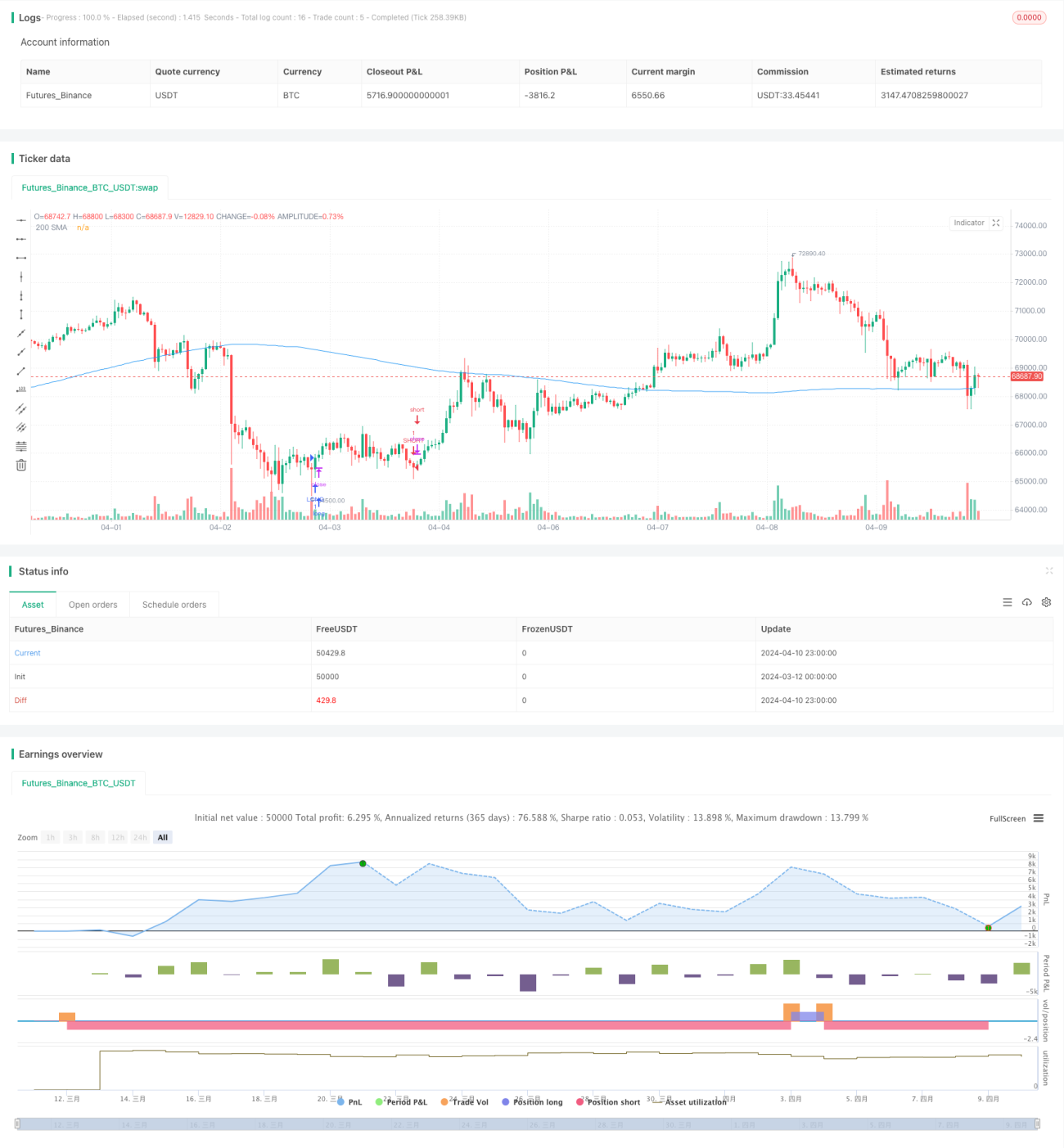
Overview
This strategy is a trading strategy based on the Stochastic Slow Oscillator, combined with Moving Average, Relative Strength Index (RSI), and Artificial Intelligence (AI) techniques. The strategy determines buy and sell signals by analyzing the crossover signals of the Stochastic Slow Oscillator, considering the position of the price relative to the 200-day moving average, and incorporating signals generated by an AI model. The strategy also sets take-profit and stop-loss levels to manage risk.
Strategy Principles
- Calculate the Stochastic Slow Oscillator with a period of 30, where the smoothing period for the K value is 18 and the smoothing period for the D value is 7.
- Determine the overbought and oversold thresholds as 40 and 19, respectively, and set the minimum K value as 12.
- Calculate the 200-day simple moving average as a trend filter.
- Use a Recurrent Neural Network (RNN) model to generate buy and sell signals.
- Long entry condition: Price crosses above the 200-day moving average, K value is below the oversold threshold and above the minimum K value, and the AI signal is 1.
- Short entry condition: Price crosses below the 200-day moving average, K value is above the overbought threshold and above the minimum K value, and the AI signal is -1.
- Buy and sell signals are also generated when the Stochastic Oscillator shows a crossover and meets the overbought or oversold conditions.
- Set the take-profit level at 500 points above or below the current price, and the stop-loss level at 200 points above or below the current price.
Strategy Advantages
- Combines multiple technical indicators and AI techniques, improving the robustness and adaptability of the strategy.
- Uses the Stochastic Slow Oscillator as the primary buy and sell signal, effectively capturing overbought and oversold market conditions.
- Introduces the 200-day moving average as a trend filter to avoid trading against the trend.
- Employs an AI model to generate buy and sell signals, enhancing the strategy's intelligence.
- Sets clear take-profit and stop-loss levels to effectively manage risk.
Strategy Risks
- The Stochastic Oscillator may generate false signals under certain market conditions.
- The effectiveness of the AI model depends on the quality of training data and model design, introducing uncertainty.
- Fixed take-profit and stop-loss levels may not adapt well to different market volatility conditions.
- The strategy lacks a mechanism to respond to sudden market events and abnormal fluctuations.
Strategy Optimization Directions
- Optimize the parameters of the Stochastic Oscillator, such as adjusting the smoothing periods for the K and D values, to improve the effectiveness of the indicator.
- Enhance the design of the AI model by incorporating more market features and data to improve its predictive accuracy.
- Implement a dynamic take-profit and stop-loss mechanism that adapts to market volatility and risk levels.
- Introduce market sentiment analysis and event-driven factors to enhance the strategy's ability to respond to sudden market events.
- Consider adding position sizing and money management modules to optimize the strategy's capital utilization efficiency and risk control.
Summary
This strategy combines the Stochastic Slow Oscillator, Moving Average, Relative Strength Index, and AI techniques to construct a multi-factor trading strategy. The strategy utilizes the Stochastic Oscillator to capture overbought and oversold signals while using a trend filter and intelligent signal generation to improve its robustness and adaptability. Although the strategy has certain risks, such as indicator failure and model uncertainty, these can be mitigated by optimizing indicator parameters, enhancing the AI model, implementing dynamic risk control measures, and incorporating additional modules for position sizing and money management.
- 1