Multi-Timeframe Reversal Confirmation Trading Strategy

Overview
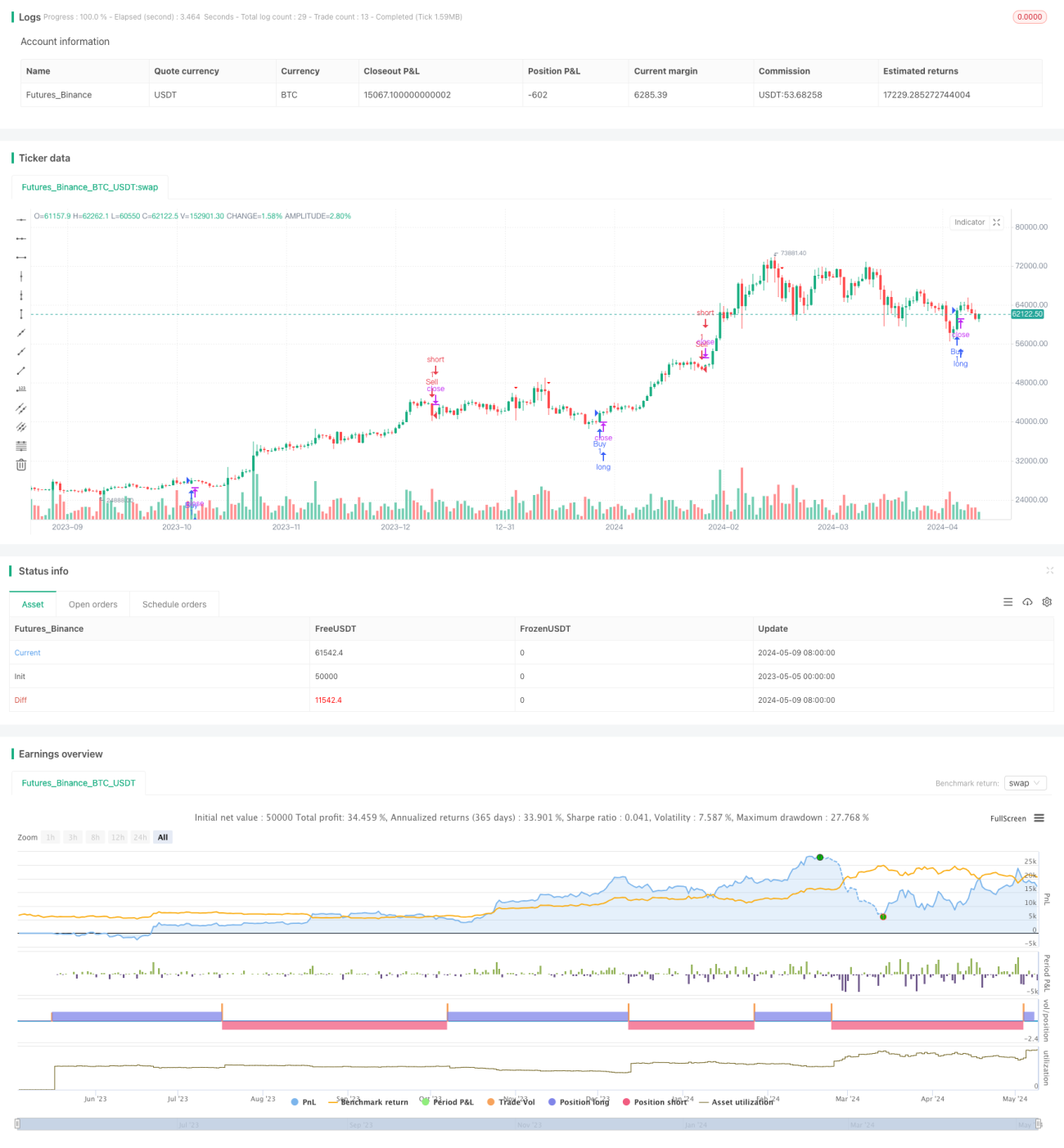
This strategy primarily utilizes the highest price, lowest price, and Exponential Moving Average (EMA) to confirm trend reversals and generate trading signals. The strategy first calculates the highest and lowest prices within a specified lookback period, then determines whether the current closing price is below the lowest price corresponding to the highest price (bearish reversal confirmation) or above the highest price corresponding to the lowest price (bullish reversal confirmation). Once a reversal confirmation signal appears, the strategy generates a corresponding entry signal. The main advantage of this strategy is its ability to capture trend reversal opportunities, while the main risk is that after a reversal confirmation signal appears, prices may experience repeated fluctuations rather than a unidirectional trend.
Strategy Principle
- Calculate the highest price (find_highest) and lowest price (find_lowest) within the specified lookback period.
- Calculate the EMA of the closing price within the specified lookback period.
- Iterate through each candle within the lookback period to find the lowest price (dnRv) corresponding to the highest price and the highest price (upRv) corresponding to the lowest price.
- Determine whether the current closing price is below dnRv (bearish reversal confirmation) or above upRv (bullish reversal confirmation).
- If a bearish reversal confirmation signal (dnRv_signal) appears and has not been triggered before, generate a short entry signal.
- If a bullish reversal confirmation signal (upRv_signal) appears and has not been triggered before, generate a long entry signal.
Strategy Advantages
- Reversal confirmation signals can help the strategy capture trend reversal opportunities, thereby increasing the strategy's potential returns.
- By utilizing EMA, the strategy can adapt to different market conditions and volatility cycles.
- The adjustability of the lookback period makes the strategy flexible and can be optimized for different trading instruments and timeframes.
Strategy Risks
- After a reversal confirmation signal appears, prices may experience repeated fluctuations rather than a unidirectional trend, leading to frequent entries and exits, increasing trading costs.
- The strategy lacks explicit stop-loss and take-profit mechanisms, which may result in excessive risk exposure for individual trades.
- The strategy does not consider the characteristics of trading instruments and market environments, which may lead to suboptimal performance in certain situations.
Strategy Optimization Directions
- Introduce stop-loss and take-profit mechanisms to control risk exposure for individual trades. Dynamic or static stop-loss and take-profit levels can be set based on ATR, percentage, or fixed points.
- Combine other technical indicators or market environment factors, such as RSI, MACD, volatility, etc., to improve the reliability of reversal confirmation signals and filter out false signals.
- Perform parameter optimization for different trading instruments and timeframes to find the most suitable lookback period and EMA period, improving the strategy's adaptability and stability.
- Consider introducing position sizing and risk control mechanisms, such as adjusting position sizes based on market volatility or account equity, to manage overall risk.
Summary
The Multi-Timeframe Reversal Confirmation Trading Strategy identifies potential trend reversal opportunities using the highest price, lowest price, and EMA, generating corresponding entry signals. The strategy's advantage is its ability to capture trend reversals, but it also faces issues of frequent trading and insufficient risk control. By introducing stop-loss and take-profit mechanisms, combining other indicators, parameter optimization, and position sizing, the strategy's performance and stability can be further improved. In practical applications, strategy parameters and risk control measures need to be adjusted according to specific trading instruments and market environments.
- 1