
Overview
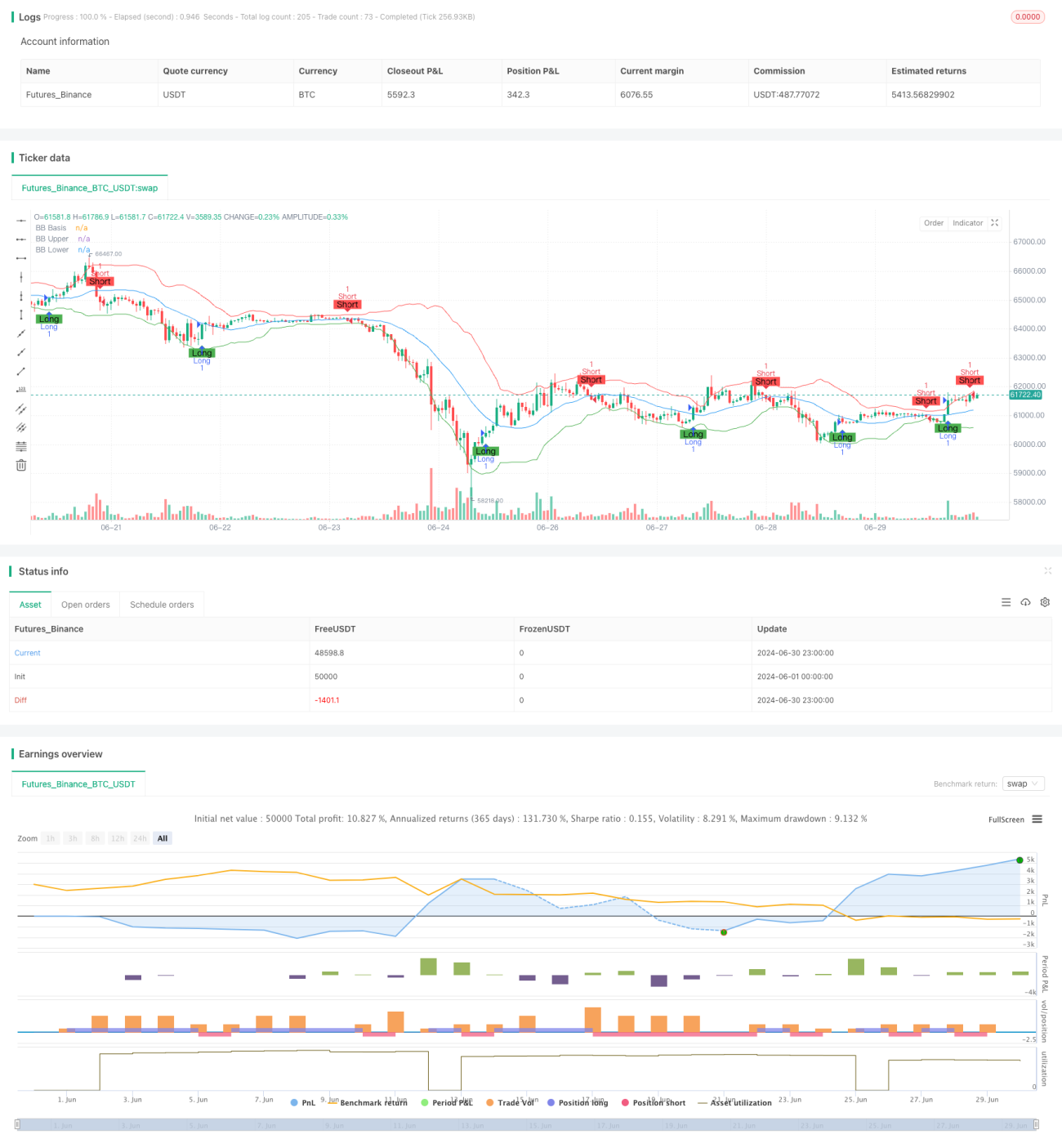
This multi-indicator comprehensive trading strategy is a complex trading system that combines momentum, overbought/oversold, and volatility analysis. The strategy integrates three technical indicators: Moving Average Convergence Divergence (MACD), Relative Strength Index (RSI), and Bollinger Bands (BB), aiming to capture market trends, identify overbought/oversold conditions, and utilize price volatility to optimize trading decisions. This multi-dimensional analysis approach is designed to provide more comprehensive and robust trading signals, suitable for various market environments.
Strategy Principles
-
MACD Analysis:
- Uses 12-period and 26-period Exponential Moving Averages (EMA) to calculate the MACD line.
- Calculates a 9-period MACD signal line.
- MACD histogram is used to determine momentum changes.
-
RSI Analysis:
- Uses a 14-period RSI calculation.
- Sets 70 as the overbought level and 30 as the oversold level.
-
Bollinger Bands Analysis:
- Uses a 20-period Simple Moving Average (SMA) as the middle band.
- Upper and lower bands are set at 2 standard deviations above and below the middle band.
-
Entry Conditions:
- Long Entry: MACD line crosses above the signal line or RSI drops below the oversold level, and price is above the lower Bollinger Band.
- Short Entry: MACD line crosses below the signal line or RSI breaks above the overbought level, and price is below the upper Bollinger Band.
-
Risk Management:
- Sets a 2% stop loss.
- Sets a 5% take profit.
Strategy Advantages
-
Multi-dimensional Analysis: Combines momentum, overbought/oversold, and volatility indicators for more comprehensive market insights.
-
Adaptability: Performs well in both trending and ranging markets.
-
Risk Control: Built-in stop loss and take profit mechanisms effectively manage risk for each trade.
-
Automated Execution: Strategy can run fully automatically, reducing human intervention and emotional influence.
-
Visual Support: Displays indicators and trading signals on charts for easy analysis and optimization.
Strategy Risks
-
False Breakout Risk: May generate frequent false signals in sideways markets.
Solution: Consider adding signal confirmation mechanisms, such as requiring signals to persist for a certain period. -
Overtrading: Multiple indicators may lead to excessive trading, increasing costs.
Solution: Add trading interval restrictions or raise entry thresholds. -
Parameter Sensitivity: Multiple indicator parameters need optimization, potentially leading to overfitting.
Solution: Conduct rigorous historical data backtesting and forward testing. -
Market Environment Dependency: Strategy performance may be inconsistent across different market environments.
Solution: Add market environment recognition mechanisms to adjust strategy parameters accordingly. -
Limitations of Fixed Stop Loss and Take Profit: May exit favorable trends too early in some cases.
Solution: Consider using dynamic stop loss and take profit, such as trailing stops.
Strategy Optimization Directions
-
Dynamic Parameter Adjustment:
- Automatically adjust MACD, RSI, and Bollinger Bands parameters based on market volatility.
- Reason: Different market environments require different parameter settings for optimal performance.
-
Add Market Trend Filter:
- Introduce long-term trend judgment, such as a 200-day moving average.
- Reason: Can reduce counter-trend trades in strong trend markets, improving win rates.
-
Optimize Entry Timing:
- Add volume confirmation or price action analysis.
- Reason: Can reduce false breakouts and improve trade quality.
-
Improve Risk Management:
- Implement dynamic stop loss and take profit, such as ATR-based trailing stops.
- Reason: Better adapts to market volatility, protects profits, and reduces unnecessary losses.
-
Incorporate Sentiment Indicators:
- Integrate VIX or other market sentiment indicators.
- Reason: Market sentiment significantly affects short-term price movements, can improve prediction accuracy.
-
Implement Position Sizing:
- Dynamically adjust position size based on risk and signal strength.
- Reason: Optimizes capital utilization efficiency, increasing returns on high-confidence trades and controlling risk on low-confidence trades.
Conclusion
This multi-indicator comprehensive trading strategy creates a comprehensive trading system by combining MACD, RSI, and Bollinger Bands, capable of capturing market momentum, identifying overbought/oversold conditions, and utilizing price volatility. The strategy's main advantages lie in its multi-dimensional analysis and built-in risk management mechanisms, allowing it to maintain stability across different market environments. However, the strategy also faces challenges such as false signals, overtrading, and parameter optimization.
Future optimization directions should focus on dynamic parameter adjustment, market environment recognition, entry timing optimization, and more advanced risk management techniques. Through these improvements, the strategy has the potential to become a more robust and adaptive trading system.
It is important for traders to remain vigilant in practical application, continuously monitor strategy performance, and make timely adjustments based on market changes. Although this strategy provides a powerful framework, successful trading still requires experience, patience, and continuous learning.
- 1