Multi-EMA Crossover with Time Interval Integration Strategy

Overview
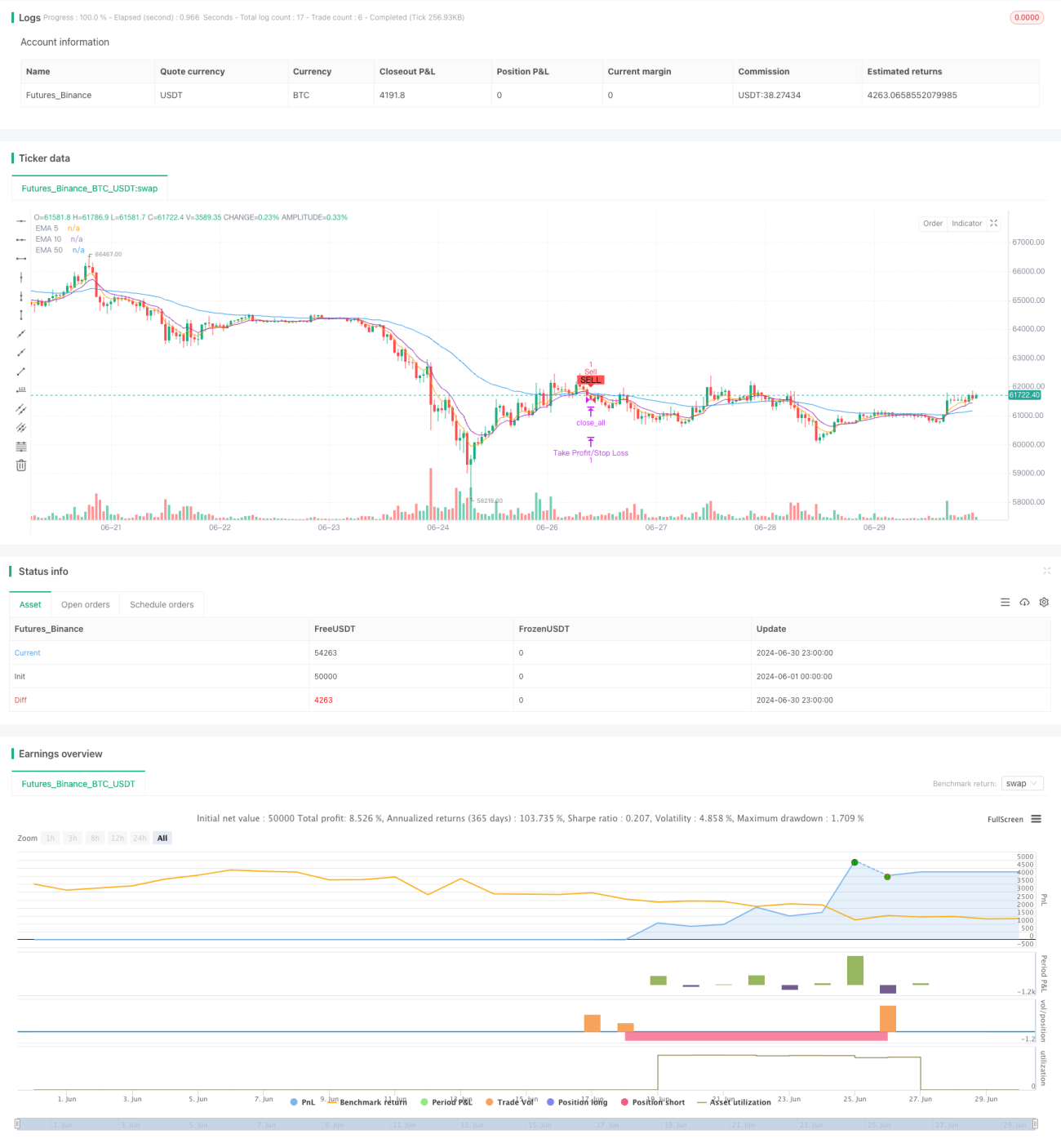
This strategy is a quantitative trading system based on multiple Exponential Moving Average (EMA) crossovers and time interval control. It utilizes crossover signals between the 50-period EMA and both 5-period and 10-period EMAs to generate buy and sell decisions. The strategy also incorporates a 30-candle time interval mechanism to avoid overtrading and sets fixed take-profit and stop-loss levels for risk management. This approach aims to capture medium to long-term trends while improving trade quality through time filters and risk management measures.
Strategy Principles
-
Moving Average System: The strategy uses three EMAs - 50-period (slow), 10-period (medium), and 5-period (fast).
-
Entry Signals:
- Buy Signal: Triggered when both 5-period and 10-period EMAs cross above the 50-period EMA.
- Sell Signal: Triggered when both 5-period and 10-period EMAs cross below the 50-period EMA.
-
Time Interval Control: The strategy ensures at least 30 candle periods have passed since the last trade before executing a new one. This helps reduce noisy trades and focus on more significant trend changes.
-
Risk Management:
- Take Profit is set at 50 pips.
- Stop Loss is set at 30 pips.
-
Trade Execution:
- All existing positions are closed before opening new ones.
- Buy and sell orders are executed using market orders.
-
Visualization: The strategy plots the three EMA lines and trade signal markers on the chart for analysis and backtesting purposes.
Strategy Advantages
-
Multiple Confirmations: Using two fast EMAs (5 and 10-period) crossing the slow EMA (50-period) simultaneously provides stronger trend confirmation signals, reducing false breakouts.
-
Trend Following: The 50-period EMA serves as the main trend indicator, helping to capture medium to long-term market movements.
-
Time Filtering: The 30-candle period interval requirement effectively reduces overtrading and improves signal quality.
-
Risk Control: Fixed take-profit and stop-loss levels provide a clear risk-reward ratio for each trade.
-
Automation: The strategy is fully automated, eliminating human emotional interference.
-
Adaptability: While the strategy uses fixed parameters, its logic can be easily adapted to different markets and timeframes.
-
Visual Assistance: Graphical representation of EMA lines and trade signals aids in intuitive assessment of strategy performance.
Strategy Risks
-
Lag: EMAs are inherently lagging indicators and may react slowly in highly volatile markets.
-
Performance in Ranging Markets: The strategy may produce frequent false signals in sideways or choppy markets.
-
Fixed Take-Profit and Stop-Loss: While providing stable risk management, these may not be suitable for all market conditions.
-
Parameter Sensitivity: The choice of EMA periods and time interval can significantly affect strategy performance.
-
Over-reliance on Technical Indicators: The strategy does not consider fundamental factors and may underperform during major news events.
-
Drawdown Risk: The strategy may face significant drawdowns during strong trend reversals.
-
Execution Slippage: In fast markets, there may be a risk of high execution slippage.
Strategy Optimization Directions
-
Dynamic Parameter Adjustment: Consider dynamically adjusting EMA periods and trade intervals based on market volatility.
-
Incorporate Volume Indicators: Combine volume or other momentum indicators to enhance signal reliability.
-
Adaptive Take-Profit and Stop-Loss: Set dynamic take-profit and stop-loss levels based on market volatility or ATR.
-
Market State Classification: Add logic to determine market state (trending/ranging) and apply different trading strategies accordingly.
-
Timeframe Fusion: Consider signal confirmation across multiple timeframes to improve trade quality.
-
Risk Exposure Management: Introduce position sizing logic to adjust trade volume based on account risk and market volatility.
-
Add Filters: Such as trend strength indicators or volatility filters to reduce false signals.
-
Backtesting Optimization: Conduct more extensive parameter optimization and out-of-sample testing to improve strategy robustness.
Conclusion
The Multi-EMA Crossover with Time Interval Integration Strategy is a quantitative trading system that combines technical analysis with risk management. It captures trends through multiple EMA crossovers, uses a time filter to improve signal quality, and manages risk through fixed take-profit and stop-loss levels. While the strategy shows potential for capturing medium to long-term trends, it also faces some inherent limitations of technical indicators. Through the suggested optimization directions, such as dynamic parameter adjustment, multi-indicator integration, and adaptive risk management, the strategy has the potential to further enhance its performance and adaptability. In practical application, comprehensive backtesting and forward testing are necessary, with fine-tuning based on specific market conditions and risk preferences.
- 1